


You’ve made the decision to ditch your glasses or contacts for good, but now the real question hits: what to expect after laser eye surgery? It’s completely normal to feel a mix of excitement and nerves when you don’t know exactly how the first few hours, days, and weeks will unfold. Understanding the recovery process before you walk into the clinic gives you a genuine sense of control over your healing.
At Bright Sight Eye Specialists in Randwick, Dr Capucine Odouard performs LASIK, PRK, and SMILE procedures and guides patients through every stage of their recovery. From the moment you leave the surgical centre, her team provides clear aftercare instructions tailored to your specific procedure and lifestyle. That hands-on support makes a real difference, especially during the first 24 to 48 hours when your eyes are adjusting.
This guide breaks down your laser eye surgery recovery day by day, covering the physical sensations you’re likely to feel, the side effects that are perfectly normal, and the activity restrictions you’ll need to follow. Whether you’re booked in for surgery next week or still weighing up your options, this timeline will give you a realistic picture of what lies ahead.
Why recovery looks different for each laser procedure
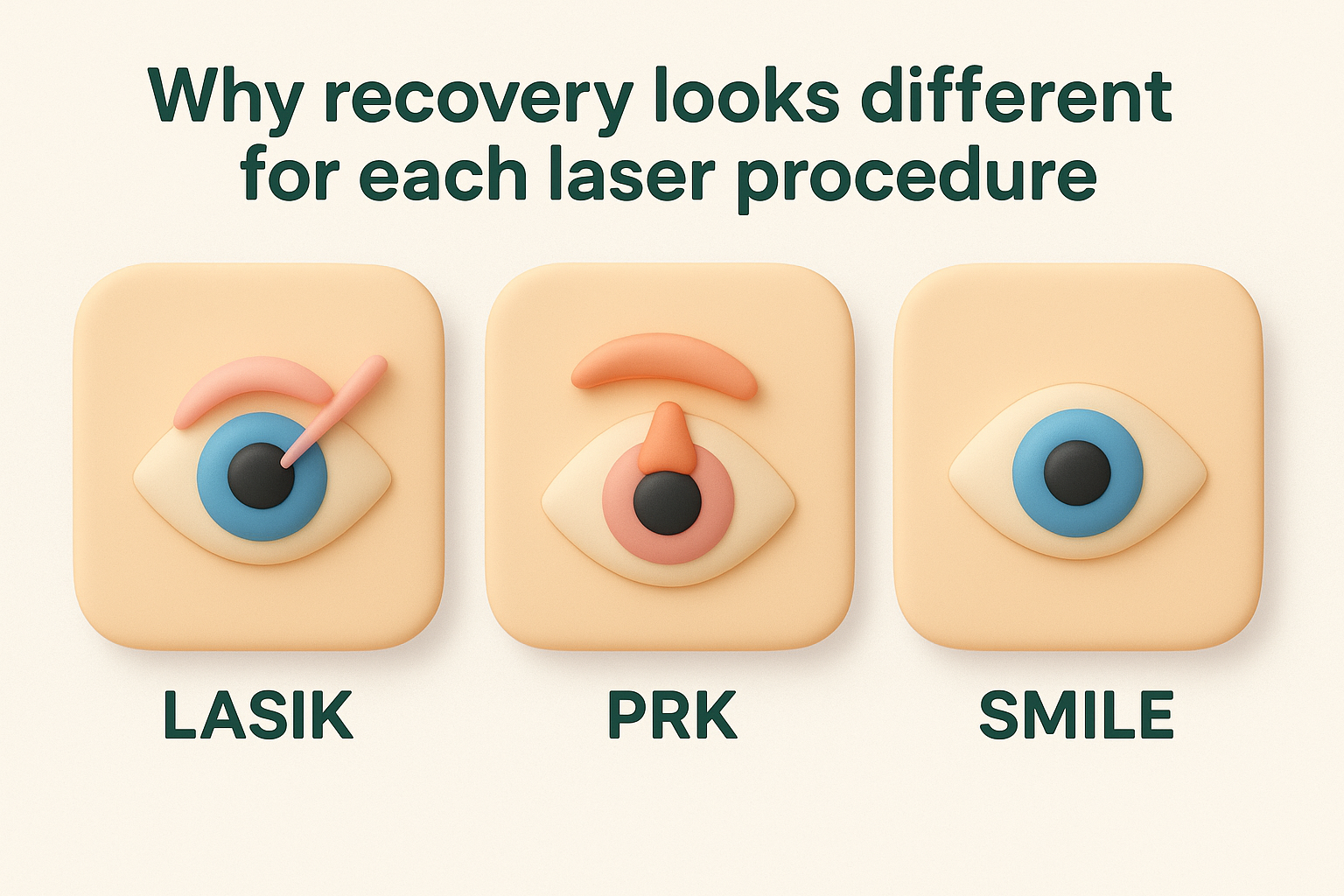
Not every laser eye surgery recovery follows the same path. LASIK, PRK, and SMILE each reshape the cornea using a different technique, and that difference determines how quickly your vision clears and how much discomfort you’ll feel along the way.
LASIK: the flap approach
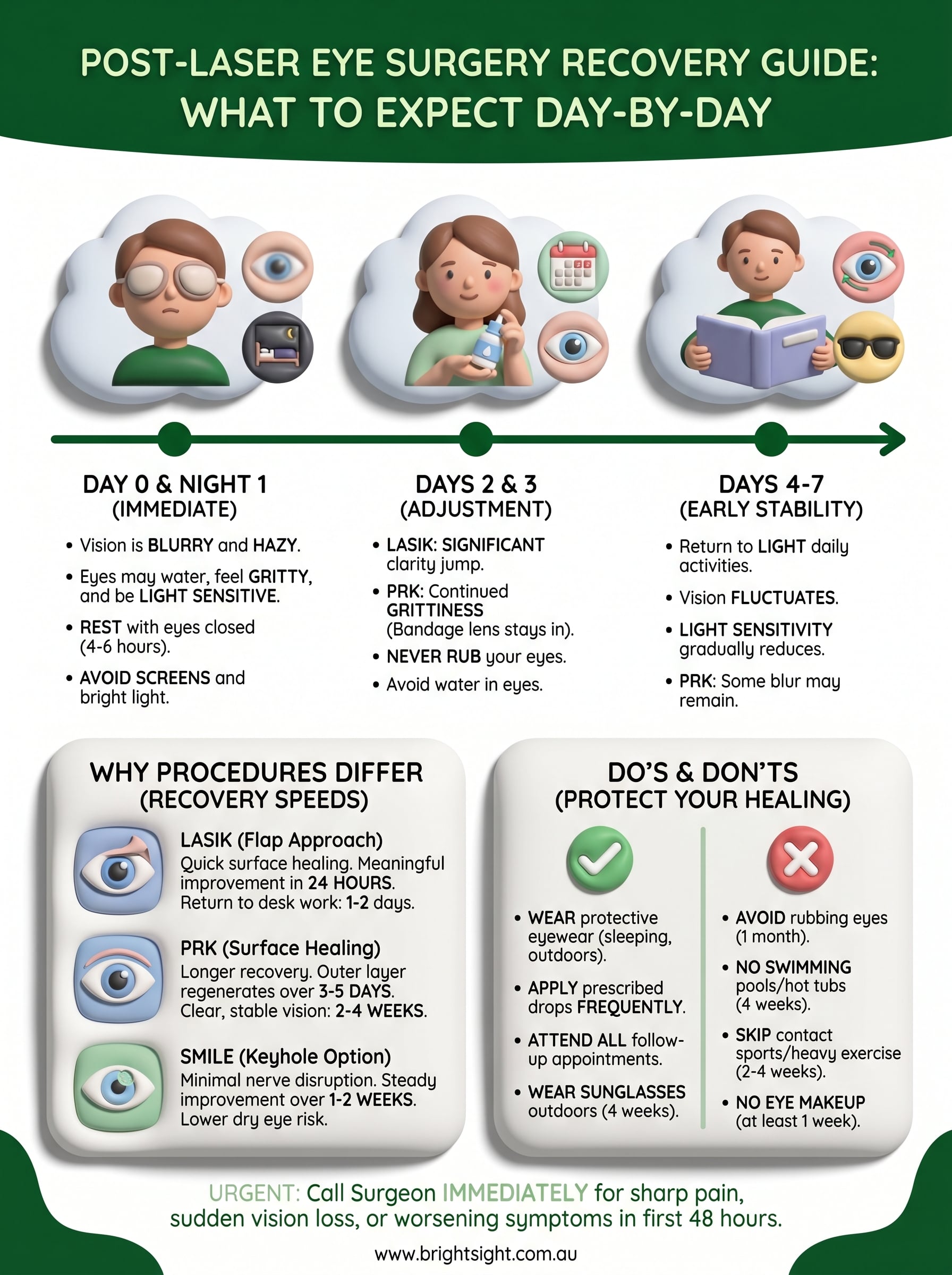
LASIK creates a thin protective flap in the surface of your cornea, allowing the laser to treat the tissue underneath. Because that flap is folded back into place at the end of the procedure, your surface heals quickly. Most patients see a meaningful improvement within 24 hours, with mild dryness and light sensitivity fading over the following days.
Most LASIK patients can return to desk work within one to two days, though full visual stability can take up to three to six months.
PRK: more surface healing required
PRK removes the outer epithelial layer of the cornea entirely, exposing the tissue underneath for laser reshaping. Your body then regenerates that surface layer over three to five days. Clear, stable vision typically takes two to four weeks to develop, and during that time your eyes may feel scratchy, watery, and more sensitive to light than after LASIK.
Your surgeon will fit you with a bandage contact lens immediately after PRK to protect the healing surface and reduce discomfort during those first few days.
SMILE: the keyhole option
SMILE uses a femtosecond laser to create a small disc of tissue inside the cornea, which is removed through a tiny incision. There’s no flap involved, so disruption to the corneal nerves is minimal and dry eye symptoms are usually less pronounced. Most patients notice steady visual improvement over the first one to two weeks.
Because the incision is so small, healing is generally predictable, and your risk of surface complications is lower compared to PRK.
Your day-by-day recovery timeline
Knowing what to expect after laser eye surgery on each specific day removes a lot of the uncertainty that makes recovery feel harder than it needs to be. The timeline below covers the first week, which is where the most noticeable changes happen.
Day of surgery and the first night
Your vision will be blurry and hazy immediately after the procedure. Your eyes may water, feel gritty, and become sensitive to light, so rest with your eyes closed as much as possible for the first four to six hours. Avoid screens and bright rooms entirely.
Days 2 and 3
LASIK patients typically notice a significant jump in clarity by the next morning. PRK patients, however, should expect continued grittiness while the epithelium regrows. Your bandage contact lens stays in place until your surgeon removes it, usually on day three or four, so avoid rubbing your eyes entirely.
Never rub your eyes during the first week, as this can dislodge a LASIK flap or disturb healing corneal tissue.
Days 4 to 7
Most patients return to light daily activities by day four. Vision fluctuates throughout the day, which is completely normal at this stage. Your light sensitivity gradually reduces, though PRK patients may still notice some blur through to the end of the week.
Weeks 2 to 12: what changes and what should improve
By week two, the dramatic early changes settle and your recovery enters a steadier phase. LASIK and SMILE patients generally enjoy functional, stable vision from this point, with only minor fluctuations day to day. PRK patients notice clarity sharpening progressively through weeks two to four as the epithelial surface fully matures.
Dry eye and visual fluctuations
Dryness and variable vision are the two most reported experiences during weeks two to twelve, and both are temporary. Your corneal nerves are still regenerating, which disrupts the normal feedback loop that triggers tear production. Using preservative-free lubricating drops multiple times daily reduces discomfort and supports more consistent vision.
Dry eye symptoms typically peak around weeks two to four and then improve steadily as nerve function recovers.
Halos and glare around lights at night are also common during this window. These symptoms gradually reduce as your cornea settles, and most patients find them barely noticeable by the end of week six.
When to expect full stability
Knowing what to expect after laser eye surgery in the longer term helps you stay patient during this phase. LASIK and SMILE patients usually reach full visual stability between weeks four and eight, while PRK patients may need up to twelve weeks for their prescription to settle completely.
Attend every follow-up appointment your surgeon schedules during this window. These check-ins confirm your healing is progressing correctly and give your surgeon the chance to catch any prescription changes before they become a concern.
Do’s and don’ts after laser eye surgery
Understanding what to expect after laser eye surgery includes knowing which daily habits protect your healing cornea and which ones slow it down. Sticking to these guidelines consistently during the first four weeks makes a real difference to your outcome.
What you should do
Wear your protective eyewear when sleeping for at least the first week to prevent accidental rubbing overnight. Apply your prescribed lubricating drops frequently, even when your eyes feel comfortable, and attend every follow-up appointment so your surgeon can monitor your recovery closely.
- Wear sunglasses outdoors for at least four weeks
- Apply antibiotic and anti-inflammatory drops exactly on schedule
- Rest your eyes regularly during the first two days
What you should avoid
Several common activities put unnecessary strain on your healing cornea and raise your infection risk. Knowing these in advance lets you plan around them before your surgery date.
Avoid swimming pools, hot tubs, and open water for at least four weeks to significantly reduce your risk of infection.
- Avoid rubbing your eyes for at least one month
- Skip contact sports and heavy exercise for two to four weeks
- Do not wear eye makeup for at least one week
When to call your surgeon urgently
Most side effects you experience during recovery are normal and resolve on their own. However, knowing what to expect after laser eye surgery also means recognising when a symptom crosses from "common" to "concerning." Contacting your surgeon immediately in these situations protects your long-term vision outcome.
Warning signs in the first 48 hours
The first two days carry the highest risk for complications, so pay close attention to anything that feels wrong. Sharp or worsening pain, sudden vision loss, or discharge from the eye are not normal post-operative symptoms and need immediate review.
- Increasing pain that your prescribed drops do not relieve
- Sudden loss of vision or a dramatic drop in clarity
- Visible discharge, redness that worsens rather than settles, or a fever
Symptoms that appear later
Some complications develop gradually during weeks two to four, making them easier to overlook. If your vision fluctuates severely day to day, if you notice a new dark shadow in your visual field, or if light sensitivity suddenly worsens after improving, call the clinic without delay.
Do not wait for your next scheduled appointment if a symptom appears suddenly or worsens rapidly.
Your surgeon would always rather review you unnecessarily than have a treatable problem caught too late.
What to do next
Now that you know what to expect after laser eye surgery, the next step is speaking with a surgeon who can assess whether you’re a suitable candidate. Your corneal thickness, prescription strength, and overall eye health all influence which procedure suits you best, and that information only comes from a proper clinical assessment.
Dr Capucine Odouard at Bright Sight Eye Specialists in Randwick performs LASIK, PRK, and SMILE procedures for patients across Sydney’s Eastern Suburbs. Her approach focuses on matching the right procedure to your specific eyes and lifestyle, so you leave with a clear understanding of your options before committing to anything.
Booking a consultation is the most practical way to move forward. You’ll receive a thorough examination and a transparent breakdown of costs before making any decisions, with no pressure to commit on the day. Book a consultation with Dr Odouard and take the first step toward clear, glasses-free vision.