


If you’ve been wearing glasses or contact lenses for years, the idea of waking up with clear vision can feel almost too good to be true. But laser eye surgery has made that a reality for millions of people, and one of the newest options is raising the bar even further. So, what is SMILE eye surgery, and why are so many patients and surgeons drawn to it? SMILE, which stands for Small Incision Lenticule Extraction, is a minimally invasive laser procedure that corrects short-sightedness and astigmatism without the need for a corneal flap.
Unlike LASIK, which has been the go-to for decades, SMILE works through a tiny keyhole incision, typically just 2–4 mm. This means less disruption to the cornea, a lower risk of dry eye, and a recovery experience that many patients find surprisingly straightforward.
At Bright Sight Eye Specialists in Randwick, Sydney, Dr Capucine Odouard performs refractive laser surgery including SMILE for patients across the Eastern Suburbs and beyond. With training from Sydney Eye Hospital and a Master of Science in Biology of Vision from University College London, she brings both precision and a patient-first approach to every procedure. In this article, we’ll walk you through how SMILE works, who it’s suited for, what the risks and benefits look like, and how it stacks up against LASIK and PRK, so you can make an informed decision about your vision.
Why SMILE eye surgery matters
Laser vision correction has been around since the early 1990s, but SMILE represents a genuine leap forward in how surgeons can reshape the cornea with minimal disruption to surrounding tissue. To understand why that matters, it helps to look at the bigger picture: how common vision problems like myopia are, why earlier treatments left certain gaps, and what SMILE does differently. Understanding what is SMILE eye surgery in a broader context shows why it has become one of the fastest-growing refractive procedures in the world.
The scale of myopia and what it costs you
Short-sightedness, known medically as myopia, affects a significant and growing portion of the population. In Australia, estimates suggest that around 30% of adults live with some degree of myopia, and rates have been climbing steadily, particularly among younger generations. For most people, this means a lifetime of glasses or contact lenses, both of which carry ongoing costs, inconvenience, and in the case of contacts, a real risk of eye infections if hygiene is not maintained consistently.
Glasses fog up, break, and limit peripheral vision. Contact lenses require daily cleaning and carry a risk of corneal irritation or infection when worn too long or replaced too infrequently. Over a lifetime, the financial cost of corrective eyewear adds up to thousands of dollars, and the practical limitations are something most wearers simply accept as part of seeing clearly.
Many people don’t realise how much of their daily life is shaped around managing their vision until they no longer have to.
Why previous laser options had limitations
LASIK transformed refractive surgery when it became widely available in the late 1990s. It works by cutting a thin corneal flap, folding it back, removing tissue with a laser, and then repositioning the flap. For most patients, the results are excellent. But the flap creation itself carries certain drawbacks. The flap never fully reattaches to the same structural strength as the original cornea, which means patients with physically active jobs or contact sports face a small but real risk of flap displacement years after surgery.
Dry eye is another concern with LASIK. The flap creation cuts across corneal nerves that help regulate tear production, and for a portion of patients, this leads to persistent dryness that can last months or longer. PRK, the older technique that removes the corneal surface cells rather than creating a flap, sidesteps the flap problem but involves a longer and more uncomfortable recovery period as the surface heals.
How SMILE changes the picture
SMILE takes a different approach entirely. Instead of cutting a flap or removing the surface, the laser creates a small disc of tissue called a lenticule inside the cornea. The surgeon then removes this lenticule through a tiny 2-4 mm incision, reshaping the cornea’s curvature without exposing the surface or creating a large opening. Because the incision is so small, far fewer corneal nerves are disrupted compared with LASIK.
This matters for several reasons. Patients who have SMILE typically report lower rates of post-operative dry eye than those who undergo LASIK, which makes it a more suitable option for people who already experience dryness. The structural integrity of the cornea is also better preserved, which is relevant for patients with active lifestyles or physically demanding work. For surgeons, the flapless technique also removes one of the more delicate steps involved in LASIK, reducing a specific category of procedural risk.
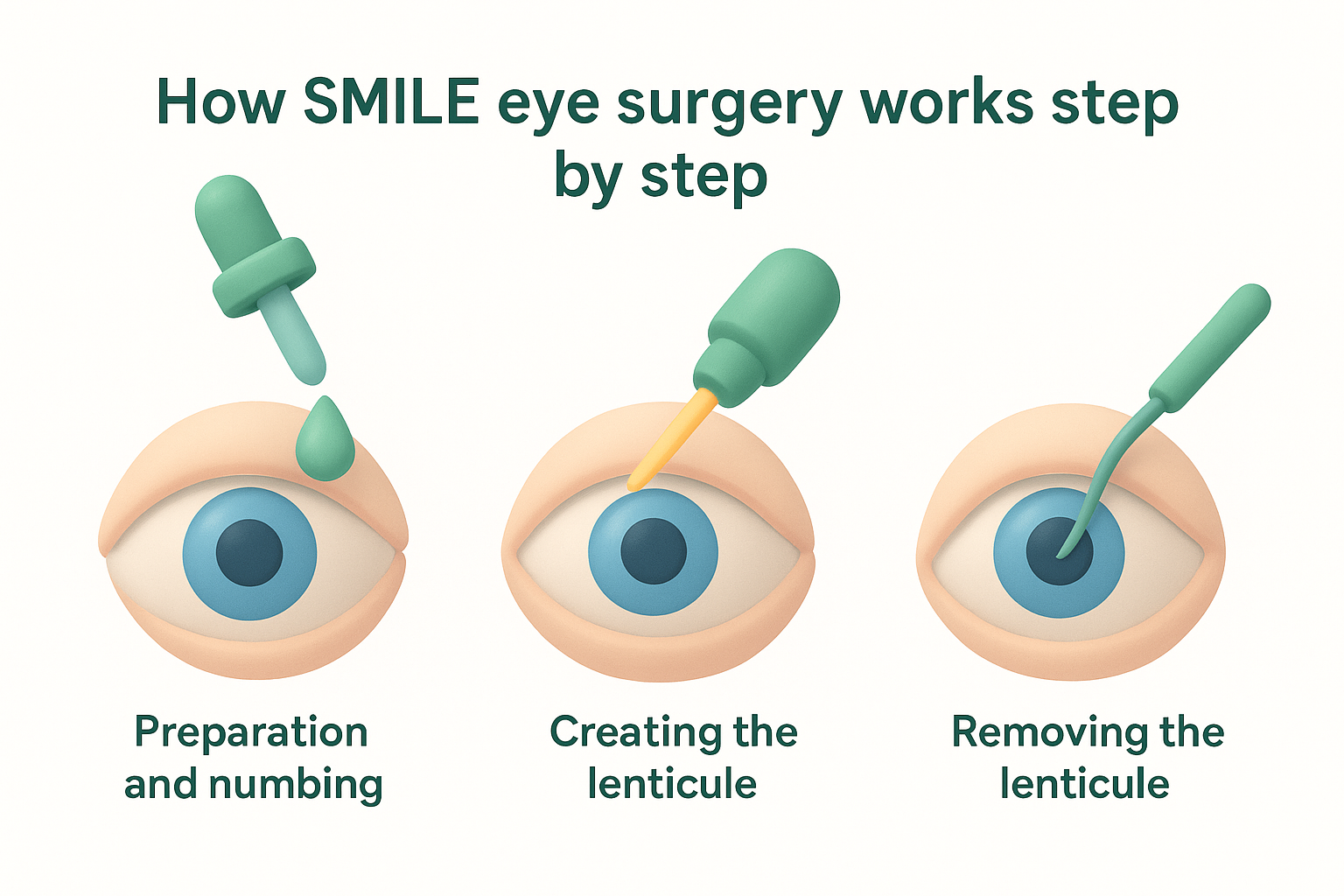
How SMILE eye surgery works step by step
Understanding what is SMILE eye surgery at a technical level helps you feel more confident walking into your consultation. The entire procedure typically takes around 15 to 20 minutes per eye, and you remain awake throughout, though your eye is fully numbed with anaesthetic drops so you feel no pain. The fact that everything happens inside the cornea, rather than on its surface, is what makes the procedure so distinct from its predecessors.
Preparation and numbing
Before anything begins, your surgeon applies topical anaesthetic eye drops to the surface of your eye and positions you comfortably under the laser. You are asked to focus on a small target light to keep your gaze steady during the procedure. A gentle suction device is placed on your eye to stabilise it, which ensures precise laser alignment throughout. Most patients describe feeling mild pressure at this stage rather than any sharp sensation. The preparation phase takes only a few minutes and sets the foundation for everything that follows.
Creating the lenticule inside the cornea
Once your eye is stabilised, the femtosecond laser gets to work beneath the corneal surface without opening it. The laser delivers thousands of rapid, concentrated light pulses that create two curved planes of tiny bubbles inside the corneal tissue, effectively outlining a disc of tissue called a lenticule. The exact shape and thickness of the lenticule are calculated in advance based on your specific prescription. This step takes less than 30 seconds and is largely silent. You will see a brief dimming of the target light as the laser works.
The femtosecond laser never cuts through the surface of your eye; it works entirely within the corneal layers to define the tissue that will be removed.
Removing the lenticule through the small incision
Your surgeon uses fine microsurgical instruments to carefully separate the lenticule from the surrounding tissue and guide it out through a small incision, typically 2 to 4 mm wide. Once removed, your cornea sits in its new, corrected shape and your vision begins to change almost immediately. Because the incision is so small, the majority of corneal nerves that regulate tear production are left undisturbed, which is one key reason SMILE is associated with lower rates of post-operative dry eye than LASIK. No stitches are required. The incision seals naturally, and most patients notice meaningfully clearer vision within hours of leaving the clinic. The whole process from anaesthetic drops to walking out the door typically takes under 30 minutes.
What vision problems SMILE can correct
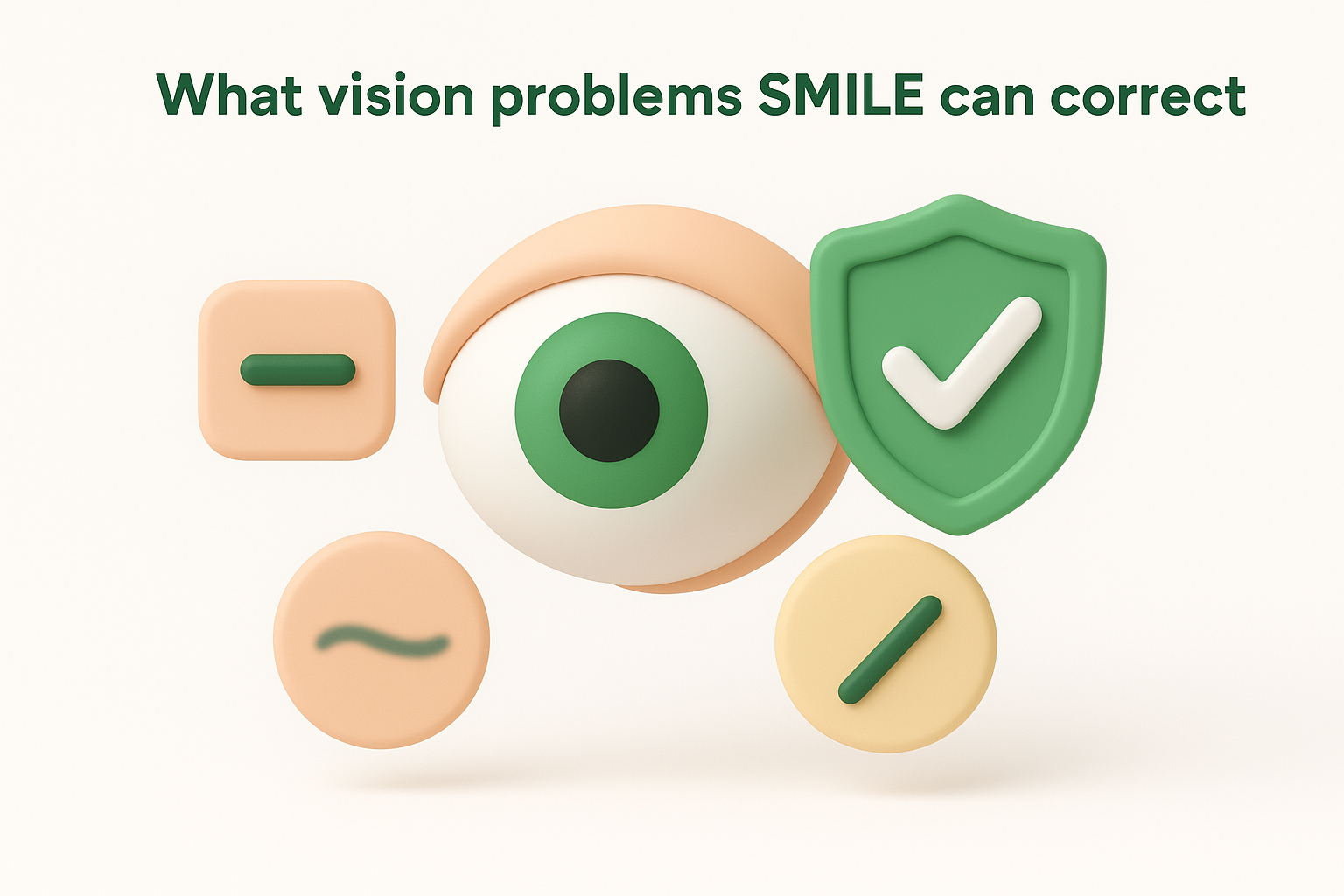
Before booking a consultation, it helps to know whether your specific prescription falls within the range that SMILE can treat. The procedure is not a universal solution for every refractive error, but for the right candidates, it delivers highly accurate and stable vision correction. Understanding what is SMILE eye surgery in terms of treatable conditions helps you set realistic expectations from the outset.
Myopia (short-sightedness)
Myopia is the primary condition SMILE was designed to treat, and it remains the most common indication for the procedure worldwide. If you struggle to see objects clearly at a distance but have no trouble reading up close, you are most likely myopic. Your prescription is expressed as a negative number in dioptres, such as -3.00 or -6.00. SMILE is currently approved to treat myopia up to approximately -10.00 dioptres, which covers the vast majority of people seeking laser vision correction. The laser removes a precise volume of corneal tissue to flatten the cornea’s curvature, bending incoming light correctly onto the retina rather than in front of it.
SMILE has been used to treat myopia in millions of patients globally since receiving CE marking in Europe in 2011, with strong long-term data supporting its stability and safety.
Astigmatism
Many people with myopia also have astigmatism, a condition where the cornea is shaped more like a rugby ball than a round sphere. This irregular curvature causes light to focus at multiple points rather than one, producing blurred or distorted vision at all distances. SMILE can correct astigmatism of up to approximately -5.00 dioptres when it occurs alongside myopia. The femtosecond laser accounts for the asymmetric shape when creating the lenticule, so the removed tissue corrects both problems in a single pass.
What SMILE currently does not treat
It is worth being clear about the conditions that fall outside SMILE’s current scope. The procedure does not yet treat hyperopia, which is long-sightedness, because the lenticule removal required to steepen the cornea for hyperopia correction has not been as reliably achieved with current laser platforms. LASIK or PRK remain the standard options for hyperopic prescriptions. SMILE also does not correct presbyopia, the age-related loss of near focus that typically begins in the mid-forties. If your prescription is purely hyperopic, or if you are dealing with presbyopia alone, your surgeon will discuss the alternatives that suit your situation.
Who is a good candidate for SMILE
Knowing what is SMILE eye surgery is one thing, but knowing whether it suits your eyes specifically is another. Not everyone who wants to be free of glasses is an ideal candidate, and your surgeon will use a thorough pre-operative assessment to confirm that your eyes meet the right criteria. The good news is that most healthy adults with stable myopia will find they fall comfortably within the suitable range.
Age and prescription stability
The most important factor beyond your prescription range is stability. Your surgeon will want to see that your glasses or contact lens prescription has not changed by more than 0.50 dioptres in the 12 months before your procedure. If your prescription is still shifting, operating now risks under-correcting your vision, since your cornea would continue changing after surgery. For most patients, this stability tends to be established by the mid-twenties, which is also around the time surgeons are comfortable proceeding. You need to be at least 18 years of age, though many surgeons prefer patients to be in their early to mid-twenties to ensure the eye has fully matured.
Candidates over 40 should also discuss how SMILE will interact with the onset of presbyopia, since the procedure corrects distance vision but does not address age-related near focus loss.
Corneal thickness and health
Because SMILE removes tissue from inside the cornea, adequate corneal thickness is essential for the procedure to be safe and effective. Your surgeon will measure your corneal thickness during the pre-operative assessment using a process called pachymetry. Most candidates need a minimum corneal thickness of around 500 microns before any tissue is removed, though your surgeon will calculate the exact requirement based on your prescription. If your corneas are too thin, SMILE may not leave sufficient residual tissue to maintain structural stability after the lenticule is extracted.
Corneal health matters just as much as thickness. Conditions such as keratoconus, a progressive thinning disorder, rule out SMILE entirely, since the cornea is already structurally weakened and removing further tissue would accelerate the problem rather than solve it.
Lifestyle factors that make SMILE a strong fit
Active people tend to be excellent candidates for SMILE. Because the procedure involves no flap and only a tiny incision, it suits those who play contact sports, work in physically demanding environments, or spend significant time outdoors where a displaced flap is a genuine concern. The reduced risk of dry eye also makes SMILE the preferred option for people who already experience mild dryness from extended contact lens wear, giving them a safer path to clear, unaided vision.
Who should not have SMILE
Understanding what is SMILE eye surgery includes knowing when it is not the right option. Just as important as identifying good candidates is recognising the situations where proceeding with SMILE would carry unacceptable risk or simply produce a poor outcome. Your surgeon will assess every one of these factors during your pre-operative workup, but being informed in advance helps you walk into that consultation with the right questions.
Corneal conditions that rule out the procedure
Keratoconus is the most significant corneal condition that disqualifies you from SMILE. This progressive disorder causes the cornea to thin and bulge outward into an irregular cone shape, and removing tissue from an already weakened cornea would worsen the structural problem rather than correct your vision. Even a mild or suspected form of keratoconus, sometimes called forme fruste keratoconus, is enough for a careful surgeon to decline the procedure.
If your pre-operative scans show irregular corneal topography patterns, your surgeon may recommend a procedure like corneal cross-linking to stabilise your cornea before considering any refractive surgery.
Corneas that are simply too thin also fall outside safe limits. If your residual corneal bed after lenticule removal would drop below the safe threshold, typically around 250 microns, the structural integrity of your eye becomes a concern. This is calculated individually based on your prescription and baseline thickness, not a fixed rule, which is why detailed measurement is non-negotiable before any decision is made.
Prescription ranges and refractive conditions outside SMILE’s scope
If your prescription sits outside SMILE’s current treatment range, the procedure cannot deliver the correction you need. Hyperopia (long-sightedness) is not currently treatable with SMILE on approved platforms in Australia, so if your prescription is a positive number, LASIK or PRK will be your surgeon’s recommendation instead. Similarly, purely presbyopic patients seeking near-vision correction are not candidates for SMILE.
Significant dry eye disease before surgery is another reason to pause. While SMILE is associated with lower post-operative dry eye rates than LASIK, starting the procedure with moderate to severe dry eye can still lead to a difficult recovery and suboptimal results. Your surgeon may ask you to manage the dryness first with lubricants or other treatments before revisiting your suitability.
Systemic health factors
Certain systemic conditions affect how your cornea heals after any refractive procedure. Uncontrolled autoimmune conditions such as rheumatoid arthritis or lupus can impair wound healing and increase the risk of post-operative complications. Active connective tissue disorders and conditions requiring long-term immunosuppressant medication are treated as relative or absolute contraindications depending on severity. Pregnancy and breastfeeding also postpone eligibility, since hormonal changes during this period can temporarily shift your prescription and affect corneal hydration.
Benefits of SMILE vs LASIK and PRK
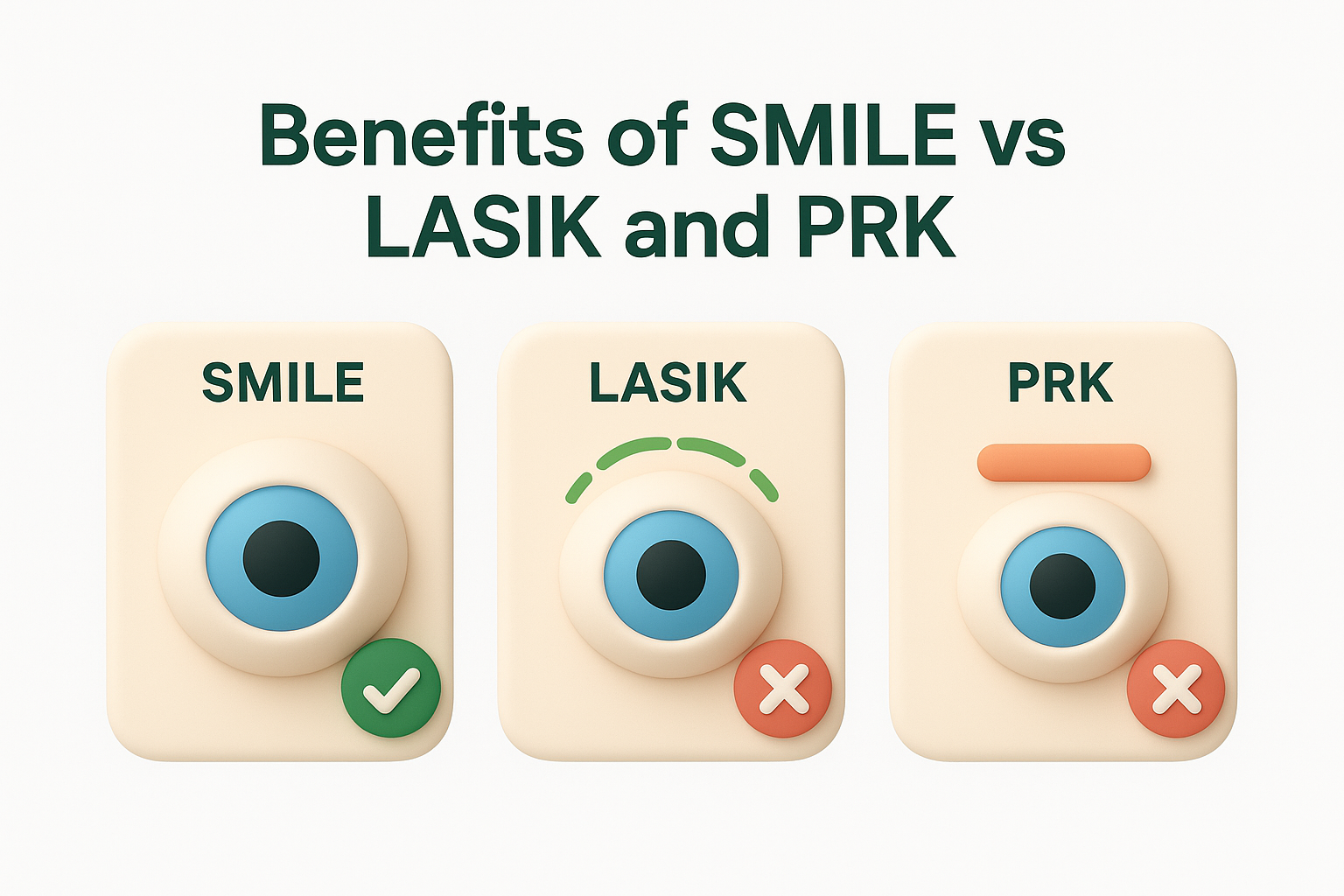
When patients ask what is SMILE eye surgery compared to its predecessors, the answer comes down to how each procedure interacts with the cornea. LASIK and PRK both deliver strong results for the right patients, but SMILE’s flapless, minimal-incision design addresses some of the most common post-operative concerns associated with the older techniques. Understanding these differences helps you make a genuinely informed choice, not just accept the first option presented to you.
Significantly lower dry eye rates
One of the most clinically meaningful advantages SMILE holds over LASIK is its impact on tear production. Because the laser works entirely inside the cornea through a 2-4 mm incision, the majority of the subbasal nerve plexus, the network of nerves responsible for triggering tear secretion, remains intact. LASIK’s flap creation cuts across a far wider arc of corneal nerves, and for a proportion of patients this leads to post-operative dry eye that can persist for six months or longer.
For people who already experience mild dryness from years of contact lens wear, this distinction matters enormously when choosing between procedures.
PRK avoids the flap entirely, so nerve disruption is less than LASIK but still greater than SMILE, since the surface epithelium is removed across the entire treatment zone rather than contained within a small opening.
Stronger corneal structure after surgery
LASIK leaves a permanent structural weak point in the form of the flap, which never reattaches to full original strength. For most people living routine lives, this is a minor consideration. For those who play contact sports, train in martial arts, or work in high-impact physical environments, the risk of flap displacement from a direct eye injury, however small, is a real factor worth weighing.
SMILE removes tissue from inside the cornea without creating a large surface opening, which preserves the anterior corneal lamellae, the strongest layers at the front of the eye. Biomechanical studies consistently show that SMILE leaves the cornea with greater structural integrity than LASIK after equivalent tissue removal.
Faster functional recovery than PRK
PRK requires the surface epithelium to regenerate after surgery, which takes several days and involves noticeable discomfort and blurred vision during that period. Most PRK patients need a week before they feel comfortable returning to work. SMILE patients, by contrast, typically notice meaningfully clearer vision within 24 to 48 hours and report minimal discomfort during the recovery window, placing it closer to the LASIK experience in terms of downtime while retaining the structural and dry eye advantages over both.
Risks and side effects to know about
No surgical procedure is without risk, and understanding what is SMILE eye surgery in full means looking honestly at what can go wrong, not just what goes right. The good news is that SMILE has a strong safety record supported by over a decade of clinical data, but your surgeon will always walk you through the complete risk profile before you consent to the procedure. Being informed in advance is simply part of making a good decision.
Common short-term side effects
Most patients experience temporary visual disturbances in the days immediately following the procedure. These commonly include mild haziness, sensitivity to light, and halos or glare around lights at night. These effects are a normal part of the healing process as your cornea adapts to its new shape, and they typically resolve within the first one to four weeks without any intervention. Mild discomfort or a gritty sensation in the eye is also common in the first 24 to 48 hours and usually responds well to lubricating eye drops. Your surgeon will provide a specific drop regimen to support the healing process during this window.
Most short-term side effects after SMILE settle on their own, but you should contact your surgeon promptly if symptoms worsen rather than improve after the first week.
Less common but serious complications
Serious complications from SMILE are uncommon but not impossible. Suction loss during the procedure, where the stabilising device loses contact with the eye before the lenticule is fully created, can require the procedure to be paused or rescheduled. Incomplete or torn lenticule extraction is another rare complication that demands careful surgical judgement to manage. In a small number of cases, patients experience under-correction or over-correction, meaning the achieved prescription does not match the target. When significant, this may require a secondary enhancement procedure, typically performed using PRK on the original incision site.
How your surgeon minimises risk
Thorough pre-operative screening is the single most effective risk-reduction tool available. Mapping your corneal topography, measuring thickness, assessing tear film quality, and confirming prescription stability all feed into a picture of whether your eyes can safely tolerate the procedure. Choosing a surgeon with specific SMILE training and experience reduces procedural risk further, since the lenticule extraction step requires a distinct tactile skill set that develops with volume. Asking your surgeon directly about their case numbers and complication rates is a reasonable and worthwhile question to raise during your consultation.
SMILE recovery time and aftercare
One of the most common questions patients ask after learning what is SMILE eye surgery is how quickly they can get back to normal life. The short answer is: faster than you might expect. Because SMILE creates no corneal flap and only a tiny incision, your eye has far less surface trauma to repair than with LASIK or PRK, and most patients find the recovery genuinely manageable.
What to expect in the first 48 hours
Your vision will likely be noticeably clearer within the first 24 hours, though it may feel slightly hazy or soft as your cornea settles. Some patients experience mild grittiness, light sensitivity, or watery eyes during the first day, all of which are normal responses to the procedure. Your surgeon will prescribe antibiotic and anti-inflammatory eye drops to use on a strict schedule, and lubricating drops to keep the eye comfortable as healing progresses. You should plan to rest at home for the remainder of the day after surgery and avoid screens for at least a few hours.
Resist the urge to rub your eyes during the first week, even if they feel irritated. Rubbing does not dislodge the incision, but it can introduce bacteria and disrupt the healing surface.
Returning to normal activities
Most patients return to desk work and light daily tasks within one to two days. Driving is typically permitted once your surgeon confirms your vision meets the legal standard at your first follow-up, which usually falls within 24 to 48 hours post-procedure. The following general timeline gives you a practical sense of what to work around:
- Day 1 to 2: Rest, limited screen use, avoid driving until cleared
- Day 3 to 7: Return to office work, light walking, avoid dusty or smoky environments
- Week 2: Most patients resume normal social and professional activities
- Week 4: Low-impact exercise typically resumes, confirm with your surgeon
- Week 6 to 8: Swimming and contact sports cleared after surgeon review
Long-term aftercare habits
Your vision will continue to stabilise over the first three to six months as the corneal tissue fully integrates into its new shape. Attending every scheduled follow-up appointment matters during this window, since your surgeon monitors your healing and checks that your achieved prescription matches the intended correction. If your vision fluctuates or you notice unexpected changes, contacting your surgeon promptly is always the right move. Wearing UV-protective sunglasses outdoors is also recommended long-term, since protecting the cornea from sun exposure supports lasting results.
Cost of SMILE eye surgery in Australia
When you’re weighing up what is SMILE eye surgery as a genuine option, cost is one of the practical questions that deserves a straight answer. SMILE is a premium refractive procedure, and pricing in Australia reflects that. You should expect to pay in the range of $2,500 to $3,500 per eye, depending on the clinic, the surgeon’s experience, and the technology used. Some providers quote an all-inclusive fee covering pre-operative assessments and follow-up appointments, while others price these components separately, so it pays to confirm exactly what a quoted figure includes before you compare.
Getting a detailed breakdown of what your quoted fee covers is a straightforward question to ask at your consultation, and any reputable clinic will answer it clearly.
What private health insurance covers
Private health insurance does not typically cover SMILE because Medicare and most funds classify laser vision correction as an elective cosmetic procedure rather than a medical necessity. This means the full cost sits with you as an out-of-pocket expense, regardless of your level of hospital or extras cover. A small number of policies do provide a partial rebate toward refractive surgery under certain extras categories, so it is worth calling your insurer directly before your consultation to ask whether any benefit applies to laser vision correction. Do not assume the answer is no without checking.
Some clinics offer interest-free payment plans that spread the cost across several months, which makes the procedure more accessible without requiring the full amount upfront. If financing is a factor in your decision, ask the clinic whether an arrangement is available and confirm the terms clearly before committing.
Why prices vary between surgeons and clinics
Surgeon experience is one of the most significant drivers of price variation in SMILE. A surgeon who has performed hundreds of SMILE procedures brings a level of lenticule extraction skill that takes time to develop, and their fees often reflect that. The laser technology platform used also influences cost, since the latest generation femtosecond lasers require significant capital investment from the clinic.
Geography plays a role too. Practices based in major metropolitan centres like Sydney typically charge more than regional alternatives, partly due to operating costs and partly due to demand. Choosing a surgeon based on price alone is rarely the right approach for a procedure that directly affects your vision. Balancing value, transparency, and surgical expertise gives you a far more reliable basis for your decision than cost comparisons alone.

What to do next
Now that you understand what is SMILE eye surgery, how it works, who it suits, and what recovery looks like, the logical next step is finding out whether your eyes are the right fit. Reading about the procedure gets you informed, but only a thorough pre-operative assessment can confirm whether your prescription, corneal thickness, and overall eye health make you a genuine candidate.
At Bright Sight Eye Specialists in Randwick, Dr Capucine Odouard offers refractive laser surgery including SMILE for patients across Sydney’s Eastern Suburbs and beyond. She takes a patient-centred approach to every consultation, walking you through your options honestly rather than steering you toward a procedure that does not suit your situation.
If you are ready to take the next step toward clear, unaided vision, book a consultation with Dr Odouard to get a complete picture of what SMILE could mean for your eyes.