


The term vision surgical comes up often when people search for eye surgery options, but it can mean different things depending on context. Some people are looking for surgical equipment suppliers, others for specific procedures like cataract removal or laser correction, and many simply want to understand what surgical options exist for improving their sight.
At Bright Sight Eye Specialists in Randwick, Sydney, we perform a wide range of ophthalmic surgical procedures, from cataract and retinal surgery to refractive laser correction and corneal grafts. Led by Dr Rahul Dubey and Dr Capucine Odouard, our practice combines advanced surgical techniques with a straightforward, patient-first approach to care across the Eastern Suburbs and beyond.
This article breaks down what vision surgical actually refers to, the main categories of eye surgery available in Sydney, who might need these procedures, and how to find the right specialist. Whether you’ve been referred by your optometrist or you’re researching options on your own, you’ll walk away with a clearer picture of the surgical side of eye care, and what to expect from the process.
What "vision surgical" means in eye care
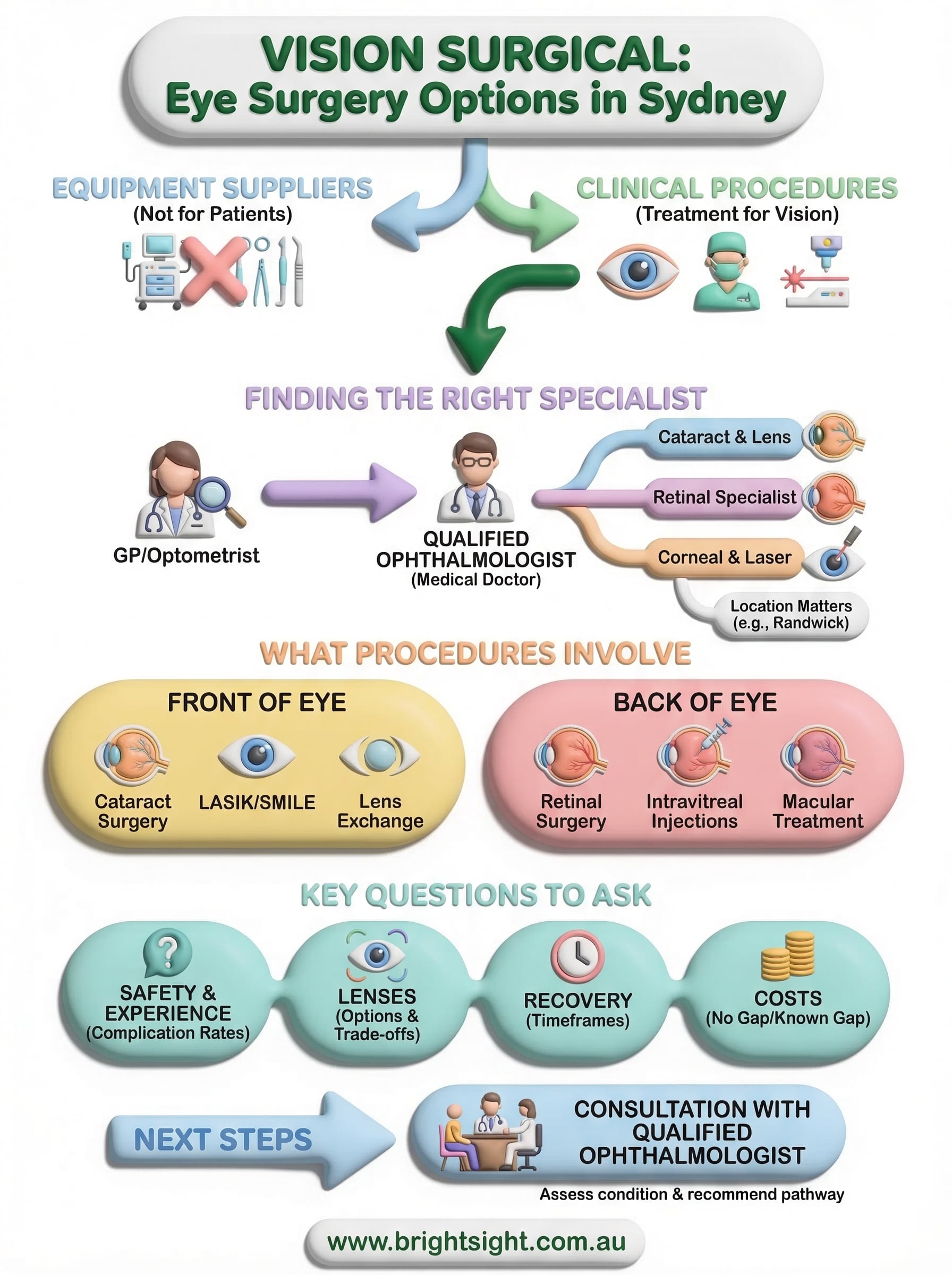
The phrase vision surgical gets used in two distinct ways. In some cases, people use it to describe companies that supply surgical instruments and equipment to ophthalmologists and hospitals. In others, it refers broadly to surgical procedures performed to treat or correct vision problems, from cataracts and retinal conditions to laser refractive surgery. Understanding which meaning applies to your situation helps you search more effectively and ask better questions when speaking to a specialist.
When the term refers to suppliers
Some businesses use "vision surgical" as a trading name or product category label. These are typically medical device distributors that supply operating theatres, eye clinics, and hospitals with instruments such as phacoemulsification machines, intraocular lenses, and vitrectomy equipment. If you come across this usage in your research, it means you’ve landed in the product and equipment side of ophthalmology, which matters to clinicians but is not directly relevant to patients seeking treatment.
When the term refers to clinical procedures
For most people searching online, vision surgical points to the clinical side: the actual procedures a trained ophthalmologist performs to improve, restore, or protect your sight. This includes cataract surgery, retinal surgery, corneal grafts, laser vision correction, and refractive lens exchange, among others. Each procedure targets a specific problem in the eye’s structure or function, and each requires a different level of surgical skill and technology.
The key distinction is that vision surgical procedures are performed by medical doctors with specialist ophthalmology training, not optometrists or general practitioners.
Knowing which category you are dealing with saves time and ensures you land in the right place when you need answers about your eye health.
Why the term matters when choosing surgery in Sydney
When you search for vision surgical services in Sydney, the results can pull in two different directions: equipment distributors and clinical eye care providers. If you don’t spot the difference early, you can waste time on the wrong type of information before you find a qualified ophthalmologist who can actually assess and treat your condition.
Getting to the right provider from the start
Sydney has a number of eye surgery clinics and specialist practices, each with different areas of focus. Some concentrate on refractive laser procedures; others specialise in retinal or corneal surgery. Knowing that you need a clinician rather than a supplier narrows your search and puts you in contact with someone who can evaluate your eyes and recommend a suitable procedure.
Referrals from your GP or optometrist are one of the fastest ways to find the right surgical eye specialist in Sydney.
Your geographic location also matters more than people expect. If you live in the Eastern Suburbs, choosing a specialist based in Randwick means shorter travel times and easier follow-up appointments. Practical factors like these influence how consistently you attend post-operative care, which directly affects your surgical outcome.
How to work out what type of specialist you need
The type of eye specialist you need depends entirely on your condition, your symptoms, and what stage of care you’re at. If your optometrist has flagged a concern, they will usually refer you directly to the right type of ophthalmologist. If you’re researching independently, understanding the main subspecialties within vision surgical eye care helps you target the right clinic from the start.
Match your condition to a subspecialty
Different ophthalmologists focus on different parts of the eye. Cataract and lens surgery sits under anterior segment surgery, while conditions like retinal detachment, macular degeneration, and diabetic eye disease require a vitreoretinal specialist. Corneal problems, including grafts and some laser procedures, fall under corneal surgery.
Choosing a specialist whose training matches your specific condition gives you access to better equipment, more relevant experience, and more accurate advice.
Start with a referral from your GP or optometrist
Your GP or optometrist can assess your symptoms and point you toward the correct subspecialty. This step saves time and ensures your private health insurance claim is handled correctly from the outset.
When you attend your referral appointment, bring:
- Previous eye test results or glasses prescriptions
- A list of current medications
- Notes on how long you’ve experienced your symptoms
What "vision surgical" can involve in real procedures
Vision surgical procedures cover a wide range of operations that target different structures inside the eye. The specific procedure you need depends on where the problem sits and how far it has progressed.

Procedures for the front of the eye
Cataract surgery involves removing your clouded natural lens and replacing it with an intraocular lens implant. Depending on your goals, you can choose a standard monofocal lens or a premium option such as a multifocal or extended depth of focus lens to reduce your dependence on glasses. Refractive laser procedures like LASIK, SMILE, and PRK reshape the cornea to correct short-sightedness, long-sightedness, or astigmatism without removing the lens at all.
The type of lens or laser technology used has a direct impact on your visual outcome, so this decision deserves a careful conversation with your surgeon.
Procedures for the back of the eye
Retinal surgery addresses conditions such as retinal detachment, macular holes, and epiretinal membranes. These procedures require a vitreoretinal specialist with specific training and equipment. Intravitreal injections treat macular degeneration, diabetic eye disease, and retinal vein occlusion by delivering medication directly into the eye to slow or stop damage.
What to ask about safety, lenses, recovery and costs
Before committing to any vision surgical procedure, you should prepare a list of specific questions for your surgeon. The quality of answers you receive tells you a great deal about how well the clinic communicates and how seriously they take informed consent.
Questions about safety and your surgeon’s experience
Ask your surgeon directly how many times they have performed your specific procedure and what their complication rate looks like. You should also ask what happens if something goes wrong and what the plan is for follow-up care. These are straightforward questions, and any experienced ophthalmologist should answer them clearly without hesitation.
A surgeon who welcomes your questions is one who respects your right to make an informed decision.
What to ask about lenses, recovery and costs
For cataract or refractive lens surgery, ask which lens options suit your lifestyle and what the trade-offs are between standard and premium implants. On recovery, ask how long before you can drive, return to work, and resume your usual activities. Regarding costs, confirm whether your procedure is no gap or known gap for private health insurance holders, and ask for a written fee estimate before you agree to anything.
Next steps if you’re considering eye surgery
If you’ve been referred by your optometrist or GP, your next step is to book a consultation with a qualified ophthalmologist who specialises in the procedure you need. Bring your referral letter, any recent test results, and a list of questions about your specific condition. The consultation gives your surgeon a chance to assess your eyes properly and recommend the most appropriate vision surgical pathway for your situation.
At Bright Sight Eye Specialists in Randwick, Dr Rahul Dubey and Dr Capucine Odouard see patients from across Sydney’s Eastern Suburbs for conditions ranging from cataracts and retinal disease to laser vision correction and corneal surgery. Most procedures are no gap or known gap for private health insurance holders, and the team takes time to walk you through every option before you make a decision. Book a consultation with our team to get started.