


If you have astigmatism and need cataract surgery, you’ve likely heard that standard lens implants won’t fully correct your vision. You might still need glasses for distance or reading afterwards. Toric IOL lenses offer a different outcome, they’re specifically designed to correct astigmatism at the same time as replacing your cloudy natural lens.
At Bright Sight Eye Specialists, Dr. Rahul Dubey performs advanced cataract surgery using premium lens implants, including toric IOLs, for patients across Sydney’s Eastern Suburbs. We believe you deserve clear information about your options before making decisions about your eye health. That means understanding not just what toric lenses can do, but also their limitations, costs, and whether they suit your eyes.
This article explains how toric IOLs work, who benefits most from them, what results you can realistically expect, and how much they cost in Australia. We’ll also cover the risks involved and help you understand whether a toric lens might be the right choice for your cataract surgery.
How toric IOL lenses work
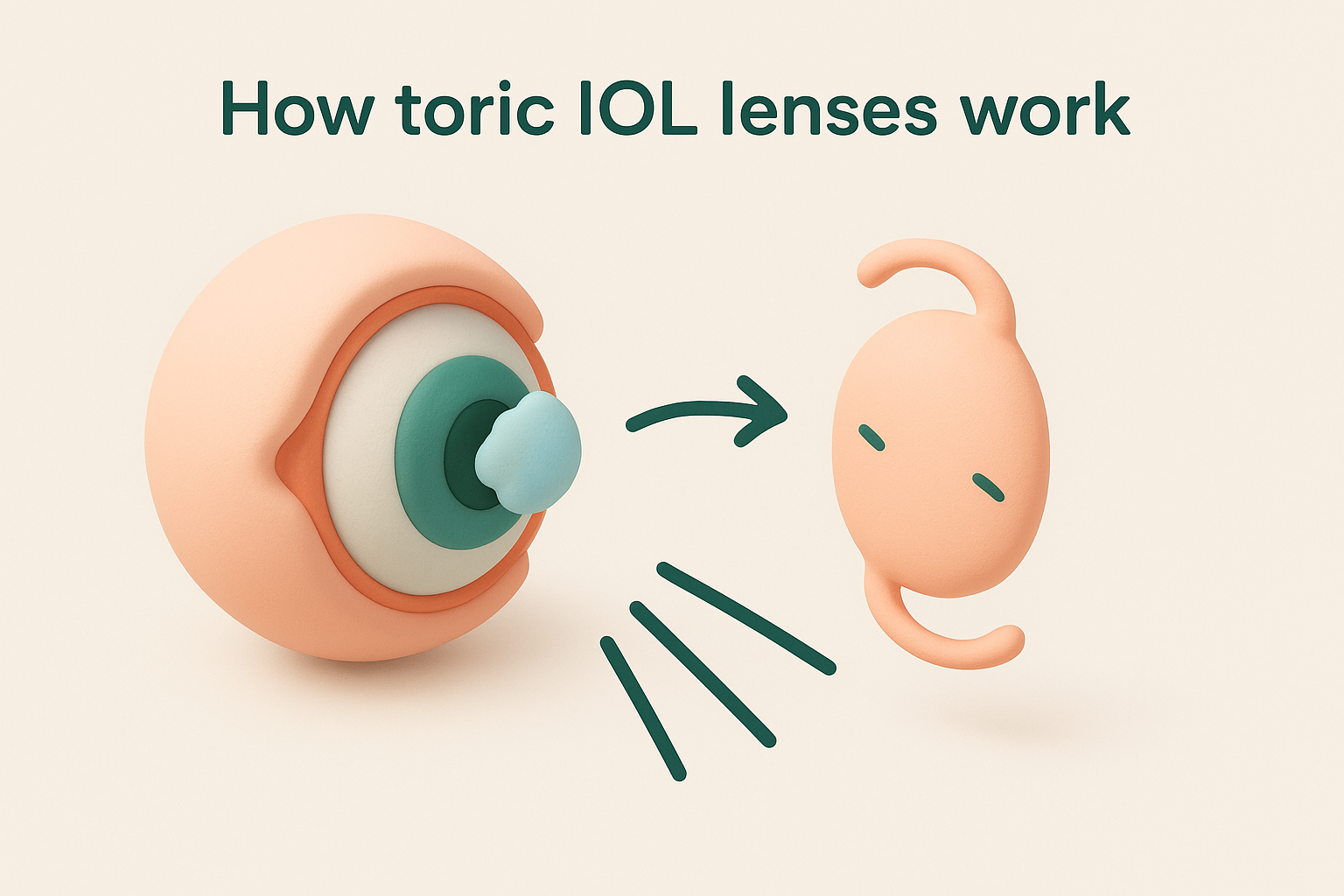
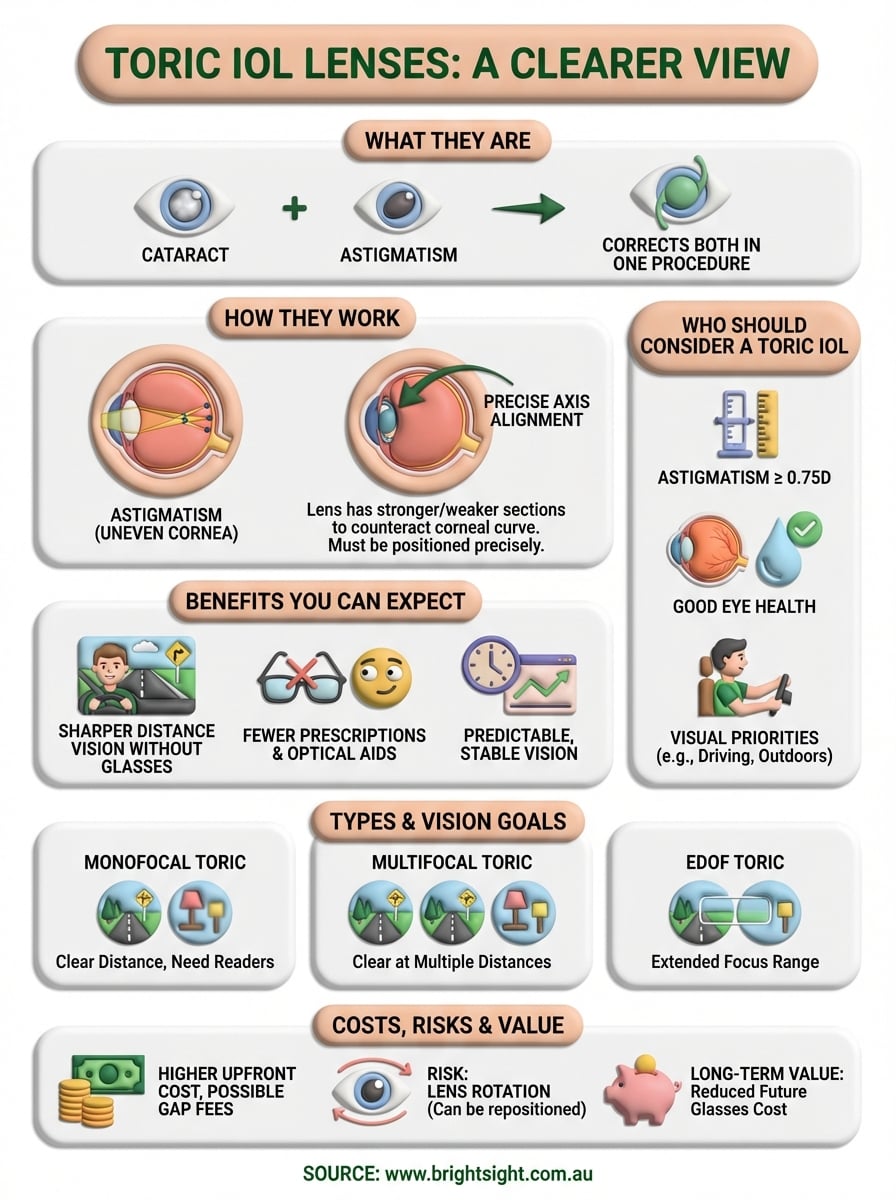
Your eye’s natural lens sits behind your pupil and helps focus light onto your retina. When you develop a cataract, that lens becomes cloudy and needs to be removed. During cataract surgery, your surgeon replaces it with an artificial intraocular lens (IOL) that becomes a permanent part of your eye. Toric IOL lenses are a specialised type of lens implant that addresses two problems at once: they replace your cloudy lens and correct the uneven curvature of your cornea that causes astigmatism.
The astigmatism correction mechanism
Astigmatism occurs when your cornea (the clear front surface of your eye) has an oval shape rather than a round one. Think of it like the difference between a basketball and a rugby ball. This irregular shape means light entering your eye focuses at multiple points instead of one, creating blurred or distorted vision at all distances.
Toric lenses have different refractive powers built into different meridians of the lens. One section of the lens is stronger, while another section has less power. When your surgeon positions the lens correctly during surgery, the stronger section aligns precisely with the steeper curve of your cornea. This counteracts the uneven shape and allows light to focus properly on your retina.
Standard IOLs have the same power throughout the entire lens, which means they can’t correct astigmatism on their own.
The design is similar to how toric contact lenses work, except these lenses sit permanently inside your eye rather than on its surface. You won’t need to remove them, clean them, or worry about them falling out.
Alignment and precision
For toric IOL lenses to work effectively, your surgeon must position them at exactly the right angle during surgery. The lens has tiny markings on it that indicate which axis needs to align with the steepest part of your cornea. Even a rotation of 10 degrees can significantly reduce how well the lens corrects your astigmatism.
Before your surgery, Dr. Dubey takes precise measurements of your eye using advanced diagnostic equipment. These measurements map out the exact shape of your cornea and identify where the astigmatism sits. Your surgeon uses this data to calculate which toric lens power you need and which rotational position will give you the best vision.
During the procedure itself, surgeons use reference points on your eye to guide the final lens placement. Some practices use digital marking systems or image-guidance technology to ensure accuracy down to the degree. The lens needs to sit in a specific orientation, and your surgeon checks this positioning before completing the surgery.
After surgery, the lens typically stays in position because of its design and how it sits within the capsular bag (the natural pocket that held your original lens). In rare cases, the lens can rotate slightly during the healing process, which is why you’ll have follow-up appointments to monitor your vision and lens position. If rotation does occur, your surgeon can reposition the lens in a quick procedure.
Your eye’s natural structures help keep the lens stable over time. The capsular bag shrinks slightly as it heals, which actually holds the lens more securely. Most patients maintain stable vision with their toric lenses for many years without any adjustment needed.
Benefits you can expect
Choosing toric IOL lenses means you’re addressing both your cataract and your astigmatism in a single procedure. Most patients with astigmatism who opt for standard lenses still need glasses for distance vision after surgery, even though their cataract has been removed. Toric lenses change that outcome by correcting the corneal irregularity at the same time as restoring your clarity.

Sharper distance vision without glasses
The most noticeable benefit you’ll experience is clearer distance vision without needing corrective lenses. After healing from your cataract surgery with a toric IOL, you should be able to drive, watch television, recognise faces across a room, and see road signs without reaching for your glasses. Studies show that patients with toric lenses achieve significantly better uncorrected distance vision compared to those with standard IOLs who have similar levels of astigmatism.
Your astigmatism correction becomes permanent because the lens sits inside your eye rather than on its surface like contact lenses do. You won’t need to worry about discomfort, dryness, or infections that can come with daily contact lens wear. The correction works continuously without any maintenance or replacement on your part.
Patients with moderate to high astigmatism typically see the most dramatic improvement in their quality of vision after choosing toric IOLs.
Fewer prescriptions and optical aids
Beyond just distance vision, toric IOL lenses simplify your daily routine by reducing how often you reach for glasses. While you’ll likely still need reading glasses for close-up tasks (unless you choose a multifocal toric lens), you won’t be constantly switching between different pairs throughout your day. Many patients find this freedom from distance glasses makes activities like exercising, travelling, or working outdoors far more convenient.
Your vision becomes more predictable and consistent because the lens doesn’t shift or rotate like contacts can. You wake up with clear distance vision immediately, rather than needing to insert lenses or put on glasses before you can function properly. This stability matters especially for people with active lifestyles or those who found managing astigmatism with glasses or contacts frustrating.
The financial benefit adds up over time as well. You’ll spend less on prescription glasses and avoid the ongoing costs of toric contact lenses, cleaning solutions, and replacement schedules. While toric IOLs cost more upfront, many patients find the long-term savings and convenience justify the initial investment.
Who should consider a toric IOL
Toric IOL lenses suit patients who have both cataracts and astigmatism that affects their vision quality. Not everyone with astigmatism needs a toric lens, though. Your decision depends on how much astigmatism you have, what visual outcomes matter most to you, and whether your eyes meet specific health criteria that make the lens a safe option.
Measuring your astigmatism level
Your astigmatism gets measured in units called dioptres (D). Most surgeons recommend toric IOLs for patients with at least 0.75D to 1.0D of astigmatism, though some people with lower amounts still choose them if they want to avoid glasses for distance vision. Above 1.5D, the benefits become much clearer because standard lenses simply cannot provide sharp distance vision on their own.
Patients with higher levels of astigmatism (over 2.0D) gain the most dramatic improvement from toric lenses. If you’ve always struggled with blurry or distorted vision even with glasses, and your astigmatism sits in this range, you’ll likely notice a significant difference in your visual clarity after surgery. Dr. Dubey measures your astigmatism precisely during your consultation to determine whether the correction justifies the additional cost of a toric lens.
The sweet spot for toric IOL benefit typically falls between 1.0D and 4.0D of corneal astigmatism.
Your measurement needs to be stable and regular for toric lenses to work properly. If your astigmatism changes frequently or has an irregular pattern (such as from keratoconus or corneal scarring), a toric IOL might not be your best option. These lenses correct regular astigmatism where your cornea has a consistent oval shape, not complex irregularities.
Other factors that influence suitability
Beyond astigmatism levels, your overall eye health plays a role in whether you’re a good candidate. You need a healthy retina, stable eye pressure, and no significant corneal disease. Conditions like severe dry eye, previous corneal surgery, or unstable tear film can affect how well your surgeon measures your eye and how accurately they can position the lens during surgery.
Your lifestyle and visual priorities matter just as much as your clinical measurements. If you spend most of your day driving, watching screens at a distance, or doing outdoor activities where glasses feel inconvenient, a toric IOL makes excellent sense. Patients who primarily read or do close-up work might find the investment less worthwhile, since you’ll still need reading glasses regardless of which lens you choose.
Cost considerations are legitimate too. If your budget is tight and your astigmatism sits below 1.5D, you might manage well with standard lenses and a good pair of distance glasses. Your surgeon can also correct small amounts of astigmatism with corneal relaxing incisions during surgery, which costs less than upgrading to a toric lens.
Types of toric IOLs and vision goals
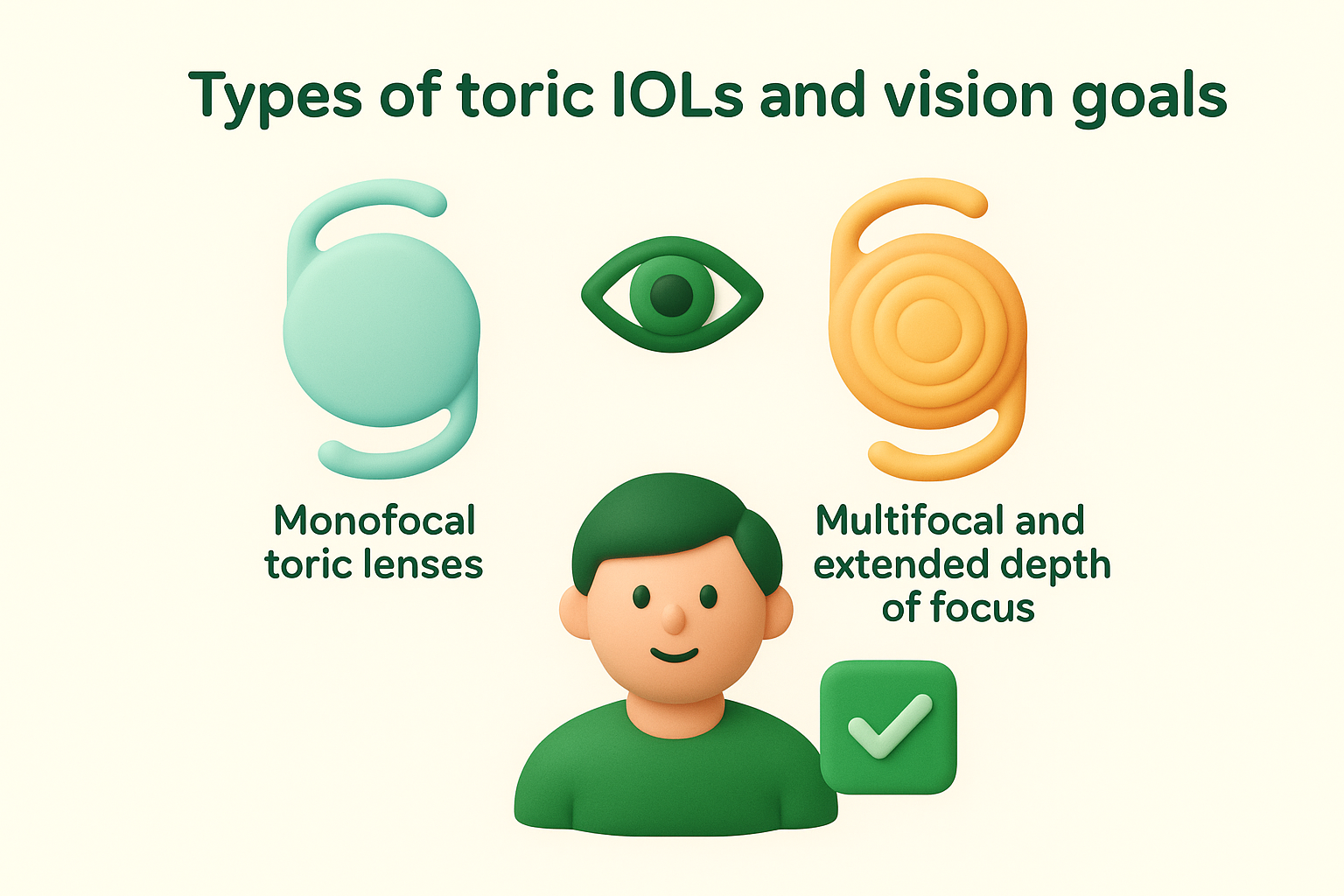
Toric IOL lenses come in several varieties, each designed to meet different visual priorities beyond just correcting your astigmatism. Your choice depends on whether you want to optimise your distance vision only, or whether you’d prefer to reduce your dependence on reading glasses as well. Understanding these options helps you align your lens selection with how you actually use your eyes throughout your day.
Monofocal toric lenses for distance clarity
Standard toric IOLs provide excellent distance vision while correcting your astigmatism, but they work at only one focal point. You’ll see clearly across the room, while driving, and when watching television without glasses. However, you’ll still need reading glasses for close-up tasks like reading menus, using your phone, or doing detailed work.
Most patients choose monofocal toric lenses because they deliver predictable, crisp distance vision with the fewest visual compromises. You won’t experience the halos, glare, or reduced contrast that can occur with more complex lens designs. If you’ve worn reading glasses comfortably for years and simply want to eliminate your distance prescription, this option makes excellent sense for your lifestyle.
Monofocal toric lenses remain the most popular choice because they balance excellent visual quality with astigmatism correction at a lower cost than premium multifocal options.
The Australian health system subsidises monofocal toric lenses through private health insurance no-gap arrangements at many practices, making them more affordable than advanced multifocal designs. Your out-of-pocket costs decrease significantly when you choose this straightforward option.
Multifocal and extended depth of focus options
Multifocal toric IOLs combine astigmatism correction with multiple focal points, allowing you to see clearly at distance, intermediate, and near ranges. These lenses use concentric rings or other optical designs to split light between different distances. You gain more freedom from glasses overall, though you might notice slightly reduced contrast or experience halos around lights at night.
Extended depth of focus (EDOF) toric lenses offer a middle ground between monofocal and multifocal designs. They provide excellent distance vision and good intermediate vision (computer screens, dashboard), with less dependence on glasses than standard lenses. You’ll likely still need readers for sustained close-up work, but you gain more functional vision throughout your day without the visual side effects that some patients experience with full multifocal lenses.
Your lifestyle determines which technology suits you best. Patients who drive frequently at night might prefer EDOF lenses to minimise glare and halos. Those who spend hours on computers or doing crafts often appreciate the extended range without fully committing to multifocal optics. Your surgeon will discuss these trade-offs during your consultation to help you choose the lens that matches your daily visual demands.
How surgeons calculate toric power and axis
Getting your toric IOL lenses positioned correctly requires precise mathematical calculations based on detailed measurements of your eye. Your surgeon needs to determine two critical factors: how much astigmatism correction power you need, and at which exact rotational angle (axis) to place the lens during surgery. Even small errors in these calculations can leave you with residual astigmatism and blurred vision, which is why your pre-operative assessment involves multiple sophisticated measurements.
Pre-operative measurements and biometry
Your surgeon begins by measuring the curvature of your cornea using a device called a keratometer or corneal topographer. This equipment creates a detailed map showing exactly where your cornea is steeper and where it’s flatter. The measurements reveal both the magnitude of your astigmatism (how much correction you need) and the axis (the direction of the steepest curve).
Modern practices use multiple measurement techniques to ensure accuracy. Dr. Dubey combines optical biometry with corneal topography to cross-check the data and identify any irregularities that might affect your results. Your eye’s axial length, anterior chamber depth, and lens thickness all get measured during this process, as these factors influence which toric lens power will work best for your specific eye anatomy.
Accurate pre-operative measurements are the foundation of successful toric IOL outcomes, which is why your surgeon takes multiple readings at different appointments.
The biometry device also accounts for your posterior corneal surface (the back of your cornea), which standard keratometry often misses. This back surface contributes about 10% of your total corneal astigmatism, and ignoring it can lead to under-correction or over-correction of your astigmatism after surgery.
Calculating the correct axis placement
Once your surgeon has all the measurements, they use specialised calculation software to determine which toric lens model you need and where to position it. The software considers your corneal astigmatism, the expected surgically induced astigmatism (the small amount created by the incision itself), and the effective lens position inside your eye.
Your surgeon marks reference points on your eye before surgery to guide the final lens alignment. These marks indicate the steepest meridian of your cornea, showing exactly where the toric lens needs to sit. The calculation must account for how you’ll be positioned during surgery, as your eye naturally rotates slightly when you lie down compared to when you’re sitting upright during measurements.
The toric IOL calculator also factors in the incision location your surgeon plans to use. Every surgical cut causes a small flattening effect on the cornea near that spot, which shifts your astigmatism axis by a few degrees. The software compensates for this shift to ensure the lens ends up at the correct final position after your eye heals.
What happens on surgery day and recovery
Your cataract surgery with toric IOL lenses typically takes place as a day procedure at a hospital or surgical centre. You’ll arrive about an hour before your scheduled time to complete paperwork and have your eye prepared. The nursing staff will give you dilating drops to widen your pupil and anaesthetic drops to numb your eye. Most patients feel nervous beforehand, which is completely normal, but the actual procedure is painless and surprisingly quick.
The surgical procedure itself
Dr. Dubey performs your surgery while you’re awake but comfortable under local anaesthesia. You’ll lie on a surgical bed while a microscope is positioned above your eye. The procedure takes about 15 to 20 minutes, though it might feel longer because you’re focused on staying still. Your surgeon makes a tiny incision in your cornea, removes the cloudy natural lens using ultrasound energy (phacoemulsification), and then inserts the folded toric IOL through the same small opening.
Once inside your eye, the lens unfolds and your surgeon rotates it to the precise axis calculated during your pre-operative measurements. You might see colours, lights, or movement during this positioning stage, but you won’t feel pain. The incision is self-sealing in most cases, requiring no stitches. Your surgeon places a clear shield over your eye before you leave the operating theatre.
Immediate post-operative care
After surgery, you’ll rest in a recovery area for 30 to 60 minutes while the staff monitors your eye pressure and overall comfort. Your vision will be blurry immediately after the procedure due to the dilating drops and natural post-surgical swelling. You’ll receive written instructions and prescription eye drops to prevent infection and reduce inflammation. Someone must drive you home, as your vision won’t be clear enough for you to drive safely.
Most patients notice improved vision within 24 hours, though your eye continues healing and your vision keeps sharpening over several weeks.
Recovery timeline and visual changes
Your vision improves gradually as your eye heals. Expect some mild discomfort, grittiness, or light sensitivity for the first few days. You’ll use antibiotic and anti-inflammatory drops four times daily for about four weeks. Most patients return to normal activities within a day or two, though you should avoid heavy lifting, swimming, and rubbing your eye for at least two weeks after surgery.
Follow-up appointments happen at one day, one week, and one month after your procedure. Your surgeon checks that your toric lens hasn’t rotated and that your astigmatism correction is working as planned. Your vision typically stabilises within four to six weeks, at which point you’ll receive your final prescription if you need reading glasses.
Risks, complications and how they are managed
Toric IOL lenses carry the same general surgical risks as standard cataract surgery, plus a few specific concerns related to the astigmatism correction component. Your chance of experiencing a serious complication remains low overall (less than 1% for most issues), but you deserve to understand what could go wrong and how your surgeon addresses these situations if they occur. Being informed helps you make confident decisions and recognise when to contact your surgical team during recovery.

Common risks shared with standard cataract surgery
All intraocular lens procedures involve creating an opening in your eye, which introduces infection risk (endophthalmitis) in roughly 1 in 1,000 to 1 in 3,000 cases. Your surgeon minimises this risk through sterile techniques, antibiotic drops, and careful post-operative monitoring. You’ll receive detailed instructions about keeping your eye clean and avoiding contamination during the healing period.
Other standard complications include posterior capsule rupture (where the natural lens bag tears during surgery), retinal detachment, increased eye pressure, and inflammation. Your surgeon’s experience and technique significantly reduce these risks. Dr. Dubey performs comprehensive pre-operative assessments to identify any factors that might increase your individual risk profile, such as weak zonules (the fibres holding your lens in place) or complex cataracts.
Toric-specific complications
The main concern unique to toric lenses is rotation after surgery. If your lens shifts from its intended axis by more than 10 degrees, your astigmatism correction decreases and your vision becomes blurry again. This happens in approximately 2 to 3% of cases, usually within the first few weeks as your eye heals. You’ll notice the problem because your distance vision won’t be as sharp as expected.
Residual astigmatism can also occur if the pre-operative measurements weren’t perfectly accurate or if your surgeon’s calculations didn’t account for all variables in your eye’s anatomy. You might achieve better vision than before surgery but still need glasses for certain activities. This outcome differs from a complication because nothing went wrong during the procedure itself, the lens simply couldn’t correct 100% of your astigmatism.
Your surgeon can address lens rotation with a quick repositioning procedure if the rotation is significant enough to impact your daily function.
How complications get addressed
If your toric lens rotates after surgery, your surgeon can reposition it in a brief procedure performed in the operating theatre. This typically happens within the first month while your eye is still healing and the capsular bag hasn’t fully contracted around the lens. The repositioning takes only a few minutes and restores your intended astigmatism correction.
For residual astigmatism that persists despite proper lens positioning, you have several options. Many patients simply wear glasses for activities requiring perfect distance vision. Others choose laser vision correction (PRK or LASIK) several months after their cataract surgery to fine-tune the remaining refractive error. Your surgeon discusses these possibilities during your follow-up appointments based on how much residual astigmatism affects your quality of life.
Infections, inflammation, or other standard complications get managed with antibiotic drops, anti-inflammatory medications, or additional procedures depending on the severity. Your surgical team provides 24-hour emergency contact information and clear instructions about warning signs that require immediate attention, such as sudden vision loss, severe pain, or increasing redness.
Costs and value in Australia
Toric IOL lenses cost more than standard monofocal lenses because they incorporate astigmatism correction technology into the lens design. Your total expense depends on whether you have private health insurance, which surgeon you choose, and whether your practice offers no-gap arrangements. Understanding these costs upfront helps you budget appropriately and decide whether the visual benefits justify the additional investment compared to standard lenses with glasses afterwards.
Private health insurance and gap fees
Your private health insurance typically covers the hospital and anaesthetist fees for cataract surgery, but the lens itself sits in a grey area. Standard monofocal lenses fall under most policies as part of the basic surgery package, but toric IOL lenses get classified as a premium lens upgrade. Many insurers cover a portion of the toric lens cost, while others treat the entire upgrade as an out-of-pocket expense for you.
No-gap arrangements vary significantly between surgical practices. Some ophthalmologists have agreements with major health funds that allow fully covered toric lens implants for patients with appropriate hospital cover. Others charge a known gap fee ranging from $500 to $1,500 per eye for the lens upgrade. You need to contact both your surgeon’s practice and your health fund before booking surgery to understand your specific financial commitment.
Calling your health fund directly with your surgeon’s item numbers gives you the most accurate gap fee estimate for your individual policy.
Medicare rebates and out-of-pocket costs
Medicare provides a rebate for cataract surgery through the public system, but this covers only the basic procedure with standard lenses. The Medicare Benefits Schedule (MBS) doesn’t offer additional rebates for premium lens technology like toric IOLs. Your surgeon receives the standard surgical fee from Medicare, and you pay the lens upgrade cost separately as an out-of-pocket expense if you’re a public patient or don’t have private cover.
Uninsured patients typically pay $2,500 to $4,000 per eye for the complete procedure including the toric lens, surgeon’s fees, and facility costs. This total sits considerably higher than what insured patients pay, though some practices offer payment plans to spread the cost over several months.
Comparing cost to long-term value
When you calculate the long-term value, consider how much you currently spend on prescription glasses or toric contact lenses annually. Distance glasses typically cost $300 to $600 every two years, while toric contacts run $400 to $800 yearly including solutions and check-ups. Over a decade, these ongoing expenses often exceed the upfront toric lens investment.
Your quality of life improvements matter beyond just dollars saved. Not needing distance glasses for driving, sports, or social activities holds practical value that’s hard to quantify. Patients who choose toric IOL lenses consistently report high satisfaction with their decision, particularly those who found managing astigmatism with external correction frustrating or limiting.
Next steps
You now understand how toric IOL lenses correct both cataracts and astigmatism simultaneously, giving you clearer distance vision without the ongoing hassle of glasses or contact lenses. Your decision comes down to weighing the upfront cost against the long-term convenience and improved visual quality these lenses deliver throughout your daily activities.
If you’re considering cataract surgery and have astigmatism above 0.75D, your next step involves getting precise measurements of your corneal curvature to determine whether you’re a suitable candidate. These measurements reveal not just your astigmatism level but also whether your overall eye health supports this technology. Dr. Rahul Dubey at Bright Sight Eye Specialists in Randwick offers comprehensive consultations where you’ll receive detailed assessments, transparent pricing discussions, and clear explanations of all lens options, including no-gap arrangements for insured patients across Sydney’s Eastern Suburbs.
Book a consultation at Bright Sight Eye Specialists to discuss whether toric IOL lenses match your specific vision goals and lifestyle requirements.