


Most symptoms eye patients experience, from sudden flashes of light to gradual blurriness, start subtly enough to brush off. A bit of redness here, some dryness there. But certain signs point to conditions that need prompt attention, and knowing the difference can protect your vision long-term.
At Bright Sight Eye Specialists in Randwick, Dr. Rahul Dubey and Dr. Capucine Odouard diagnose and treat the full range of eye conditions, from cataracts and macular degeneration to retinal detachment and diabetic eye disease. That clinical experience shapes this guide, it’s built around the symptoms our patients most commonly ask about.
Below, we cover eight eye symptoms you shouldn’t ignore, what typically causes them, and the specific warning signs that mean it’s time to book in with a specialist rather than wait it out.
1. Sudden vision loss or a dark curtain
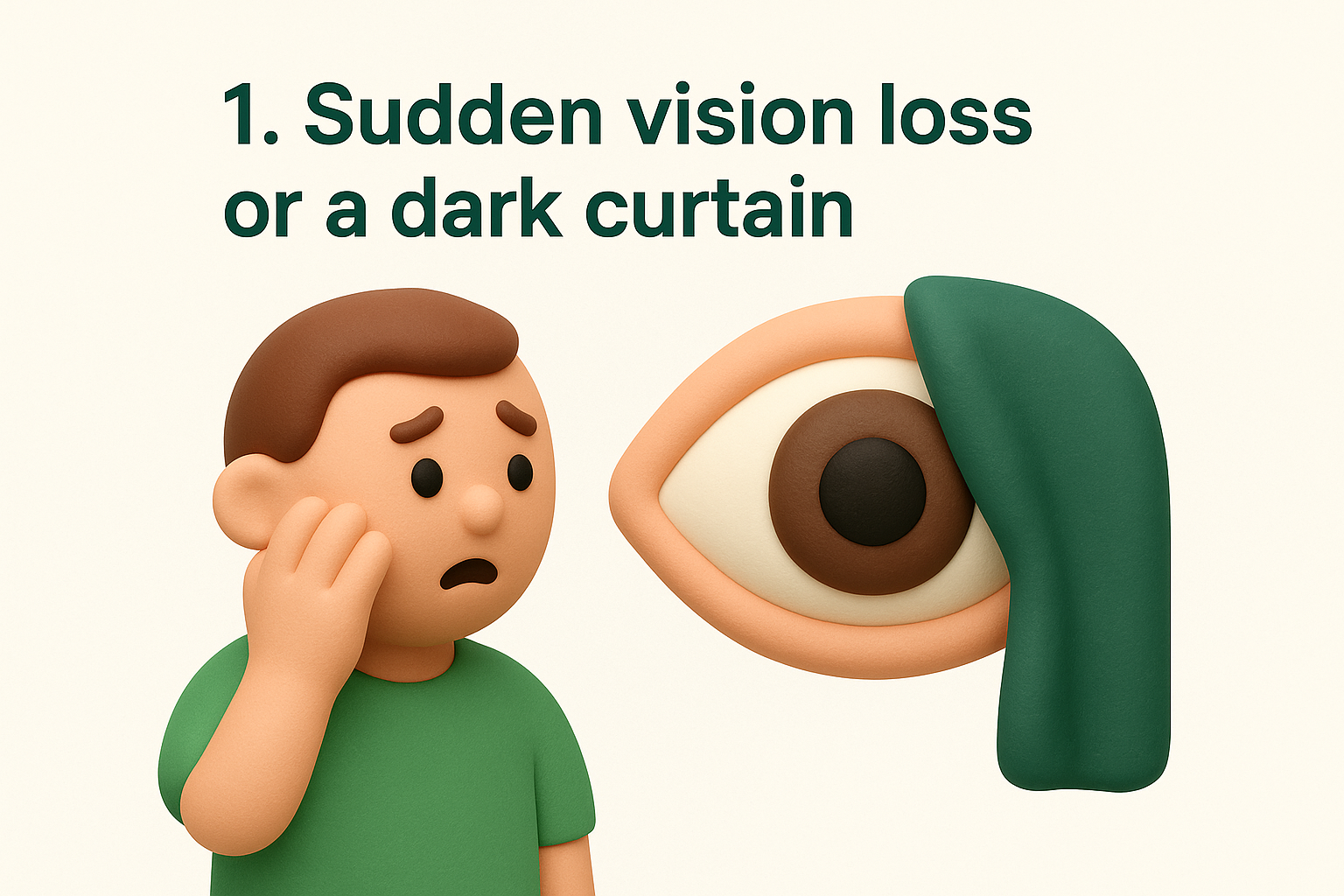
Sudden vision loss or the sensation of a dark curtain dropping across part of your visual field is one of the most alarming eye symptoms a person can experience. If this happens to you, treat it as a medical emergency and seek care the same day.
What it can mean
This symptom tells you that something has disrupted the blood supply or the physical structure of your retina. Your retina is the light-sensitive layer at the back of your eye that converts what you see into signals your brain can process. When it loses blood supply or lifts away from the wall of the eye, vision disappears in that area fast.
Sudden, painless vision loss that affects part or all of one eye is a retinal emergency until proven otherwise.
Common causes
The most serious cause is retinal detachment, where the retina peels away from the underlying tissue. A vascular event such as central retinal artery occlusion (effectively a stroke in the eye) or central retinal vein occlusion can also produce rapid vision loss. Less commonly, a vitreous haemorrhage, where blood fills the jelly-like centre of the eye, blocks light from reaching the retina entirely.
Other causes include ischaemic optic neuropathy, where the optic nerve loses its blood supply, and, in older adults, giant cell arteritis, a systemic inflammatory condition that can destroy vision in both eyes within days if not treated.
When it needs urgent care
You need same-day assessment if you notice any of the following:
- A shadow, curtain, or dark patch that covers part of your vision
- A sudden, complete blackout in one eye, even if it resolves within minutes
- Painless, rapid vision loss in one or both eyes
- Vision loss accompanied by headache, jaw pain, or scalp tenderness
What an eye specialist checks
Your specialist will examine the retina and optic nerve using dilated fundus examination and optical coherence tomography (OCT) to map retinal layers in detail. Fluorescein angiography may be used to assess blood flow through the retinal vessels and identify blockages or areas of ischaemia, guiding the most appropriate treatment quickly.
2. Flashes or a sudden shower of floaters
Flashes of light and floating specks or strands in your vision are among the most common symptoms eye patients report when they first visit a specialist. In many cases, these have a benign explanation, but a sudden change in either, especially together, signals a problem that needs assessment the same day.
What it can mean
Your eye contains a gel-like substance called the vitreous, which fills most of the interior. As you age, this gel shrinks and pulls away from the retina, a process called posterior vitreous detachment (PVD). This pulling triggers flashes and releases clumps of gel that cast shadows on the retina, which you see as floaters.
If you notice a sudden increase in floaters or new flashes of light, do not wait to see if it settles.
Common causes
The most frequent cause is PVD, which is a normal age-related change that affects most people over 60. However, if the vitreous pulls too forcefully, it can create a retinal tear, which may then progress to full retinal detachment if fluid tracks beneath the tear.
When it needs urgent care
You need same-day review if you experience a sudden shower of new floaters, new or persistent flashes, a shadow entering your peripheral vision, or any reduction in your overall vision clarity.
What an eye specialist checks
Your specialist performs a dilated retinal examination to check for retinal tears or detachment and uses OCT imaging to assess the vitreous-retinal interface in detail.
3. Painful red eye
A painful red eye is one of those symptoms eye patients often dismiss as minor irritation or allergies. Sometimes that is accurate. But pain combined with redness can also indicate serious conditions that threaten your sight if left untreated.
What it can mean
Redness alone usually points to surface-level inflammation, but when you add pain to the picture, it suggests involvement of deeper structures. This includes the cornea, the iris, or the internal drainage system of the eye. The more intense the pain, the more urgently you need a proper assessment.
Common causes
The most serious cause is acute angle-closure glaucoma, where the drainage angle of the eye closes suddenly and pressure spikes to dangerous levels. Corneal ulcers, often linked to contact lens overwear or bacterial infection, are another significant cause. Uveitis, which is inflammation inside the uveal tract, also produces a painful, red eye that requires prompt treatment to prevent long-term damage.
When it needs urgent care
A red eye with pain, blurred vision, nausea, or halos around lights is a medical emergency.
You should seek same-day care if your red eye is accompanied by significant pain, reduced vision, sensitivity to light, or vomiting. These signs point strongly to acute angle-closure glaucoma, which can cause permanent vision loss within hours without treatment.
What an eye specialist checks
Your specialist measures your intraocular pressure and examines the cornea, anterior chamber, and drainage angle using slit-lamp biomicroscopy. This allows them to distinguish between surface conditions and deeper structural problems, directing you to the right treatment quickly.
4. Blurry vision that comes and goes
Intermittent blurry vision is one of the symptoms eye patients most frequently delay acting on, largely because it clears up on its own. That pattern of temporary blurring and return to normal can make it easy to attribute to tiredness or screen use. In some cases, that is true, but recurring blurriness often reflects an underlying condition that will worsen without proper assessment.
What it can mean
When your vision blurs and then clears, your eye is struggling to maintain consistent focus or adequate blood supply to the retina. This can point to issues with the eye’s optical system, its surface, its blood vessels, or even your systemic health. The frequency, duration, and circumstances of the blurring help narrow down the likely cause.
Common causes
The most common causes include dry eye disease, where a unstable tear film scatters light unevenly, and early-stage cataracts, which reduce contrast and clarity in shifting lighting. Diabetic macular oedema and fluctuating blood sugar levels can also cause transient blurriness, as can early macular degeneration and raised intraocular pressure from glaucoma.
Blurry vision linked to diabetes or blood pressure changes tends to worsen over time without active management.
When it needs urgent care
You should book an appointment promptly if your blurring occurs more than occasionally, lasts longer than a few seconds, or accompanies floaters, flashes, or eye pain.
What an eye specialist checks
Your specialist assesses visual acuity, corneal surface quality, and macular health using OCT imaging and slit-lamp examination to identify the exact source of the fluctuation.
5. Double vision
Double vision, or diplopia, means you see two images of a single object at the same time. Whether it affects one eye or both, this symptom warrants prompt attention because it often points to a structural or neurological problem that needs proper investigation.
What it can mean
Diplopia signals that your two eyes are no longer pointing at the same object in a coordinated way, or that the optics within a single eye have been disrupted. Monocular diplopia, which persists when you close one eye, points to a problem within that eye itself. Binocular diplopia, which only occurs with both eyes open, suggests a problem with the muscles, nerves, or brain pathways that control eye movement.
Common causes
The most frequent causes of binocular double vision include nerve palsies affecting the third, fourth, or sixth cranial nerves, which control the muscles that move each eye. Thyroid eye disease, myasthenia gravis, and stroke or intracranial aneurysm are also significant contributors. Monocular double vision is more commonly caused by cataracts, an irregular cornea, or an uncorrected refractive error.
New double vision, particularly when it comes with a headache or facial drooping, should be treated as a neurological emergency.
When it needs urgent care
You need same-day assessment if your double vision appeared suddenly, or if it accompanies headache, eyelid drooping, limb weakness, or dizziness.
What an eye specialist checks
Your specialist tests ocular alignment and eye movement in all directions using a cover test and prism assessment, and may refer you for neuroimaging if a cranial nerve palsy or intracranial cause is suspected.
6. Halos and glare at night
Seeing rings of light around headlights or street lamps, or experiencing intense glare when driving after dark, goes beyond a minor inconvenience. These are symptoms eye patients frequently attribute to tiredness, but they often signal specific changes in the eye’s optical structures that are worth investigating properly.
What it can mean
Halos and glare occur when light entering your eye scatters before it reaches the retina cleanly. Anything that clouds your cornea or lens disrupts this process, bending light in irregular directions.
The effect tends to worsen in low-light conditions when your pupil dilates, allowing in more scattered light and amplifying the symptom noticeably.
Common causes
The most frequent cause is cataracts, where the lens becomes cloudy and diffracts incoming light. Other contributors include:
- Corneal irregularities such as keratoconus or corneal oedema
- Glaucoma or certain treatments associated with it
- Uncorrected or poorly corrected refractive errors
When it needs urgent care
If halos appear suddenly alongside eye pain, redness, or nausea, treat this as acute angle-closure glaucoma until an eye specialist confirms otherwise.
Gradual onset of halos and glare warrants a routine specialist review, while any abrupt change in your night vision should not be left to monitor at home.
What an eye specialist checks
Your specialist assesses the clarity of your lens and cornea using slit-lamp examination, and may perform corneal topography to map any surface irregularities. OCT imaging then confirms whether cataract formation or a corneal condition is the primary driver of the symptom.
7. Wavy or distorted central vision
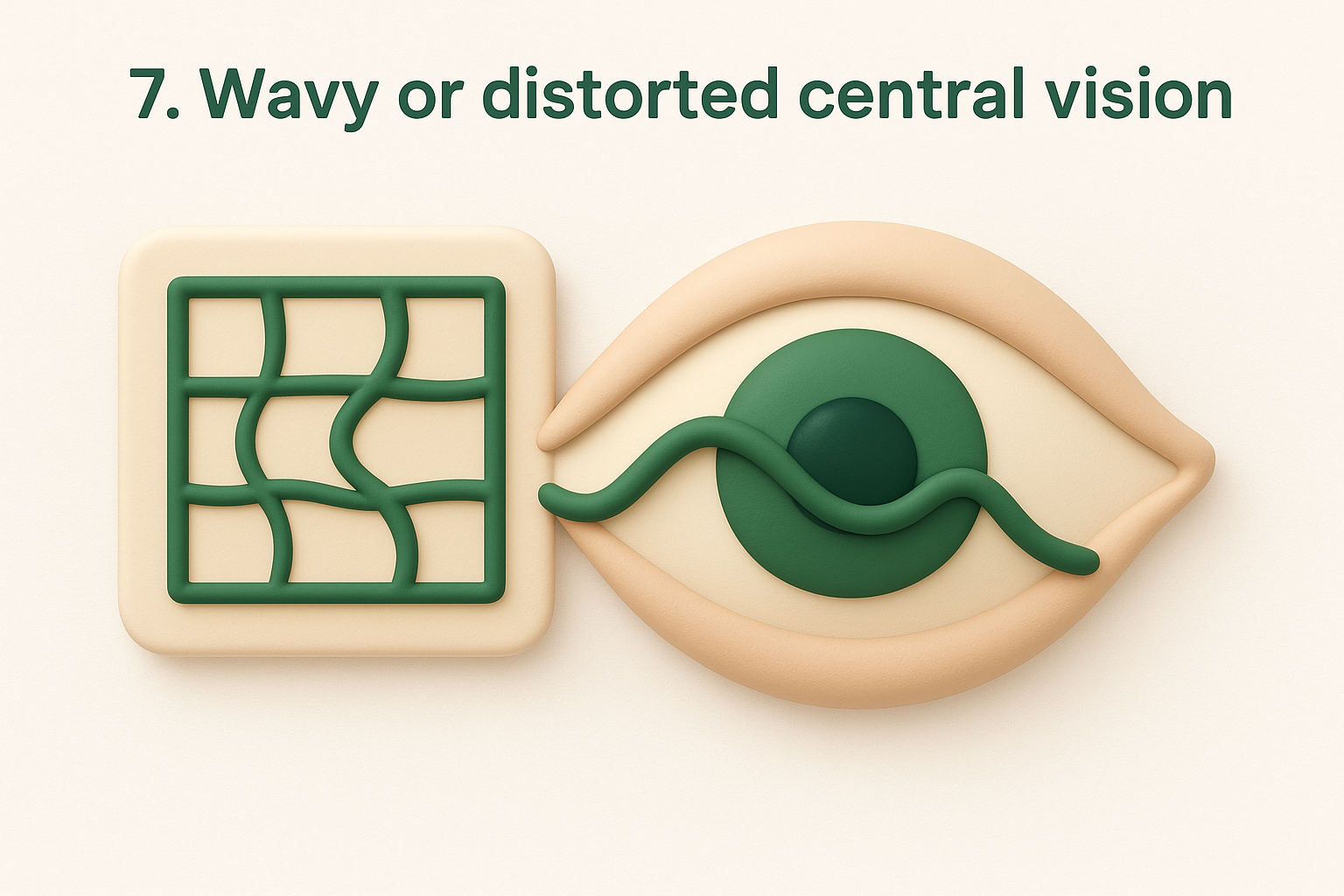
Wavy or distorted central vision, where straight lines appear bent or curved, is one of the most telling symptoms eye patients report when something has changed in their central retina. Unlike blurriness, this type of distortion has a specific name, metamorphopsia, and it points directly to structural changes at the macula, the small central zone of the retina responsible for your sharpest vision.
What it can mean
When your macula is healthy, it processes fine detail in a precise, organised way. Swelling, fluid accumulation, or tissue changes at this location distort that processing, causing the image your brain receives to appear warped rather than flat.
Metamorphopsia affecting your reading vision or facial recognition is one of the clearest early warning signs of macular disease.
Common causes
The most frequent cause is age-related macular degeneration (AMD), particularly the wet form, where abnormal blood vessels leak fluid beneath the retina. Epiretinal membrane, a thin layer of scar tissue forming across the macular surface, is another common driver. Macular hole, diabetic macular oedema, and central serous retinopathy can all produce a similar warping effect.
When it needs urgent care
You should book an urgent specialist appointment if the distortion appeared quickly, is worsening over days, or accompanies a central dark spot in your vision.
What an eye specialist checks
Your specialist uses OCT imaging to scan the macular layers in cross-section, identifying fluid, membrane tissue, or structural thinning driving the distortion.
8. Dry, gritty or watery eyes
Dry, gritty, or constantly watery eyes are among the most common symptoms eye patients present with across all age groups. They are easy to dismiss as minor irritation, but persistent dryness or tearing can significantly affect your daily quality of life and, in some cases, signal an underlying condition that needs treatment.
What it can mean
Your eye relies on a stable, layered tear film to keep the surface lubricated, clear, and protected. When this film becomes insufficient or unstable, your ocular surface triggers reflex tearing as a compensatory response. This is why dry eye disease paradoxically causes watery eyes in many people.
Common causes
The most frequent cause is dry eye disease, which can stem from meibomian gland dysfunction, hormonal changes, or prolonged screen use. Blepharitis, a chronic inflammation along the eyelid margin, disrupts the oil layer of the tear film and is a significant contributor. Other common drivers include:
- Contact lens wear or prolonged overwear
- Low-humidity environments such as air-conditioned offices
- Certain systemic medications, including antihistamines and antidepressants
When it needs urgent care
If dryness accompanies significant light sensitivity, vision reduction, or a white spot on your cornea, seek same-day assessment.
Book a prompt appointment if your symptoms persist despite lubricating drops or if your vision fluctuates alongside the irritation.
What an eye specialist checks
Your specialist evaluates your tear film stability and meibomian gland function using slit-lamp examination and tear breakup time testing to identify which layer of your tear film is failing and guide the most effective treatment plan.
Next steps
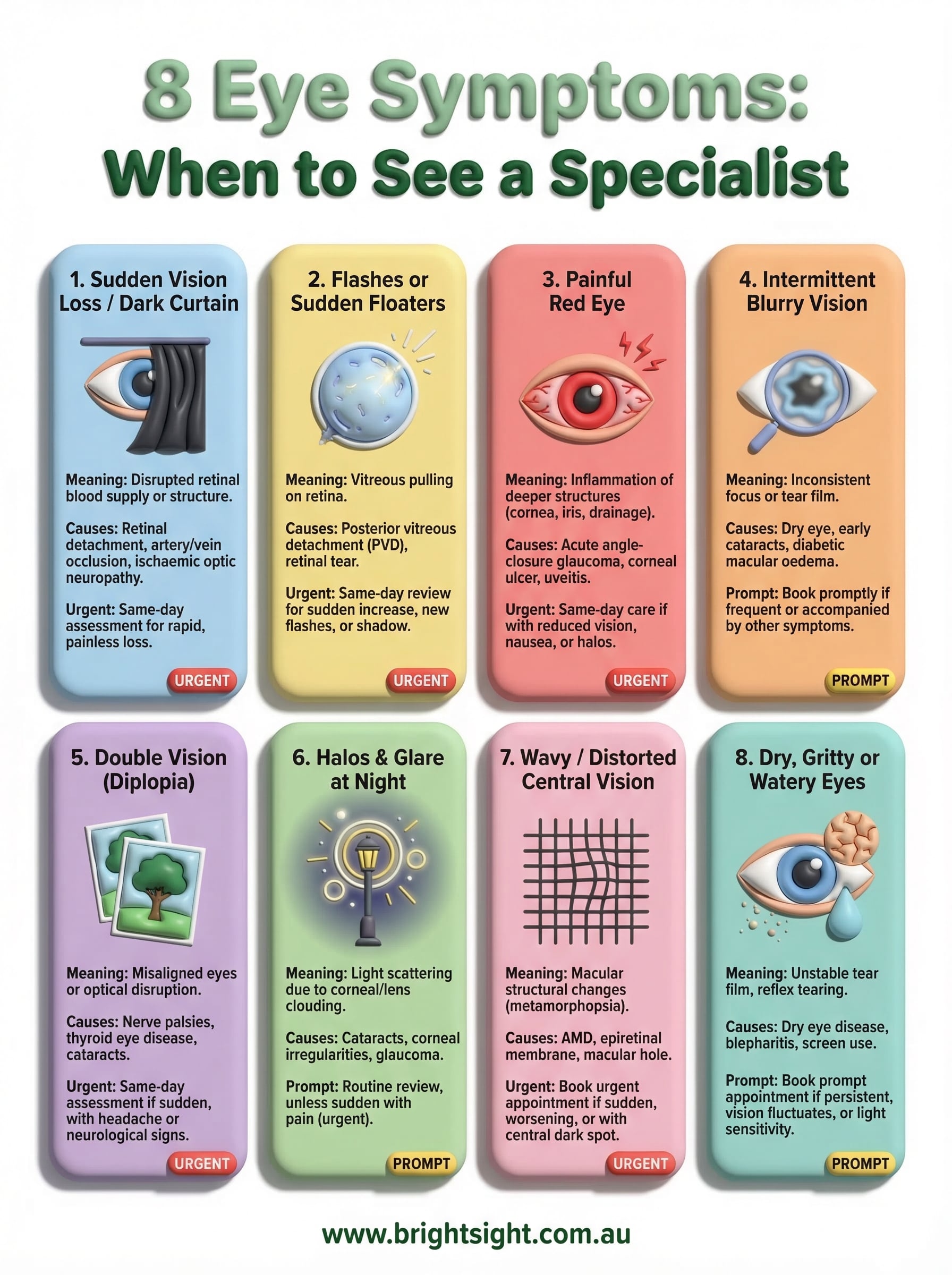
The eight symptoms eye patients most commonly overlook are also the ones most likely to point to conditions that respond well to early treatment. Whether you have noticed sudden vision changes, persistent distortion, or ongoing irritation, the pattern is consistent: earlier assessment leads to better outcomes and more treatment options.
None of the symptoms covered here are ones to monitor indefinitely at home. Some require same-day care. Others warrant a prompt but non-emergency appointment. In either case, a thorough examination by a specialist, rather than a watch-and-wait approach, gives you the clearest picture of what is happening and what to do next.
Dr. Rahul Dubey and Dr. Capucine Odouard at Bright Sight Eye Specialists in Randwick assess and treat the full range of conditions behind these symptoms. If something has changed with your vision, book an appointment with our team and get the answers you need.