


Surgical lenses are tiny artificial lenses that replace your natural lens during cataract or lens replacement surgery. They restore clear vision after your surgeon removes the cloudy lens. These lenses stay in your eye permanently. They come in different types with different focusing powers. Some give you sharp distance vision. Others help you see at multiple distances. Your choice affects whether you need glasses after surgery and how clearly you see in different situations.
You might feel overwhelmed by the options. Which lens suits your lifestyle? What will each type cost? How do you know if you’re choosing the right one? This guide breaks down the main types of surgical lenses available in Australia. You’ll learn the pros and cons of each option. We cover what they cost and what private health insurance typically covers. You’ll also discover how to choose the best lens for your vision needs. By the end, you’ll understand enough to have a confident conversation with your eye specialist about your surgery.
Why surgical lenses matter
The lens you choose affects every moment of your waking life. You use your vision for reading labels at the supermarket, driving at night, checking your phone, cooking dinner, and spotting your grandchildren across the park. Your surgical lenses determine how clearly you see these tasks. They also decide whether you reach for glasses multiple times each day or rarely need them at all. The wrong choice can mean constant frustration. The right one transforms your independence and quality of life.
Your daily activities depend on it
Different lenses suit different lifestyles. If you spend hours on screens, you need strong intermediate vision. Active retirees who golf, garden, and drive frequently may prioritise distance clarity over reading. Someone who works with fine details might value close-up sharpness above all else. Your lens choice either supports your routine or forces you to adapt to its limitations. Think about which activities matter most to you before surgery.

The lens you choose now stays with you for decades, so matching it to your lifestyle pays off every single day.
One decision for life
Surgical lenses are permanent. You won’t swap them out like glasses or contact lenses. Revision surgery is possible but uncommon and more complex than the original procedure. Most people live with their first lens choice for 20, 30, or 40 years. This permanence makes your decision crucial. Understanding your options now prevents regret later.
How to choose a surgical lens
Your lifestyle and vision priorities guide this choice more than any single “best” option. Start by listing what you do most often during a typical week. Note which tasks frustrate you with your current vision. Ask yourself whether you’d accept glasses for reading if it meant perfect distance vision for driving. Consider whether night driving matters more than reading menus without help. Your honest answers shape which surgical lenses suit you best.
Start with your vision goals
Think about your non-negotiables first. Some people refuse to wear glasses ever again. Others don’t mind reading glasses but want freedom from distance specs. Your goals determine whether you need monofocal, multifocal, or extended depth-of-focus lenses. Write down your top three visual priorities before meeting your surgeon. Rank them by importance to your daily life.
Realistic expectations matter just as much as goals. No lens eliminates all visual compromises. Multifocal lenses may cause glare around headlights at night. Monofocal lenses set for distance require reading glasses. Understanding these trade-offs helps you choose confidently rather than feel disappointed later.
Consider your health factors
Certain eye conditions limit your lens options. If you have significant astigmatism, you might need toric lenses regardless of which type you prefer otherwise. People with macular degeneration or glaucoma may not benefit from premium lenses. Dry eye syndrome can affect how well you adapt to multifocal options.
Your general health plays a role too. Diabetes affects healing and visual outcomes. Autoimmune conditions may influence which lens materials work best. Discuss your complete medical history with your surgeon, not just your eye health.
Talk openly with your surgeon
Book enough time for a thorough consultation. Bring your list of priorities and questions. Ask your surgeon to explain why they recommend specific lenses for your situation. Request to see examples or diagrams of how different lenses work.
Your surgeon has performed hundreds of these procedures and can predict which lens suits your anatomy, lifestyle, and visual goals.
Don’t hesitate to ask about success rates, revision rates, and patient satisfaction for each lens type they offer. Request clear pricing information for every option. A good surgeon welcomes questions and explains options without pressure.
Types of surgical lenses explained
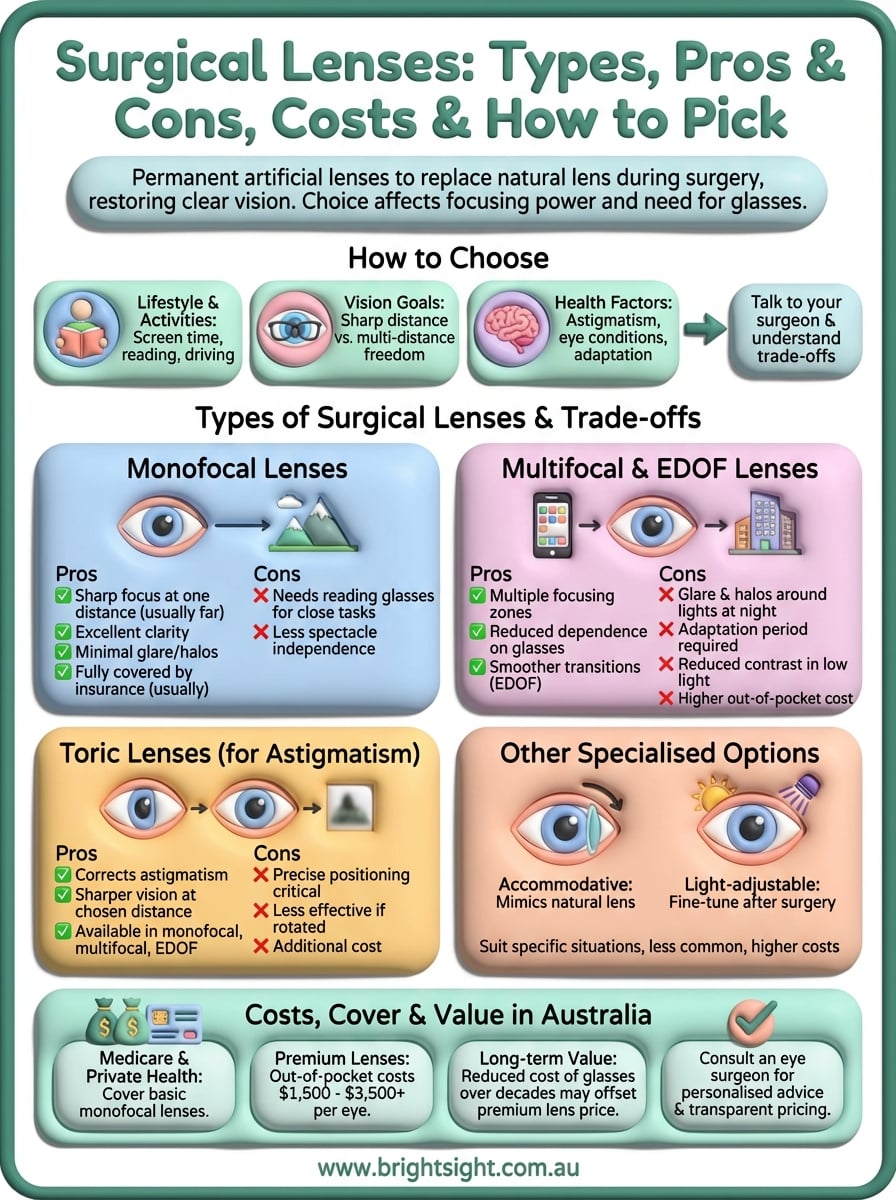
Australian surgeons commonly offer five main categories of surgical lenses. Each type corrects vision differently. Your surgeon measures your eye precisely before recommending specific options. Understanding these categories helps you recognise which matches your vision needs. Most people choose between monofocal, multifocal, or extended depth-of-focus lenses. Patients with astigmatism need toric versions of whichever lens they select.

Monofocal lenses
Monofocal lenses provide sharp focus at one fixed distance. Your surgeon typically sets them for clear distance vision so you can drive, watch television, and recognise faces across a room. You’ll need reading glasses for books, menus, phone screens, and other close-up tasks. These lenses represent the most common choice in Australia and work reliably for most patients. Private health insurance usually covers monofocal lenses completely.
Multifocal and EDOF lenses
Multifocal lenses contain multiple focusing zones within the same lens. They aim to give you clear vision at near, intermediate, and far distances simultaneously. Your brain learns to select the right zone for each task. Extended depth-of-focus (EDOF) lenses work differently by creating one elongated focal point that covers distance and intermediate vision smoothly. Both types reduce your dependence on glasses compared to monofocal options.
These premium lenses offer convenience but require an adjustment period while your brain adapts to the new way of seeing.
Toric lenses for astigmatism
Toric lenses correct astigmatism alongside other vision problems. Astigmatism occurs when your cornea curves unevenly like a rugby ball instead of a soccer ball. This irregularity blurs vision at all distances. Toric surgical lenses include special correction zones that compensate for this uneven curve. They come in monofocal, multifocal, and EDOF versions. Your surgeon positions them precisely during surgery to align with your astigmatism angle.
Other specialised options
Accommodative lenses attempt to mimic your natural lens by shifting position inside your eye as you focus on different distances. Light-adjustable lenses let your surgeon fine-tune your prescription after surgery using ultraviolet light treatments. These options suit specific situations but aren’t as widely available as standard choices. Ask your surgeon whether your eye anatomy and visual goals make you a candidate for these specialised surgical lenses.
Pros and cons of each lens option
Every surgical lens type involves trade-offs between visual freedom and potential side effects. Your choice depends on which compromises you can accept most comfortably. Some people prefer simple, predictable results even if that means wearing glasses occasionally. Others prioritise spectacle independence despite accepting visual quirks like night-time glare. Understanding these trade-offs before surgery prevents disappointment and helps you choose confidently.
Monofocal lens trade-offs
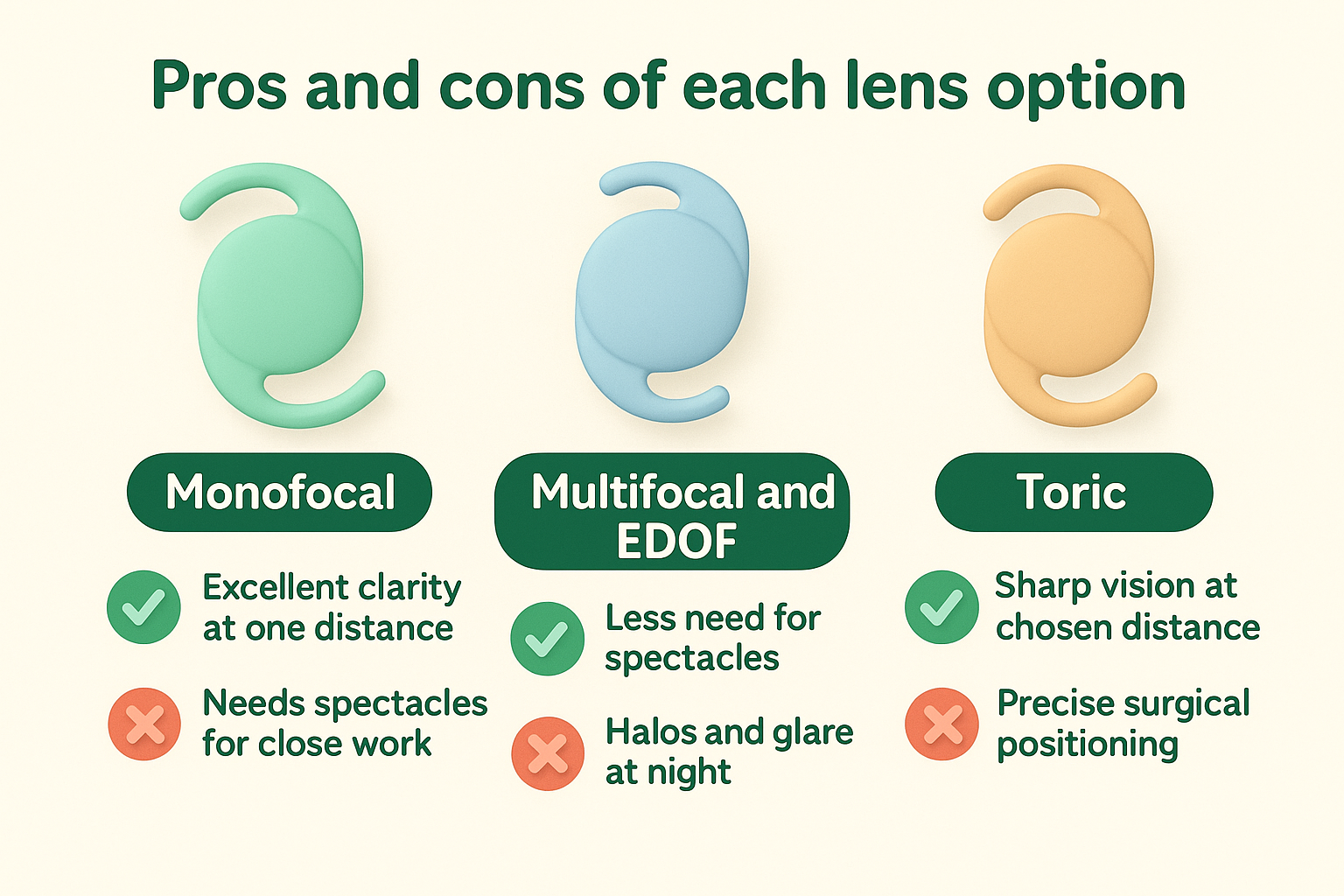
Monofocal lenses deliver excellent clarity at one distance with minimal side effects. You get sharp distance vision for driving, sport, and recognising faces. Night vision stays crisp without halos or starbursts around lights. These surgical lenses suit people who don’t mind reading glasses or who already wear them comfortably. The main drawback is simple: you need spectacles for close work. Reading books, checking your phone, threading needles, and reading labels all require glasses. Some people find this dependency frustrating after surgery.
Multifocal and EDOF lens considerations
Multifocal lenses reduce or eliminate your need for glasses across most distances. You can read menus, use your phone, and drive without switching between different specs. This convenience appeals to active people who dislike carrying multiple pairs of glasses. However, these lenses cause halos and glare around lights at night for many patients. Some people notice reduced contrast sensitivity in low light. Your brain needs several weeks to adapt to the multiple focal zones. Around 10 to 15 per cent of patients never fully adapt and feel dissatisfied.
Extended depth-of-focus lenses typically cause less glare than multifocal options while still reducing your dependence on glasses.
EDOF lenses provide smoother vision transitions between distances compared to multifocal designs. They work particularly well for computer use and dashboard reading. Most people still need reading glasses for small print. The reduced side effects make EDOF lenses popular among people who drive frequently at night.
Toric lens benefits and limits
Toric surgical lenses correct astigmatism that standard lenses cannot fix. You gain sharper vision at your chosen distance without the blur that astigmatism causes. These lenses work in monofocal, multifocal, and EDOF versions, so you still choose your focusing strategy separately. The main consideration is precise surgical positioning. If the lens rotates slightly after surgery, your astigmatism correction becomes less effective. Most surgeons achieve excellent results, but the risk exists.
Costs, cover and value in Australia
Surgical lens costs vary widely depending on which type you choose. Medicare and private health insurance cover standard monofocal lenses completely in most cases. Premium options like multifocal, EDOF, or toric lenses involve additional out-of-pocket expenses. Understanding these costs upfront helps you budget properly and avoid surprise bills after surgery. The price difference between basic and premium surgical lenses can significantly impact your decision, especially if you’re paying without insurance.

Private health insurance coverage
Medicare provides a basic rebate for cataract surgery that covers essential surgical costs and standard monofocal lenses. Private health insurance with appropriate hospital cover typically pays the gap between Medicare and your surgeon’s fees for standard procedures. You walk away paying little or nothing for basic monofocal lenses. However, insurers classify premium lenses as upgrades or out-of-scope items. Your fund may contribute a fixed amount towards premium options, but you pay the difference. Check your policy’s ophthalmology benefits before booking surgery to understand exactly what your cover includes.
Out-of-pocket costs for premium lenses
Premium surgical lenses typically cost between $1,500 and $3,500 per eye beyond what insurance covers. Multifocal lenses usually sit at the higher end of this range. EDOF lenses often cost slightly less than multifocal options. Toric corrections for astigmatism add roughly $500 to $1,000 to whichever base lens you select. These figures represent averages across Australian practices. Your specific costs depend on your surgeon’s fees, the lens brand, and your insurance contributions.
Transparent pricing matters because out-of-pocket costs can reach $7,000 for both eyes with premium lenses.
Weighing long-term value
Consider the cost of glasses over 20 years when evaluating premium lens prices. Quality progressive spectacles cost $600 to $1,200 every few years. You might spend $3,000 to $6,000 on glasses over two decades. Premium surgical lenses that reduce your dependence on specs may pay for themselves through reduced eyewear costs. However, this calculation only makes sense if you genuinely need and use the lens capabilities. Paying extra for multifocal lenses doesn’t deliver value if you’re comfortable wearing reading glasses.
Next steps for your vision
You now understand the main types of surgical lenses, their trade-offs, and what they cost in Australia. Your next move involves booking a consultation with an experienced eye surgeon who can assess your individual eye health and vision needs. Bring your list of priorities and questions. Discuss which lens options suit your anatomy, lifestyle, and budget. Your surgeon will perform detailed measurements and recommend specific surgical lenses based on your unique situation.
Don’t rush this decision. Take time to consider how each option aligns with your daily activities and long-term goals. If you’re in Sydney’s Eastern Suburbs and looking for expert guidance, Bright Sight Eye Specialists offers transparent pricing, advanced surgical techniques, and patient-centred care. Dr Rahul Dubey can help you choose the surgical lens that best suits your vision for life.