


If you’re considering laser vision correction, the choice between SMILE eye surgery vs PRK often comes down to your specific eye anatomy, lifestyle, and how quickly you need to recover. Both procedures can reduce or eliminate your dependence on glasses and contact lenses, but they work in fundamentally different ways, and those differences matter.
SMILE (Small Incision Lenticule Extraction) is a newer, minimally invasive technique, while PRK (Photorefractive Keratectomy) has a longer clinical track record and remains the preferred option for certain patients. Understanding how each procedure is performed, what recovery looks like, and which one suits your eyes gives you the clarity to make a confident decision.
At Bright Sight Eye Specialists in Randwick, Dr Capucine Odouard performs both SMILE and PRK procedures, tailoring her recommendation to each patient’s corneal thickness, prescription, and visual goals. This article breaks down the key differences between the two surgeries, from technique and healing time to comfort and long-term outcomes, so you can walk into your consultation already informed.
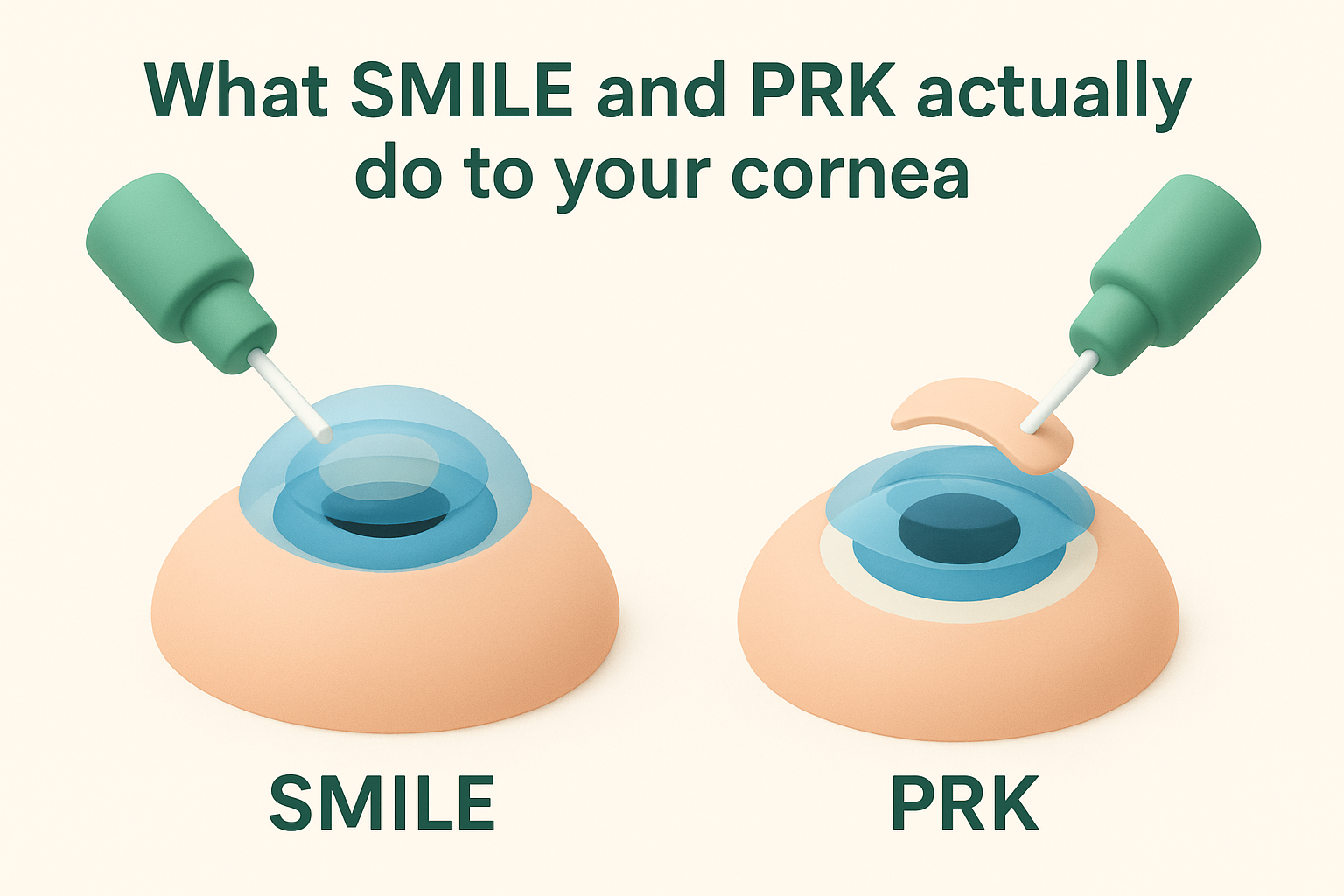
What SMILE and PRK actually do to your cornea
Both procedures use a laser to reshape your cornea, the clear front surface of your eye, so that light focuses correctly on your retina. The key difference lies in how each surgery accesses and modifies that tissue. When comparing smile eye surgery vs prk, the surgical approach determines your recovery speed, post-operative comfort, and overall suitability for the procedure.
How SMILE reshapes your cornea
SMILE uses a femtosecond laser to create a small, lens-shaped piece of tissue called a lenticule inside the cornea, without cutting a surface flap. The surgeon then removes this lenticule through a tiny incision of around 2 to 4 mm, which changes the cornea’s curvature and corrects your vision. Because the outer corneal surface stays largely intact, the structural integrity is better preserved and the nerve fibres near the surface are far less disrupted.
This reduced nerve disruption is why SMILE tends to produce lower rates of post-operative dry eye compared to flap-based procedures.
How PRK reshapes your cornea
PRK takes a fundamentally different approach. Your surgeon removes the thin outer layer of the cornea, known as the epithelium, to expose the underlying stromal tissue, then applies an excimer laser to reshape it precisely. The epithelium grows back naturally over three to five days, but this regeneration period drives the longer initial recovery and the temporary surface discomfort most patients notice in the first week.
Your cornea heals from the outside inward, which means visual acuity improves gradually rather than within hours of surgery. PRK is often the stronger choice when corneal thickness is limited or when surface irregularities make an internal approach less appropriate. The procedure carries decades of clinical data behind it, supporting safe use across a wide range of prescriptions.
Key differences at a glance
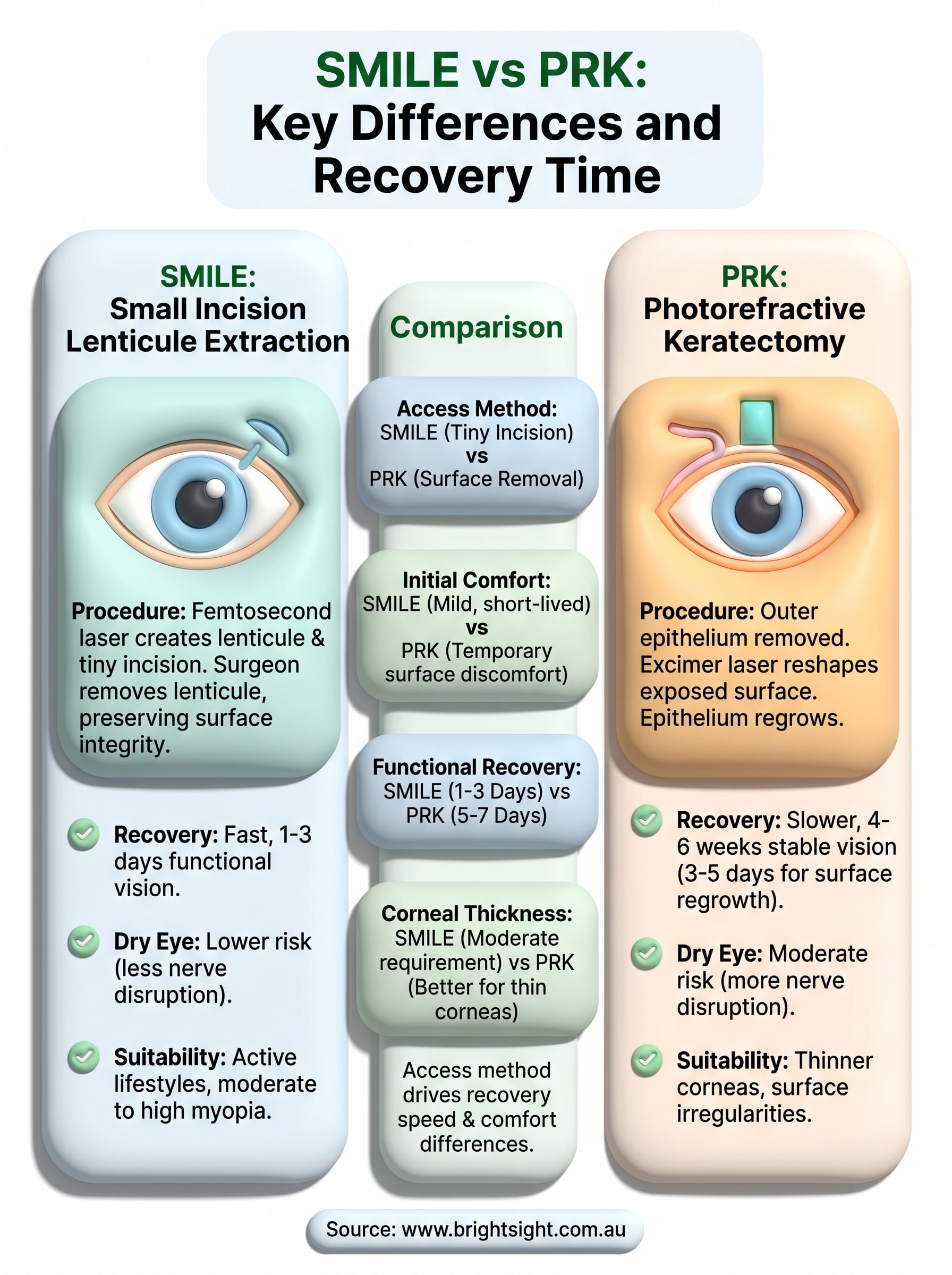
When weighing up smile eye surgery vs PRK, five factors tend to determine which procedure suits you better: the surgical access method, recovery speed, dry eye risk, corneal thickness requirements, and suitability for physically active lifestyles. The table below makes these distinctions easier to assess side by side.
| Factor | SMILE | PRK |
|---|---|---|
| Surgical access | Small internal incision | Surface epithelium removed |
| Functional vision recovery | 1 to 3 days | 5 to 7 days |
| Dry eye risk | Lower | Moderate |
| Thin cornea suitability | Moderate requirement | Better suited |
| Contact sport suitability | High | High |
Why the access method shapes everything else
The way each procedure reaches your corneal tissue drives almost every other clinical difference between the two surgeries. SMILE preserves far more surface nerve fibres, which directly reduces the inflammatory response and dry eye symptoms that some patients notice during the first few months after PRK.
Your corneal thickness and current prescription are the two measurements your surgeon will assess first when recommending one procedure over the other.
PRK removes the epithelium entirely, so your eye heals from the surface inward, which extends the initial discomfort window but leaves more options open for patients with thinner corneas or surface irregularities.
Recovery timeline and what to expect
Recovery is often the deciding factor when patients weigh up smile eye surgery vs PRK. Your lifestyle, work demands, and tolerance for a slower healing period all influence which timeline suits you better.

SMILE recovery: back to normal quickly
Most SMILE patients notice functional vision within one to three days. Your eye surface remains largely intact, so discomfort tends to be mild and short-lived. Many patients return to desk work and screen use within 48 hours, though your vision may still fluctuate slightly during the first two weeks as the cornea settles. Driving clearance varies by individual, so your surgeon confirms that timing at your post-operative review.
Avoid rubbing your eyes in the first week after SMILE, since the small incision site needs undisturbed time to seal fully.
PRK recovery: slower but straightforward
PRK requires more patience. Your epithelium regenerates over three to five days, during which your surgeon places a protective bandage contact lens over the eye to reduce discomfort. Stable, clear vision typically takes four to six weeks to establish, with gradual improvement continuing for up to three months. Your surgeon will prescribe anti-inflammatory drops to support the healing surface and reduce the risk of haze.
Visual outcomes, dry eye and other risks
Both SMILE and PRK deliver strong, comparable long-term visual outcomes for most patients with myopia. Studies consistently show that final corrected vision at 12 months is similar between the two procedures, with the main differences appearing in the first weeks of recovery rather than the endpoint.
Dry eye after each procedure
Dry eye is one of the most commonly reported side effects of laser vision correction. Because PRK removes the epithelium entirely, it disrupts more surface nerve fibres than SMILE, which means temporary dry eye symptoms tend to last longer after PRK. SMILE’s smaller incision preserves more corneal nerves, making it a better fit if you already experience dry eye before surgery.
If you have pre-existing dry eye, discuss this clearly with your surgeon before deciding between smile eye surgery vs PRK.
Haze, regression and other considerations
Corneal haze is a risk specific to PRK, where new tissue forming during healing can reduce clarity. Your surgeon manages this with steroid eye drops over several weeks. SMILE carries a lower haze risk but is technically more complex, so your surgeon’s experience matters significantly for your outcome.
Regression, where your prescription gradually shifts back, can occur with both procedures. Your surgeon will account for your age and prescription stability when assessing whether you’re a suitable candidate for either.
Who tends to suit SMILE vs PRK in Australia
Your individual eye profile determines which procedure your surgeon recommends. Factors like corneal thickness, dry eye history, occupation, and prescription strength all play a role in matching you to the right technique when comparing smile eye surgery vs PRK.
Patients who tend to suit SMILE
SMILE works well for patients with moderate to high myopia who have adequate corneal thickness and want a faster return to normal activities. If you work in a physically demanding job, play contact sports, or simply want to minimise your downtime, SMILE’s shorter recovery period is a practical advantage. Patients who already experience mild dry eye symptoms before surgery also tend to tolerate SMILE better, given its lower impact on corneal nerve fibres.
Discuss your pre-surgical dry eye status honestly with your surgeon, as it directly influences which procedure will suit your eyes.
Patients who tend to suit PRK
PRK suits patients with thinner corneas where removing internal tissue would leave insufficient structural support. Your surgeon may also recommend PRK if your corneal surface has any irregularities that make an internal approach less precise. PRK remains a strong option across a wide prescription range and carries an extensive safety record, making it a reliable choice for patients who do not qualify for SMILE.
A simple way to choose your next step
The decision between smile eye surgery vs PRK rarely comes down to one single factor. Instead, your surgeon weighs your corneal thickness, prescription strength, dry eye history, and how quickly you need to recover to recommend the procedure that matches your eyes and your life. If you have thinner corneas or existing dry eye, PRK gives you reliable outcomes with fewer structural constraints. If you want a faster return to work or sport and your cornea supports the technique, SMILE offers a practical advantage.
Both procedures deliver strong long-term vision results for the right patient. The key is matching the technique to your specific eye profile, not choosing based on what worked for someone else. Dr Capucine Odouard assesses each patient individually and explains your options clearly before you commit to anything. To find out which procedure suits your eyes, book a consultation with Dr Odouard at Bright Sight Eye Specialists in Randwick.