


If you’re tired of reaching for glasses every morning or dealing with contact lenses that dry out halfway through the day, sight surgery could be the solution you’ve been weighing up. Advances in surgical techniques now mean that millions of people worldwide have reduced or eliminated their dependence on corrective lenses, and the procedures available in Australia are among the most refined and well-regulated globally.
But choosing to have surgery on your eyes isn’t a decision you make lightly. You’ll want to understand what each procedure involves, how much it actually costs, what the realistic risks are, and what recovery looks like week by week. The answers vary depending on the type of surgery, your eye health, and your specific visual goals, which is exactly why clear, honest information matters.
At Bright Sight Eye Specialists in Randwick, Sydney, our ophthalmologists, Dr Rahul Dubey and Dr Capucine Odouard, perform a range of vision correction procedures, from refractive laser surgery (LASIK, PRK, SMILE) to refractive lens exchange. We see first-hand how the right procedure, matched to the right patient, changes daily life. This guide breaks down the main types of sight surgery available in Australia, what they cost, the risks involved, and what you can realistically expect during recovery, so you can approach your options with confidence.
Why people consider sight surgery
Most people reach a point where corrective lenses stop feeling like a minor inconvenience and start affecting real quality of life. Whether you’re struggling to find your glasses before you can read your phone in the morning, dealing with contact lens discomfort after a long shift, or simply wanting the freedom to swim, travel, or exercise without worrying about vision aids, the motivation to explore surgery is often deeply personal and practical.
The daily frustrations of corrective lenses
Glasses and contact lenses solve the immediate problem but come with their own limitations. Contact lens wearers often experience dryness, infection risk, and the ongoing cost of lenses, solutions, and cases. People who wear glasses know the frustration of fogging, breakage, and the way frames interfere with sport or physical work. For many, the cumulative lifetime cost of prescription lenses, frames, and optometrist appointments adds up to thousands of dollars, making surgery a financially sensible option over the long term.
Over a lifetime, the combined cost of glasses and contact lenses can exceed the one-off investment of laser vision correction for many patients.
Beyond the financial side, many people report that their self-confidence and daily comfort improve significantly after sight surgery. Activities like driving at night, reading without strain, and recognising faces across a room all become easier without the barrier of corrective lenses.
When vision deteriorates with age
Not everyone pursuing sight surgery is doing so purely for lifestyle reasons. Cataracts, which cause the natural lens of the eye to cloud over, affect the majority of Australians over 65 and eventually make useful vision impossible without intervention. For these patients, surgery is not optional; it is the only way to restore functional sight. Similarly, people with severe short-sightedness, long-sightedness, or astigmatism that cannot be safely corrected with laser treatment may be candidates for refractive lens exchange, where the natural lens is replaced with a precision implant.
Age-related changes also affect the eye’s ability to focus at different distances, a condition called presbyopia. Premium lens implants, including multifocal and extended depth of focus (EDOF) lenses, can address both distance and near vision in a single procedure, reducing reliance on reading glasses as well as distance correction. For patients managing diabetic eye disease or macular conditions, early surgical intervention can also prevent further deterioration, which makes timely assessment critical rather than something to put off.
Types of sight surgery in Australia
Australia offers access to a wide range of sight surgery procedures, and the right option for you depends on your age, prescription, corneal thickness, and lifestyle. Understanding what each procedure actually does helps you have a more informed conversation with your ophthalmologist when the time comes.
Laser vision correction
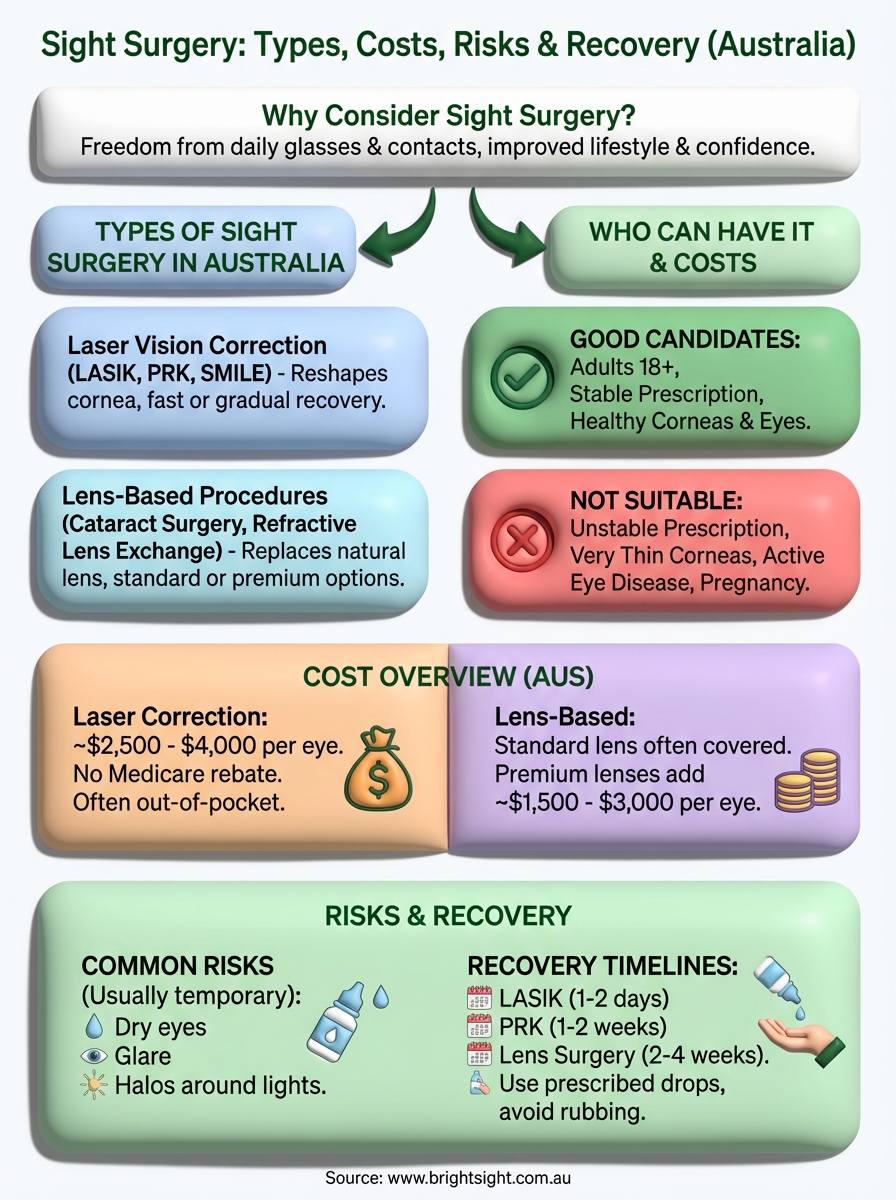
Laser procedures reshape the cornea (the clear front surface of the eye) to change how light focuses on the retina. LASIK involves creating a thin flap in the cornea before the laser is applied underneath, which allows for a fast recovery. PRK (photorefractive keratectomy) removes the outer corneal cells before reshaping the surface directly, making it better suited to patients with thinner corneas. SMILE is a newer, minimally invasive technique that uses a femtosecond laser to remove a small disc of tissue from inside the cornea without cutting a flap, resulting in less disruption to corneal nerves.
Laser vision correction is typically suitable for adults with stable prescriptions who have sufficient corneal thickness to allow safe reshaping.
Lens-based procedures
Where laser treatment is not suitable, or where the natural lens has already changed, lens-based surgery offers an effective alternative. Cataract surgery removes the clouded natural lens and replaces it with an intraocular lens (IOL), with premium options including multifocal and EDOF lenses that can correct both distance and near vision simultaneously. Refractive lens exchange follows the same surgical process but is performed on a clear lens, purely to correct a high prescription or presbyopia. Both procedures are performed at Sydney Surgical Centre and Sydney Eye Hospital, where Dr Dubey and Dr Odouard operate using current microsurgical techniques.
Who can and cannot have sight surgery
Not everyone who wants sight surgery is a suitable candidate, and a thorough assessment with an ophthalmologist is the only way to know for certain. That said, there are well-established factors that indicate whether you are likely to qualify, and understanding them early saves you time and sets realistic expectations.
Characteristics that make you a good candidate
Your eligibility depends on several clinical factors that your surgeon will measure at your initial consultation. Most laser procedures require a stable prescription for at least 12 months, sufficient corneal thickness to allow safe reshaping, and pupils that are not excessively large. For lens-based procedures like refractive lens exchange, age and prescription strength carry more weight than corneal measurements, making this option accessible to patients who fall outside the laser treatment range.
Adults over 18 with a stable prescription, healthy corneas, and no active eye disease represent the most common group suited to laser correction.
Good candidates are also free from autoimmune conditions or uncontrolled diabetes that could impair healing. Pregnancy and breastfeeding temporarily change the eye’s refraction, so surgery is deferred until hormonal stability returns.
When surgery is not the right option
Some patients are not suitable candidates, at least not for every procedure. Very thin corneas, advanced keratoconus (a progressive corneal thinning condition), or severely dry eyes can rule out laser approaches entirely. Patients with uncontrolled glaucoma or active retinal disease may also need those conditions stabilised before any elective vision correction is considered. Children and teenagers are excluded because the prescription is still changing. If you fall into one of these categories, your ophthalmologist will explain which alternatives, if any, apply to your situation.
Cost of sight surgery in Australia
The cost of sight surgery in Australia varies considerably depending on the procedure, the technology used, and whether you hold private health insurance. As a general guide, you should expect to pay a one-off fee that, for most patients, works out to be less than the cumulative cost of glasses and contact lenses over the following decade.
Laser vision correction costs
Laser procedures, including LASIK, PRK, and SMILE, typically range from $2,500 to $4,000 per eye in Australia. The variation reflects differences in the laser platform used, the complexity of your prescription, and whether wavefront-guided (custom) treatment is included. Medicare provides no rebate for elective laser correction, and most private health insurers classify it as a cosmetic procedure, which means you are likely to pay the full amount out of pocket. Comparing quotes carefully and asking what is included, such as follow-up appointments and enhancement procedures, is important before committing.
Getting a detailed written quote that covers post-operative care and any potential enhancement procedures helps you avoid unexpected costs down the line.
Lens-based surgery costs
Cataract surgery carries different cost structures depending on the type of lens implant you choose. Standard monofocal lenses are typically covered with no gap or a known gap for privately insured patients, meaning your out-of-pocket costs can be minimal. Upgrading to premium multifocal or EDOF lenses to reduce your reliance on reading glasses involves an additional cost, generally between $1,500 and $3,000 per eye above the insured benefit. Refractive lens exchange for patients without cataracts is treated as elective surgery, so insurance rebates are limited. At Bright Sight Eye Specialists, pricing is presented transparently so you understand your exact costs before any procedure is booked.
Risks and recovery after sight surgery
Every surgical procedure carries risk, and sight surgery is no exception. The good news is that complication rates for laser and lens-based procedures performed by experienced ophthalmologists are low, but you still need to go in with clear, accurate expectations rather than assumptions.
Common risks to know about
The most frequently reported side effects after laser correction include dry eyes, glare, and halos around lights, particularly at night. These symptoms are usually temporary and settle within three to six months as the eye heals. More serious complications, such as infection, corneal ectasia (where the cornea weakens and changes shape), or significant under- or over-correction, are uncommon but do occur. Lens-based procedures carry a small risk of posterior capsule opacification, which is easily treated with a short laser procedure in the clinic.
Choosing a qualified ophthalmologist who performs a thorough pre-operative assessment significantly reduces your risk of a serious complication.
What recovery looks like week by week
Recovery timelines differ depending on which procedure you have. After LASIK, most patients notice a clear improvement within 24 to 48 hours and return to normal activities within a few days. PRK takes longer because the surface cells need to regenerate, and you can expect blurred vision for one to two weeks with gradual improvement over the following month. After cataract or refractive lens surgery, your vision typically stabilises within two to four weeks, though individual healing varies.
During recovery, you will need to use prescribed eye drops to prevent infection and reduce inflammation, and you will also be asked to avoid swimming, eye rubbing, and dusty environments for a set period. Your surgeon will schedule follow-up appointments to monitor your progress throughout.
What to do next
If you have read this far, you already have a solid understanding of the main sight surgery options available in Australia, what they cost, and what to expect during recovery. The next step is getting a proper clinical assessment, because no article can tell you which procedure suits your eyes specifically. Your prescription, corneal measurements, age, and lifestyle all factor into which option is right for you, and those details require an examination, not a guess.
At Bright Sight Eye Specialists in Randwick, Dr Rahul Dubey and Dr Capucine Odouard assess each patient individually before recommending any procedure. You will receive a clear explanation of your options and transparent pricing before anything is booked, so there are no surprises. Whether you are considering laser correction, a premium lens implant, or cataract surgery, the first step is the same. Book a consultation with our team and find out exactly what is possible for your vision.