


A retinopathy specialist is an ophthalmologist who focuses on diagnosing and treating conditions affecting your retina. The retina is the light-sensitive tissue at the back of your eye that sends visual signals to your brain. When disease or damage affects this delicate layer, you need expert care to protect your vision. These specialists have advanced training in medical and surgical treatments for retinal conditions like diabetic retinopathy, macular degeneration, and retinal detachment.
Finding the right specialist can feel overwhelming when you’re worried about your eyesight. This guide helps you understand what a retinopathy specialist does, how to choose one in Sydney, and what to expect from your care. You’ll learn about common retinal conditions, available treatments, and the steps to take for better eye health. Whether you’ve been referred by your optometrist or GP, or you’re researching options yourself, you’ll find practical information to make confident decisions about your vision.
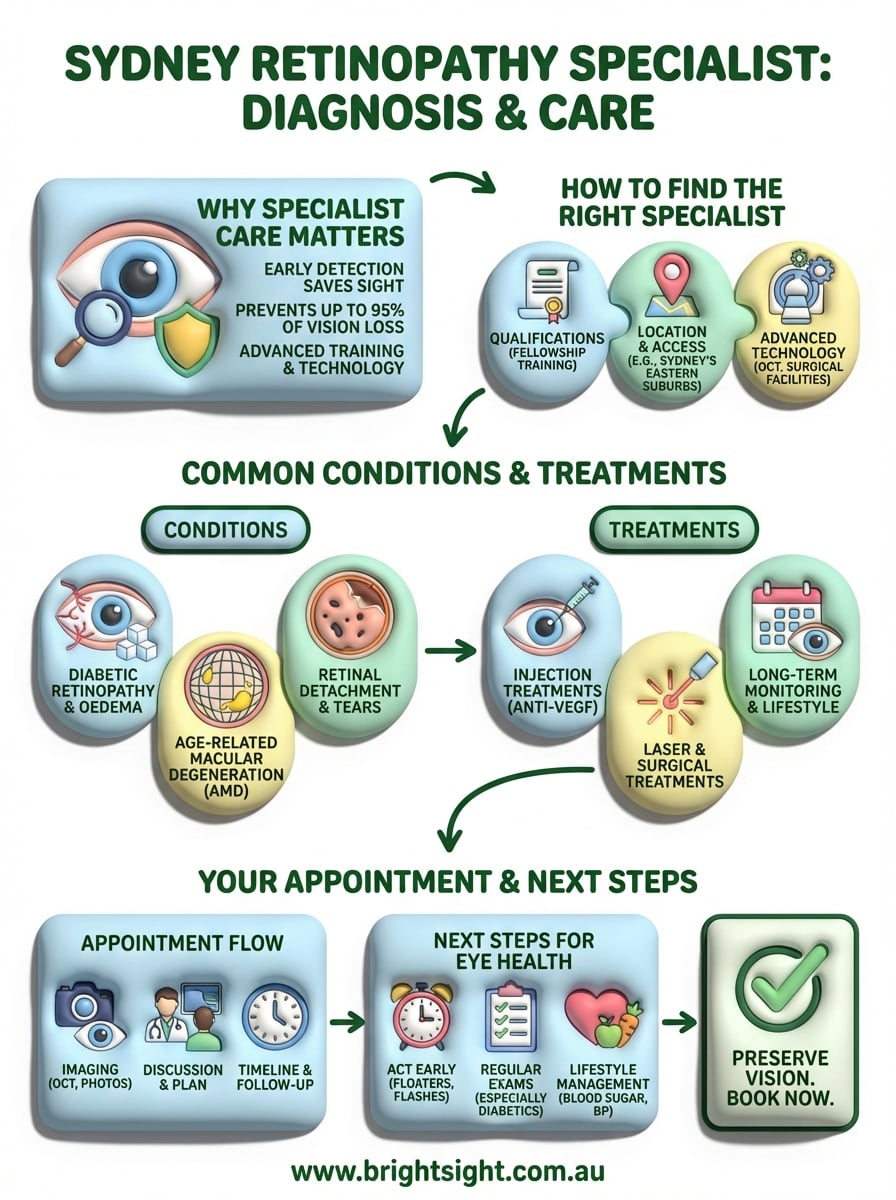
Why specialist retinopathy care matters
Your retina is one of the most complex and delicate structures in your body. When problems develop here, general eye care isn’t enough to prevent permanent damage. A retinopathy specialist has the advanced training, equipment, and experience needed to diagnose subtle changes early and provide targeted treatments that can save your sight. Many retinal conditions progress quickly, so expert intervention at the right time makes all the difference between preserving your vision and facing irreversible loss.
The risk of vision loss without expert care
Retinal diseases often develop without obvious symptoms in their early stages. You might not notice anything wrong until significant damage has already occurred to your central or peripheral vision. By the time you see blurred spots, floaters, or dark areas, the condition may have progressed to a stage that’s harder to treat. A retinopathy specialist uses specialized imaging technology to detect problems months or even years before you’d notice them yourself, giving you the best chance of successful treatment.
Early detection and specialist care can prevent up to 95% of vision loss from diabetic retinopathy.
Specialist training makes the difference
Your retinopathy specialist completes years of additional fellowship training beyond standard ophthalmology qualifications. This intensive education focuses specifically on medical and surgical retina care, including the latest injection techniques, laser treatments, and vitreoretinal surgery. They work with conditions that general ophthalmologists rarely see, building expertise through high-volume practice. Equipment in a specialist clinic includes optical coherence tomography (OCT) scanners and fundus cameras that provide detailed images of your retinal layers. This combination of advanced training and technology means you receive care based on the most current research and proven outcomes.
How to find the right retina specialist
Finding the right retina specialist in Sydney requires research and careful consideration of several key factors. You need someone with proven expertise in retinal conditions, access to advanced diagnostic equipment, and a practice that matches your needs for location and appointment availability. The choices you make now will affect your treatment outcomes and long-term vision health, so it’s worth taking time to evaluate your options thoroughly. Your GP or optometrist may provide a referral, but you can also research specialists independently to find the best fit for your situation.
Check qualifications and fellowship training
Start by verifying that any specialist you consider has completed fellowship training specifically in medical and surgical retina. This advanced training goes beyond standard ophthalmology qualifications and focuses exclusively on retinal conditions. Look for specialists who trained at recognized institutions like Moorfields Eye Hospital in London or major Australian teaching hospitals. You can check their credentials through the Royal Australian and New Zealand College of Ophthalmologists (RANZCO) website, which lists qualified specialists and their areas of expertise.
Experience matters significantly when treating complex retinal conditions. Ask how many procedures the specialist performs each year for your specific condition. Someone who treats dozens of cases monthly will have better outcomes than a generalist who occasionally handles retinal problems. Most specialists list their training background and areas of focus on their practice websites, making it easier to compare options before booking.
Consider location and accessibility
Location affects both your initial visits and ongoing care requirements. Many retinal conditions need regular monitoring and follow-up treatments, so choosing a practice near your home or workplace saves time and reduces stress. Sydney’s Eastern Suburbs, for example, offer several specialist clinics that serve surrounding areas including Randwick, Maroubra, Kensington, and Bondi.
Think about parking availability, public transport options, and whether the practice has accessible facilities if you have mobility concerns. Some specialists also offer telehealth consultations for follow-up appointments, which can reduce the number of in-person visits you need. However, your first appointment will always require an in-person examination with specialized equipment.
Evaluate technology and facilities
Modern retinal care depends on advanced imaging technology to diagnose and monitor conditions accurately. When researching specialists, check whether their practice has optical coherence tomography (OCT) scanners, fundus photography, and fluorescein angiography equipment. These tools allow your specialist to see detailed cross-sections of your retinal layers and detect problems that wouldn’t show up in a standard eye exam.
The latest OCT technology can detect retinal changes as small as 5 micrometres, helping specialists catch problems months before symptoms appear.
Your specialist should also have on-site surgical facilities or close partnerships with day surgery centres if you need procedures like vitrectomy or laser treatment. This integration means smoother care transitions and better coordination between your diagnostic appointments and any required procedures.
Review patient feedback and communication style
Look for reviews that mention how well the specialist explains treatment options and involves patients in decision-making. You want someone who takes time to answer your questions and discusses the risks and benefits of different approaches clearly. Many practices now have Google reviews where previous patients share their experiences with both the specialist and support staff.
Consider booking a consultation to assess whether you feel comfortable and confident with the specialist’s communication style. Your retinopathy specialist will be your partner in managing your eye health for potentially years to come, so finding someone you trust makes a real difference to your treatment experience.
Common conditions a retinopathy specialist treats
A retinopathy specialist diagnoses and manages a wide range of conditions that affect your retina and macula. These conditions vary from slowly progressive diseases like macular degeneration to sudden emergencies like retinal detachment that require immediate intervention. Understanding the most common retinal conditions helps you recognize symptoms early and seek specialist care before permanent damage occurs. Your specialist uses advanced imaging and treatment techniques specifically designed for each type of retinal problem.
Diabetic retinopathy and diabetic macular oedema
Diabetes damages the tiny blood vessels in your retina over time, causing them to leak fluid or bleed. This condition, called diabetic retinopathy, affects more than 30% of people who have had diabetes for over 20 years. Early stages may not cause noticeable symptoms, but your specialist can detect changes during a dilated eye exam with OCT imaging. Regular screening catches problems before they affect your central vision.
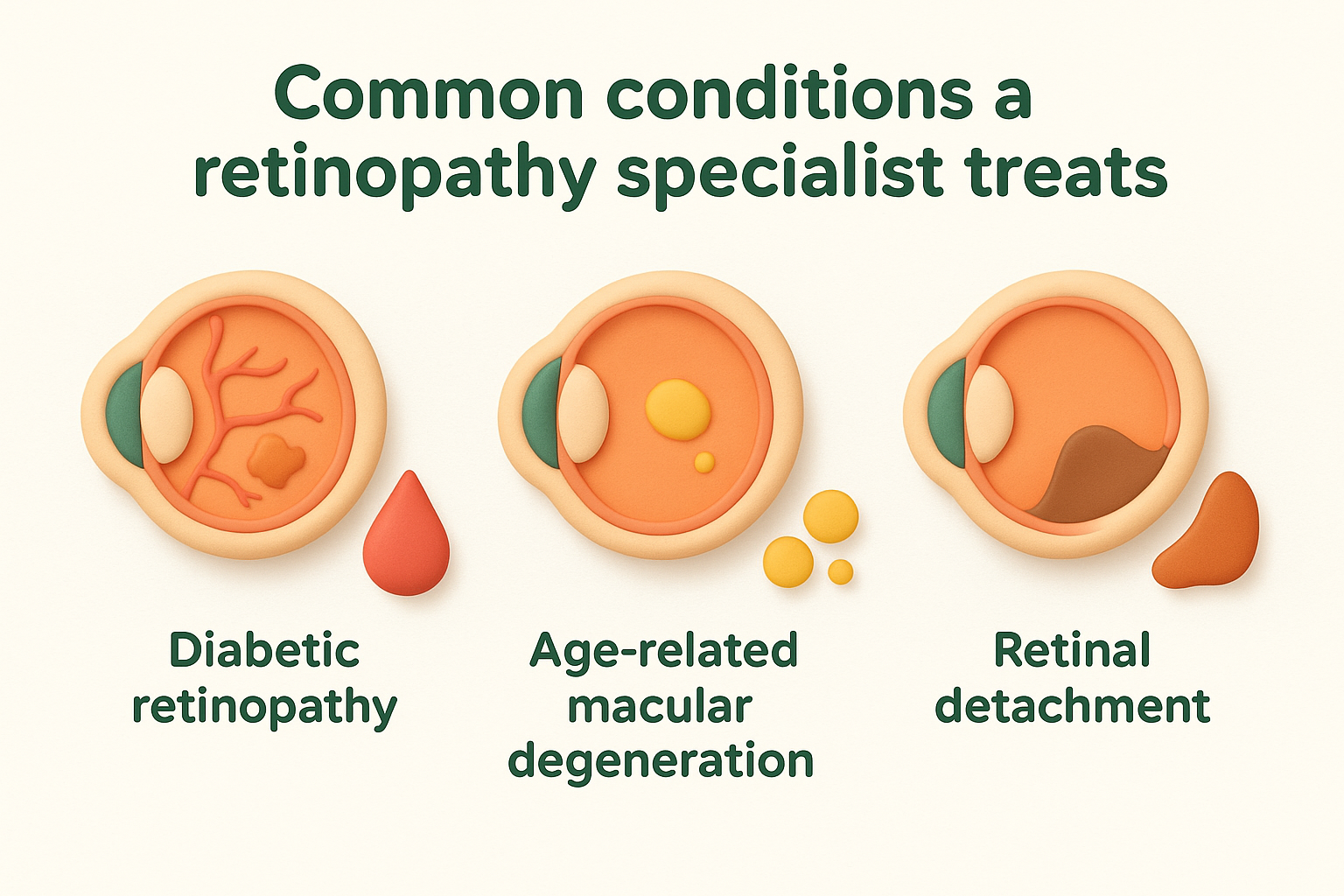
When fluid accumulates in your macula (the centre of your retina), you develop diabetic macular oedema. This causes blurred or distorted central vision that makes reading and recognizing faces difficult. Your specialist treats this condition with intravitreal injections of anti-VEGF medications, which reduce swelling and prevent further blood vessel leakage. Some patients also benefit from focal laser treatment to seal leaking vessels. Most people need multiple injections over months or years to maintain stable vision.
Age-related macular degeneration
Age-related macular degeneration (AMD) affects your central vision by damaging the macula. The dry form progresses slowly through accumulation of yellow deposits called drusen under your retina. Your specialist monitors dry AMD with regular OCT scans and recommends specific vitamin supplements that may slow progression. Lifestyle changes like stopping smoking and protecting your eyes from UV light also help.
Wet AMD develops when abnormal blood vessels grow under your macula and leak fluid or blood. This form progresses rapidly and causes sudden vision changes like straight lines appearing wavy or dark spots in your central vision. Your specialist treats wet AMD with anti-VEGF injections given every four to twelve weeks, depending on how your condition responds. Early treatment prevents severe vision loss in most cases.
Without treatment, wet AMD can cause legal blindness within months, but regular injections preserve reading vision in over 90% of patients.
Retinal detachment and tears
Your retina can develop tears or holes when the vitreous gel inside your eye pulls away from the retinal surface. You might notice sudden flashes of light or a dramatic increase in floaters. Small tears don’t always cause symptoms immediately, but they create a high risk of retinal detachment if fluid seeps underneath. Your specialist seals tears with laser treatment or cryotherapy before detachment occurs.
Retinal detachment happens when fluid separates your retina from the supporting tissue underneath. This creates a shadow or curtain across your vision that expands if left untreated. Complete detachment causes permanent vision loss in the affected area, so you need emergency surgery within days. Your specialist performs vitrectomy surgery to reattach your retina and restore as much vision as possible. Recovery takes several weeks, but early intervention gives you the best outcome.
What to expect at your retina appointment
Your first visit to a retinopathy specialist typically takes 60 to 90 minutes and involves several diagnostic tests before you meet with the doctor. The practice staff will dilate your pupils with eye drops, which takes about 20 minutes to work fully. This dilation allows your specialist to examine the entire retina and detect problems that wouldn’t be visible through an undilated pupil. You’ll experience blurred vision and light sensitivity for three to six hours after dilation, so bring sunglasses and arrange transport home if possible.
Initial diagnostic testing and imaging
Your appointment begins with detailed imaging scans that create a comprehensive picture of your retinal health. The optical coherence tomography (OCT) scan takes cross-sectional images of your retinal layers, similar to how an MRI works for other body parts. This test is completely painless and takes only a few minutes per eye. Staff may also perform fundus photography to document the appearance of your retina and create a baseline for future comparisons.

Some conditions require additional testing like fluorescein angiography, where a dye injected into your arm travels to your eye’s blood vessels. This test shows your specialist exactly where blood vessels are leaking or blocked. The imaging process happens before you meet with your specialist, so they have all your results ready for discussion.
Discussion with your specialist
Your retinopathy specialist reviews all test results with you and explains any problems they’ve found using images from your scans. They’ll show you exactly where disease or damage appears in your retina and discuss how it affects your vision. This conversation covers your treatment options, expected outcomes, and the timeline for any procedures you might need. Your specialist answers questions about risks, benefits, and alternatives to help you make informed decisions about your care.
Most patients find seeing their own retinal scans helps them understand their condition better than verbal explanations alone.
Timeline and follow-up requirements
Before you leave, you’ll schedule any necessary treatment appointments and future monitoring visits. Many retinal conditions require regular follow-up scans every three to six months, even when your vision feels stable. Your specialist’s team provides clear instructions about medication schedules if you need injections, and they explain warning signs that require immediate contact outside your scheduled appointments.
Treatment options and ongoing eye care
Your retinopathy specialist tailors treatment to your specific condition, focusing on stopping disease progression and preserving your functional vision. Most treatments aim to control underlying causes rather than cure retinal diseases completely, which means you’ll need ongoing care to maintain results. Modern retinal treatments have transformed outcomes for conditions that once led inevitably to blindness, giving you realistic hope for keeping the vision you need for daily activities. Understanding your treatment options helps you commit to the long-term care plan your specialist recommends.
Injection treatments for retinal conditions
Anti-VEGF injections form the primary treatment for wet macular degeneration, diabetic macular oedema, and retinal vein occlusion. Your specialist injects medication directly into your eye using a very fine needle after numbing the surface with drops. The injection itself takes only seconds and feels like brief pressure rather than pain. These medications stop abnormal blood vessel growth and reduce fluid leakage that damages your macula.
Treatment schedules vary depending on how your condition responds. You might need injections every four to eight weeks initially, then less frequently once your condition stabilizes. Your specialist monitors your response through OCT scans at each visit and adjusts timing based on whether fluid reappears. Most patients find the injection process becomes routine after the first few treatments, and the vision benefits far outweigh any temporary discomfort.
Laser and surgical treatments
Laser photocoagulation seals leaking blood vessels in diabetic retinopathy and treats retinal tears before they progress to detachment. Your specialist applies focused laser energy to specific areas of your retina during an office visit. The treatment takes 15 to 30 minutes and requires only numbing drops. You’ll see bright flashes during the procedure, but you won’t feel pain.

Vitrectomy surgery removes blood or scar tissue from inside your eye and repairs more complex problems like retinal detachment or macular holes. Your specialist performs this microsurgical procedure under local or general anaesthesia in a day surgery centre. Recovery takes several weeks, during which you may need to maintain specific head positions to help your retina heal properly. Your specialist provides detailed post-operative instructions and monitors your healing through regular follow-up appointments.
Combining injection therapy with lifestyle changes like blood sugar control doubles your chances of maintaining stable vision long-term.
Long-term monitoring and lifestyle adjustments
Regular monitoring appointments let your specialist detect changes before symptoms worsen and adjust treatment as needed. Your follow-up schedule depends on your condition’s stability, ranging from monthly visits during active treatment to six-monthly checks once controlled. Consistent attendance at these appointments prevents vision loss that occurs when people skip monitoring.
Lifestyle factors significantly affect your retinal health and treatment outcomes. Controlling blood sugar and blood pressure slows diabetic retinopathy progression, while stopping smoking reduces your risk of macular degeneration advancing. Your retinopathy specialist works with your GP or endocrinologist to coordinate the medical care that protects your vision alongside specific eye treatments.
Next steps for your eye health
Taking action now protects your vision for years to come. If you’re experiencing symptoms like floaters, flashes, or changes in your vision, book an appointment with a retinopathy specialist immediately rather than waiting for your routine check-up. Early intervention makes the crucial difference between preserving your sight and facing permanent loss that affects your quality of life.
Schedule regular eye examinations even when your vision seems fine, particularly if you have diabetes, high blood pressure, or a family history of retinal conditions. Your optometrist or GP can refer you to a specialist, or you can contact a retina practice directly to arrange a comprehensive assessment. Bright Sight Eye Specialists offers expert retinal care in Sydney’s Eastern Suburbs, with advanced diagnostic technology and transparent pricing for both insured and uninsured patients.