


When your optometrist or GP mentions you need retinal laser treatment, it’s natural to have questions. What exactly does the procedure involve? Will it hurt? How long until you’re back to normal? These concerns are completely valid, and understanding what lies ahead can make all the difference in how you approach your care.
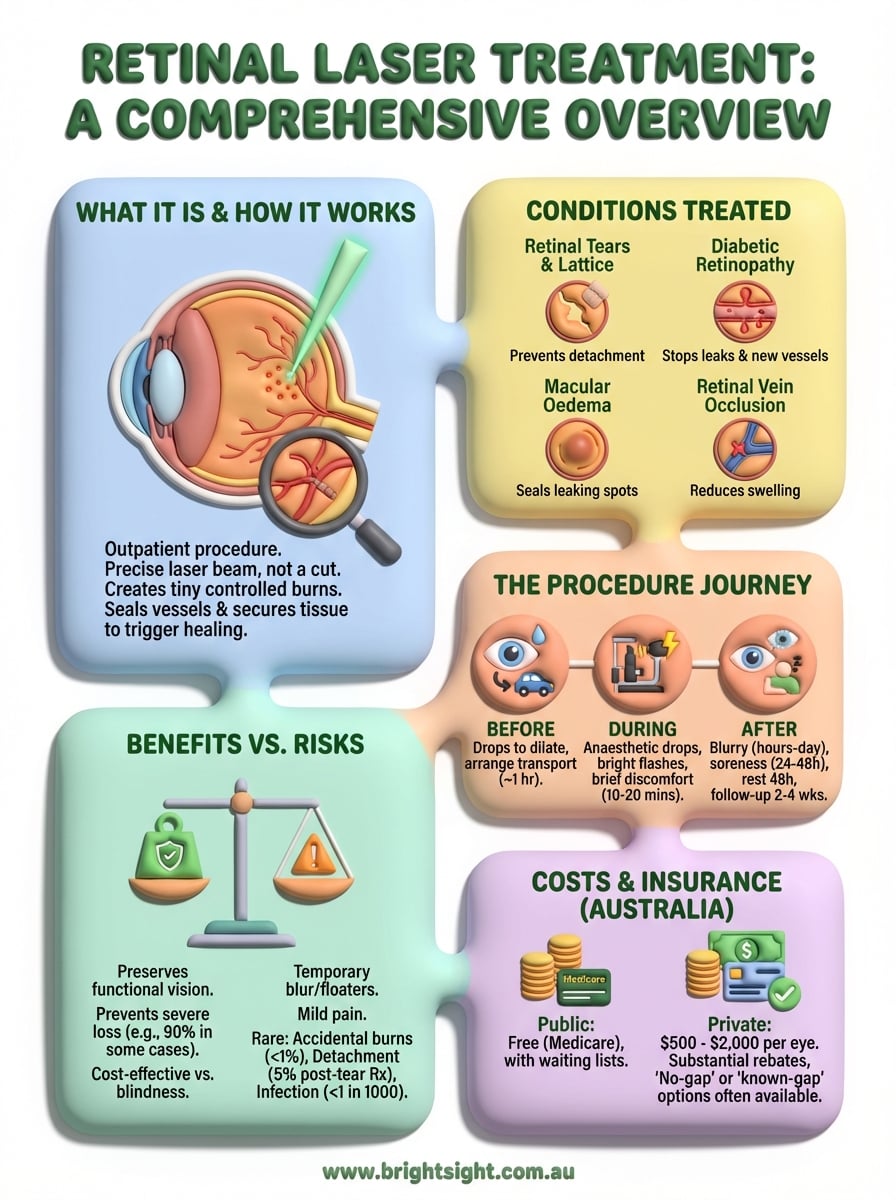
Retinal laser is a precise, outpatient procedure used to address several sight-threatening conditions, from retinal tears and diabetic retinopathy to certain complications of macular degeneration. The laser creates tiny, controlled burns that seal damaged blood vessels or secure weakened retinal tissue, helping to preserve your vision before problems escalate.
At Bright Sight Eye Specialists, Dr. Rahul Dubey performs retinal laser procedures regularly as part of our comprehensive retinal and macular services in Randwick, Sydney. With training from Moorfields Eye Hospital and a commitment to patient-centred care, we believe clear information helps you feel confident about your treatment decisions.
This guide covers everything you need to know, how the procedure works, which conditions it treats, potential risks and benefits, what recovery looks like, and the costs you can expect. By the end, you’ll have a thorough understanding of retinal laser treatment from start to finish.
Why retinal laser matters for saving vision
Your retina sits at the back of your eye, capturing light and sending visual signals to your brain. Once damaged, retinal tissue cannot regenerate or repair itself, unlike skin or bone. This makes early intervention with retinal laser absolutely critical for conditions that threaten your sight.
Without timely treatment, retinal tears can progress to full retinal detachment within days or weeks. Diabetic retinopathy can silently steal your vision while abnormal blood vessels leak and bleed. Retinal vein occlusions can cause permanent damage as fluid builds up in your macula. Each of these conditions follows a predictable path towards irreversible vision loss if left untreated.
Retinal laser works by creating controlled damage that triggers healing in the right places, preventing far worse damage from occurring naturally.
The procedure has preserved sight for millions of people worldwide since its development in the 1960s. Research shows that timely laser treatment reduces the risk of severe vision loss by up to 90% in certain diabetic retinopathy cases. For retinal tears, the success rate for preventing detachment exceeds 95% when caught early.
The retina doesn’t heal on its own
Most parts of your body have remarkable healing abilities. Cut your skin, and new cells grow to close the gap. Break a bone, and it knits back together over weeks. Your retina works differently. The specialised cells that detect light, called photoreceptors, cannot regenerate once destroyed.
This biological limitation means that waiting is rarely a good strategy with retinal problems. A small tear won’t shrink or seal itself. Leaking blood vessels in diabetic retinopathy won’t spontaneously stop bleeding. The damage accumulates, and each day of delay allows the problem to spread.
Retinal laser provides what your eye cannot do naturally. The controlled burns created by the laser cause scar tissue to form, which bonds weakened areas of retina to the underlying tissue. For abnormal blood vessels, the laser seals them shut, stopping leaks before fluid floods your macula. These interventions work because they harness your body’s healing response in a targeted way.
When timing makes the difference between sight and blindness
Some retinal conditions give you weeks or months to act. Others demand immediate attention to prevent catastrophic vision loss. Retinal tears discovered during a routine examination often fall into the first category. Your specialist can schedule laser treatment within days, securing the tear before it progresses.
Acute symptoms change the timeline completely. Sudden flashes of light, a shower of new floaters, or a curtain descending across your vision may signal retinal detachment in progress. Hours matter in these situations. The longer your retina remains detached, the more photoreceptors die from lack of oxygen and nutrients.
Diabetic retinopathy follows a more gradual course, but still has critical windows for intervention. Once the condition reaches the proliferative stage, with new abnormal blood vessels growing across your retina, the risk of bleeding and scarring climbs sharply. Laser treatment at this stage can prevent up to 50% of severe vision loss cases.
Prevention costs less than blindness
Beyond the obvious benefit of keeping your sight, retinal laser makes economic sense compared to the alternatives. The procedure typically costs between $500 and $2,000 per eye in Australia, depending on the extent of treatment needed. This represents a fraction of the lifetime costs associated with vision loss.
Severe vision impairment brings ongoing expenses that add up quickly. Mobility aids, modifications to your home, assistance with daily tasks, and loss of independence all carry financial and emotional costs. Studies estimate the lifetime cost of blindness exceeds $700,000 per person when accounting for medical care, lost productivity, and support services.
Most importantly, you cannot put a price on functional vision for the activities that matter to you. Reading, driving, recognising faces, and maintaining your independence all depend on healthy retinas. Retinal laser offers a straightforward path to protecting these abilities before damage becomes permanent.
How retinal laser works inside the eye
Your eye surgeon uses a highly focused beam of light to create controlled burns on specific areas of your retina. These burns measure just microns across, smaller than the width of a human hair, yet they produce precise therapeutic effects. The laser doesn’t cut tissue like a surgical blade. Instead, it delivers concentrated energy that heats and coagulates targeted cells, triggering a healing response exactly where your retina needs reinforcement.

During the procedure, you sit at a slit lamp, the same equipment your optometrist uses for routine examinations. A special contact lens placed on your eye helps focus the laser beam and keeps your eye steady. Each laser pulse lasts mere fractions of a second, creating a tiny spot of scar tissue. Your surgeon applies hundreds or even thousands of these spots in a single session, building a protective barrier or sealing off problematic blood vessels.
The science behind laser burns that heal
The laser beam converts light energy into heat at the exact point it strikes your retinal tissue. This heat causes proteins in the cells to denature and coagulate, similar to how egg whites turn solid when heated. The process creates a permanent bond between your retina and the underlying layers of your eye wall.
The controlled scarring from retinal laser treatment prevents larger, uncontrolled damage from spreading.
For retinal tears, these bonds act like spot welds around the tear’s edges, preventing fluid from seeping underneath and causing detachment. The scar tissue forms within days of treatment and continues strengthening over several weeks. Your body recognises these burns as areas requiring repair, sending healing cells to seal everything together permanently.
Different types of laser for different problems
Two main laser types dominate retinal treatment: argon lasers emit blue-green light that blood vessels and pigmented retinal cells absorb readily, making them ideal for sealing leaking vessels in diabetic retinopathy. YAG lasers deliver infrared energy that penetrates deeper, useful for creating stronger bonds in lattice degeneration or securing retinal tears.
Panretinal photocoagulation, a specific laser pattern, treats advanced diabetic retinopathy by applying 1,200 to 2,000 burns across your peripheral retina. This deliberately destroys oxygen-starved tissue that would otherwise stimulate abnormal blood vessel growth. Focal laser treatment uses just a few dozen precise burns to seal specific leaking spots in your macula. Your specialist selects the appropriate laser type and pattern based on your specific condition and the results they need to achieve.
Conditions retinal laser treats and why it helps
Retinal laser addresses several distinct conditions, each threatening your sight through different mechanisms. Understanding which problem you face helps explain why your specialist recommends this particular treatment. The procedure works because it prevents progression rather than reversing existing damage, making early diagnosis and prompt treatment crucial for the best outcomes.

Your retina specialist typically recommends laser treatment for five main categories of conditions. Some require immediate intervention to prevent catastrophic vision loss, whilst others benefit from planned treatment that stops gradual deterioration. Each condition responds to laser in specific ways, targeting the underlying problem rather than just managing symptoms.
Retinal tears and lattice degeneration
Retinal tears occur when the vitreous gel inside your eye pulls away from the retina, creating a horseshoe-shaped or flap-like opening. These tears allow fluid to seep underneath your retina, potentially causing detachment within days. Laser treatment creates a barrier of scar tissue around the tear, bonding your retina to the wall of your eye and preventing fluid from spreading.
Lattice degeneration appears as thin patches of retina with a criss-cross pattern of blood vessels. These weakened areas carry a higher risk of developing tears, particularly if you experience trauma or sudden vitreous changes. Preventive laser treatment reinforces these thin spots before tears develop, reducing your detachment risk by up to 95%.
Laser treatment for retinal tears works best when performed within days of diagnosis, before fluid accumulation begins.
Diabetic retinopathy and macular oedema
Diabetes damages the tiny blood vessels feeding your retina, causing them to leak fluid and bleed. Advanced diabetic retinopathy triggers the growth of abnormal new vessels that haemorrhage easily and pull on your retina through scar tissue. Panretinal photocoagulation uses hundreds of laser burns across your peripheral retina, deliberately reducing oxygen demand and stopping new vessel formation.
Focal laser treatment targets specific leaking spots in your macula, the central part of your retina responsible for detailed vision. This approach seals individual microaneurysms and leaking vessels, preventing fluid accumulation that blurs your central sight. Studies show focal laser reduces vision loss by 50% in patients with clinically significant macular oedema.
Retinal vein occlusion and other conditions
When a vein in your retina becomes blocked, blood and fluid back up, causing swelling and bleeding throughout the affected area. Laser treatment reduces this oedema by sealing leaking vessels and preventing abnormal blood vessel growth in oxygen-starved regions. Central vein occlusions affecting your entire retina may require extensive panretinal photocoagulation, whilst branch occlusions need more limited treatment.
Less common conditions like central serous retinopathy occasionally respond to targeted laser burns that seal specific leaking points beneath your retina. Your specialist evaluates each condition individually, determining whether retinal laser offers the best chance of preserving your functional vision long-term.
What to expect before, during, and after treatment
Retinal laser treatment happens as an outpatient procedure, meaning you arrive at the clinic, have your treatment, and return home the same day. The entire visit typically takes 60 to 90 minutes from check-in to departure, though the actual laser application lasts only 10 to 20 minutes. Understanding each stage helps you prepare mentally and practically for what lies ahead.
Pre-treatment preparation and what brings you in
Your specialist dilates your pupils with eye drops 30 to 60 minutes before the procedure begins, allowing clear visualisation of your entire retina. These drops blur your near vision temporarily and make your eyes sensitive to light, so bring sunglasses for the journey home. You can eat and drink normally beforehand unless your specialist gives specific instructions otherwise.
Plan for someone to drive you home after treatment, as your dilated pupils and potential temporary vision changes make driving unsafe for several hours. The drops typically wear off within four to six hours, though some people experience effects lasting into the evening. Wear comfortable clothing and expect to sit still at the slit lamp for 15 to 30 minutes during the actual laser application.
The treatment session from start to finish
Your surgeon places anaesthetic drops in your eye to prevent discomfort, then positions a special contact lens against your cornea to focus the laser beam. This lens feels slightly unusual but doesn’t hurt. You rest your chin and forehead against the slit lamp supports, just as you would during a routine eye examination.
Most patients describe retinal laser as uncomfortable rather than painful, with brief flashes of light and occasional stinging sensations.
During treatment, you see bright flashes with each laser pulse and may feel mild stinging or aching. The sensation varies depending on where your specialist applies the laser, with peripheral treatments generally causing less discomfort than those near your macula. Your surgeon pauses periodically if you need to blink or rest, and the entire process remains under your specialist’s constant control.
Recovery timeline and activity restrictions
Immediately after treatment, your vision appears blurry and hazy from the dilating drops, contact lens gel, and inflammation caused by the laser burns. This clears within several hours to a day for most people. Your eye may feel mildly sore or gritty for 24 to 48 hours, similar to having something in your eye.
Avoid heavy lifting, strenuous exercise, and bending for 48 hours after treatment to prevent increased eye pressure. You can return to desk work the next day in most cases, though driving requires waiting until your vision stabilises completely. Your specialist schedules a follow-up examination within two to four weeks to assess how well your retina has responded to treatment and determine whether additional laser sessions are necessary.
Risks, side effects, and when to seek urgent help
Retinal laser carries a strong safety record built over six decades of use, with serious complications occurring in fewer than 1 in 100 cases. However, no medical procedure comes without risks, and understanding what to expect helps you distinguish between normal healing responses and warning signs that require immediate attention. Your specialist should explain these risks during your consultation, ensuring you make an informed decision about proceeding with treatment.
Common side effects you’ll likely experience
Your vision will appear blurry and distorted for several hours after treatment, caused partly by the dilating drops and partly by temporary inflammation in your retina. This clears within 24 hours for most people. You might notice new floaters or dark spots drifting across your vision as your eye heals, particularly if your surgeon applied extensive laser burns. These typically fade over weeks as your brain adapts.
Mild discomfort ranging from a scratchy sensation to dull aching affects roughly half of patients during the first day after treatment. This responds well to over-the-counter pain relievers like paracetamol. Your peripheral vision may feel slightly reduced or narrowed following panretinal photocoagulation for diabetic retinopathy, as the laser deliberately destroys some outer retinal tissue to protect your central sight.
Minor side effects from retinal laser treatment usually resolve within days to weeks without requiring additional intervention.
Rare but serious complications that need monitoring
Accidental laser burns to your central macula can occur if you move suddenly during treatment or if targeting proves difficult. This happens in fewer than 1% of cases but can cause permanent central vision loss. Your surgeon minimises this risk through careful technique and by asking you to hold still during critical moments.
Bleeding inside your eye develops occasionally when the laser hits a blood vessel directly, creating temporary vision cloudiness that clears as your body absorbs the blood over several weeks. Retinal detachment remains a possibility even after successful laser treatment for tears, with a 5% risk in the first year following treatment. Infection represents an extremely rare complication, affecting fewer than 1 in 1,000 patients.
Warning signs that require immediate medical attention
Contact your specialist within 24 hours if you experience sudden vision loss, a dramatic increase in floaters, or flashes of light that persist beyond the first day after treatment. These symptoms may signal retinal detachment requiring urgent intervention. A curtain or shadow spreading across your visual field demands immediate attention, as does severe eye pain that doesn’t respond to paracetamol.
Watch for redness, discharge, or swelling that worsens after the first 48 hours, as these signs suggest infection. Your specialist provides emergency contact details at discharge, ensuring you can reach help quickly if concerning symptoms develop outside normal clinic hours.
Costs in Australia and how to choose a specialist
Retinal laser treatment costs vary significantly across Australia, ranging from $500 to $2,000 per eye depending on the complexity of your condition and where you receive care. Understanding these costs upfront and knowing what to look for in a specialist helps you make informed decisions about your eye health without financial surprises. The investment proves worthwhile when you consider the alternative costs of untreated retinal conditions and potential vision loss.
What retinal laser costs in different settings
Public hospital systems in Australia provide retinal laser treatment free of charge through Medicare, though waiting lists can extend from several weeks to months depending on the urgency of your condition. Private specialists typically charge between $1,200 and $2,000 for comprehensive retinal laser procedures, with simpler treatments for single retinal tears costing closer to $500 to $800 per eye.
The quoted price usually covers your consultation, the laser procedure, and follow-up examination within the first month after treatment. Additional costs arise if you need multiple treatment sessions or develop complications requiring further intervention. Some clinics itemise fees separately for the consultation, procedure, and facility use, whilst others provide all-inclusive pricing that covers everything upfront.
Insurance coverage and gap payments
Private health insurance policies with appropriate optical or hospital cover typically provide substantial rebates for retinal laser treatment, reducing your out-of-pocket costs significantly. Most specialist eye surgeons work with insurance funds to offer no-gap or known-gap arrangements for eligible patients, meaning you pay nothing or a predictable, limited amount towards the procedure.
Confirm your specific out-of-pocket costs before proceeding with treatment, as gap amounts vary between specialists and insurance policies.
Contact your insurer directly to verify your coverage level and any waiting periods that might apply. Some policies require 12 months of continuous cover before you can claim benefits for eye procedures. At Bright Sight Eye Specialists, we provide transparent pricing and work with your insurance fund to clarify costs before your treatment date.
Finding a qualified retinal specialist
Look for an ophthalmologist with subspecialist training in retinal and vitreoretinal surgery, as these specialists complete additional fellowship training beyond standard ophthalmology qualifications. Dr. Rahul Dubey trained at Moorfields Eye Hospital in London, one of the world’s leading centres for retinal surgery, bringing international expertise to his practice in Randwick.
Ask potential specialists about their experience with your specific condition and how many similar procedures they perform annually. Higher procedure volumes generally correlate with better outcomes and fewer complications. Check whether the specialist uses modern laser equipment and maintains active involvement in continuing education. Your GP or optometrist can provide referrals, but you maintain the right to choose any specialist who meets your needs and accepts your insurance arrangements.
A simple way to decide what to do next
Your next steps depend entirely on where you stand with your eye health right now. If your optometrist or GP has already diagnosed a retinal condition requiring laser treatment, schedule your procedure as soon as your specialist recommends. Delays allow small problems to escalate into serious complications that threaten permanent vision loss, and your retina cannot heal itself without intervention.
Perhaps you’re experiencing warning symptoms like sudden flashes of light, a shower of new floaters, or shadowy areas creeping across your peripheral vision. These signs demand urgent attention from a retinal specialist within 24 to 48 hours. Early detection makes the difference between straightforward retinal laser treatment and complex vitreoretinal surgery later.
If you need clarity about your diagnosis or want a second opinion on recommended treatment, consulting an experienced retinal surgeon provides the expert guidance you deserve. At Bright Sight Eye Specialists in Randwick, Dr. Rahul Dubey offers comprehensive retinal and macular services with transparent pricing and no-gap options for eligible patients.