


When your optometrist or GP refers you to a retina dr, the stakes feel high, and they are. The retina is responsible for converting light into the signals your brain reads as vision, so any condition affecting it demands a specialist who truly knows what they’re doing. Whether you’re dealing with macular degeneration, a retinal detachment, diabetic eye disease, or persistent floaters, the doctor you choose can directly influence your outcome and long-term sight.
Finding the right retina specialist in Sydney’s Eastern Suburbs shouldn’t be a guessing game. You need someone with verified surgical expertise, transparent communication about your diagnosis and costs, and a genuine focus on your comfort throughout treatment. That’s exactly the standard we hold at Bright Sight Eye Specialists in Randwick, where Dr. Rahul Dubey, fellowship-trained at London’s Moorfields Eye Hospital, provides advanced retinal and macular care backed by years of surgical experience.
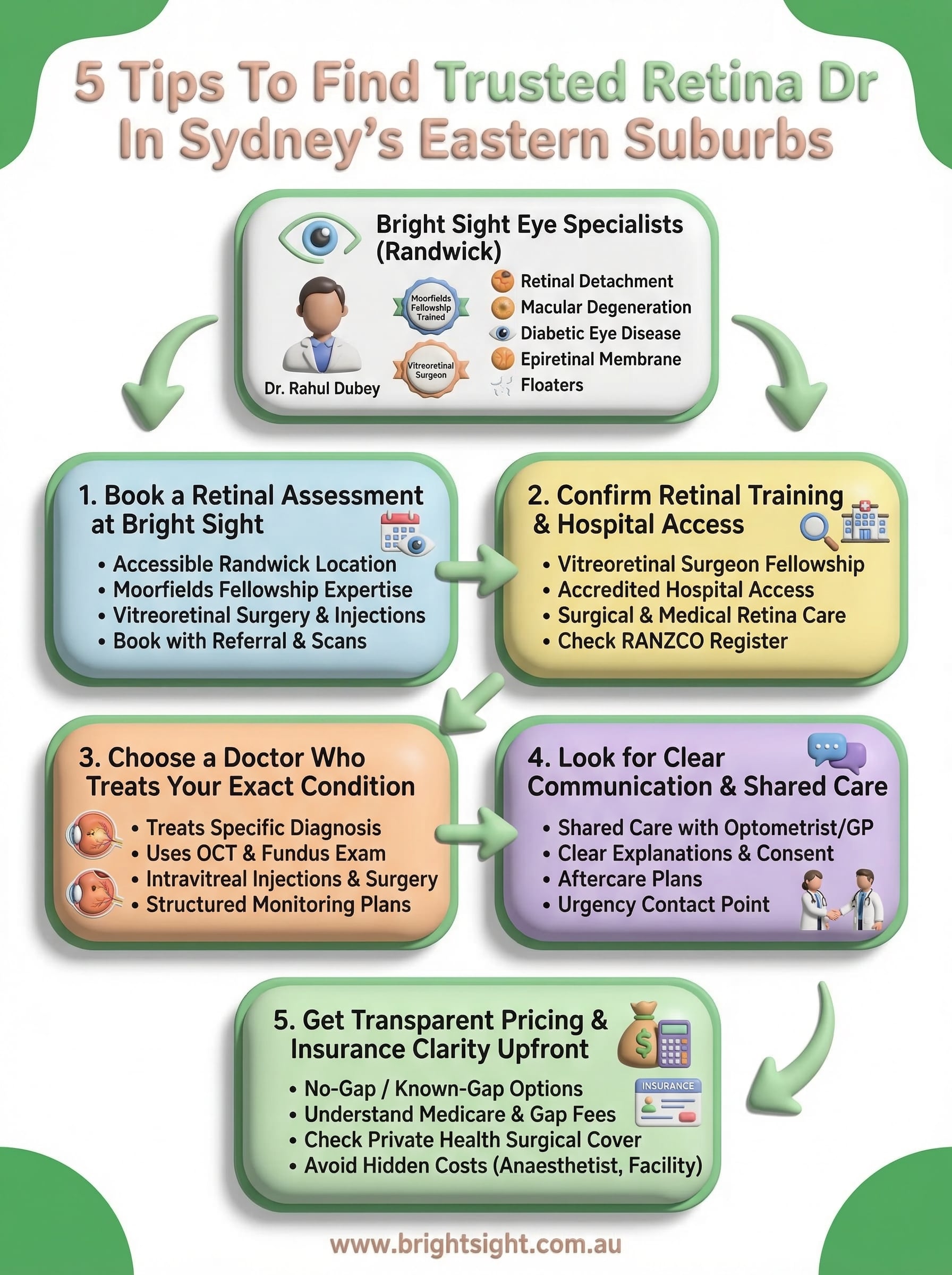
To help you make a confident, informed decision, here are five practical tips for finding a retina doctor you can trust in the Eastern Suburbs, whether you’ve been referred to us or you’re still weighing your options.
1. Book a retinal assessment at Bright Sight
If you’ve been referred to a retina dr or you’re noticing changes in your central or peripheral vision, Bright Sight Eye Specialists in Randwick is a well-equipped and accessible starting point for patients across Sydney’s Eastern Suburbs.
Why this is a strong first option in Randwick
Dr. Rahul Dubey completed his fellowship at Moorfields Eye Hospital in London, one of the world’s leading eye institutions. That background means you’re consulting a surgeon with dedicated retinal and macular expertise, not a general ophthalmologist managing these cases on the side.
Fellowship training at Moorfields is internationally recognised as one of the most rigorous pathways into vitreoretinal surgery.
Retina and macula conditions they treat
Bright Sight treats a broad range of retinal and macular conditions that affect patients at different life stages. The conditions covered include:

- Retinal detachment and retinal tears
- Age-related macular degeneration
- Diabetic retinopathy and diabetic eye disease
- Epiretinal membrane and macular hole
- Retinal vein occlusion and vitreous floaters
Treatments and procedures available
The practice delivers both vitreoretinal surgery and intravitreal injections, alongside laser treatment and structured monitoring programs for chronic conditions. Having surgical and medical retina options under one roof reduces the need for multiple referrals and keeps your care consistent.
How to book and what to bring to the visit
You can book through the Bright Sight website or by calling the practice directly. To make your first appointment as productive as possible, bring the following:
- Referral letter from your GP or optometrist
- Medicare card and private health insurance details
- Any existing OCT scans, fundus photographs, or imaging reports
2. Confirm retinal training and hospital access
Not every ophthalmologist specialises in retinal conditions, so confirming a retina dr’s specific training background before you book is worth the extra step.
What "retina specialist" should mean in Australia
In Australia, a vitreoretinal surgeon completes general ophthalmology training and then undertakes a competitive fellowship specifically in retina and vitreous surgery. This additional training typically runs one to two years and covers both surgical and medical retina management in depth.
Credentials to look for and how to verify them
Look for Fellowship of the Royal Australian and New Zealand College of Ophthalmologists (FRANZCO) as a baseline, plus documented subspecialty fellowship training in vitreoretinal surgery. You can ask the practice directly where and when that fellowship was completed, and cross-reference it with the RANZCO public register.
A surgeon’s fellowship location, particularly a world-recognised institution, tells you a great deal about the complexity and volume of cases they have managed.
Why operating rights and facilities matter
A retina surgeon needs accredited hospital or surgical centre access to perform procedures like vitrectomy or retinal detachment repair safely. Ask the practice which facilities your surgeon operates at before committing to a consultation.
When you need a vitreoretinal surgeon vs medical retina care
Some conditions, such as wet macular degeneration, are managed medically with regular intravitreal injections, while others, like retinal detachment, require surgical intervention. Knowing which category your condition falls into helps you confirm you are seeing the right subspecialist from the outset.
3. Choose a doctor who treats your exact condition
Retinal conditions vary widely, and so does the expertise required to treat them. Confirming that your retina dr manages your specific diagnosis is a practical step before booking a consultation.
Common retinal and macular problems people search for
Patients typically seek specialist care for retinal detachment, macular degeneration, diabetic retinopathy, epiretinal membrane, macular hole, retinal vein occlusion, and vitreous floaters. Each condition follows a different clinical path.
The tests a retina doctor uses to confirm a diagnosis
Your specialist will use optical coherence tomography (OCT) and dilated fundus examination as core diagnostic tools. Fluorescein angiography may also be ordered to map blood vessel activity across the retina.
Accurate imaging underpins every retinal diagnosis – without it, treatment decisions lack a reliable basis.
What treatment pathways look like for major conditions
Intravitreal injections manage wet macular degeneration and retinal vein occlusion, while vitreoretinal surgery addresses detachments, macular holes, and epiretinal membranes. Some conditions also require laser treatment as part of an integrated care plan.
What a good plan includes for monitoring and follow-up
A structured follow-up schedule is essential for chronic conditions like diabetic retinopathy. Your doctor should outline review intervals, repeat imaging timelines, and clear escalation criteria if your condition changes between appointments.
4. Look for clear communication and shared care
A trusted retina dr works collaboratively, not in isolation. Good communication across your care team and with you directly shapes both your confidence and your outcomes.
How good clinics work with your optometrist and GP
Strong practices send detailed correspondence back to your referring optometrist or GP after each visit. This shared care model keeps everyone aligned on your diagnosis, treatment progress, and any changes that need urgent attention.
Questions to ask about urgency and appointment timing
Ask the clinic how quickly they can see you if your symptoms worsen suddenly, and what their process is for urgent referrals like suspected retinal detachment. A responsive clinic gives you a direct contact point rather than a general waiting queue.
How to judge explanations, consent, and time in consults
Your surgeon should explain your diagnosis, treatment options, and risks in plain language before you consent to anything.
A thorough consult gives you time to ask questions. If you feel rushed or unclear about your next steps, that is worth noting before you proceed.
What aftercare should look like for injections and surgery
After intravitreal injections or surgery, you should receive written aftercare instructions and a clear follow-up schedule. Know exactly who to contact if you notice sudden vision changes between appointments.
5. Get transparent pricing and insurance clarity upfront
Retinal care can involve repeated visits, ongoing injections, and complex surgery, so understanding costs before you commit avoids unwelcome surprises. A practice that discusses pricing clearly from the outset signals that it respects your time and budget.
Typical cost buckets for retina care in Sydney
Retina costs in Sydney generally fall into three categories: diagnostic imaging and consultations, intravitreal injections, and surgical procedures. Injections are typically lower cost per visit but accumulate over months or years, while vitreoretinal surgery carries a higher single-episode cost.
What to ask about Medicare, item numbers, and gaps
Ask your retina dr which Medicare Benefits Schedule item numbers apply to your treatment and what the out-of-pocket gap will be. Knowing the gap figure upfront lets you budget accurately rather than estimate.
Bright Sight offers no-gap or known-gap options for insured patients across many procedures, so ask about this directly when you book.
Private health insurance questions for retinal surgery
Confirm your hospital cover tier and whether your policy includes the surgical facility your surgeon uses. Some policies exclude certain day-surgery centres.
How to compare quotes without missing key inclusions
When comparing costs, check whether anaesthetist fees, facility charges, and follow-up appointments are included. A lower headline figure sometimes excludes these, making the real cost higher than it first appears.
Next steps
Finding a trusted retina dr in Sydney’s Eastern Suburbs comes down to a few clear criteria: verified subspecialty training, the ability to treat your specific condition, transparent costs, and a care team that communicates well. These five tips give you a reliable framework to assess any specialist you’re considering, whether you’re acting on a referral or starting your search independently.
Bright Sight Eye Specialists in Randwick ticks each of these boxes. Dr. Rahul Dubey brings fellowship-level vitreoretinal expertise, and the practice offers straightforward pricing, shared care with your GP and optometrist, and appointments structured to give you real answers. If you’re ready to take the next step, book a consultation with our team and bring your referral letter, imaging results, and insurance details. The sooner you get a proper assessment, the more options you have for protecting your sight.