


If you’ve spent years reaching for glasses first thing in the morning or dealing with dry, irritating contact lenses, you’ve likely wondered whether there’s a better option. Refractive laser surgery reshapes the cornea to correct common vision errors, myopia (short-sightedness), hyperopia (long-sightedness), and astigmatism, so you can see clearly without relying on corrective lenses. It’s one of the most studied elective procedures in modern medicine, with millions performed worldwide each year.
But "laser eye surgery" isn’t a single procedure. LASIK, PRK, and SMILE each work differently, suit different eyes, and carry their own recovery profiles. Choosing the right one depends on your prescription, corneal thickness, lifestyle, and long-term goals. Not everyone is a suitable candidate, and understanding the eligibility criteria upfront saves time and prevents disappointment. Safety is also a fair concern, one we’ll address with current evidence rather than vague reassurances.
At Bright Sight Eye Specialists in Randwick, Dr Capucine Odouard performs refractive laser surgery at Sydney Surgical Centre and Sydney Eye Hospital, offering LASIK, PRK, and SMILE tailored to each patient’s eyes and daily life. This article covers how these procedures work, who they’re suited for, what the risks actually look like, and what to expect from consultation through to recovery.
Why refractive laser surgery matters
For most people, wearing glasses or contact lenses feels routine until they start adding up what it actually costs: money spent on frames, lenses, and solutions year after year, plus the everyday friction of fogged glasses, dry eyes from extended lens wear, and never quite seeing clearly the moment you wake up. Refractive laser surgery addresses the root cause of these problems rather than simply managing around them.
The ongoing cost of corrective lenses
Corrective lenses are not a one-time expense. A quality pair of prescription glasses in Australia typically costs between $300 and $800, and most people replace them every one to two years. Contact lens wearers spend roughly $400 to $600 annually on lenses and solutions alone. Over a decade, the combined outlay often exceeds the cost of laser surgery, without factoring in optometry appointments, lost or broken frames, or running out of lenses while travelling.
Refractive laser surgery is not just a cosmetic choice. For many patients, it becomes cost-effective within five to seven years compared with ongoing corrective lens expenses.
Beyond the financial side, dry eye from prolonged contact lens wear is one of the most common complaints optometrists hear from adults under 50. Soft lenses reduce oxygen flow to the cornea over time, and extended wear raises the risk of corneal infections. For people who exercise, swim, or work in screen-heavy environments, these limitations are real and daily.
What clear vision changes in practice
The shift most patients notice after refractive laser surgery is not dramatic in an obvious way, but it builds quickly. Waking up and reading a clock without reaching for glasses, driving at night without glare from outdated lenses, playing sport without contacts drying out mid-game. These are the practical changes that matter most.
Your daily routine becomes simpler in ways that compound over time. Overseas travel, early morning sport, working in dusty conditions, and even swimming all become less complicated without the need to manage lenses or keep a spare pair of glasses within reach.
How refractive laser surgery works
Your eye focuses light through the cornea and lens onto the retina at the back. When the cornea is too steep, too flat, or irregularly curved, light lands in front of or behind the retina, producing blurry vision. Refractive laser surgery corrects this by precisely reshaping the cornea so light focuses exactly where it needs to.
The role of the cornea
The cornea handles roughly 70% of your eye’s total focusing power, making it the primary target for correction. Its curvature determines how light bends as it enters the eye. A cornea that is too steep causes short-sightedness; one that is too flat causes long-sightedness. Astigmatism results from uneven curvature, where the cornea curves more steeply in one direction than another.
Reshaping the cornea, rather than placing a corrective lens in front of the eye, is what makes the improvement lasting rather than temporary.
What the laser does
A laser guided by detailed mapping of your eye’s surface removes tiny, precise amounts of corneal tissue in a pre-planned pattern. The full treatment takes only minutes per eye. Modern eye-tracking systems follow any small movements during treatment, maintaining accuracy throughout.
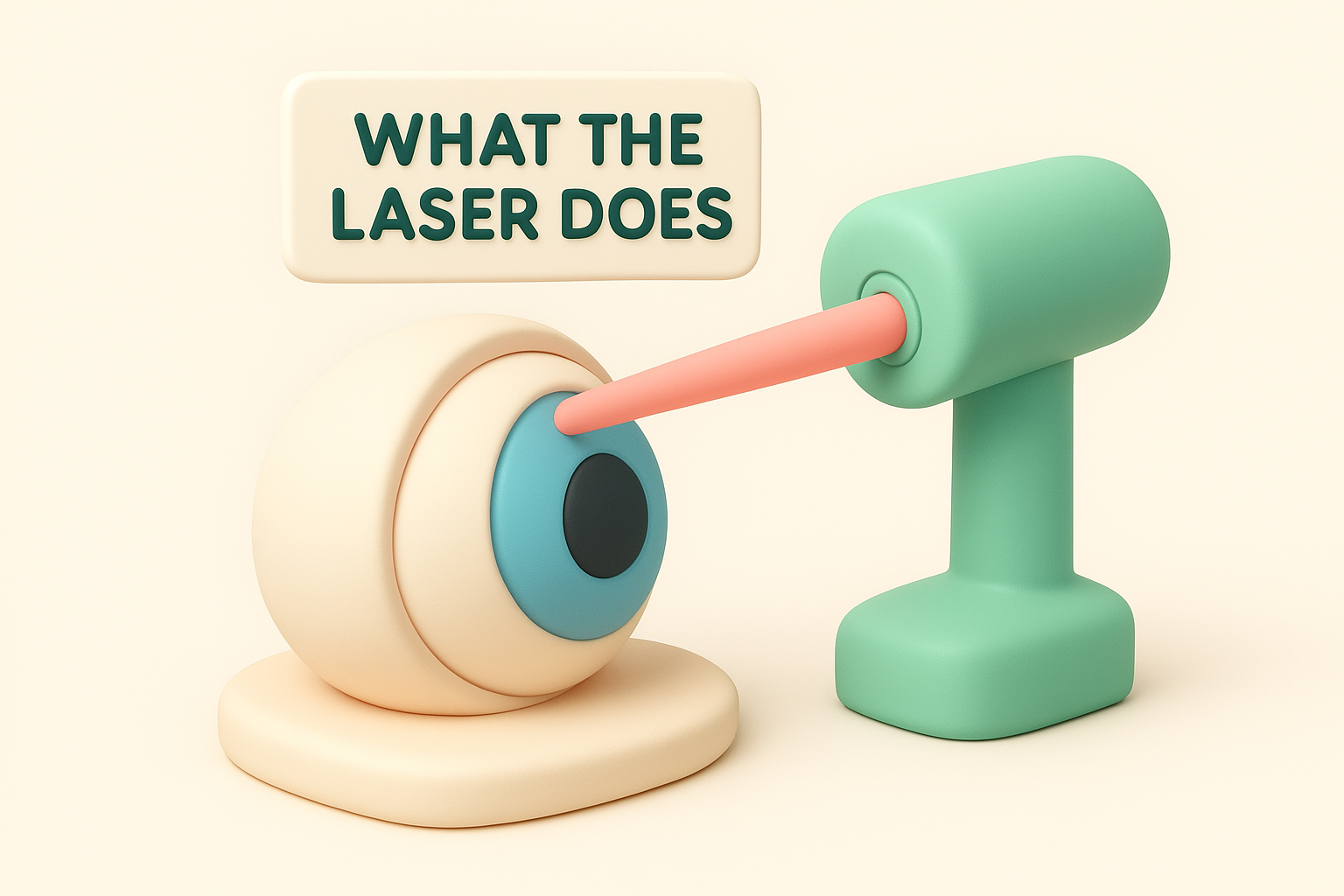
Each technique differs in how the laser reaches the cornea. That difference is what separates LASIK, PRK, and SMILE from one another, and it directly affects recovery time and which procedure suits your eyes best.
Types of refractive laser surgery
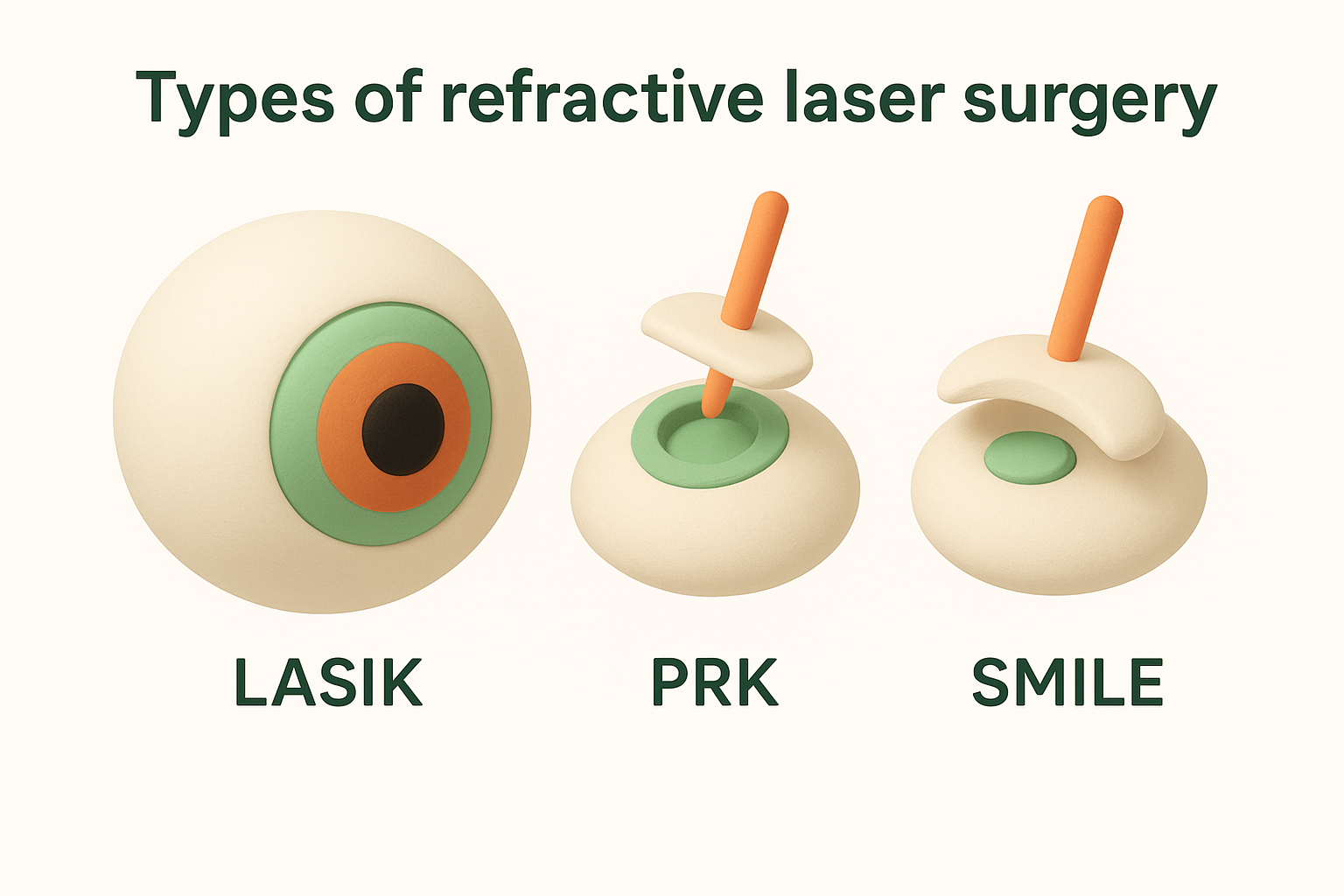
Three procedures cover most refractive laser surgery performed in Australia: LASIK, PRK, and SMILE. Each corrects myopia, hyperopia, and astigmatism but differs in how the laser reaches the cornea, which directly determines your recovery timeline and whether you qualify.
LASIK and PRK
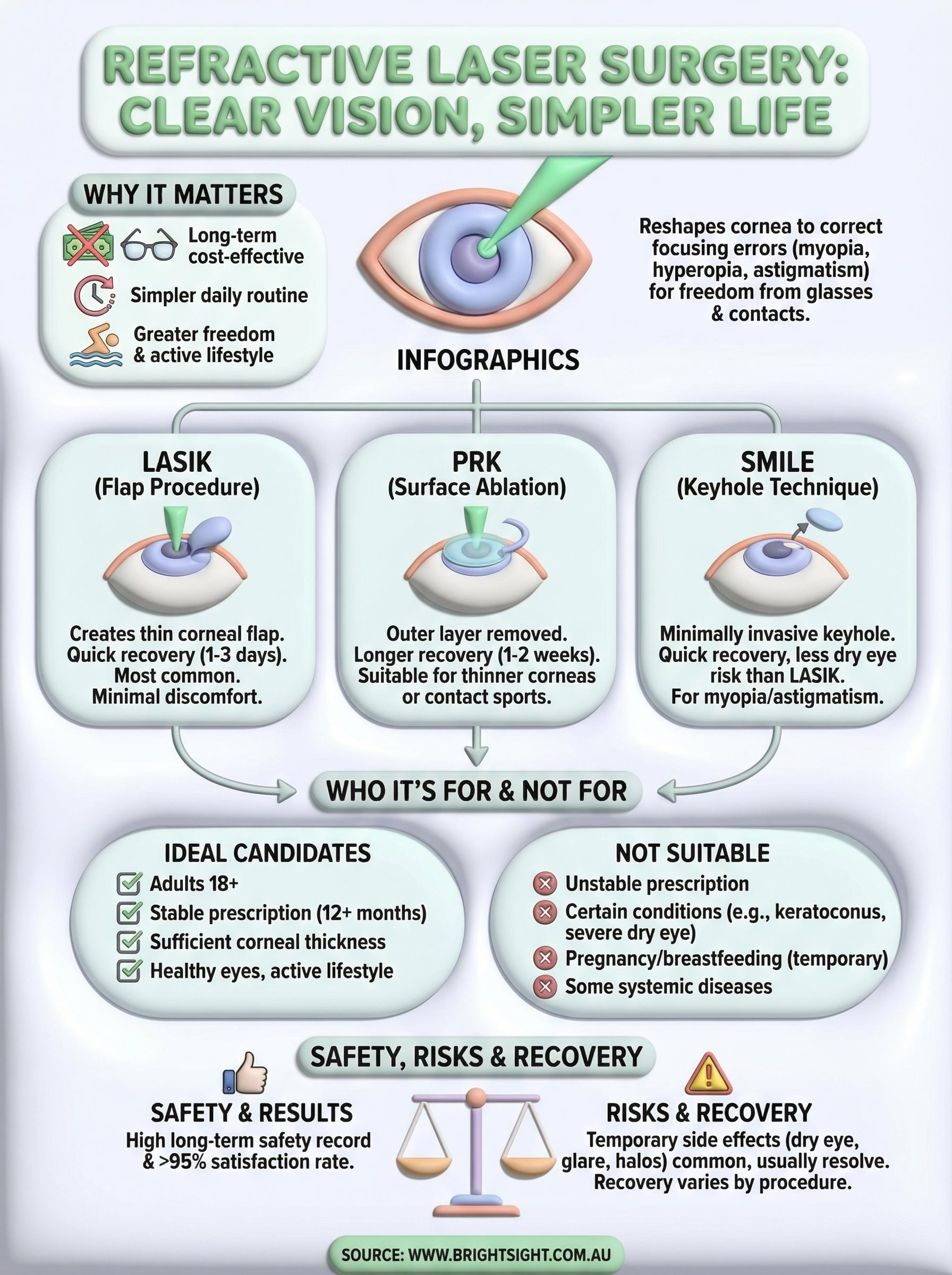
LASIK creates a thin flap in the outer corneal layer, applies the reshaping laser underneath, then carefully repositions the flap. Most patients see clearly within 24 hours, with minimal discomfort, making it the most common choice for people with adequate corneal thickness.
PRK removes the outer epithelial layer entirely before reshaping the corneal surface, allowing the cells to regenerate over several days. Recovery takes longer, roughly one to two weeks for stable vision, but PRK suits patients with thinner corneas or those in contact sports where flap displacement is a concern.
The right choice between LASIK and PRK depends on your corneal thickness, prescription strength, and how quickly you need to return to normal activities.
SMILE
SMILE uses a single femtosecond laser to create a small disc of tissue within the cornea, which the surgeon removes through a tiny incision. No flap is created at any stage, meaning less disruption to corneal nerves and a lower risk of post-operative dry eye than LASIK.
Suitable prescriptions for SMILE currently include myopia up to approximately -10.00 dioptres, with or without astigmatism. Your surgeon will confirm at consultation whether your corneal profile and prescription fall within the treatable range for this technique.
Who refractive laser surgery is for
Not everyone who dislikes glasses or contacts qualifies for laser correction, and a thorough pre-operative assessment determines your suitability before any treatment is planned. The goal is to match the right procedure to your eye anatomy, not to push a one-size approach.
Ideal candidates
Adults aged 18 and over with a stable prescription for at least 12 months are the starting point. Stability matters because treating a prescription that is still changing leads to under-correction over time. Most candidates fall within a myopic range of -1.00 to -10.00 dioptres, with hyperopia and astigmatism also treatable within defined limits.
Your corneal thickness must be sufficient to allow safe tissue removal without weakening the structural integrity of the eye. Pupils, overall corneal shape, and tear film quality all factor into the assessment as well. Refractive laser surgery suits people with active lifestyles, screen-heavy careers, or simply a strong preference for reducing dependence on corrective lenses.
Suitability is determined by objective measurements taken during consultation, not by your prescription strength alone.
When laser surgery is not the right fit
Certain conditions rule out laser treatment, including keratoconus (a corneal thinning condition), very thin corneas, and some autoimmune disorders that affect healing. Pregnancy and breastfeeding temporarily change corneal shape, so assessment is deferred until hormones stabilise. Your surgeon will identify any contraindications early and discuss suitable alternatives.
Safety, risks, recovery, and long-term results
Refractive laser surgery has one of the strongest long-term safety records of any elective procedure. Patient satisfaction rates consistently exceed 95% in large-scale studies, and serious complications such as significant vision loss remain rare in properly screened candidates. The pre-operative assessment exists precisely to identify cases where surgery is not the right option.
Risks worth understanding
Temporary side effects such as halos, glare, and fluctuating vision are common in the weeks after treatment and typically resolve as the cornea heals, usually within one to three months. A small percentage of patients need an enhancement procedure if under-correction or regression occurs over time.
Choosing a qualified surgeon and completing a thorough pre-operative assessment reduces the likelihood of complications substantially.
Dry eye is the most frequently reported ongoing concern, particularly after LASIK, and your surgeon will evaluate your tear film before recommending a procedure. SMILE and PRK carry a lower risk of post-operative dry eye compared to LASIK for patients who are already susceptible.
Recovery and long-term outcomes
LASIK patients typically return to work within two to three days, while PRK requires two to four weeks for stable, comfortable vision. SMILE sits between the two in terms of downtime, with less disruption to corneal nerves contributing to a smoother recovery for many patients.
Long-term results remain durable for most people, though age-related changes such as presbyopia occur naturally over time regardless of prior surgery. Your surgeon will set realistic expectations during your consultation.
What to do next
If you’ve read this far, you have a clear picture of what refractive laser surgery involves, how the three main procedures differ, and what the pre-operative assessment looks for. The next step is finding out whether your eyes are suitable candidates, and that requires a proper clinical assessment, not an online quiz or a prescription check at an optometrist.
Dr Capucine Odouard consults at Sydney Surgical Centre in Randwick and brings specific expertise in LASIK, PRK, and SMILE. She will review your corneal thickness, prescription stability, tear film, and overall eye health to determine which procedure fits your anatomy and lifestyle. If laser correction is not appropriate for your eyes, she will explain why and outline what alternatives exist.
Most patients leave their first consultation with a clear answer about their suitability and a realistic plan. Book a consultation with Dr Odouard to get that answer for your specific situation.