


You pick up a menu, hold it at arm’s length, and still can’t quite make out the words. Sound familiar? If you’re over 40, there’s a good chance presbyopia, the gradual loss of your eyes’ ability to focus on close objects, has started to affect your daily life. Reaching for a pair of reading glasses is the most common fix, but it’s far from the only one. Today, there are several proven reading glasses alternatives that can reduce or even eliminate your dependence on them, from prescription eye drops to advanced surgical procedures.
At Bright Sight Eye Specialists in Randwick, Dr Rahul Dubey and Dr Capucine Odouard regularly help patients across Sydney’s Eastern Suburbs explore these options. Whether it’s refractive lens surgery, laser vision correction, or specialised contact lenses, the right approach depends on your eyes, your lifestyle, and your goals. Our team provides honest, evidence-based guidance so you can make an informed choice, not a pressured one.
Below, we break down five alternatives to reading glasses worth knowing about, how each one works, who it suits best, and what to realistically expect. If you’ve been wondering whether there’s a better option out there for you, this is a good place to start.
1. Refractive lens surgery with multifocal or EDOF lenses
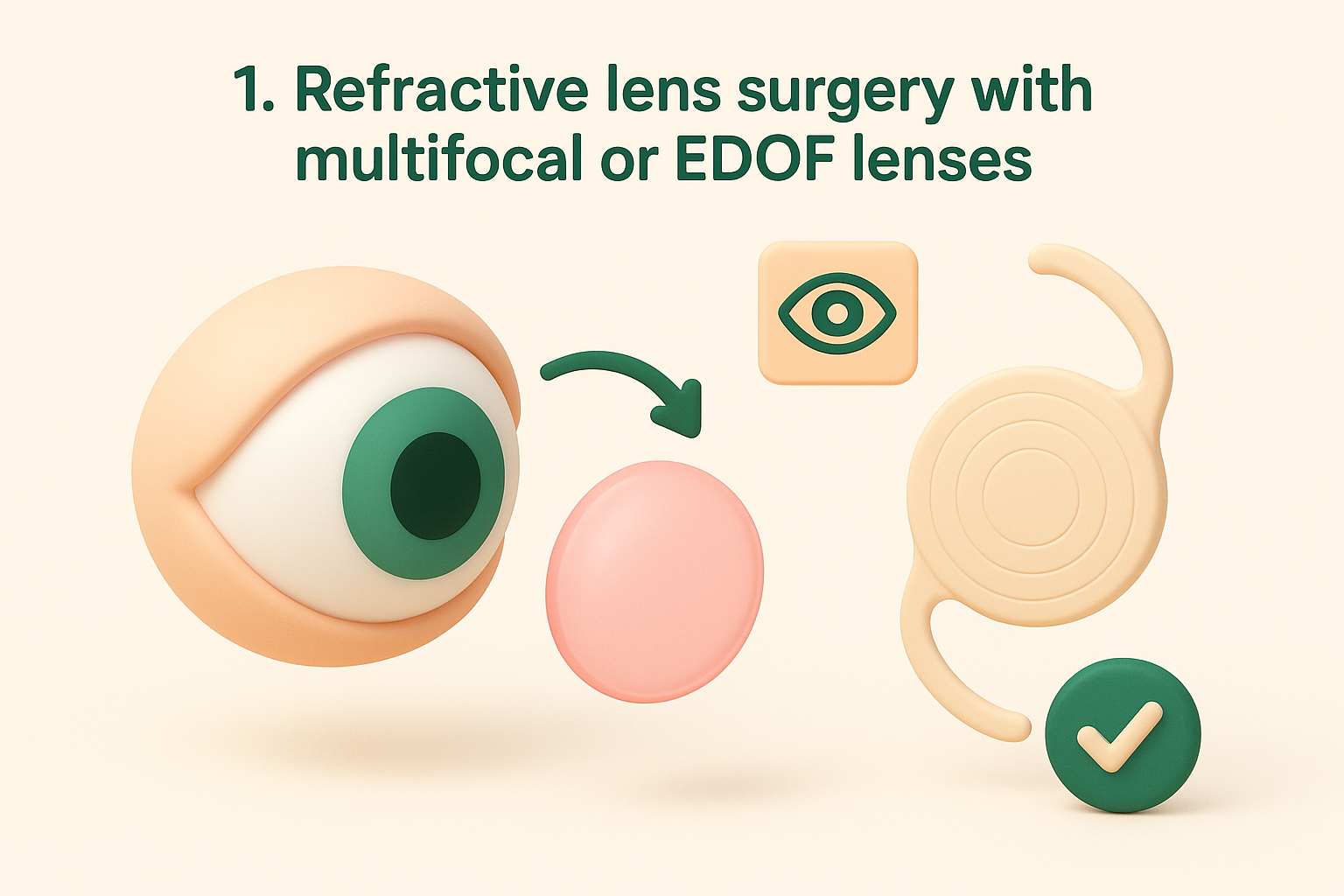
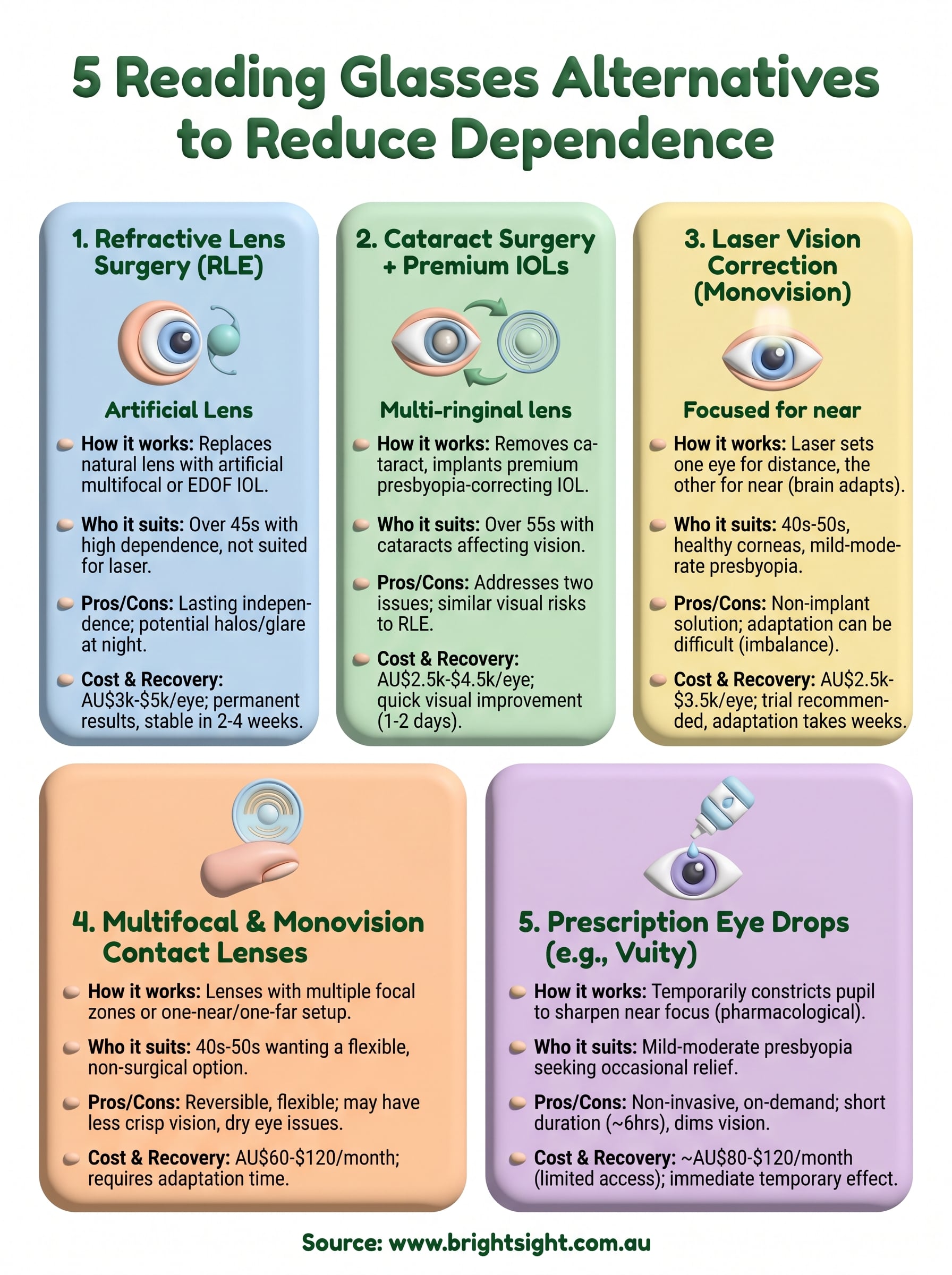
Refractive lens exchange (RLE) removes your eye’s natural lens and replaces it with an artificial intraocular lens (IOL) designed to focus at multiple distances. As one of the most comprehensive reading glasses alternatives available today, RLE addresses presbyopia at the source rather than compensating for it with external aids.
How it works for presbyopia
Your natural lens stiffens gradually with age, losing its ability to flex and shift focus between near and far objects. RLE replaces it with either a multifocal IOL, which splits incoming light into distinct focal points, or an EDOF (Extended Depth of Focus) lens, which stretches the focal range for a smoother, more continuous transition across distances. The surgical technique itself is essentially identical to cataract surgery.
Who it suits best
RLE works best for people over 45 who are heavily dependent on reading glasses and also want to reduce their reliance on distance correction. It is a strong option if you are:
- Not suited to laser surgery due to thin corneas or a high refractive prescription
- Seeking a permanent solution rather than ongoing lens or drop management
Benefits and trade-offs to expect
The main benefit is lasting independence from reading glasses for the vast majority of daily tasks. Some patients notice halos or glare around lights at night, which is more common with multifocal designs. EDOF lenses tend to produce fewer visual disturbances, though they may not deliver the same sharpness at very close distances that full multifocal designs can achieve.
Most patients achieve spectacle independence for over 90% of daily activities after premium IOL implantation.
Recovery and how long results last
Vision typically stabilises within two to four weeks, though most people return to normal activities within a few days of surgery. Because the implanted lens does not deteriorate or stiffen over time, results are permanent and presbyopia will not return to that eye.
Typical costs in Australia
RLE generally costs between $3,000 and $5,000 per eye in Australia. Private health insurance with hospital cover may reduce your out-of-pocket expenses. Your surgeon will provide a transparent cost breakdown before you make any decisions.
2. Cataract surgery with presbyopia-correcting lens implants
If cataracts are already affecting your vision, surgery can address both conditions at once. Choosing a premium presbyopia-correcting IOL makes this one of the most practical reading glasses alternatives for patients over 55.
How it works and when it makes sense
Your surgeon removes the clouded lens through a small incision and replaces it with a clear artificial lens. A premium IOL at this stage corrects near vision simultaneously, rather than accepting a standard single-focus lens that still leaves you needing readers.
Lens options that reduce reading glasses
The two main options are multifocal IOLs, which provide distinct focal points for near and far, and EDOF lenses, which extend the focus range with fewer visual disturbances. Your surgeon matches the choice to your corneal health and daily visual demands.
Benefits and trade-offs to expect
Most patients gain solid independence from glasses for daily tasks. The key trade-off is that multifocal lenses carry a higher risk of halos and glare at night. EDOF designs reduce this but may offer slightly less sharpness at very close distances.
Over 85% of patients with premium IOLs report spectacle independence for most daily activities.
Recovery and aftercare basics
Vision typically improves within one to two days, with most patients returning to normal routines quickly. You will need to use antibiotic and anti-inflammatory drops for several weeks post-surgery to support healing.
Typical costs in Australia
Out-of-pocket costs typically sit between $2,500 and $4,500 per eye. Private health insurance with hospital cover can reduce this considerably, and your surgeon will give you transparent pricing before you commit.
3. Laser vision correction with monovision
Laser eye surgery is typically associated with correcting distance vision, but it can also address presbyopia through a technique called monovision. As one of the more flexible reading glasses alternatives, monovision laser correction works without any implant, making it a less invasive option for the right candidate.
How monovision changes your near and distance focus
With monovision, your surgeon uses laser correction (LASIK, PRK, or SMILE) to set one eye for clear distance vision and the other for clear near vision. Your brain then learns to favour the relevant eye depending on the task, blending both inputs into a functional result across distances.
Who it suits and who should avoid it
Monovision works best for people in their 40s and 50s with healthy corneas and mild to moderate presbyopia. It is not recommended if you depend heavily on precise depth perception for your work or hobbies, or if you have a history of poor tolerance to lens imbalance.
Benefits and trade-offs to expect
The main benefit is glasses-free daily function without an implant procedure. The trade-off is that some patients struggle to adapt, finding the imbalance between eyes distracting rather than seamless.
Trialling monovision with contact lenses for several weeks before surgery is strongly recommended to confirm you adapt well.
Recovery timeline and when you can drive again
Most patients return to driving within one week, though full visual adaptation to the monovision setup often takes two to four weeks.
Typical costs in Australia
Expect to pay between $2,500 and $3,500 per eye, depending on the laser technology used and your surgeon’s experience.
4. Multifocal and monovision contact lenses
Contact lenses offer a non-surgical path to managing presbyopia, making them one of the more accessible reading glasses alternatives for people who want flexibility without a permanent commitment. Two main designs are available: multifocal contacts and monovision contacts.
How multifocal vs monovision contacts work
Multifocal lenses build concentric prescription zones into each lens, letting your brain select near or far focus depending on the task. Monovision contacts use a different strategy, correcting one eye for distance and the other for near, which mirrors the monovision laser approach without any surgical procedure.
Who they suit, including dry eye considerations
These lenses work well for people in their 40s and 50s who want a reversible, non-invasive option. If you have dry eye disease, discuss this with your specialist first, as reduced tear production can make extended lens wear uncomfortable and reduce visual clarity throughout the day.
Benefits and trade-offs to expect
The main advantage is immediate reversibility; if the result falls short of your expectations, you simply stop wearing them. Some patients find that neither design delivers the same crispness across all distances as surgical correction, and mild blur during adaptation is common.
Trialling monovision contacts before committing to monovision laser surgery is a practical way to confirm you tolerate the effect.
Fitting process and adaptation tips
Your optometrist or eye specialist will run trial fittings to dial in the right prescription for each eye. Allow two to four weeks before judging the result, as your brain needs time to adapt to the new focal setup.
Typical costs in Australia
Premium multifocal contact lenses typically cost between $60 and $120 per month, depending on the brand and your prescription complexity.
5. Prescription presbyopia eye drops (Vuity)
Prescription eye drops designed to treat presbyopia represent the newest category of reading glasses alternatives on the market. Rather than correcting your lens or cornea permanently, these drops use pharmacology to temporarily improve near vision, making them the most reversible option on this list.
How presbyopia drops improve near vision
Vuity contains pilocarpine 1.25%, a compound that constricts your pupil. A smaller pupil increases depth of field, which sharpens near focus without surgery or physical correction. The effect typically kicks in within 15 minutes and lasts for around six hours per dose.
Who can use them safely
These drops suit people with mild to moderate presbyopia who want occasional relief rather than a full-time solution. They are not appropriate for patients with a history of certain retinal conditions or inflammatory eye disease.
Benefits and trade-offs to expect
The key benefit is on-demand use with no permanent changes to your eyes. The trade-off is that results vary considerably between individuals, and the six-hour window limits how useful they are for full-day activities.
Vuity is currently FDA-approved in the United States but is not yet TGA-approved for general use in Australia.
Side effects, precautions, and night driving
Common side effects include headache and temporary darkening of vision in dim conditions. Pupil constriction reduces light entry, so driving at night after using the drops is not recommended.
Typical costs in Australia
Because TGA approval is pending, access in Australia is limited. Where available through specialist pathways, costs typically sit around $80 to $120 per month.
Next steps
Each of the reading glasses alternatives covered in this article addresses presbyopia differently, and no single option suits everyone. The right choice depends on factors including your corneal health, degree of presbyopia, lifestyle, and how much visual disturbance you can tolerate. A thorough eye examination gives you the clinical data you need to make a well-grounded decision rather than guessing.
At Bright Sight Eye Specialists in Randwick, Dr Rahul Dubey and Dr Capucine Odouard take the time to assess your eyes fully and explain which options genuinely apply to your situation. Neither surgeon will push you toward a procedure that does not suit your goals.
If you are ready to explore your options, or simply want a clearer picture of where your vision stands, book a consultation with our team. Reducing your dependence on reading glasses may be more straightforward than you expect.