


PRK (photorefractive keratectomy) is one of the most established laser vision correction procedures available, and for good reason. It delivers excellent long-term visual outcomes for people who want to reduce or eliminate their dependence on glasses and contact lenses. But like any surgical procedure, it comes with a recovery period, and understanding PRK eye surgery side effects before you commit helps you make a genuinely informed decision. Most side effects are temporary and manageable, though some deserve careful consideration and discussion with your surgeon.
At Bright Sight Eye Specialists in Randwick, Sydney, Dr Capucine Odouard performs PRK, LASIK, and SMILE procedures and takes the time to walk every patient through what recovery actually looks like, not just the best-case scenario. Her approach is straightforward: you should know exactly what to expect so there are no surprises. That includes the common short-term discomfort, the timeline for visual improvement, and the rarer complications that can occasionally occur.
This article covers the full picture of PRK side effects, from the first few days post-surgery through to the months that follow. You’ll find a clear breakdown of short-term symptoms like light sensitivity and dry eyes, what’s considered normal during healing, and the less common risks worth being aware of. Whether you’re actively considering PRK or simply weighing up your options, this guide will give you the practical detail you need to feel confident about your next step.
Why PRK has side effects and what is normal
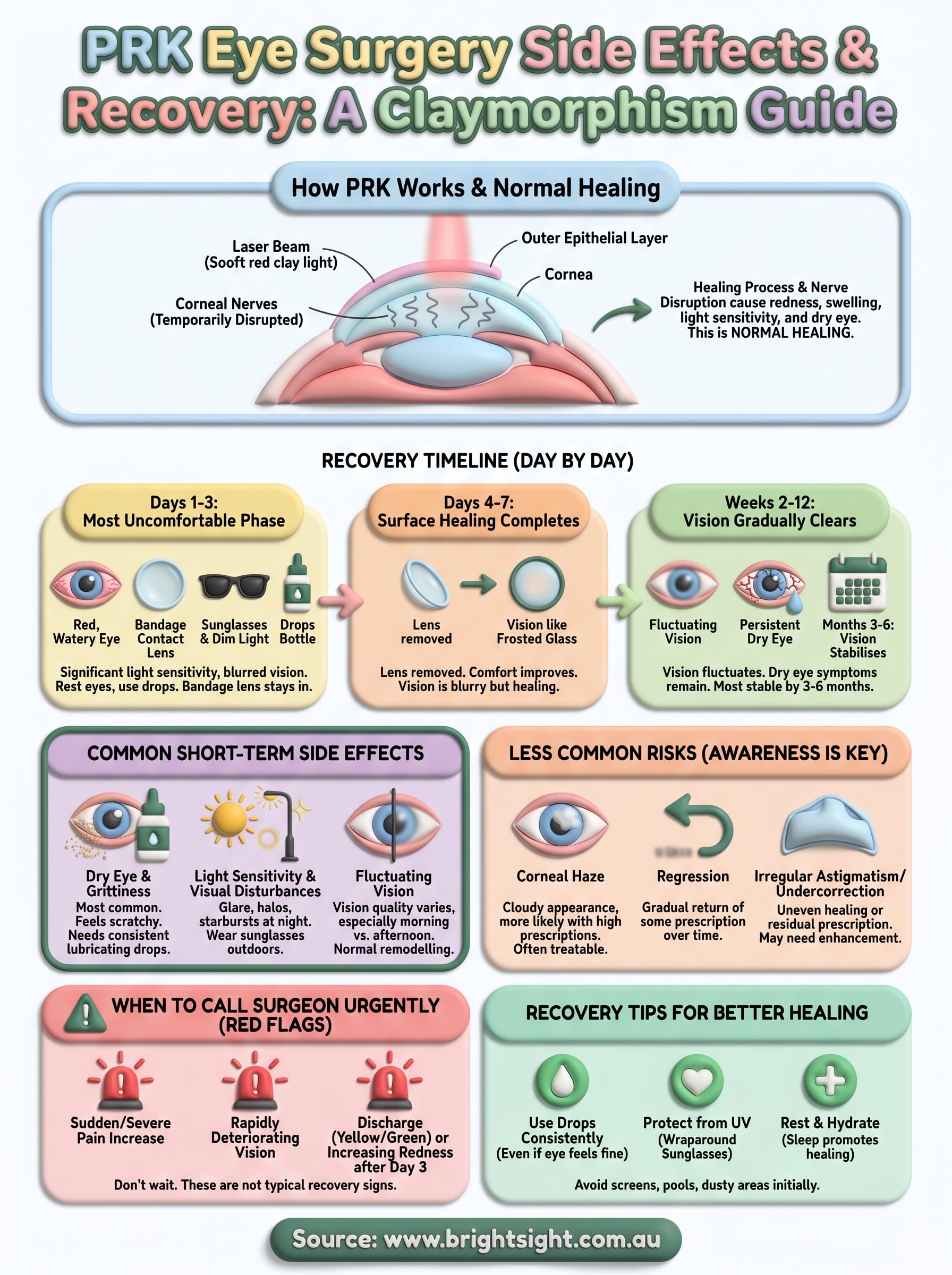
PRK works by removing the outer layer of the cornea (the epithelium) and then using a laser to reshape the corneal tissue underneath. This is fundamentally different from LASIK, where a flap is created and replaced. Because PRK removes the surface cells entirely, your eye has to regrow that outer layer from scratch over the first few days. That regeneration process is what drives most of the PRK eye surgery side effects you’ll experience during recovery, and understanding this helps you frame what’s happening as healing rather than damage.
How the laser changes your cornea
The excimer laser used in PRK removes precise amounts of corneal tissue to correct your refractive error, whether that’s short-sightedness, long-sightedness, or astigmatism. Each pulse of the laser removes roughly 0.25 microns of tissue, which is extraordinarily controlled. Even so, that precision still creates a wound that your immune system and corneal cells must repair. Your body’s natural inflammatory response kicks in immediately after surgery, sending healing signals to the treated area, which causes the redness, swelling, and sensitivity you’ll feel in the first few days.

Corneal nerves are also temporarily disrupted during the procedure. These nerves play a direct role in regulating tear production, which is why dry eye is one of the most consistent short-term complaints after PRK. This disruption is not permanent for most people, but it does mean your eyes may feel gritty, uncomfortable, or sensitive to light while those nerve connections re-establish themselves over the weeks and months that follow surgery.
Most side effects in the first week are a direct sign that your cornea is actively healing, not evidence that something has gone wrong.
What counts as normal during recovery
Knowing which symptoms fall within the expected range matters just as much as knowing which ones don’t. Pain, blurred vision, and light sensitivity in the first few days are all considered normal. You should also expect some watering and a sensation similar to having a grain of sand in your eye. What’s happening is that your epithelial cells are migrating across the surface to close the treated area, which typically takes three to five days for the initial covering to complete.
Your surgeon will place a soft bandage contact lens on your eye straight after surgery to protect the surface and reduce discomfort while that regrowth occurs. This is standard practice, and you should not remove or touch it before your follow-up appointment. Once the epithelium has fully closed, the lens comes off and you’ll generally notice a meaningful improvement in comfort.
Beyond the surface, your cornea continues to remodel at a deeper level for months after surgery. This is why vision can fluctuate during recovery, feeling clearer on some days and blurrier on others. The remodelling process, known as stromal wound healing, gradually stabilises your prescription over time. Most patients reach their final visual outcome somewhere between three and six months post-surgery, though this varies depending on the degree of correction involved and how your individual cornea responds to the healing process. Having realistic expectations about this timeline is one of the most important things you can do before committing to PRK.
What PRK recovery looks like day by day
Recovery from PRK follows a predictable sequence, though the exact timing varies depending on your prescription level and how your cornea responds to treatment. Understanding the general timeline before surgery helps you plan around work, family commitments, and daily routines. Most people take at least a week off after PRK, and those in visually demanding roles often need longer. Planning around the actual recovery curve, rather than an optimistic version of it, makes the whole process considerably easier to navigate.
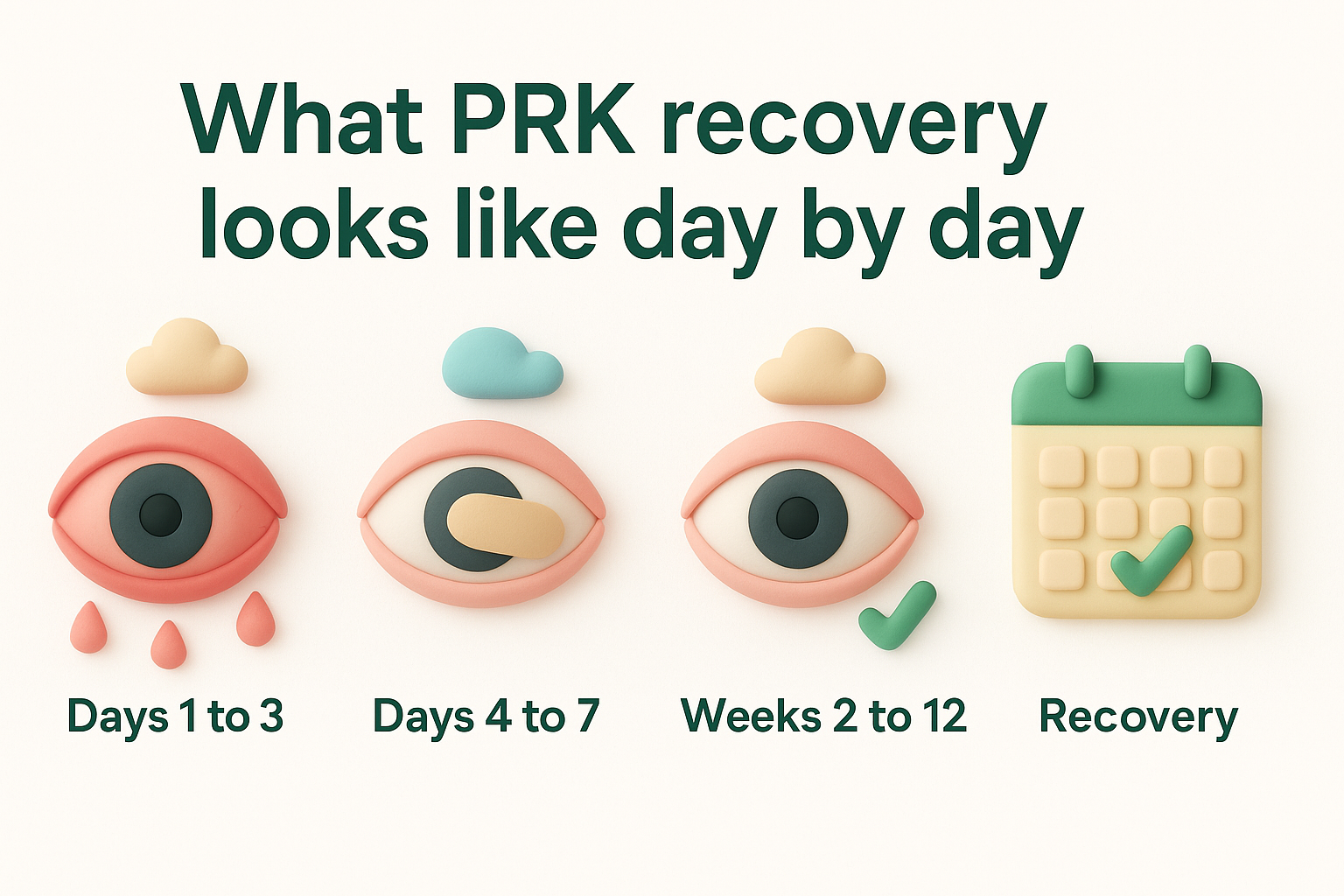
Days 1 to 3: The most uncomfortable phase
The first three days are typically the most difficult in terms of comfort. Your eye will be red, watery, and sensitive to light, and your vision will be noticeably blurred. The bandage contact lens placed by your surgeon at the end of the procedure stays in during this time, protecting the surface while your epithelial cells regrow. You should rest your eyes as much as possible, avoid screens, and use your prescribed antibiotic and anti-inflammatory drops on schedule. Paracetamol is usually sufficient for managing discomfort, though your surgeon may prescribe additional medication if needed.
Your level of discomfort during these first days is directly linked to the size of the treated area, which means higher prescriptions can mean a slightly longer uncomfortable phase.
During this period, light sensitivity can be significant, and many people find it easier to stay in a dimly lit environment. Sunglasses are essential outdoors. Avoid rubbing your eyes under any circumstances, as this can disturb the healing epithelium while it is still fragile and incomplete.
Days 4 to 7: Surface healing completes
By around day four or five, most people notice a meaningful improvement in comfort as the epithelium closes over the treated area. Your surgeon will remove the bandage contact lens at your follow-up appointment once the surface has healed adequately. Vision at this stage is still not stable or sharp, and many patients describe it as looking through frosted glass. This is entirely expected and continues improving over the coming weeks.
Weeks 2 to 12: Vision gradually clears
From week two onwards, the more subtle PRK eye surgery side effects, particularly fluctuating vision and persistent dry eye, become the main focus of recovery. Your vision may feel clearer some days and blurrier on others, which is a normal part of corneal remodelling. By weeks 10 to 12, vision has usually settled enough for your surgeon to formally assess your outcome.
Common short-term side effects after PRK
The most frequently reported PRK eye surgery side effects in the first few weeks are well-documented and, for the vast majority of patients, resolve on their own as healing progresses. Knowing what to expect, and why each symptom occurs, makes recovery considerably less stressful than it might otherwise feel.
Dry eye and grittiness
Dry eye is the single most common complaint after PRK, and it stems directly from the disruption of corneal nerves during the procedure. These nerves normally signal your lacrimal gland to produce tears, so when they are temporarily impaired, your eye simply does not lubricate itself as effectively. You will likely notice a gritty, scratchy, or burning sensation, particularly in air-conditioned environments, when using screens, or outdoors on windy days.
Preservative-free lubricating drops are your most important comfort tool during recovery, and using them frequently, even when your eye does not feel particularly dry, helps protect the healing surface.
Your surgeon will prescribe a schedule for lubricating drops, and it is worth sticking to it consistently rather than only reaching for them when discomfort peaks. Most patients find dry eye symptoms improve noticeably by weeks six to eight, though some need lubricating drops for several months.
Light sensitivity and visual disturbances
Sensitivity to light is another consistent short-term effect. Bright indoor lighting, oncoming headlights, and sunlight can all feel uncomfortable or overwhelming in the first few weeks. You may also notice halos, glare, or starbursts around light sources, particularly at night. These effects are caused by corneal swelling and surface irregularities during the early healing phase, and they typically reduce significantly as the epithelium matures and the stroma continues to remodel.
Wearing good-quality sunglasses outdoors during the recovery period is important for both comfort and protection. UV exposure on a healing cornea can affect the quality of your final outcome.
Fluctuating vision
Your visual clarity will vary from day to day and even hour to hour during the first few weeks. This is not a sign that something is wrong. It reflects the ongoing remodelling of your corneal surface. Mornings often feel slightly blurrier than afternoons, and tired eyes tend to feel more out of focus. This fluctuation settles as healing progresses.
Less common and long-term risks to know
While the short-term PRK eye surgery side effects are well understood and manageable, a smaller number of patients experience issues that persist beyond the initial recovery window or require further treatment. These are not common outcomes, but they are worth understanding clearly so you can have an informed conversation with your surgeon before going ahead.
Corneal haze
Corneal haze occurs when the healing response produces excess collagen in the stromal layer, creating a cloudy appearance in the cornea that can affect visual clarity. It is more likely in patients with higher prescriptions or in those who received larger amounts of laser correction. Mild haze often clears on its own over several months, but significant haze can reduce vision quality and may require additional treatment with mitomycin-C, an agent that is now routinely applied during surgery to substantially reduce this risk.
Mitomycin-C is used as a preventive measure during PRK for higher prescriptions precisely because it reduces the likelihood of clinically significant haze developing during healing.
Your surgeon will assess your individual risk before surgery and adjust the treatment plan accordingly, so this is not something you need to manage alone.
Regression
Regression refers to a gradual return of your refractive error over time, meaning your distance or near vision slowly drifts back toward its pre-surgery state. This can happen months or even years after PRK and is more common with higher corrections. Enhancement procedures are possible in eligible patients, though your surgeon will assess corneal thickness and healing before recommending one.
Irregular astigmatism and undercorrection
Some patients experience irregular astigmatism after PRK, where the corneal surface heals unevenly, producing distorted or doubled vision that standard glasses cannot fully correct. This is uncommon with modern laser platforms but remains a recognised risk. Separately, undercorrection can leave you with some residual prescription after healing completes, which may or may not require further treatment depending on the degree and your visual demands. Both outcomes are more likely in eyes with steep or irregular corneas before surgery, which is why thorough pre-operative screening plays such a significant role in patient selection.
When to call your surgeon urgently
Most PRK eye surgery side effects fall within a predictable, manageable range, and the vast majority of patients move through recovery without serious complications. But some symptoms sit outside that range entirely and require prompt contact with your surgeon, not a wait-and-see approach. Knowing the difference between normal post-operative discomfort and a genuine warning sign is one of the most important things you can take away from this guide.
Signs that need same-day attention
Certain symptoms should prompt you to call your surgeon’s clinic on the same day they appear, regardless of how early or late it is. Sudden, severe worsening of pain after the first few days is not typical of normal healing and should never be dismissed as just part of recovery. Similarly, rapidly deteriorating vision that goes from blurry to near-complete loss of clarity in one or both eyes warrants immediate contact.
Other symptoms to act on without delay include:
- Increasing redness that gets worse after day three rather than improving
- Discharge from the eye, particularly if it is yellow or green, which can indicate infection
- A sudden increase in sensitivity to light that was improving and has now sharply reversed
- Visible changes to the shape or surface of the eye, such as unusual clouding or swelling
- Any trauma or injury to the eye during the recovery period, even if it feels minor
Infection after PRK is rare, but when it does occur, early treatment is what protects your final visual outcome, so acting quickly is always the right call.
What distinguishes normal discomfort from a warning sign
The key distinction is trajectory. Normal PRK recovery follows a general pattern of gradual improvement, with some fluctuation along the way. Pain, sensitivity, and blur all tend to reduce progressively after the first week rather than getting worse. If a symptom that was easing suddenly returns or intensifies, that reversal is what signals something worth investigating.
You should also pay attention to asymmetry between your two eyes. Some difference is normal, but if one eye is significantly more painful, red, or blurry than the other with no obvious explanation, your surgeon needs to know. Trust your instincts during recovery, and contact your clinic if something does not feel right.
How to reduce side effects and heal well
Your behaviour during recovery has a direct impact on how quickly you heal and how well your vision settles. While PRK eye surgery side effects are largely driven by your cornea’s natural healing process, there are practical steps you can take to reduce unnecessary discomfort and avoid anything that might slow your recovery down.
Use your prescribed drops consistently
Your surgeon will send you home with antibiotic drops, anti-inflammatory drops, and lubricating drops, each serving a distinct purpose during recovery. Antibiotic drops reduce infection risk while the surface heals. Anti-inflammatory drops help manage the corneal healing response and reduce the risk of haze. Lubricating drops keep the surface moist and protect the regenerating epithelial cells.
Using your drops on schedule, not just when your eye feels uncomfortable, is one of the most effective things you can do to support a smooth recovery.
Many patients underuse lubricating drops once the initial discomfort fades, but your corneal nerves remain partially disrupted for several weeks, meaning your eye is drier than it feels. Stick to the full schedule your surgeon recommends.
Protect your eyes from light and irritants
Ultraviolet exposure on a healing cornea can interfere with the remodelling process and increase your risk of corneal haze. Wearing wraparound sunglasses whenever you go outside is not optional during recovery, it is a straightforward way to protect your result. Indoors, reducing screen time in the first week takes pressure off your eyes and lets them rest during the phase when discomfort is at its peak.
Avoid swimming pools, hot tubs, and dusty environments for at least the first four weeks. Both chlorinated water and airborne particles carry contamination risk while your corneal surface remains vulnerable.
Give your body what it needs to heal
Sleep and adequate hydration play a genuine role in tissue repair. Your corneal cells regenerate faster when your body is rested, so prioritising sleep in the first week is not indulgence, it is practical recovery support. Avoid alcohol in the first few days, as it can worsen dry eye and interfere with medication. Reducing screen exposure also reduces eye strain at a point in recovery when your visual system is already working hard to adjust.
Key takeaways and next steps
PRK eye surgery side effects follow a well-understood pattern, and the vast majority of what you experience during recovery is a direct sign that your cornea is healing as expected. Pain, light sensitivity, dry eye, and fluctuating vision in the first few weeks are normal, manageable, and temporary for most patients. Corneal haze, regression, and irregular astigmatism are less common risks that your surgeon will screen for and discuss with you before you commit to anything. Your behaviour during recovery, from using your drops consistently to protecting your eyes from UV exposure, has a real impact on your outcome. And knowing which symptoms warrant an urgent call to your clinic means you can act quickly if something sits outside the expected range.
If you are weighing up PRK and want to understand whether it suits your prescription and lifestyle, book a consultation with Dr Capucine Odouard at Bright Sight Eye Specialists in Randwick.