


If you’re considering PRK to ditch your glasses or contact lenses, one of the first questions on your mind is likely PRK eye surgery cost in Australia. It’s a fair question, and one that deserves a straight answer. Prices vary between clinics, and the total you pay depends on factors like the technology used, your prescription, and your level of health insurance cover.
At Bright Sight Eye Specialists in Randwick, Dr Capucine Odouard performs PRK and other refractive laser procedures with a focus on evidence-based care tailored to each patient’s vision goals. We believe you shouldn’t have to guess what a procedure will cost, which is why we’re committed to transparent pricing from your very first consultation.
This guide breaks down what PRK typically costs across Australia in 2026, what’s included in that price, whether Medicare or private health insurance contributes anything, and how financing options can make the procedure more accessible. We’ll also explain what influences the final figure so you can compare quotes with confidence.
Why PRK prices vary in Australia
When you start researching PRK eye surgery cost Australia, you’ll quickly notice that no two clinics quote the same figure. That’s not a red flag – it reflects the fact that PRK is a personalised medical procedure, and several legitimate factors influence what a clinic charges. Understanding those factors helps you make sense of any quote you receive and decide whether it represents fair value.
The technology and equipment used
The laser platform a clinic uses has a direct impact on both the quality of your outcome and the overall cost of your procedure. Older excimer lasers deliver standard ablation profiles, while newer systems such as wavefront-guided and topography-guided platforms map the unique surface irregularities of your cornea and treat them with far greater precision. These advanced systems cost significantly more to purchase, calibrate, and maintain, and that investment flows through to what patients pay. If a quote seems unusually low, it’s worth asking specifically which laser platform the clinic uses before committing.
The laser platform matters: wavefront-guided and topography-guided treatments consistently deliver better visual outcomes for complex prescriptions, and clinics using them typically charge more as a result.
Your prescription and eye complexity
Your prescription plays a meaningful role in determining the final price. Higher prescriptions require longer ablation times and remove more corneal tissue, which increases both the technical demand and the consumables used per procedure. Patients with irregular corneas, prior eye surgeries, or conditions such as dry eye often require more complex treatment planning, which adds to the overall cost. A thorough pre-operative assessment – covering corneal mapping, pachymetry, and aberrometry – is essential before any surgeon can confirm you’re a suitable candidate and quote accurately for your specific situation.
The surgeon’s experience and clinical setting
The surgeon performing your PRK brings their own level of training, subspecialty focus, and clinical judgement to the table. A fellowship-trained refractive surgeon operating in a purpose-built surgical suite will typically charge more than a general ophthalmologist who performs occasional laser procedures. That price difference reflects real differences in training depth, intraoperative precision, and post-operative support. At Bright Sight Eye Specialists, Dr Capucine Odouard completed her ophthalmology training at Sydney Eye Hospital and holds a Master of Science in Biology of Vision from University College London, bringing internationally recognised expertise to every laser procedure she performs.
Clinic location and overhead costs
Geography influences pricing more than most people expect. Clinics based in major metropolitan areas like Sydney carry higher overheads in terms of rent, staffing, and facility costs than regional providers. That said, a higher price does not automatically mean better care, and a lower price does not mean the standard of treatment has been compromised. What matters most is what the quote actually includes and the clinical governance sitting behind it. Clinics in Sydney’s Eastern Suburbs, for example, typically operate in well-resourced environments with direct access to hospital-grade facilities, which supports a higher standard of both surgical and follow-up care.
Typical PRK cost in Australia in 2026
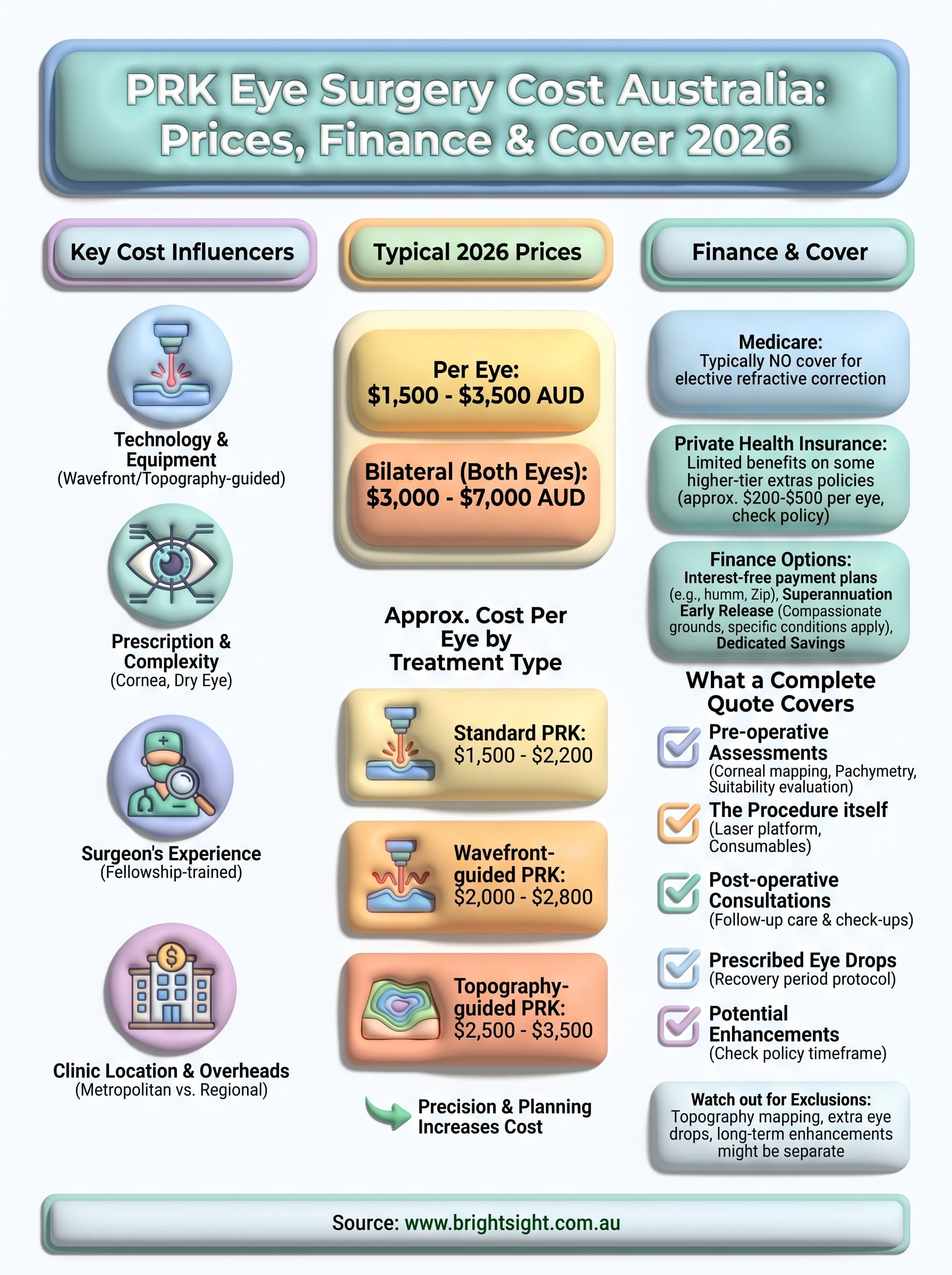
When researching PRK eye surgery cost Australia, most people want a ballpark figure before booking a consultation. Prices in 2026 typically range from $1,500 to $3,500 per eye, depending on the factors covered in the previous section. For a bilateral procedure treating both eyes, that puts the total investment somewhere between $3,000 and $7,000 for most patients.
Per-eye vs. per-procedure pricing
Clinics quote PRK in two different ways, and understanding which model applies to your quote prevents confusion when comparing costs. Some clinics advertise a per-eye price, while others present a single total bilateral fee. Always confirm whether the figure you’re given covers one eye or both, and whether post-operative consultations and follow-up care are included or billed separately. A quote that looks competitive on the surface can end up higher once you factor in topography mapping, eye drop protocols, and any enhancement procedures down the track.
Price ranges by treatment type
Not every PRK procedure sits at the same level of complexity, and the type of treatment profile your surgeon recommends directly affects the cost. Standard PRK treats a straightforward prescription using a conventional ablation pattern. Wavefront-guided PRK uses detailed measurements of your eye’s optical aberrations to create a more personalised correction, while topography-guided PRK addresses the specific contour of your corneal surface. Each step up in precision adds to the overall price, reflecting both the technology involved and the increased planning required from your surgeon.
| Treatment type | Approximate cost per eye (AUD) |
|---|---|
| Standard PRK | $1,500 – $2,200 |
| Wavefront-guided PRK | $2,000 – $2,800 |
| Topography-guided PRK | $2,500 – $3,500 |
Topography-guided PRK is often recommended for patients with irregular corneas or higher prescriptions, and the additional cost reflects both the specialised technology and the increased level of surgical planning involved.
In Sydney’s Eastern Suburbs, where clinical overheads are higher and surgeons tend to carry strong subspecialty credentials, prices toward the mid-to-upper end of each range are more common. That said, a higher price is only meaningful when you know exactly what it covers – which is why the next section looks closely at what a comprehensive PRK quote should include.
What clinics include in a PRK quote
When you’re comparing PRK eye surgery cost Australia, the headline price is only part of the story. Two quotes at similar figures can represent very different value depending on what each clinic actually bundles into that fee. Knowing what a comprehensive quote should cover protects you from unexpected out-of-pocket costs further down the track.
What a complete quote covers
A thorough PRK quote should address far more than just the laser procedure itself. Pre-operative assessments, including corneal mapping, pachymetry, and a full suitability evaluation, are necessary before your surgeon can confirm you’re a suitable candidate, and the best clinics include these in the overall fee. You should also expect post-operative consultations and follow-up care to be clearly addressed in any quote, since the recovery period after PRK involves multiple check-ups across several weeks. A quote that excludes these visits leaves you exposed to additional billing at a time when your care is most active.

A complete PRK quote should include pre-operative assessment, the procedure itself, prescribed eye drops for the recovery period, and post-operative follow-up consultations, not just the time spent under the laser.
At Bright Sight Eye Specialists, we provide clear, itemised pricing before any commitment is made, so you understand exactly what your investment covers from your very first consultation.
What to watch for in the fine print
Some clinics advertise low entry-level prices but charge separately for items that most patients reasonably expect to be included. Topography or aberrometry mapping, post-operative eye drops, and enhancement procedures are common examples of add-ons that are not always covered in a base quote. Asking directly whether enhancements are included within a defined period is a fair and practical question before signing anything.
Enhancement rates after PRK are low when the procedure is properly planned and performed, but knowing your clinic’s policy upfront gives you financial certainty throughout your recovery. A clinic that is genuinely transparent about its inclusions and exclusions is generally one that is confident in both its clinical outcomes and the fairness of its pricing structure.
Private health, Medicare and rebates for PRK
One of the most common questions people ask when researching PRK eye surgery cost Australia is whether Medicare or private health insurance will cover any of the expense. The short answer is that the financial contribution from both is limited, but understanding exactly where the boundaries sit helps you plan your budget accurately and avoid surprises.
Medicare and PRK
Medicare does not cover laser refractive surgery, including PRK, when the procedure is performed solely to reduce dependence on glasses or contact lenses. The Australian Government classifies elective refractive correction as cosmetic in nature, which places it outside the scope of Medicare Benefits Schedule rebates. This applies regardless of how strong your prescription is or how significantly your vision affects your daily life.
If PRK is recommended for a medical reason rather than for elective vision correction, your treating surgeon can advise whether any Medicare item numbers apply to your specific circumstances.
Private health insurance and PRK
Most hospital-level private health insurance policies do not cover PRK because the procedure is performed in a day surgery or clinical setting rather than as an admitted hospital inpatient. Some higher-tier extras policies include a refractive surgery benefit, but the rebate is typically modest, often ranging from $200 to $500 per eye depending on the fund and your level of cover. Checking directly with your insurer before your consultation is always worthwhile, as policy inclusions vary significantly between funds.
Your fund may also require a minimum waiting period, often 12 months, before a refractive surgery benefit becomes available. Confirming your waiting period status early avoids the frustration of discovering you are not yet eligible once you are ready to proceed.
Tax and superannuation options
While rebates from Medicare and private insurance are limited, some patients use their tax return or a health-related superannuation release to help offset the cost of PRK. The Australian Tax Office does not allow laser eye surgery as a standard medical tax deduction for healthy eyes, but superannuation early release on compassionate grounds may apply in circumstances where vision impairment significantly affects your ability to work. Speaking with a financial adviser is the right step if you believe this pathway applies to your situation.
How to budget and compare clinics safely
Comparing PRK eye surgery cost Australia across multiple clinics is a sensible step, but the cheapest quote is rarely the best starting point. The total cost of your procedure includes everything from your initial suitability assessment through to your final follow-up appointment, and a quote that omits any of those elements is not a true comparison. Focus on what each clinic includes, who performs the procedure, and what happens if you need an enhancement before making any decision.
Ask the right questions before you commit
When you contact a clinic for a quote, go beyond the headline figure. Ask specifically whether pre-operative assessments, post-operative consultations, and prescribed eye drops are included in the price. Find out which laser platform the surgeon uses and whether the fee covers a wavefront-guided or topography-guided treatment profile, or only a standard ablation. Enhancement policies are also worth clarifying upfront – a reputable clinic will tell you clearly whether a refinement procedure within a set period is included at no additional charge.
A clinic that cannot clearly answer what its quote covers is one worth approaching with caution.
- Is pre-operative corneal mapping included?
- Are post-operative consultations covered for the full recovery period?
- Which laser platform does the surgeon use?
- Is an enhancement included if needed within 12 months?
Plan your payment method early
Most clinics offer interest-free finance plans through providers such as humm or Zip, which allow you to spread the cost across monthly instalments without paying interest during the promotional period. Confirming your eligibility and repayment terms before your consultation means you can focus entirely on the clinical assessment on the day rather than the financial logistics. Some patients also use a dedicated savings account, setting aside a fixed monthly amount once they have a target price in hand.
Reaching out to two or three clinics in your area gives you a clearer sense of what a fair price looks like for the level of technology and care on offer. Once you have comparable quotes that spell out their inclusions, you are in a much stronger position to choose based on clinical confidence rather than cost alone.
Your next step
Understanding PRK eye surgery cost Australia is a solid foundation, but the only way to get an accurate figure for your specific eyes is through a proper suitability assessment. Your prescription, corneal thickness, and overall eye health all influence both whether PRK is right for you and what the procedure will cost. No online guide can replace that evaluation.
At Bright Sight Eye Specialists in Randwick, Dr Capucine Odouard provides thorough pre-operative assessments and transparent, itemised pricing so you know exactly what your investment covers before making any decision. She specialises in refractive laser procedures including PRK, and takes a patient-centred approach that puts your vision goals first.
If you’re ready to find out whether PRK suits your eyes and what it would cost in your case, book a consultation with Dr Odouard today. Clear pricing and honest advice are waiting for you from the very first appointment.