


If you’re facing cataract surgery or considering refractive lens exchange, you’ve probably come across the PanOptix IOL during your research. It’s one of the most talked-about premium lens implants available in Australia, and for good reason. This trifocal lens is designed to reduce or eliminate your dependence on glasses at near, intermediate, and distance ranges, all from a single implant.
But no lens is perfect for everyone. The PanOptix has real strengths, and it has limitations worth understanding before you commit. Things like night-time visual disturbances, your eye anatomy, and your daily visual demands all factor into whether this lens is the right choice for you. Getting a straight answer on these trade-offs can be harder than it should be, so we’ve put together a detailed, honest breakdown of what the PanOptix IOL actually delivers.
At Bright Sight Eye Specialists in Randwick, Dr Rahul Dubey and Dr Capucine Odouard regularly implant premium IOLs, including the PanOptix, as part of cataract surgery and refractive lens exchange. This article draws on that hands-on surgical experience to walk you through how the PanOptix works, who benefits most from it, potential downsides to weigh up, and how it compares to other lens options, so you can have a more informed conversation with your surgeon.
Why PanOptix IOL comes up in cataract decisions
When you have cataract surgery, your surgeon removes the clouded natural lens from your eye and replaces it with an artificial intraocular lens (IOL). That part is standard. What’s not standard is the type of lens you choose, and that choice has a direct impact on your vision quality after surgery. Most people don’t realise until they’re sitting in the consultation room that they have meaningful options beyond a basic single-focus lens.
The standard lens problem
The lens your surgeon implants by default is called a monofocal IOL. It corrects your vision at one focal point, typically set for distance. The result is that after surgery, you’ll likely still need reading glasses for near tasks like using your phone, reading a book, or checking a menu. For many patients, this comes as a surprise, particularly if they assumed cataract surgery would simply restore full, glasses-free vision across the board.
Surgeons also use a technique called monovision, where one eye is set for distance and the other is set for near. Some people adapt to this reasonably well, but others find the imbalance between eyes disorienting and struggle to fully adjust. Neither approach gives you natural, effortless focus across all distances without some form of optical aid.
This is exactly why premium multifocal and trifocal lenses like the PanOptix IOL entered the conversation, addressing what monofocal lenses were never designed to do.
What cataract surgery actually offers you
Cataract surgery is already a highly effective procedure. Your surgeon removes the clouded natural lens and replaces it with a clear implant, restoring the transmission of light into the eye. But the operation itself is also a window of opportunity, because since your lens is being replaced regardless, you can use that moment to address your refractive error at the same time, potentially reducing your dependence on distance glasses, reading glasses, or both.
Premium IOLs came out of this logic. If you’re already having surgery, there is a strong case for choosing a lens that does more than simply restore baseline clarity. Whether or not that means choosing a trifocal lens depends entirely on your visual goals and your underlying eye health, but understanding why these lenses exist helps you ask better questions of your surgeon and weigh your options with more confidence.
How PanOptix fits into the premium lens category
Not all premium lenses are the same. The premium IOL category includes monofocal-plus lenses, extended depth of focus (EDOF) lenses, and multifocal or trifocal designs. Each takes a different approach to broadening your usable visual range. The PanOptix sits at the more ambitious end of this spectrum because it targets three distinct focal distances, near, intermediate, and far, rather than relying on a continuous gradient or a single enhanced zone.

Alcon, the manufacturer, designed the PanOptix using a technology called ENLIGHTEN Optical Technology, which allocates light across the three focal ranges while directing 88% of available light to the retina. This design choice matters because some earlier multifocal lenses sacrificed too much light in the process of splitting it, leading to reduced contrast sensitivity and image quality. The PanOptix aims to maintain useful clarity at each focal distance while minimising that trade-off, which is a significant reason it became one of the most widely implanted trifocal lenses globally.
How PanOptix IOL works for near, mid and distance
The PanOptix IOL uses a trifocal optical design, which means it creates three distinct focal points within a single lens rather than relying on your eye muscles to shift focus. Your natural lens loses flexibility as you age, so by the time most people need cataract surgery, the ability to shift focus between distances has already declined significantly. The PanOptix bypasses this problem entirely by building the range of focus directly into the implant itself.
The three focal points and what they cover
Each focal point targets a specific visual range that maps to how most people actually use their eyes day to day. The near focal point sits at approximately 40 cm, which covers reading, phone use, and close-up tasks. The intermediate focal point is set at around 60 cm, covering a computer screen, dashboard displays, or reading a price tag on a supermarket shelf. The distance focal point handles anything beyond arm’s reach, from reading a road sign to recognising a face across the room.
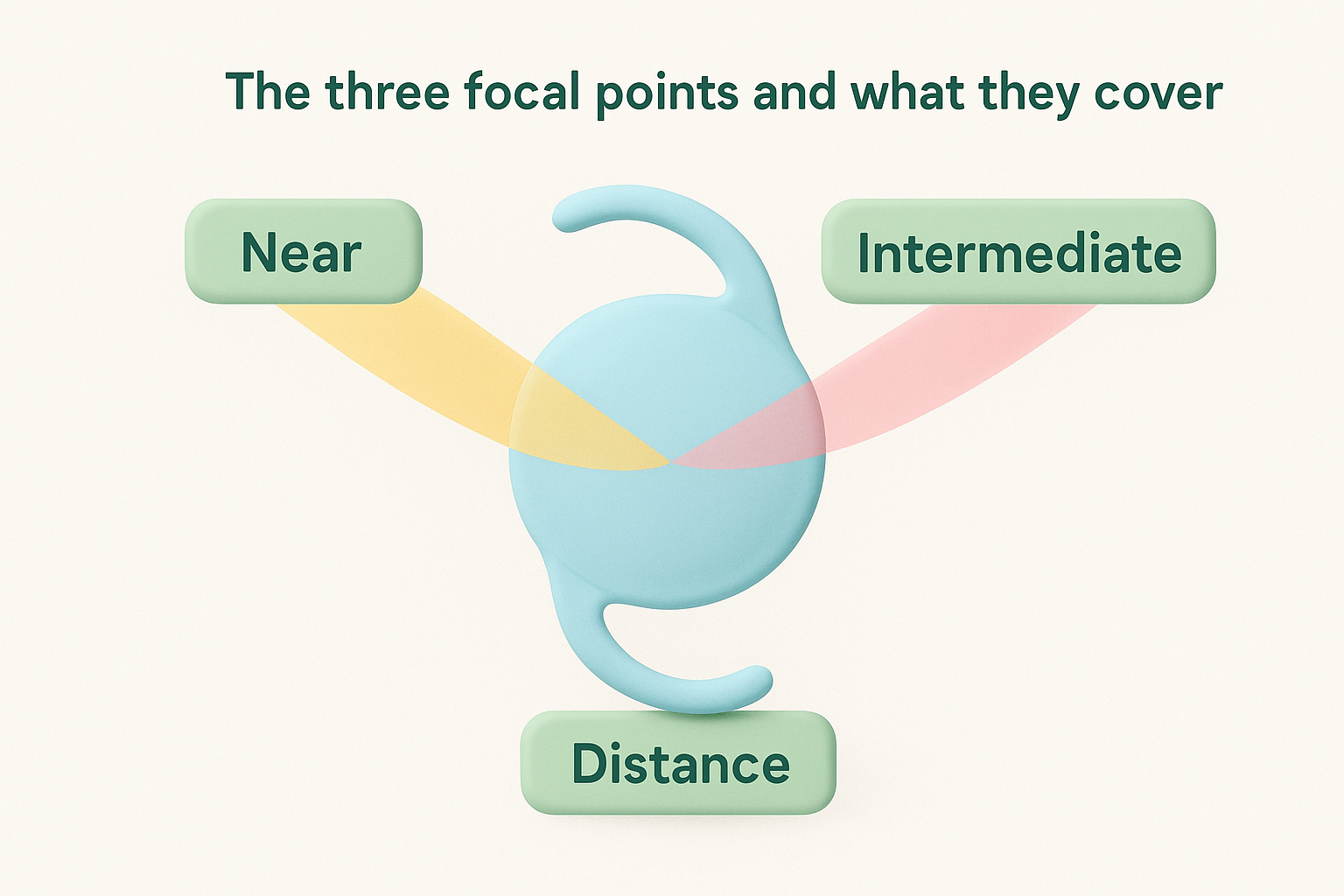
These distances were chosen based on real-world visual task research, not arbitrary optics. The gap between near and intermediate is closer together than in many older multifocal designs, which helps fill in the visual range more smoothly rather than leaving noticeable gaps between focal zones that patients must mentally compensate for.
Most patients report that the transition between focal distances feels natural rather than abrupt, which is one of the reasons this lens has become one of the most implanted trifocal designs worldwide.
How ENLIGHTEN Optical Technology manages light
The trifocal design works by splitting incoming light across the three focal points using a series of diffractive rings etched into the lens surface. The challenge with any light-splitting design is that distributing light means less of it reaches any single focal point. Alcon addressed this with ENLIGHTEN Optical Technology, which directs 88% of available light to the retina rather than losing it to internal scatter or diffraction waste.
This preservation of light matters practically because contrast sensitivity, your ability to distinguish objects against similar backgrounds, is what suffers most in poorly designed multifocal lenses. By retaining more usable light, the PanOptix maintains reasonable contrast at each focal distance, which translates to clearer, more reliable vision in lower-light conditions like restaurants or evening driving.
Benefits you can realistically expect day to day
The most important thing to understand about the PanOptix IOL is that its benefits are practical, not theoretical. Clinical studies and real-world outcomes consistently show that patients achieve meaningful independence from glasses across the three focal zones, but the degree of freedom you experience depends on your eye health going in and how your visual system adapts in the months after surgery.
Freedom from glasses across most daily tasks
The standout benefit most patients describe is waking up and getting through the bulk of their day without reaching for glasses at all. Reading a text message, checking your laptop, looking up at a television across the room, most of these tasks fall within the PanOptix’s three focal zones, and that coverage is what makes a real difference in day-to-day life.
Clinical data from Alcon’s trials showed that roughly 90% of patients with the PanOptix reported never or only occasionally needing glasses after surgery. That figure reflects consistent performance across reading distance, intermediate tasks, and distance vision in real-world conditions rather than controlled testing environments.
For the majority of patients, this level of glasses independence is a significant quality-of-life change, particularly for those who have worn correction for decades.
Clearer intermediate vision compared to older multifocals
One practical advantage of the trifocal design over older bifocal IOLs is stronger performance at the intermediate range. Screen time, cooking, and navigating around the house all sit in that 60 cm zone, and earlier multifocal lenses often left patients relying on glasses precisely for these tasks because they only addressed near and far.
With the PanOptix, the intermediate focal point fills in this gap directly rather than asking your brain to bridge the distance between two extremes. Patients who work at a computer, drive regularly, or spend significant time in the kitchen tend to notice this benefit clearly in the first weeks after surgery.
Performance that holds up in varied lighting
Your ability to see clearly does not vanish when the lighting drops. The ENLIGHTEN technology’s approach to retaining 88% of available light at the retina helps the PanOptix maintain useful contrast across focal distances in lower-light settings like indoor restaurants, shopping centres, or evening tasks at home.
This contrast retention is what separates the PanOptix from older diffractive designs that left patients struggling in dim conditions, and it is a consistent finding across independent outcome studies.
Downsides and side effects to understand upfront
The PanOptix IOL delivers strong results for most patients, but it comes with trade-offs that your surgeon should explain before you decide. Understanding these upfront helps you set realistic expectations and avoid being caught off guard by experiences that are completely normal but can feel alarming if you weren’t prepared for them.
Night vision disturbances after surgery
The most commonly reported side effect with the PanOptix is visual disturbances in low-light conditions, particularly at night. Many patients notice halos, glare, or starbursts around light sources such as headlights, street lamps, and lit signs in the early weeks and months after surgery. These effects are a direct result of the diffractive ring structure built into the lens, which splits light across the three focal points.
For most patients, these disturbances reduce significantly over the first three to six months as the brain adapts to interpreting the new visual signal, a process called neuroadaptation. A smaller proportion of patients find that halos and glare persist at a level that remains noticeable, particularly during night driving. If you do a lot of night driving professionally or regularly in low-visibility conditions, this is worth discussing in detail with your surgeon before committing.
Night vision disturbances are the most common reason patients express regret after premium IOL surgery, which makes setting accurate expectations beforehand one of the most important parts of the consultation.
Reduced contrast sensitivity in some conditions
Beyond halos, some patients notice a mild reduction in contrast sensitivity, particularly in very dim or very bright conditions. This differs from night glare in that it affects the crispness of images rather than creating visual artefacts. Most patients do not find this functionally limiting, but those who depend on fine detail or high-contrast tasks, such as surgeons, photographers, or pilots, should factor this into their decision.
When the lens is not reversible
Unlike glasses or contact lenses, an IOL implant is designed to be permanent. While explantation is technically possible, it carries surgical risk and is not a routine option if you simply decide the lens does not suit your lifestyle. This means the decision you make before surgery carries real weight, and it reinforces the importance of being honest with your surgeon about how you actually use your eyes day to day, not how you think you should use them.
Who PanOptix IOL is for and who should avoid it
Knowing whether the PanOptix IOL suits you comes down to a combination of your eye health, your visual demands, and your tolerance for the trade-offs covered in the previous section. No surgeon can make this determination from a website alone, but understanding the general profile of patients who do well with this lens, and those who do not, helps you walk into your consultation with better questions and clearer thinking.
Patients who tend to do well with this lens
The PanOptix performs most reliably in patients with healthy eyes and no significant pre-existing conditions beyond the cataract or refractive error being treated. If your corneas are regular in shape, your retina is healthy, and you have no history of significant dry eye, glaucoma, or previous refractive surgery like LASIK, you are starting from a strong position.
Patients who are highly motivated to reduce their dependence on glasses, and who accept that night glare is a likely early experience, consistently report the strongest satisfaction with this lens.
From a lifestyle perspective, the ideal candidate spends meaningful time across all three focal distances during a typical day, reading, using a screen, and moving around in the world. If your daily life genuinely requires reliable near, intermediate, and distance vision without switching glasses, the trifocal design is built for exactly that pattern of use.
Who should think carefully before choosing this lens
Some patients are poor candidates for diffractive trifocal designs regardless of how motivated they are. Significant dry eye disease reduces the optical quality of any premium lens and can amplify glare and visual disturbance. Irregular corneal surfaces, whether from keratoconus or previous refractive procedures, can produce unpredictable outcomes with a diffractive lens and often make a monofocal or EDOF lens a safer choice.
Patients with macular disease, glaucomatous damage, or diabetic macular oedema should approach trifocal lenses cautiously. The reduced contrast sensitivity that comes with any light-splitting design is less tolerable when your retina or optic nerve is already under strain.
When your job or hobbies shift the calculation
Your visual demands outside normal daily life matter. Professional night drivers, pilots, and people who work extensively in low-light or high-contrast environments should weigh the risk of persistent halos more carefully than someone who rarely drives after dark. Equally, patients whose work requires extremely fine detail at very specific distances may find a customised monofocal or EDOF arrangement delivers more predictable performance for their specific needs.
PanOptix IOL cost in Australia and what affects it
The total cost of PanOptix IOL surgery in Australia varies depending on your insurance level, your surgeon, and the hospital or surgical centre involved. Understanding what each component covers helps you avoid surprises and compare quotes accurately when you’re working out what this procedure will actually cost you.
What Medicare and private health insurance cover
Medicare provides a rebate for cataract surgery as a recognised procedure, which covers part of the surgeon’s fee. If you hold appropriate-level private health insurance that includes cataracts, your fund typically covers the hospital and anaesthetist costs, reducing or eliminating those out-of-pocket expenses entirely.
The level of hospital cover you hold matters significantly here, as not all private health policies include cataract surgery, and waiting periods may apply if you’ve recently joined or upgraded.
What neither Medicare nor private health insurance covers is the cost difference between a standard monofocal lens and a premium trifocal lens like the PanOptix. This upgrade cost is treated as an additional charge beyond the base procedure, and you pay it regardless of your insurance situation.
The premium lens upgrade and out-of-pocket costs
The out-of-pocket cost for upgrading to the PanOptix IOL in Australia typically falls somewhere between $1,500 and $3,000 per eye above what insurance covers, though this varies between practices and surgeons. Some practices offer clearly structured pricing that separates the lens upgrade fee from all other surgical costs, which makes it easier to understand exactly what you’re paying for before you commit.
At Bright Sight Eye Specialists in Randwick, transparent pricing is central to how consultations work, so you receive a clear breakdown of costs upfront rather than discovering additional charges later. Most procedures are structured as no-gap or known-gap for insured patients.
Factors that affect the final figure
Several variables shift the total price of panoptix iol surgery from one patient to the next. Your health fund tier and hospital cover level determine how much the fund absorbs. The surgical centre location, whether it’s a private day surgery or a major hospital, also affects facility fees. Surgeon experience and demand influence the professional fee component.
One factor patients often overlook is the cost of any additional procedures performed at the same time, such as correcting astigmatism with limbal relaxing incisions or laser refinement post-operatively. Asking your surgeon to outline all potential costs during the consultation gives you an accurate picture before you decide.

Your next step
The PanOptix IOL offers genuine glasses independence for most patients who choose it, but it works best when the decision is built on accurate information rather than assumption. You now understand how the lens splits light across three focal distances, what night-time disturbances to expect, which eye conditions shift the risk profile, and what the out-of-pocket costs look like in Australia. That puts you in a much stronger position to have a direct, productive conversation with a surgeon rather than working through it blind in a consultation room.
If you are considering cataract surgery or refractive lens exchange and want to know whether this lens suits your eyes and your lifestyle, the next step is a proper assessment. Dr Rahul Dubey and Dr Capucine Odouard at Bright Sight Eye Specialists in Randwick review your eye health, discuss your visual goals honestly, and give you clear pricing upfront. Book a consultation with our team to get started.