


Dry eyes can make even simple tasks, reading, driving, working at a screen, genuinely uncomfortable. If you’ve been searching for relief, there’s a good chance you’ve come across omega 3 supplements for dry eyes as a potential solution. The evidence behind them is worth understanding, because not all supplements are equal, and the difference between an effective dose and a wasted purchase is significant.
At Bright Sight Eye Specialists in Randwick, Dr Rahul Dubey and Dr Capucine Odouard regularly discuss omega-3 supplementation with patients managing dry eye symptoms. It’s a conversation that comes up often, particularly around which formulations actually work, how much you need to take, and whether supplements alone are enough to make a real difference.
This article breaks down what the current research says about omega-3s and dry eye disease, covers the recommended dosages backed by clinical evidence, and looks at specific brands available in Australia. Whether you’re exploring supplements for the first time or trying to figure out if the one you’re already taking is doing anything useful, you’ll find straightforward answers here.
Why omega-3 matters for dry eye
Dry eye disease isn’t simply a lack of tears. Most cases involve a problem with the quality of the tear film, specifically the oily outer layer that keeps tears from evaporating too quickly. Understanding this distinction matters because it explains why omega-3 fatty acids target the underlying cause of the most common type of dry eye, rather than just masking symptoms the way artificial tears do.
The tear film and how it breaks down
Your tear film has three layers: a mucin layer that helps tears stick to the surface of the eye, a watery middle layer, and an outer lipid (oil) layer that slows evaporation. This oil layer is produced by the meibomian glands, small glands that line the edges of your upper and lower eyelids. When these glands become blocked, inflamed, or dysfunctional, the oil they produce thickens or decreases in volume, and the tear film breaks apart faster than it should.

This condition is called evaporative dry eye, and it accounts for the large majority of dry eye cases seen in clinical practice. When the tear film breaks down rapidly, the surface of the eye is repeatedly exposed, triggering irritation, redness, light sensitivity, and that persistent gritty or burning feeling that makes screen time and reading genuinely difficult.
Meibomian gland dysfunction is the most common driver of evaporative dry eye, and the health of those glands is directly influenced by the fatty acids circulating in your body.
How omega-3 fatty acids work at the tissue level
Omega-3 fatty acids, particularly eicosapentaenoic acid (EPA) and docosahexaenoic acid (DHA), are incorporated into cell membranes throughout the body, including the tissues of the eyelid margin and ocular surface. When your body has adequate EPA and DHA, it produces anti-inflammatory signalling molecules called resolvins and protectins. These molecules help reduce the chronic low-grade inflammation that drives meibomian gland dysfunction and accelerates tear film instability.
Clinical research has also found that omega-3 supplementation can improve the secretion quality of the meibomian glands, producing a thinner, more fluid oil that spreads evenly across the tear film rather than clogging the gland openings. This is precisely why eye specialists include omega 3 supplements for dry eyes as part of a structured management plan rather than treating them as a general wellness product with no specific mechanism.
ALA versus EPA and DHA: why the source matters
A third omega-3, alpha-linolenic acid (ALA), is found in plant-based foods such as flaxseed, chia seeds, and walnuts. Your body can convert ALA into EPA and DHA, but this conversion is highly inefficient, typically producing less than 10% of the EPA and DHA that a direct marine source provides. For most people, relying solely on ALA from diet or plant-based supplements is unlikely to produce the tissue concentrations needed to influence meibomian gland function meaningfully. Marine-sourced supplements containing preformed EPA and DHA are consistently the formulations used in clinical trials showing positive outcomes for dry eye.
Do omega-3 supplements actually help dry eyes
The short answer is: yes, for most people with evaporative dry eye, omega-3 supplementation produces measurable improvements, but the results depend heavily on the formulation you use and how consistently you take it. The research picture is broadly positive, though it comes with some nuance worth understanding before you spend money on a bottle.
What the clinical research shows
Multiple randomised controlled trials have found that EPA and DHA supplementation improves tear film stability, reduces ocular surface inflammation, and decreases dry eye symptom scores compared to placebo. A significant 2019 study published in the journal Ophthalmology found that patients taking re-esterified triglyceride omega-3 supplements reported meaningful reductions in symptoms and showed improved tear breakup times after three months of consistent use. Improvements in meibomian gland secretion quality have also been documented across several independent studies, which aligns with what you’d expect given the mechanism described above.
The form of omega-3 used in a supplement matters as much as the dose: re-esterified triglyceride formulations show higher bioavailability than ethyl ester forms in head-to-head comparisons.
Where the evidence has limitations
Not every study has returned positive results. The DREAM trial, a large well-funded US study published in 2018, found no significant difference between omega-3 and olive oil placebo groups in dry eye symptom scores. This result caused considerable debate, partly because olive oil itself has mild anti-inflammatory properties, which may have reduced the visible difference between groups. Most independent researchers argue the DREAM trial doesn’t overturn the broader body of evidence, but it does highlight that omega-3 supplements for dry eyes are not a guaranteed fix for every patient.
Your response will depend on the severity and underlying cause of your dry eye, your baseline omega-3 intake from diet, and the specific product you take. For many patients, omega-3 works best as one component of a broader management plan rather than a standalone treatment.
How much omega-3 to take for dry eyes
Getting the dose right is where many people go wrong. They pick up a generic fish oil capsule at the supermarket, take it occasionally, and then conclude that omega 3 supplements for dry eyes don’t work. In most cases, the problem is neither the concept nor the person, it’s that the dose was too low and the duration too short to produce any measurable effect.
The recommended daily dose
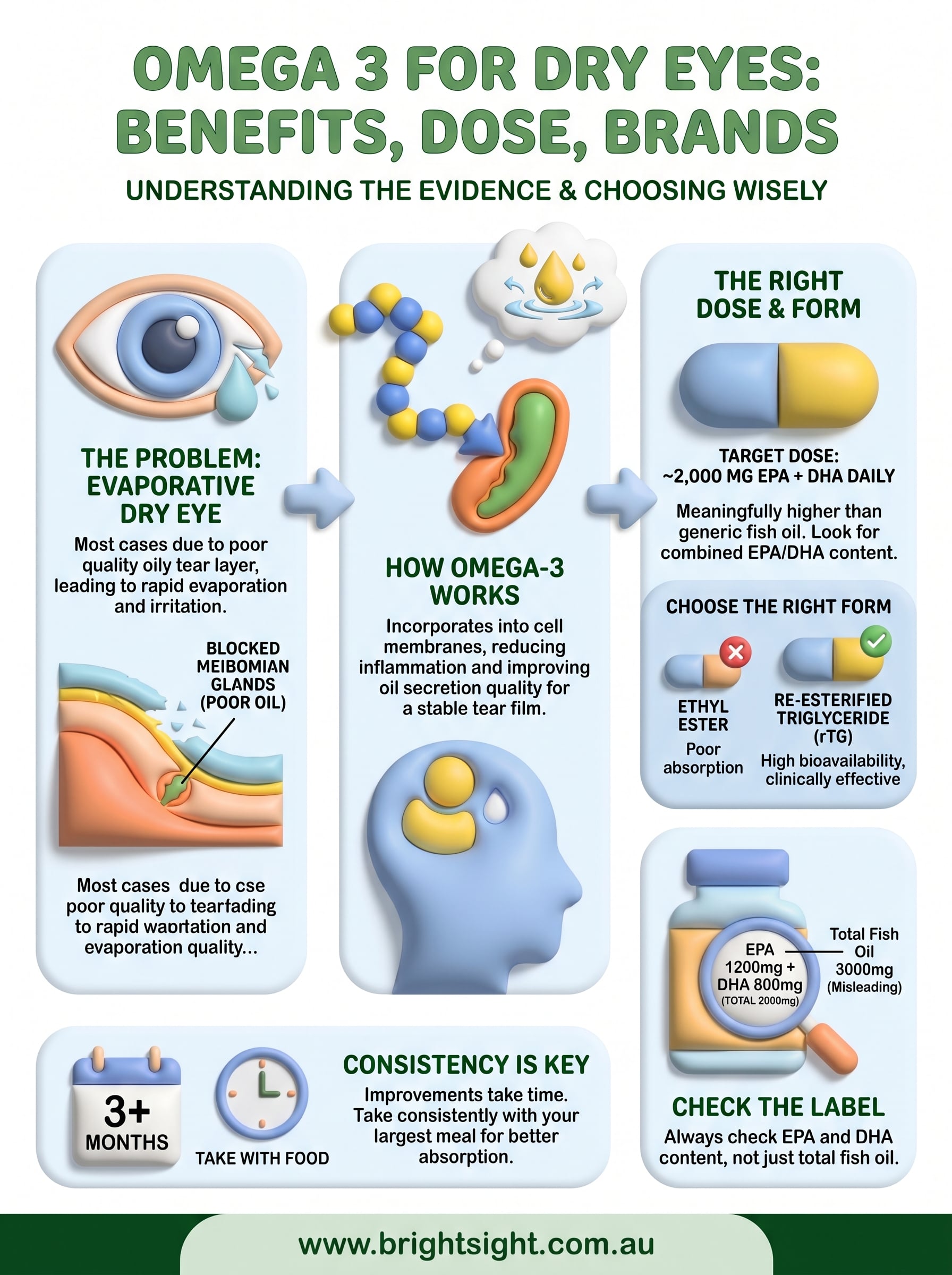
Most clinical trials that showed positive results for dry eye used a combined EPA and DHA dose of between 1,000 mg and 3,000 mg per day. The commonly cited target is around 2,000 mg of combined EPA and DHA daily, split across two doses to improve absorption. This is a meaningfully higher amount than what most standard fish oil capsules provide. A typical 1,000 mg fish oil softgel might contain only 300 mg of combined EPA and DHA, meaning you’d need to take six or more capsules daily to reach the therapeutic range.
Always check the label for the actual EPA and DHA content, not just the total fish oil weight, as these two numbers are frequently confused by consumers.
The ratio of EPA to DHA also appears to matter. Studies specifically targeting ocular surface inflammation tend to favour formulations with a higher EPA ratio, such as 3:2 or 2:1 EPA to DHA, as EPA is more directly involved in the anti-inflammatory pathways relevant to the meibomian glands.
Timing and consistency
Omega-3s are fat-soluble, so taking them with your largest meal of the day significantly improves absorption. Taking them on an empty stomach reduces how much your body actually uses and increases the likelihood of the fishy aftertaste that puts many people off continuing.
Consistency over time is essential. Most clinical trials ran for a minimum of three months before measuring outcomes, which reflects how long it takes for omega-3s to meaningfully alter cell membrane composition and meibomian gland secretion quality. Starting a supplement and expecting results within two weeks is not realistic.
How to choose a quality omega-3 supplement
The supplement aisle offers dozens of fish oil products at wildly different price points, and the variation in quality is significant. When you’re using omega 3 supplements for dry eyes as part of a treatment plan, choosing the right formulation directly affects whether you’ll see any benefit at all. Two products might both say "1,000 mg fish oil" on the front label and deliver entirely different clinical results.
Form: triglyceride versus ethyl ester
The majority of budget fish oil supplements are processed into an ethyl ester form, which is cheaper to manufacture but absorbs less efficiently in the body. Re-esterified triglyceride (rTG) formulations are closer to the natural form found in fish tissue, and clinical comparisons consistently show superior bioavailability, meaning more EPA and DHA actually reaches your tissues at an equivalent dose.
If you want to match the formulations used in clinical trials that showed positive outcomes for dry eye, look specifically for re-esterified triglyceride on the product label.
What to check on the label
Reading the label properly saves you from the most common mistake people make when buying fish oil. Check the total EPA and DHA content per serving, not the total fish oil weight listed prominently on the front. A capsule advertised as "1,000 mg omega-3" may contain far less active ingredient than you expect once you read the fine print on the back.
You should also look for third-party testing certification, such as IFOS (International Fish Oil Standards) or NSF International, which confirms the product has been independently tested for heavy metals, oxidation, and actual EPA and DHA content. Oxidised fish oil is not only ineffective but may increase inflammation rather than reduce it, so freshness matters. Check the oxidation markers (TOTOX value) if the brand publishes them, and look for products with added vitamin E (tocopherol), which acts as a natural preservative and helps keep the oil stable.
Side effects and who should be cautious
For most people, omega 3 supplements for dry eyes are well-tolerated at the doses used in clinical practice. That said, knowing what to expect, and when to pause before starting, helps you use them safely and get the most out of them.
Common side effects
The most frequently reported side effect is a fishy aftertaste or fishy burps, which is largely a sign of poor product quality or taking the supplement on an empty stomach. Switching to a higher-quality re-esterified triglyceride formulation and taking it with food tends to resolve this for most people. Loose stools or mild gastrointestinal discomfort can also occur, particularly when you first start or increase your dose. Starting at a lower dose and gradually increasing over two to three weeks usually avoids this.
If you experience persistent digestive symptoms beyond the first two weeks, try splitting your daily dose across two meals rather than taking the full amount at once.
Who should check with their doctor first
Omega-3 supplements can have mild blood-thinning effects at higher doses, which is worth discussing with your GP or specialist if you take anticoagulant medications such as warfarin or newer blood thinners. The interaction is generally modest at therapeutic dry eye doses, but your doctor should be aware of everything you’re taking.
People with fish or shellfish allergies need to check the source of any marine omega-3 product carefully before use. Some formulations are derived from algae rather than fish, which provides a suitable alternative if fish allergy is a concern. Algae-based DHA supplements also carry a lower risk of heavy metal contamination, though this risk is already minimal in third-party tested fish oil products.
Pregnant or breastfeeding women should confirm appropriate doses with their treating clinician, as omega-3 requirements and upper limits during pregnancy differ from standard guidance.
Key takeaways and next steps
Omega 3 supplements for dry eyes work best when you choose the right formulation, take the right dose, and stick with it consistently for at least three months. Re-esterified triglyceride products with 2,000 mg of combined EPA and DHA daily, taken with food, are the formulations most closely aligned with the clinical evidence. They work by reducing meibomian gland inflammation and improving the quality of your tear film’s oil layer, which is the root problem for most people with evaporative dry eye.
Supplements support treatment, but they rarely replace it entirely. If your symptoms are persistent, worsening, or affecting your daily life, a proper assessment by an eye specialist will identify whether there are other factors contributing to your dry eye that supplements alone won’t address. Book an appointment with Dr Dubey or Dr Odouard at Bright Sight Eye Specialists in Randwick to get a clear picture of what your eyes actually need.