


If your vision isn’t what it used to be, or you’re tired of relying on glasses and contact lenses, new eye lens surgery may be the solution you’ve been researching. This procedure involves removing your eye’s natural lens and replacing it with a clear artificial intraocular lens (IOL), and it’s now one of the most commonly performed surgeries in Australia. Whether you’re dealing with cataracts or exploring refractive lens exchange to correct your vision, the technology behind lens replacement has advanced significantly in recent years.
At Bright Sight Eye Specialists in Randwick, Dr Rahul Dubey and Dr Capucine Odouard perform lens replacement surgery using the latest techniques and premium IOL options. Both surgeons trained at internationally recognised institutions, and the practice offers transparent pricing with no-gap cataract surgery for eligible insured patients, something that matters when you’re weighing up a procedure like this.
This article covers how eye lens surgery works, the different types of IOLs available (including multifocal and extended depth of focus lenses), what recovery looks like, and the costs involved. By the end, you’ll have a clear picture of whether this procedure suits your eyes, your lifestyle, and your goals.
Why people choose new eye lens surgery
People come to new eye lens surgery for two main reasons: cataracts have made their vision too difficult to manage, or they want to reduce their reliance on glasses and contact lenses. Both are valid, and both are increasingly common as lens technology improves and more Australians understand what modern surgery can offer.
When cataracts affect daily life
A cataract forms when your eye’s natural lens becomes cloudy, usually due to ageing. The result is blurred vision, glare around lights at night, faded colours, and difficulty reading even with a strong prescription. Many people manage early cataracts by updating their glasses, but there comes a point where surgical lens removal is the only effective treatment.
Cataract surgery is the most commonly performed elective surgery in Australia, and it reliably restores clear vision once the natural lens has clouded beyond the point of optical correction.
Once your surgeon removes the cloudy lens, they replace it with a clear IOL matched to your prescription. Most people notice a significant improvement within days, and many find they need glasses far less than before, depending on the lens type they select.
When you want freedom from glasses
Refractive lens exchange (RLE) follows exactly the same surgical steps as cataract surgery, but the goal is different. Rather than treating a cloudy lens, you’re replacing a clear but optically limited lens to correct long-sightedness, short-sightedness, or presbyopia (age-related difficulty with near focus). This makes it a popular choice for people in their 40s and 50s who aren’t suitable candidates for laser surgery, often because of high prescriptions or early lens changes.
RLE is also worth considering if you want to avoid cataracts later in life, since an artificial IOL cannot cloud the way a natural lens does. Your surgeon will assess your prescription, corneal health, and lifestyle goals before recommending it as the right path for you.
How cataract surgery and RLE work
Both cataract surgery and refractive lens exchange (RLE) follow the same core process. Your surgeon removes the natural lens from inside your eye and replaces it with a precisely selected artificial intraocular lens. The difference lies in the reason for doing it, not the technique itself.
The surgical steps
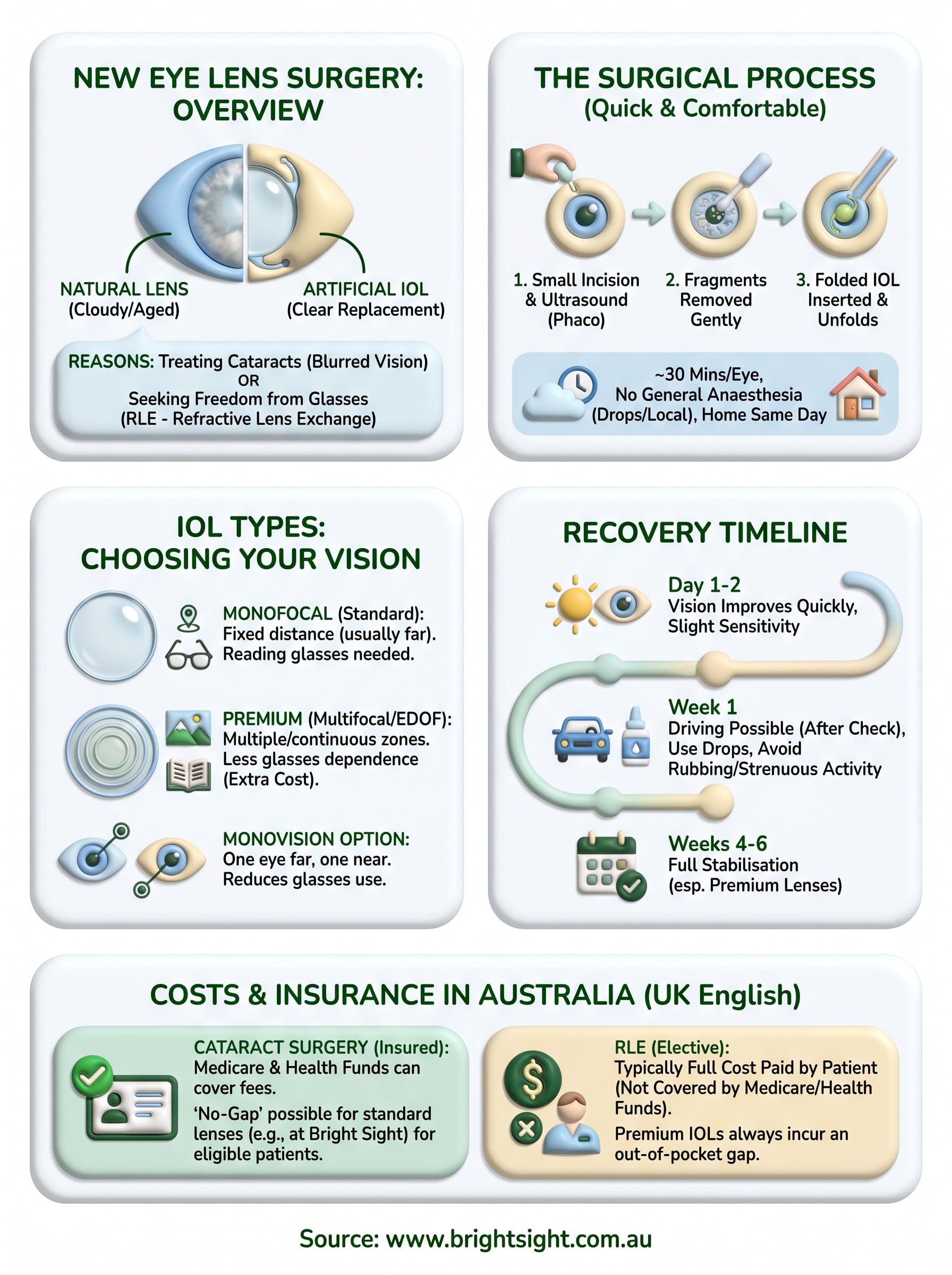
Your surgeon makes a small incision at the edge of the cornea, then uses ultrasound energy (phacoemulsification) to break up the natural lens into tiny fragments and gently remove them. Once the lens is cleared, they insert a folded IOL through the same small opening. The lens unfolds and sits within the eye’s natural lens capsule, where it stays permanently. Most procedures take under 30 minutes per eye, and surgeons typically operate on one eye at a time.
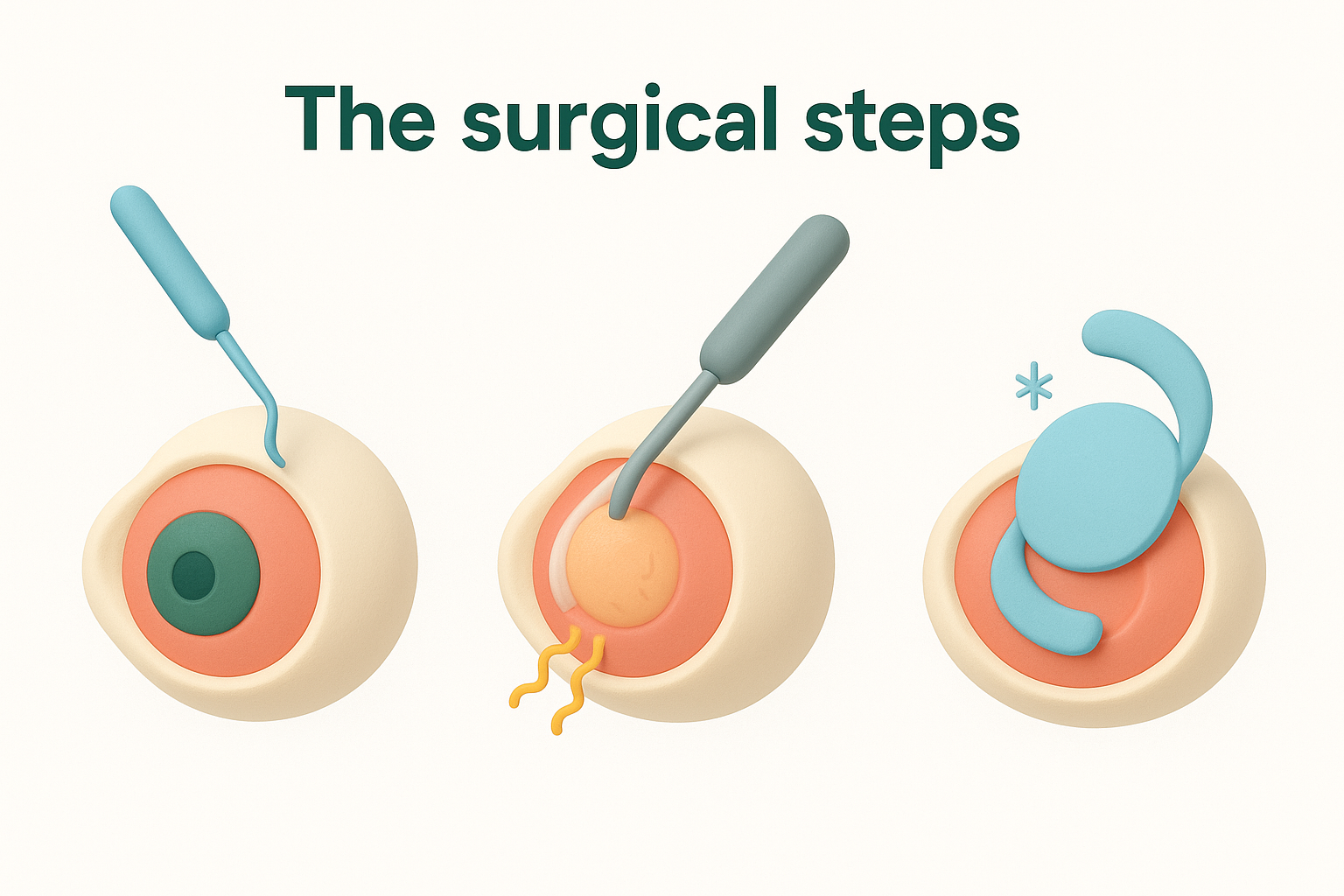
New eye lens surgery does not require general anaesthesia in most cases; your surgeon uses numbing eye drops or a local injection so you remain awake but completely comfortable throughout.
What happens in theatre
On the day, you arrive at the surgical centre, and the team prepares your eye with dilating and anaesthetic drops. You lie still under the microscope while your surgeon works through the incision. You may see light and movement, but you will not feel pain. After surgery, your eye is covered with a protective shield, and you go home the same day to rest.
IOL types and how to choose the right one
The lens your surgeon implants during new eye lens surgery has the biggest influence on your visual outcome. Choosing the right IOL depends on your prescription, corneal health, and lifestyle, and your surgeon will guide you through the options at your consultation.

Monofocal lenses
A monofocal IOL corrects vision at one fixed distance, usually set for distance. You will typically still need reading glasses for close tasks, but your distance vision will be reliably sharp. These lenses are covered under Medicare and most private health insurance, making them the standard choice for the majority of cataract patients.
Most surgeons also offer monovision, where one eye is set for distance and the other for near. Many patients adapt well to this approach and find it significantly reduces their day-to-day need for glasses.
Premium lenses: multifocal and EDOF
Multifocal IOLs divide light between near and far focal points, giving you useful vision across multiple distances without glasses. Extended depth of focus (EDOF) lenses take a different approach by stretching your clear vision into a continuous zone, which tends to produce fewer halos and glare than traditional multifocal designs.
Premium lenses suit active patients who want to minimise dependence on glasses, but they carry an additional out-of-pocket cost and are not suitable for everyone, particularly those with significant corneal irregularities.
Your surgeon will review your corneal measurements and daily vision demands before recommending the IOL that best matches your goals.
Recovery timeline and possible complications
Most people recover quickly from new eye lens surgery, with noticeable vision improvement often appearing within 24 to 48 hours of the procedure. Your eye may feel slightly gritty or sensitive to light in the first day or two, but serious discomfort is uncommon.
What to expect in the first week
Your surgeon will prescribe antibiotic and anti-inflammatory eye drops to use for several weeks after surgery. Most patients return to light daily activities within a day or two, and driving is usually possible once your surgeon confirms your vision is safe, typically within the first week. During the initial healing period, you should avoid:
- rubbing or touching your eye
- swimming or using spa pools
- dusty or smoky environments
- strenuous physical activity
Full visual stabilisation can take up to four to six weeks, particularly with a premium multifocal or EDOF lens, as your brain adapts to the new optics.
Possible complications to know about
Serious complications from lens surgery are uncommon, but knowing the risks helps you make an informed decision. The most frequent issue is posterior capsule opacification, where the membrane behind the IOL gradually clouds over months or years. Treatment involves a quick, painless laser procedure performed in the clinic.
Other rare risks include infection, raised eye pressure, and retinal detachment. Your surgeon will explain each of these at your pre-operative appointment and confirm whether your eye health makes you a safe candidate.
Costs in Australia and what affects your gap
The cost of new eye lens surgery in Australia varies depending on whether you have private health insurance, which lens type you choose, and your surgeon’s individual fee structure. Medicare covers a portion of the surgeon’s fee and the anaesthetist’s fee for cataract surgery, but it does not cover premium IOLs or the hospital facility component without private health cover in place.
Private health insurance and Medicare
If you hold hospital cover, your insurer typically pays the hospital facility fee for cataract surgery, which means you may face little or no out-of-pocket cost when your surgeon offers a no-gap arrangement. At Bright Sight Eye Specialists, eligible insured patients can access no-gap cataract surgery, which removes the financial uncertainty from the decision entirely.
RLE is generally not covered by Medicare or private health insurance because it is considered an elective refractive procedure, so you pay the full cost directly.
What drives your out-of-pocket cost
Your gap payment, if any, comes down to three factors: your surgeon’s fee relative to the Medicare Benefits Schedule, your health fund’s benefit level, and the IOL you select. Standard monofocal lenses attract the lowest out-of-pocket cost, while premium multifocal and EDOF lenses carry an additional charge that reflects the technology involved. Your surgeon will provide a written fee estimate before you commit to anything, so there are no surprises on the day of surgery.
Next steps
By now you have a solid understanding of new eye lens surgery, from the types of IOLs available to what recovery involves and how costs break down in Australia. The next move is straightforward: speak with a qualified eye surgeon who can assess your specific prescription, corneal health, and vision goals before recommending the right lens and procedure for you.
Both Dr Rahul Dubey and Dr Capucine Odouard at Bright Sight Eye Specialists in Randwick bring extensive surgical experience and a patient-centred approach to every consultation. They will walk you through your options, explain the fees upfront, and answer any questions you have before you commit to anything. Eligible insured patients can access no-gap cataract surgery, and the team also sees patients from regional areas via telehealth.
If you are ready to take the next step, book a consultation with Bright Sight Eye Specialists and find out which lens option suits your eyes and lifestyle.