


If you’re facing cataract surgery and dreaming of life without glasses, you’ve likely come across multifocal cataract lenses as a potential solution. These premium intraocular lenses promise clear vision at multiple distances, near, intermediate, and far, potentially freeing you from the constant reach for reading glasses or bifocals. It sounds ideal, but the reality is more nuanced than the marketing suggests.
The truth is, multifocal lenses aren’t right for everyone. While many patients achieve excellent results, others experience visual disturbances, particularly halos and glare around lights at night, that can make driving after dark uncomfortable. Understanding these trade-offs before surgery is essential, not optional. The decision between multifocal, monofocal, or extended depth of focus (EDOF) lenses depends on your lifestyle, visual demands, and tolerance for potential side effects.
At Bright Sight Eye Specialists, Dr Rahul Dubey helps patients in Sydney’s Eastern Suburbs navigate these choices with honest, transparent guidance. This article breaks down how multifocal lenses work, their genuine advantages and disadvantages, what to expect with night vision, and how to determine whether you’re a suitable candidate for this technology. By the end, you’ll have the information needed to have a more informed conversation with your eye surgeon about which lens option aligns with your goals.
Why lens choice matters in cataract surgery
The lens you choose during cataract surgery becomes a permanent part of your eye, so getting this decision right the first time carries genuine weight. Unlike glasses or contact lenses you can swap out if they don’t suit you, your intraocular lens (IOL) stays in place for the rest of your life. While lens exchange is technically possible, it involves additional surgery with increased risks, making it a path you’d much rather avoid. This permanence elevates lens selection from a simple choice to a crucial decision that shapes how you’ll see the world for decades.
Your surgeon removes the clouded natural lens and replaces it with an artificial one, but that replacement lens doesn’t automatically restore vision the way your young, healthy eye once worked. Each lens type offers different optical properties, trade-offs, and visual outcomes. The standard monofocal lens provides excellent distance vision but requires reading glasses for close work. Multifocal cataract lenses aim for spectacle independence across distances but may introduce visual artefacts. Extended depth of focus (EDOF) lenses split the difference, offering a middle ground that suits many patients but may still need glasses for fine print.
The permanent nature of your lens decision
Once your surgeon implants an IOL, it doesn’t degrade or need replacement under normal circumstances. The lens becomes integrated into your eye’s anatomy, sitting in the same capsular bag that held your natural lens. This permanence means any visual compromises or side effects you experience, such as halos around lights or reduced contrast sensitivity, become part of your daily visual experience indefinitely.
Exchanging an IOL after the initial surgery introduces complications. The procedure requires reopening the eye, which carries risks including infection, retinal detachment, and corneal swelling. Your capsular bag may have scarred or contracted, making the second surgery technically more challenging than the first. Surgeons generally avoid IOL exchanges unless the visual compromise severely impacts quality of life, which underscores why making an informed choice initially matters so much.
How your vision goals shape the best option
Your daily activities directly influence which lens serves you best. If you spend hours reading contracts, designing graphics, or working with detailed spreadsheets, near vision quality becomes non-negotiable. Conversely, if you drive long distances regularly, play golf, or enjoy birdwatching, prioritising crisp distance vision without visual disturbances makes more sense.
Multifocal lenses suit patients willing to trade perfect optical quality for the convenience of reduced spectacle dependence. You might accept some halo or glare in exchange for reading restaurant menus or checking your phone without glasses. However, if your profession demands perfect night vision, such as commercial driving or aviation, or if you’re particularly sensitive to visual aberrations, a monofocal lens with reading glasses might deliver better outcomes.
The lens that works brilliantly for your neighbour might frustrate you daily because your visual demands and tolerance for optical trade-offs differ fundamentally.
The financial implications of premium lenses
Standard monofocal lenses typically fall under Medicare and private health insurance coverage with minimal or no gap fees for most insured patients. Premium options like multifocal or EDOF lenses attract additional out-of-pocket costs, often ranging from several hundred to several thousand dollars per eye, depending on the specific lens technology and your insurance coverage.
These costs matter because you’re paying for potential convenience, not guaranteed perfection. Some patients invest in premium lenses and achieve spectacular results, happily abandoning glasses for most tasks. Others find the visual side effects intolerable and end up wearing glasses anyway, effectively paying twice for their vision correction. Understanding both the financial commitment and the realistic visual outcomes before surgery prevents buyer’s remorse that you can’t easily undo.
At Bright Sight Eye Specialists, Dr Dubey provides transparent pricing and realistic expectations about what each lens type delivers, ensuring you understand both the financial and visual investment you’re making. This honesty helps you align your expectations with likely outcomes before you commit to surgery.
What multifocal cataract lenses are and how they work
Multifocal cataract lenses function like progressive glasses built directly into your eye. Unlike standard monofocal lenses that provide sharp vision at only one distance (typically far), multifocal intraocular lenses split incoming light into multiple focal points simultaneously. This optical design allows you to see clearly at near, intermediate, and far distances without constantly switching between different pairs of glasses. The lens achieves this by incorporating concentric rings or zones, each engineered to focus light from different distances onto your retina at the same time.
Your eye receives all these focal points simultaneously, which creates a unique visual experience. The lens doesn’t mechanically adjust like a camera lens or your natural eye once did. Instead, it presents your brain with multiple images at once, and your visual system learns to select the sharpest image for whatever you’re looking at. This process, called neuroadaptation, typically takes several weeks to months after surgery as your brain develops new neural pathways to interpret the simultaneous images efficiently.
The optical zones that create multiple focal points
Each multifocal lens contains precisely engineered concentric rings etched into the lens surface, alternating between different optical powers. The outer rings typically focus distant objects, while inner rings handle intermediate and near vision. When light enters your eye, these zones split it into separate focal points that land on different parts of your retina simultaneously.
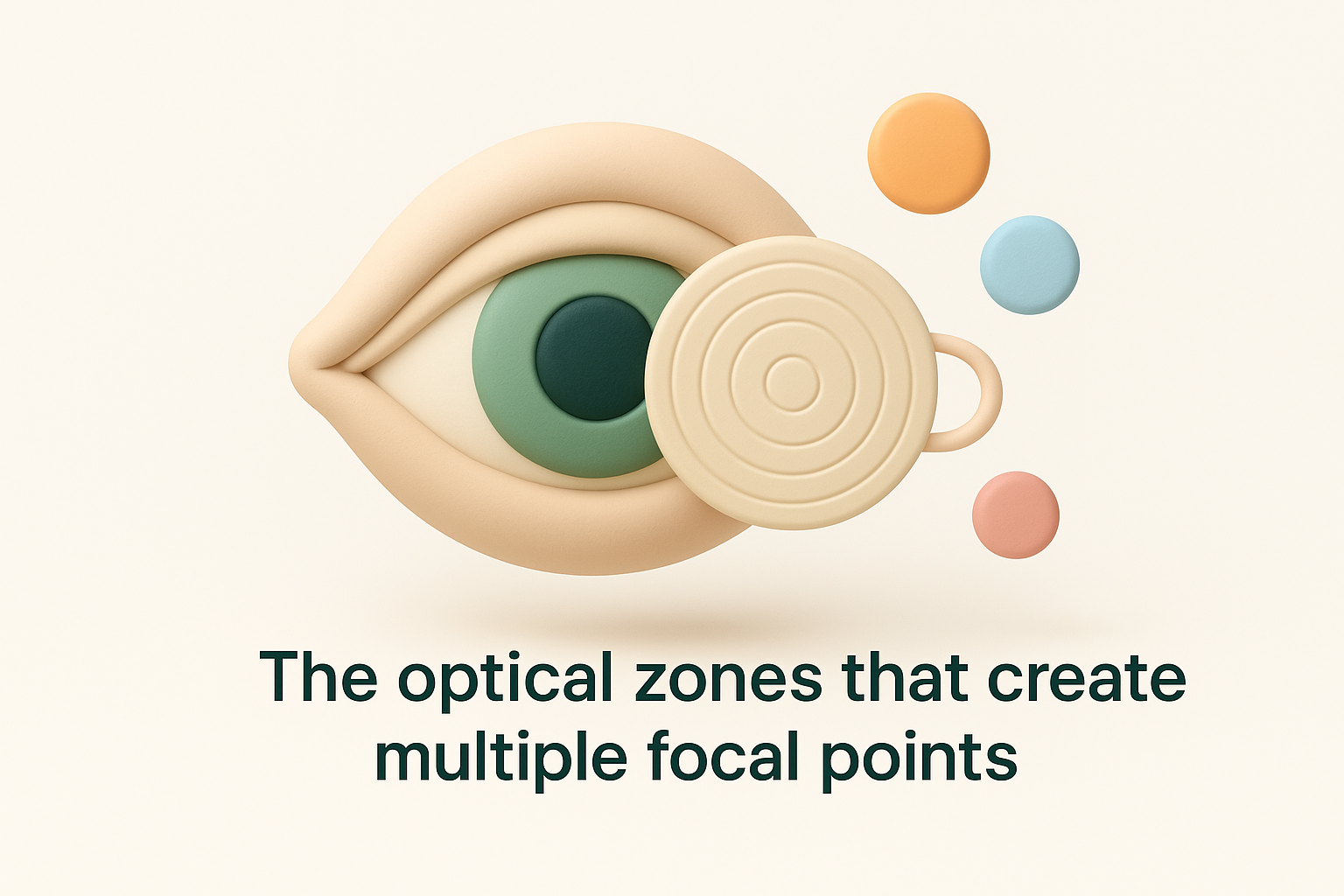
The specific design varies between manufacturers, but the principle remains consistent. Some lenses use diffractive optics, where microscopic steps on the lens surface bend light at different angles. Others employ refractive zones with varying curvatures. Both approaches aim to deliver usable vision across multiple distances, though each comes with distinct optical characteristics and potential side effects you’ll notice in different lighting conditions.
How your brain learns to select the right focus
Your brain doesn’t see the way a camera records images. Instead, it actively processes and filters visual information, suppressing what it deems irrelevant. With multifocal cataract lenses, your visual cortex receives overlapping focused and defocused images constantly. Over time, it learns to automatically select the clearest image for your current visual task while filtering out the blurred versions.
This neuroadaptation explains why multifocal lens outcomes improve significantly during the first three to six months after surgery, even though the lens itself hasn’t changed.
Younger, more neurologically flexible patients typically adapt faster than older individuals. Your success also depends on your pre-existing visual habits and expectations. Patients who previously wore progressive glasses often adapt more smoothly because their brains already developed similar filtering strategies. Those who primarily wore single-vision glasses may find the adjustment period more challenging and noticeable.
Pros and cons of multifocal cataract lenses
Understanding both sides of multifocal cataract lenses helps you set realistic expectations before surgery. These premium lenses deliver genuine benefits for many patients, but they also introduce optical compromises that monofocal lenses avoid. Your satisfaction ultimately depends on whether the advantages align with your daily visual needs and whether you can tolerate the inherent trade-offs that come with splitting light into multiple focal points.
The advantages you gain from multifocal lenses
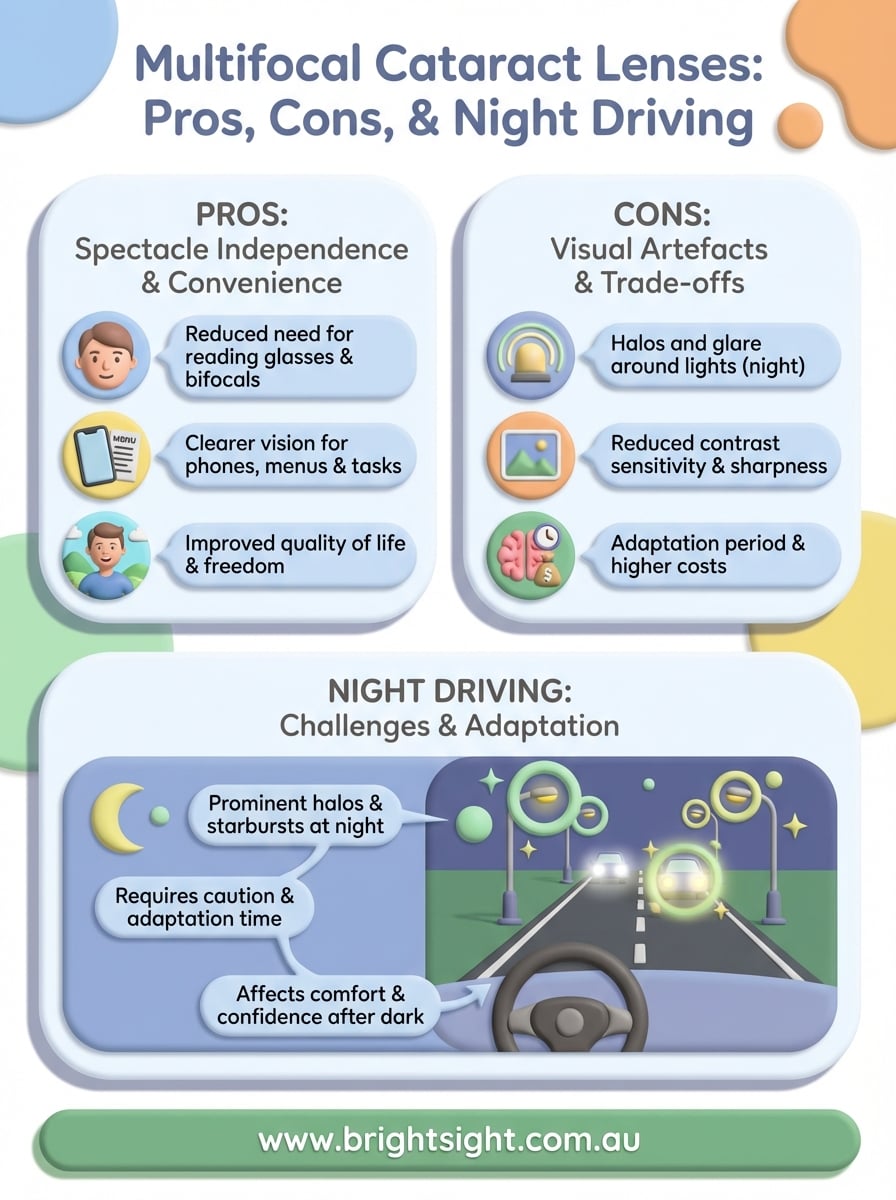
Spectacle independence represents the primary benefit most patients seek. You can read restaurant menus, check your smartphone, work on a computer, and drive without constantly reaching for different glasses. This convenience extends to spontaneous activities like reading price tags while shopping or checking your watch during meetings, tasks that would otherwise require you to carry reading glasses everywhere.

Many patients report improved quality of life from this freedom. You avoid the annoyance of misplaced glasses, the expense of multiple prescription pairs, and the physical discomfort of frames pressing on your nose and ears for hours daily. Active lifestyles particularly benefit, as you can swim, play sports, or travel without juggling optical accessories constantly.
The intermediate vision zone proves especially valuable for modern life. Computer screens, car dashboards, and kitchen counters all sit at this middle distance where traditional bifocals often struggle. Multifocal lenses provide functional vision at these ranges without the head-tilting and neck strain that progressive glasses sometimes demand.
The disadvantages and trade-offs
Visual artefacts represent the most common complaint. You’ll likely notice halos and glare around lights, particularly at night or in low-light environments. These optical phenomena result from the lens simultaneously focusing light at multiple points, creating scattered light patterns your brain can’t fully suppress. The effect ranges from mildly annoying to genuinely problematic depending on your individual visual system and lifestyle demands.
Reduced contrast sensitivity affects how you perceive fine details and subtle shading differences. Text may appear less crisp than with monofocal lenses, and facial features might seem slightly softer. This reduction stems from the optical compromises required to split light across multiple focal points, leaving less light energy concentrated at any single distance.
Not every patient achieves complete spectacle independence, even with premium multifocal lenses designed specifically for that purpose.
Adaptation varies significantly between individuals. Some patients adapt within weeks and thrive, while others struggle for months or never fully adjust to the simultaneous vision system. Your age, neurological flexibility, and previous visual habits all influence this adaptation period, making outcomes somewhat unpredictable despite careful patient selection.
Night driving and low-light vision
Night driving presents the most significant challenge for patients with multifocal cataract lenses. The halos, starbursts, and glare you might barely notice during daylight become prominent around streetlights, headlamps, and traffic signals after dark. Your pupils dilate in low light, allowing more peripheral rays to pass through the outer zones of your multifocal lens, which intensifies these optical phenomena. This physiological response means the visual disturbances you experience at night differ substantially from your daytime vision quality, catching many patients off guard when they first drive after sunset.
Why halos and glare appear at night
The concentric rings in multifocal lenses split light differently depending on which zones the light passes through. During the day, your pupil constricts to around 2 to 3 millimetres, using primarily the central lens zones and minimising diffraction effects. At night, your pupil expands to 5 to 7 millimetres or larger, engaging the outer diffractive zones that create more pronounced light scatter.

Each ring boundary acts as a miniature prism, bending light at slightly different angles. When intense point sources like headlamps or LED streetlights hit these boundaries, they create circular halos and radial starbursts that appear to surround the light source. Your brain cannot suppress these effects as effectively as the defocused images you experience during daytime reading, because the contrast between bright lights and dark backgrounds makes the artefacts more visually dominant.
Patients who drive professionally or frequently navigate rural roads without streetlighting find these night vision effects more problematic than those who primarily drive in well-lit urban environments during daylight hours.
Real-world impact on driving safety
Most patients with multifocal lenses can drive safely at night, but you’ll likely need additional adaptation time and increased caution initially. The halos don’t block your view of the road, but they add visual noise that requires more mental effort to filter out. You might find yourself driving more slowly, particularly on unfamiliar routes or in heavy traffic, until your brain learns to suppress these distractions effectively.
Certain driving conditions prove more challenging than others. Oncoming headlamps from modern vehicles with bright LED or HID lights create more pronounced halos than older halogen bulbs. Wet roads that reflect streetlights multiply the light sources your eyes must process. Roundabouts with multiple directional signs and traffic lights can feel visually overwhelming during your initial adaptation period.
Adjusting your driving habits temporarily
Your surgeon will likely recommend avoiding night driving for the first few weeks after surgery while your eyes heal and your brain begins adapting. This restriction protects both your safety and your confidence as you adjust to your new visual system. Once cleared to drive, start with familiar routes during twilight hours before progressing to full darkness, allowing yourself to build confidence gradually.
Who should consider multifocal or EDOF lenses
Choosing between lens types requires honest self-assessment about your lifestyle, visual priorities, and tolerance for optical compromises. The patients who thrive with multifocal cataract lenses share specific characteristics that predict successful adaptation, while others benefit more from alternative options. Your age, occupational demands, hobbies, and even your personality traits influence whether these premium lenses deliver satisfaction or frustration. Understanding where you fall on this spectrum prevents expensive regrets and ensures your visual outcome matches your expectations.
Ideal candidates who adapt successfully
You’re likely a strong candidate if you value spectacle independence above absolute optical perfection and pursue varied activities throughout the day. Patients between 50 and 75 years old typically adapt more quickly because their brains retain sufficient neurological flexibility to process the simultaneous images efficiently. Your willingness to invest several months in adaptation rather than expecting immediate perfection also predicts success.
Active individuals who travel frequently, play sports, or participate in social activities where glasses feel cumbersome often report high satisfaction. You appreciate the convenience of reading your phone, checking restaurant menus, and driving without constantly switching between multiple pairs of spectacles. Realistic expectations matter profoundly. Patients who understand they might still need reading glasses occasionally for extended fine print or driving glasses for long night journeys adapt more successfully than those expecting perfect vision at all distances without compromise.
Your personality influences outcomes as much as your eye health. Flexible, optimistic patients who adapt to change easily tend to thrive with multifocal lenses, while perfectionists who notice every visual artefact often struggle.
When monofocal lenses serve you better
Avoid multifocal lenses if your profession demands pristine night vision. Commercial drivers, pilots, emergency service workers, and anyone who regularly drives long distances after dark typically achieve better outcomes with monofocal lenses and reading glasses. The halos and glare around lights at night, while manageable for most patients, create unacceptable visual compromise for these occupations.
Patients with certain eye conditions also fare poorly with multifocal lenses. If you have irregular astigmatism, macular degeneration, or significant dry eye, the reduced contrast sensitivity and optical artefacts become more pronounced. Your visual system lacks the optical quality needed to separate the multiple focal points effectively, resulting in consistently blurred vision regardless of distance.
EDOF lenses as a balanced alternative
Extended depth of focus (EDOF) lenses split the difference between monofocal and multifocal options. These lenses provide excellent distance vision and functional intermediate range for computer work and dashboards while producing fewer visual disturbances than traditional multifocal designs. You’ll likely still need reading glasses for fine print, but you gain significant convenience for most daily tasks without the pronounced halos that multifocal lenses create at night.
How to choose a lens with your surgeon
Your pre-surgery consultation determines whether multifocal cataract lenses suit your specific circumstances. Dr Dubey conducts comprehensive testing that measures not just your eye health but also your visual demands and expectations. This conversation requires honesty from both sides. You need to share your genuine lifestyle priorities, not what you think sounds impressive, while your surgeon must provide frank assessments about realistic outcomes rather than marketing promises. The goal involves matching lens technology to your actual daily requirements, acknowledging that no single lens type delivers perfection for everyone.
Questions to ask about your visual needs
Start by describing your typical day in detail. Explain how much time you spend reading documents, working on computers, driving at night, or pursuing hobbies that demand specific visual distances. Your surgeon needs this information to assess whether multifocal lenses align with your priorities or whether monofocal or EDOF options serve you better. Ask directly about night vision trade-offs and request examples of what halos and glare actually look like, rather than accepting vague assurances that "most patients adapt fine".
Discuss your tolerance for visual compromise honestly. If you react strongly to minor annoyances like scratched glasses or dirty windscreens, you might struggle with the optical artefacts that multifocal lenses produce. Your surgeon should explain the neuroadaptation timeline specifically, not generically, including what percentage of their patients ultimately choose to wear glasses occasionally despite having premium lenses.
The most successful outcomes occur when surgeons match lens technology to individual patient characteristics rather than promoting one lens type universally.
What testing reveals about your eyes
Your surgeon performs measurements that predict how well you’ll respond to multifocal lenses. Corneal topography maps your cornea’s shape, revealing irregularities that might scatter light and worsen the halos these lenses create. Optical coherence tomography (OCT) scans examine your retina and macula, checking for conditions like macular degeneration that compromise the contrast sensitivity multifocal lenses already reduce.
Pupil size measurements in different lighting conditions prove particularly relevant. Larger night-time pupils engage more lens zones, intensifying visual disturbances. Your tear film quality matters because dry eyes exacerbate the optical artefacts these lenses produce, creating variable vision that frustrates patients expecting consistent clarity.
Understanding the financial commitment
Premium lens costs vary significantly between lens types and your insurance coverage. At Bright Sight Eye Specialists, Dr Dubey provides transparent pricing upfront, explaining what your private health fund covers and what gap fees you’ll pay. This clarity prevents surprise bills and allows you to weigh financial investment against realistic visual outcomes. Remember that you’re paying for potential convenience, not guaranteed perfection, so the cost-benefit calculation deserves thoughtful consideration before you commit.
A simple way to decide your next step
Deciding whether multifocal cataract lenses suit your needs comes down to honest conversation with an experienced surgeon who prioritises your outcomes over sales targets. You’ve learned how these lenses work, the genuine trade-offs they involve, and which patients typically succeed with them. Now you need personalised assessment of your specific eye health, lifestyle demands, and tolerance for optical compromises that only a thorough consultation reveals.
Dr Rahul Dubey at Bright Sight Eye Specialists provides transparent guidance about lens options for patients across Sydney’s Eastern Suburbs. Rather than promoting one lens type universally, he matches technology to your individual circumstances, explaining realistic outcomes and costs upfront. Your consultation includes comprehensive testing that reveals whether your eyes suit multifocal lenses or whether monofocal or EDOF options deliver better results for your situation. Book an appointment to discuss your cataract surgery with clear, honest advice that puts your visual goals first.