


Eye surgery can restore vision and transform quality of life, but the cost often raises questions. Understanding medical insurance for eye surgery is essential before booking any procedure. Whether you’re considering cataract removal, retinal surgery, or laser vision correction, knowing what your health fund covers can mean the difference between a substantial out-of-pocket expense and a manageable, or even minimal, gap payment.
At Bright Sight Eye Specialists in Randwick, we regularly guide patients through their insurance options. Many are surprised to learn that private health insurance can significantly reduce costs for procedures like cataract and retinal surgery, with some policies offering no-gap or known-gap arrangements. However, coverage varies widely depending on your insurer, policy level, and the specific procedure you need.
This guide breaks down how Australian health insurance applies to eye surgery in 2026. You’ll find clear information on what’s typically covered, common waiting periods, cost structures, and how to check your own policy. Whether you’re planning ahead or facing an unexpected diagnosis, understanding your options puts you in control of both your eye health and your budget.
Why medical insurance matters for eye surgery costs
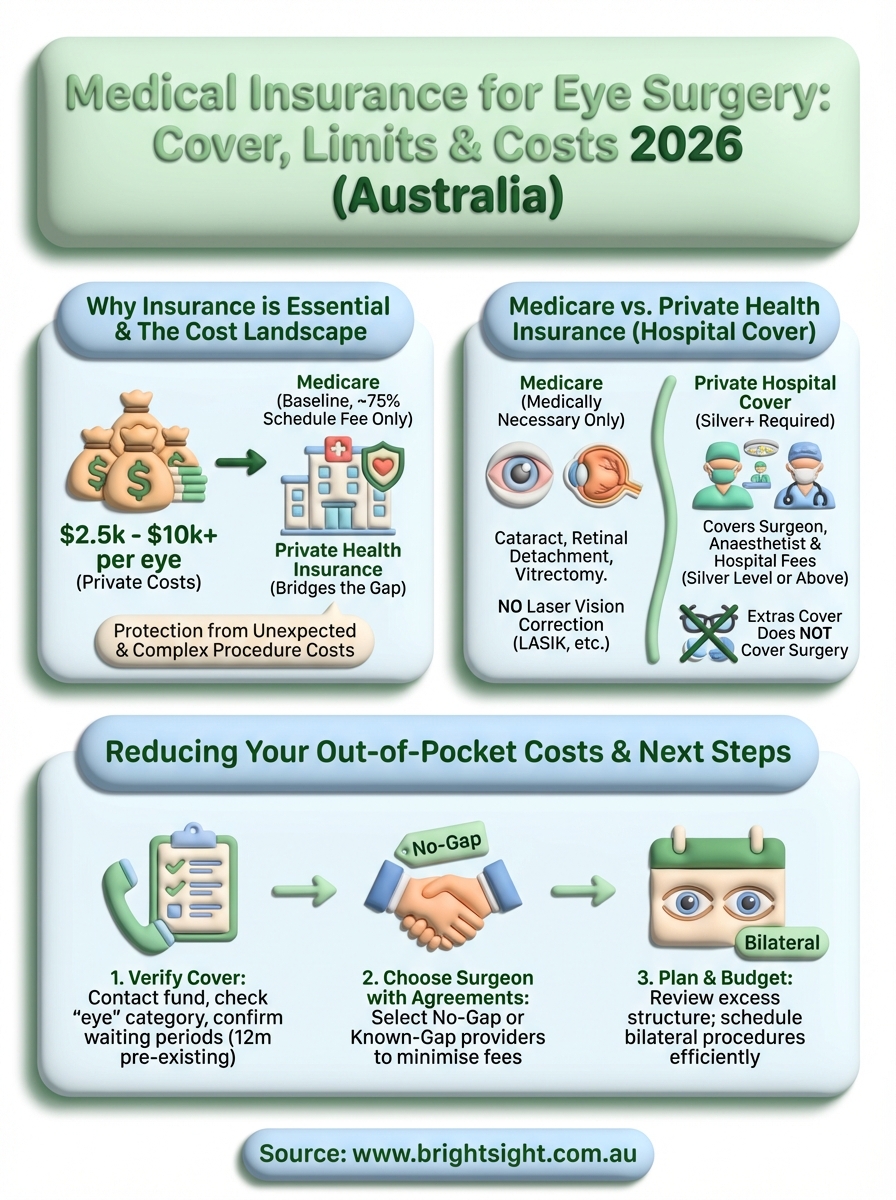
Eye surgery costs in Australia can range from a few thousand dollars to over $10,000 per eye, depending on the procedure and surgeon. Without adequate insurance cover, you face these expenses entirely on your own. Private health insurance helps bridge the gap between what Medicare provides and what specialists actually charge, often reducing your payment to zero or a predictable known gap.
Direct cost impact on common procedures
Cataract surgery typically costs between $2,500 and $5,000 per eye when performed privately, with premium lens options pushing fees higher. Retinal procedures like vitrectomy or membrane peeling can exceed $8,000 per eye for the surgeon’s fee alone. These figures don’t include anaesthetist fees, facility charges, or post-operative care, which add thousands more to your final bill.
Medical insurance for eye surgery becomes particularly valuable when you need bilateral procedures or face complex conditions requiring multiple interventions. If you require surgery on both eyes, costs effectively double. Your policy level determines how much of these fees your fund rebates, with hospital cover at silver level or above typically required for eye surgery benefits.
Quality eye surgery involves specialist expertise, operating theatre time, and precision equipment, costs that reflect the complexity of preserving and restoring your vision.
Protection from unexpected expenses
Eye conditions often develop without warning. A retinal detachment requires urgent surgery, sometimes within 24 hours, leaving no time to upgrade insurance or compare costs. Waiting periods on new policies can extend 12 months for pre-existing conditions, meaning cover you arrange today may not help with immediate problems.
Your insurance also protects against cascading costs. Complications or follow-up procedures may arise after initial surgery, requiring additional theatre time or specialist consultations. Comprehensive cover ensures you receive necessary care without financial stress compounding health concerns. Some funds even offer rehabilitation or allied health benefits that support recovery, particularly after complex retinal surgery.
Cost predictability matters just as much as coverage. Known-gap arrangements between surgeons and health funds let you budget accurately before committing to treatment. At Bright Sight Eye Specialists, we maintain no-gap and known-gap agreements with major insurers, eliminating surprise bills for most privately insured patients. Understanding your policy details before surgery removes financial uncertainty and lets you focus entirely on recovery and outcomes.
What Medicare covers for eye surgery in Australia
Medicare provides the foundation for eye surgery coverage in Australia through the Medicare Benefits Schedule (MBS), but its contribution represents only part of your total surgical costs. You receive a rebate for medically necessary procedures performed by ophthalmologists, though this amount rarely matches what surgeons actually charge. Understanding these baseline benefits helps you evaluate whether medical insurance for eye surgery offers worthwhile value for your circumstances.
Medicare Schedule Fee and rebate structure
The MBS assigns an item number to each surgical procedure with a corresponding schedule fee. Medicare typically rebates 75% of this schedule fee for out-of-hospital services and 100% for in-hospital procedures when you’re a public patient. For cataract surgery, the MBS fee might be $800, but specialists often charge $3,000 to $5,000, leaving a significant gap between the rebate and actual cost.
Your Medicare card entitles you to free treatment in public hospitals, though waiting lists can extend months or years for non-urgent procedures. Private surgery lets you choose your surgeon and schedule, but Medicare only covers the schedule fee portion, leaving you responsible for the difference unless you hold appropriate private cover.
Medically necessary procedures only
Medicare restricts coverage to procedures that restore or preserve vision, excluding cosmetic or elective enhancements. Cataract surgery, retinal detachment repair, vitrectomy for floaters causing significant impairment, and surgery for macular holes or membrane peeling all qualify for Medicare rebates when clinically indicated.
Laser vision correction (LASIK, PRK, SMILE) receives no Medicare rebate because it improves otherwise functional vision rather than treating disease. Cosmetic eyelid surgery similarly falls outside Medicare’s scope unless excess skin demonstrably obstructs your visual field. Your ophthalmologist documents medical necessity through detailed clinical notes and imaging, ensuring your procedure meets Medicare’s criteria before scheduling.
Medicare rebates form the starting point for surgical costs, but the gap between schedule fees and actual charges makes private insurance essential for most patients seeking prompt, specialist-led care.
What private health insurance may cover
Private health insurance extends beyond Medicare’s baseline coverage, potentially eliminating or substantially reducing your out-of-pocket expenses for eye surgery. Your policy’s hospital cover component determines whether you receive benefits for surgical procedures performed in private hospitals or day surgery centres. Medical insurance for eye surgery typically requires silver level cover or above, with gold policies offering the most comprehensive benefits and lowest gaps.
Hospital cover levels and surgical benefits
Most Australian health funds structure their hospital policies into bronze, silver, gold, and basic tiers, each covering different categories of treatment. Eye surgery falls under the "eye" category in the government’s standardised classification system, meaning you need a policy that specifically includes this category to receive benefits. Silver policies must cover all treatments in the eye category, making them the minimum level for most surgical procedures.

Your fund rebates a percentage of the surgeon’s fee, anaesthetist’s fee, and hospital facility charges according to your policy level and the fund’s agreement with your chosen specialist. Gold cover typically provides higher rebates and more extensive no-gap or known-gap arrangements, while silver policies may involve moderate gaps. Bronze and basic hospital covers explicitly exclude eye surgery, leaving you responsible for all costs above Medicare’s contribution.
Extras cover limitations for surgical procedures
Extras policies (also called general treatment or ancillary cover) do not provide benefits for surgical procedures regardless of your premium or coverage level. These policies cover services like optometry consultations, prescription glasses, and contact lenses, but hospital-based surgery requires hospital cover. Many patients mistakenly believe comprehensive extras will help with surgical costs, only discovering the limitation when claiming.
Surgical eye procedures demand hospital cover at silver level or higher; extras policies support vision maintenance but never replace the need for appropriate hospital coverage when you require theatre-based treatment.
How to check your cover, limits and waiting periods
Reviewing your policy details before scheduling surgery prevents unexpected bills and ensures you understand your financial responsibility upfront. Most Australians hold insurance but remain unclear about specific surgical benefits, waiting periods, or gap arrangements until they actually need care. Taking 30 minutes to verify your coverage now saves considerable stress and potential thousands of dollars later when you’re focused on recovery rather than paperwork.
Contact your fund directly for procedure-specific information
Ring your health insurer’s member services line with your policy number and proposed procedure details ready. Ask specifically about coverage for eye surgery, any applicable excess payments, and whether your policy includes the "eye" category under the government’s standard classification. Request confirmation of your current waiting periods and whether any apply to your planned procedure, particularly if you’ve recently upgraded your cover or changed funds.
Your insurer can also confirm if your surgeon holds a provider agreement with the fund. These arrangements determine whether you face no gap, a known gap, or potentially unlimited out-of-pocket costs. Write down the names of staff you speak with and request email confirmation of the information provided, creating a record you can reference if discrepancies arise later.
Understanding waiting periods for surgical procedures
Most health funds impose 12-month waiting periods for pre-existing conditions, meaning any eye problem diagnosed or treated before joining may not receive benefits immediately. Standard surgical waiting periods typically range from two to twelve months depending on your policy and the specific procedure. If you’ve held continuous hospital cover for over 12 months with appropriate category coverage, you’ve likely satisfied all waiting requirements.
Pre-existing condition exclusions can delay coverage for up to 12 months, making early policy review essential if you suspect developing vision problems or have a family history of eye disease.
Your fund may waive waiting periods if you transfer from another insurer with equivalent or higher cover, provided you maintain continuous coverage without breaks. Check your policy’s transfer rules and request a clearance certificate from your previous fund to streamline this process and access benefits sooner.
Typical out-of-pocket costs and ways to reduce them
Out-of-pocket expenses for eye surgery vary dramatically based on your insurance provider, policy level, and surgeon’s fee arrangements. Even with comprehensive private cover, you may face gap payments ranging from zero to several thousand dollars per eye. Understanding typical cost structures and available strategies helps you budget accurately and potentially reduce or eliminate these expenses entirely through informed choices about timing, providers, and policy management.
Common gap payment ranges
Cataract surgery with no-gap agreements typically costs you nothing beyond your annual excess, which ranges from $250 to $750 depending on your policy. Known-gap arrangements usually involve $500 to $1,500 per eye for surgeon fees, plus similar amounts for anaesthetists and facilities if your fund doesn’t cover these fully. Without provider agreements, gaps can exceed $3,000 per eye even with gold cover.
Retinal procedures like vitrectomy or membrane peeling generally involve higher specialist fees and longer theatre times, resulting in gaps between $2,000 and $5,000 per eye with standard insurance arrangements. Premium lens implants for cataract surgery add $1,500 to $3,000 per eye above standard implant costs, as many funds classify these as upgrades rather than medically necessary components.
Choosing surgeons who maintain provider agreements with your specific health fund represents the single most effective way to reduce or eliminate gap payments for medical insurance for eye surgery.
Strategies to minimize your expenses
Select a surgeon who holds no-gap or known-gap arrangements with your health insurer before scheduling your procedure. At Bright Sight Eye Specialists, we maintain agreements with major Australian funds, ensuring predictable costs for most privately insured patients. Contact our practice to verify your specific fund’s arrangement before your consultation.
Review your excess structure and annual limits well before surgery. Some policies let you choose higher excess levels in exchange for lower premiums, but paying a $750 excess once per year often costs less than ongoing gap fees. Scheduling bilateral procedures within the same calendar year may also maximize your benefit limits and minimize repeat excess payments.
Next steps
Understanding medical insurance for eye surgery puts you in control of both treatment decisions and costs. You now know that private hospital cover at silver level or above provides the foundation for surgical benefits, that Medicare offers only baseline support, and that choosing surgeons with provider agreements dramatically reduces out-of-pocket expenses. Armed with this knowledge, you can confidently plan ahead rather than face financial surprises when vision problems arise.
Start by verifying your current policy’s eye surgery coverage and waiting periods through direct contact with your health fund. If you’re considering cataract surgery or have concerns about retinal health, schedule a consultation to discuss your specific needs and insurance arrangements. At Bright Sight Eye Specialists in Randwick, we maintain no-gap and known-gap agreements with major Australian insurers, ensuring transparent pricing before any procedure.
Contact our practice to verify your insurance arrangements and discuss your eye health needs with Dr. Rahul Dubey or Dr. Capucine Odouard. Your vision deserves expert care without financial uncertainty.