


If you’re considering laser vision correction to ditch your glasses for good, you’ve likely come across the debate of LASIK vs SMILE eye surgery. Both procedures reshape your cornea to correct short-sightedness (myopia) and astigmatism, but they do so in fundamentally different ways. Understanding those differences matters, because the right choice depends on your eyes, your prescription, and your lifestyle.
LASIK has been the go-to refractive procedure for over two decades. SMILE (Small Incision Lenticule Extraction) is the newer alternative, offering a flapless approach that appeals to many patients. Each has distinct advantages when it comes to recovery time, surgical technique, and long-term outcomes, and neither is universally "better."
At Bright Sight Eye Specialists in Randwick, Dr Capucine Odouard performs both LASIK and SMILE procedures, helping patients across Sydney’s Eastern Suburbs find the option that fits their eyes and their goals. This article breaks down how each procedure works, what recovery looks like, the risks involved, and who is best suited for each, so you can walk into your consultation informed and confident.
LASIK and SMILE explained in plain English
LASIK (Laser-Assisted In Situ Keratomileusis) and SMILE (Small Incision Lenticule Extraction) are both laser vision correction procedures designed to reduce or eliminate your dependence on glasses or contact lenses. When comparing lasik vs smile eye surgery, the core difference comes down to how the surgeon accesses and reshapes your cornea, the clear dome at the front of your eye that focuses light onto your retina.
What LASIK is
In use since the 1990s, LASIK remains the most commonly performed refractive procedure globally. Your surgeon uses a laser to create a thin flap in the outer layer of your cornea. That flap is folded back, and a second laser reshapes the tissue underneath to correct your prescription. The flap is then repositioned and bonds naturally without stitches, sealing over within minutes.
What SMILE is
SMILE is the newer approach, approved in Australia and used increasingly across Sydney. Your surgeon uses a single femtosecond laser to create a small lens-shaped piece of tissue (called a lenticule) inside the cornea, then removes it through a tiny incision of around 2 to 4 millimetres. Because no flap is created, the cornea’s surface layers stay largely intact, which is a fundamental structural difference from LASIK.
SMILE leaves more of the cornea’s outer surface undisturbed, which may offer benefits for patients with thinner corneas or those who play high-contact sports.
How they compare at a glance
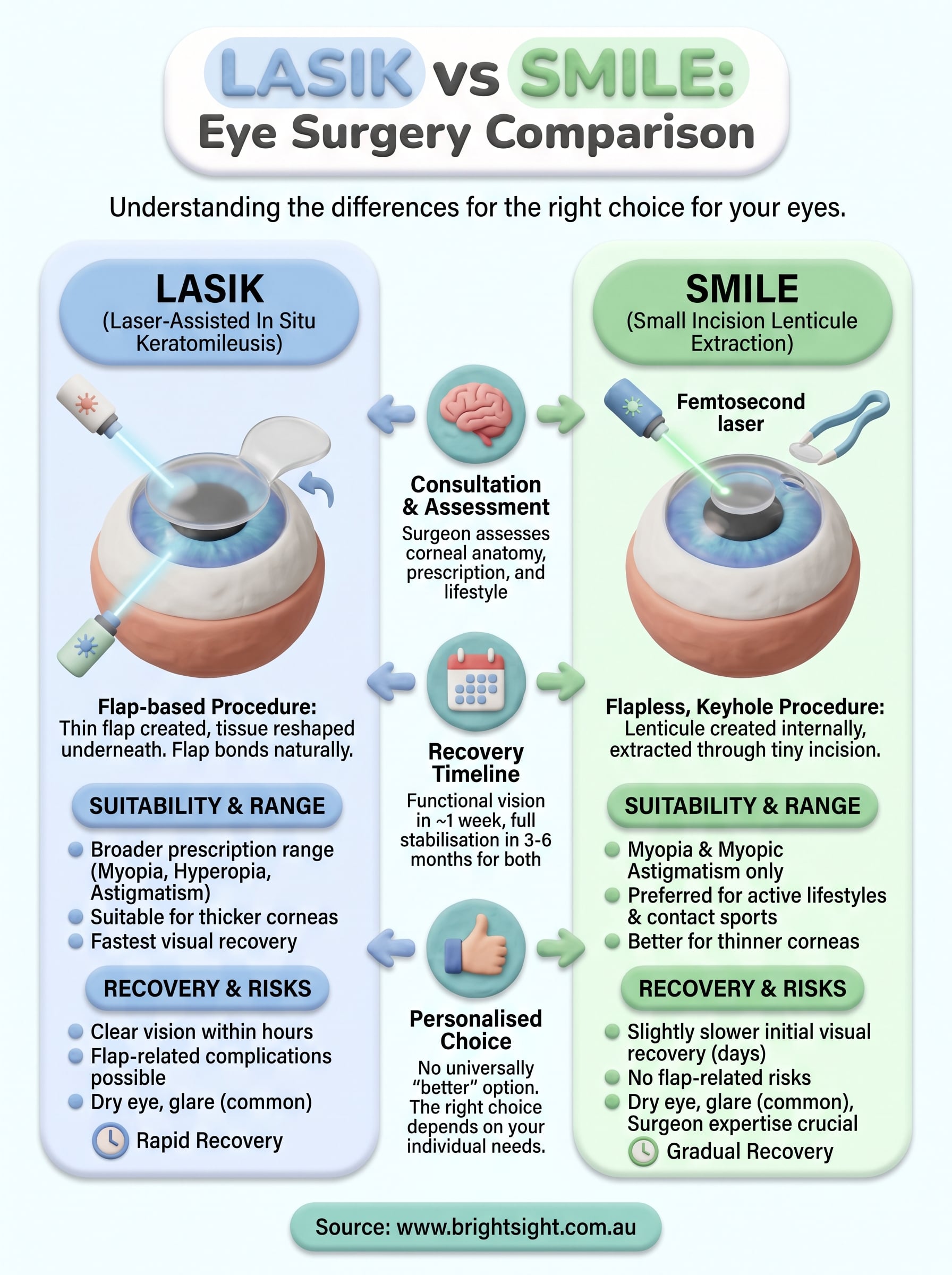
Both procedures correct myopia (short-sightedness) and astigmatism, and both are performed as day procedures under topical anaesthetic drops, taking around 10 to 15 minutes per eye. Your surgeon removes no tissue permanently in LASIK; instead, the laser evaporates precise amounts beneath the flap. With SMILE, a small disc of corneal tissue is physically extracted through the keyhole incision. LASIK currently covers a wider range of treatable prescriptions and can also correct hyperopia (long-sightedness), while SMILE is approved for myopia and myopic astigmatism only. Your suitability for either procedure depends on your corneal thickness, prescription strength, and lifestyle, all of which your surgeon assesses thoroughly before recommending a path forward.
How LASIK and SMILE work step by step
Understanding what actually happens during each procedure takes away a lot of the uncertainty around surgery day. Both procedures are performed under topical anaesthetic with numbing eye drops rather than a general anaesthetic, so you stay awake and comfortable throughout. Knowing the steps also helps you understand why surgeons recommend one procedure over the other for different patients.
The LASIK procedure
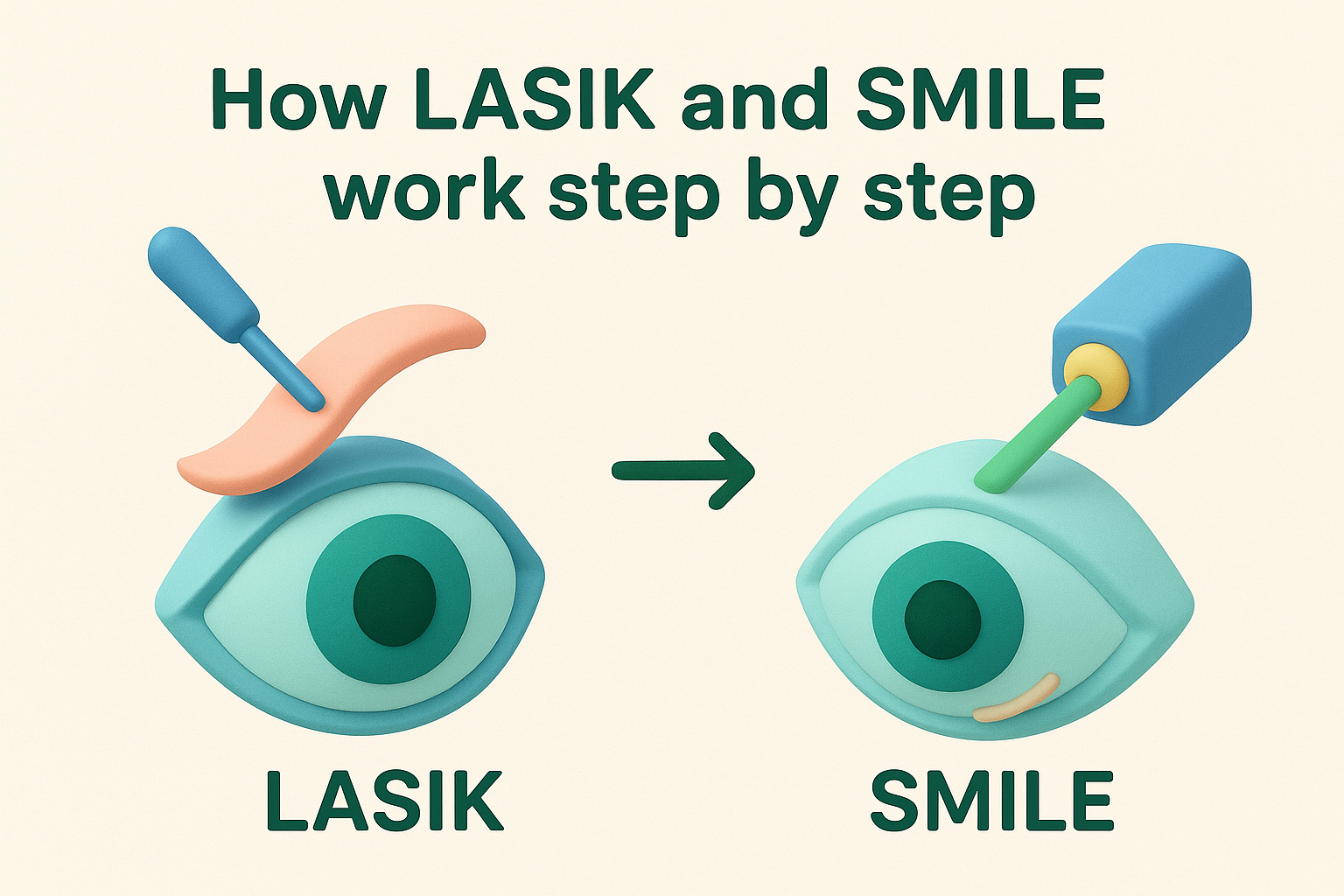
Your surgeon begins by creating a thin corneal flap using either a microkeratome blade or, more commonly today, a femtosecond laser. That flap folds back to expose the stromal layer underneath. An excimer laser then reshapes that tissue for roughly 20 to 60 seconds, depending on your prescription strength. Once the reshaping is done, the flap is repositioned and bonds naturally without sutures.
Most patients notice a dramatic change before they leave the clinic, and vision often improves within hours of LASIK. This rapid result makes the early recovery feel fast and reassuring.
The SMILE procedure
With SMILE, your surgeon uses a single femtosecond laser to create a small disc of tissue called a lenticule inside the cornea, all without lifting a flap. The entire cutting process happens below the surface. Your surgeon then makes a 2 to 4 millimetre incision and carefully removes the lenticule through it, altering the cornea’s curvature and correcting your vision.
When weighing lasik vs smile eye surgery, this flapless approach is the defining structural difference, and it has real implications for corneal strength and how your eye heals.
Suitability: who each procedure suits best
Not everyone is a candidate for both procedures, and your corneal anatomy, prescription range, and daily activities all influence which option your surgeon recommends. The lasik vs smile eye surgery decision is rarely about one being superior overall; it comes down to what your individual eyes need.
Who suits LASIK best
LASIK covers a broader prescription range, making it the more versatile option for patients with higher levels of myopia, astigmatism, or hyperopia (long-sightedness). Your surgeon may also lean toward LASIK if your cornea is thick enough to safely accommodate a flap and if you have a relatively stable prescription over the past 12 months. LASIK also suits patients who want the fastest possible visual recovery.
- Myopia up to approximately -10.00 dioptres
- Hyperopia and astigmatism correction
- Patients with adequate corneal thickness for flap creation
Who suits SMILE best
SMILE is particularly well suited to patients with myopia and myopic astigmatism who want to avoid the risks associated with a corneal flap. Because the incision is tiny and the outer corneal layers stay mostly intact, SMILE is a strong option if you play contact sports, combat sports, or have an active outdoor lifestyle where an eye knock is a real possibility.
SMILE may also benefit patients who experience dry eye symptoms, as it disrupts fewer corneal nerves than LASIK does.
Your surgeon will assess corneal topography, thickness, and tear film quality before confirming which procedure is appropriate for you.
Recovery: what to expect by day, week and month
Recovery timing is one of the most practical factors to consider when comparing lasik vs smile eye surgery. Both procedures let most patients return to desk work quickly, but the speed and character of healing differ in ways that matter depending on your lifestyle and schedule.
The first 24 to 48 hours
After LASIK, many patients notice significantly clearer vision within hours of surgery. You will likely experience light sensitivity, mild tearing, and a gritty sensation for the remainder of the day, which typically settles overnight. Your surgeon will ask you to rest your eyes and avoid screens during this period.
With SMILE, visual recovery in the first 24 hours is slightly more gradual. Some patients notice a hazy quality to their vision for the first day or two, though this resolves as the small incision heals and the cornea adjusts to its new shape.
In both cases, most patients can resume light daily tasks the following morning if they follow their post-operative care instructions carefully.
Week one and beyond
By the end of the first week, most patients from both procedures achieve functional, clear vision. Dry eye, haloes around lights, and mild visual fluctuations are normal at this stage and usually settle without intervention.
- Weeks 1 to 2: LASIK patients often stabilise slightly faster; SMILE patients close the gap shortly after
- Month 1: Most patients reach comfortable, clear vision for daily tasks
- Months 3 to 6: Full corneal healing and prescription stabilisation complete for both procedures
Risks and side effects: what can go wrong
No surgical procedure is completely without risk, and laser vision correction is no exception. Understanding what can go wrong with each option is an important part of the lasik vs smile eye surgery decision, and your surgeon will walk you through your individual risk profile before you commit to anything.
Risks shared by both procedures
Both LASIK and SMILE carry a set of common short-term side effects that most patients experience to some degree. These include dry eye, glare, haloes around lights at night, and fluctuating vision during the healing period. For the majority of patients, these settle within three to six months without further treatment.
- Dry eye symptoms lasting weeks to months
- Glare and haloes, particularly in low-light conditions
- Under-correction or over-correction requiring enhancement
- Infection (rare but possible with both techniques)
Risks specific to each procedure
LASIK carries the additional risk of flap-related complications, which include flap displacement from a direct knock to the eye, incomplete flap creation, or flap folds developing during healing. These complications are uncommon but are the primary reason some surgeons prefer SMILE for active or athletic patients.
SMILE eliminates flap-related risks entirely, but it introduces a steeper learning curve for the surgeon, meaning your outcome is closely tied to your surgeon’s experience with the technique.
With SMILE, transient visual disturbances during the first week are slightly more common than with LASIK, though they resolve as the lenticule extraction site heals completely.
Next steps
Choosing between lasik vs smile eye surgery comes down to your prescription, corneal anatomy, lifestyle, and how quickly you need to recover. There is no single correct answer, and the right procedure for your friend or colleague may not be the right one for you. What matters is getting a thorough assessment from a surgeon who performs both procedures and can give you an honest recommendation based on your eyes, not on availability or preference.
At Bright Sight Eye Specialists in Randwick, Dr Capucine Odouard offers LASIK, SMILE, and PRK, tailoring her recommendation to each patient after a detailed consultation. She works with adults across Sydney’s Eastern Suburbs who are ready to reduce their dependence on glasses or contact lenses. If you’re ready to find out which procedure suits your eyes, book a consultation with Dr Odouard and get a clear, personalised answer.