


LASIK is one of the most commonly performed elective procedures in ophthalmology, with a high satisfaction rate among patients. But no surgery is without risk, and if you’re considering laser vision correction, you deserve a clear picture of what LASIK eye surgery complications actually look like, how common they are, what causes them, and how they’re managed if they occur.
At Bright Sight Eye Specialists in Randwick, Dr Capucine Odouard performs LASIK, PRK, and SMILE procedures with a focus on thorough pre-operative assessment and honest patient conversations. Part of that honesty means explaining not just the benefits, but the potential downsides too. An informed patient makes a better decision.
This article breaks down the recognised complications of LASIK surgery, from common short-term side effects like dry eyes and visual disturbances to rarer long-term risks. We’ll cover what symptoms to watch for, how complications are treated, and what factors can increase your risk. The goal is to give you the information you need to weigh up whether LASIK is right for you.
Why LASIK complications matter and how common they are
When you’re considering an elective procedure on your eyes, knowing the real risk profile matters. LASIK eye surgery complications don’t occur at the same rate across all patients, and understanding the statistics helps you put the risks in perspective without dismissing them or overstating them. The procedure has one of the highest patient satisfaction rates in elective surgery, with studies consistently reporting figures above 95%, but that still leaves a meaningful minority of patients who experience unwanted outcomes. Your eyes are not replaceable, so getting an accurate picture of the risk landscape before you commit is not optional.
What the published research actually shows
The data on LASIK outcomes is extensive. A systematic review of over 300 studies covering more than 67,000 eyes found that approximately 95.4% of patients achieved 20/20 vision or better following surgery. Serious, vision-threatening complications are rare, occurring in fewer than 1% of procedures performed on well-screened candidates. The more common issues, such as dry eyes, halos, and glare, are usually temporary and resolve within the first three to six months post-operatively.
Temporary side effects are common after LASIK, but permanent, vision-threatening outcomes remain rare when pre-operative screening and surgical technique are both sound.
That said, "rare" does not mean impossible. Conditions like corneal ectasia, where the cornea progressively weakens and bulges forward after surgery, can cause significant long-term vision problems. Ectasia rates are estimated at between 0.04% and 0.6% depending on the patient population studied, and the consequences for those affected can be serious, sometimes requiring specialised contact lenses or a corneal transplant to restore functional vision.
Why pre-operative screening changes everything
The majority of serious post-LASIK complications are linked to patients who were not appropriate candidates in the first place. Issues like an irregular corneal shape, insufficient corneal thickness, or undiagnosed dry eye disease significantly raise your risk when left undetected before surgery. A thorough pre-operative assessment that maps corneal topography, measures pachymetry, evaluates tear film quality, and rules out subclinical keratoconus is the single most important factor in reducing your personal risk.
Selecting a surgeon who takes time over proper screening is one of the most direct ways you can protect your outcome. Advanced diagnostic technology, paired with a clinician who is prepared to decline surgery when the criteria are not met, is what separates a predictable result from a preventable complication.
The main LASIK complications and side effects
Understanding the full range of LASIK eye surgery complications helps you have a more productive conversation with your surgeon and set realistic expectations before your procedure date. Complications fall into two broad categories: short-term side effects that most patients experience to some degree, and less common complications that can persist or require treatment.
Short-term side effects most patients experience
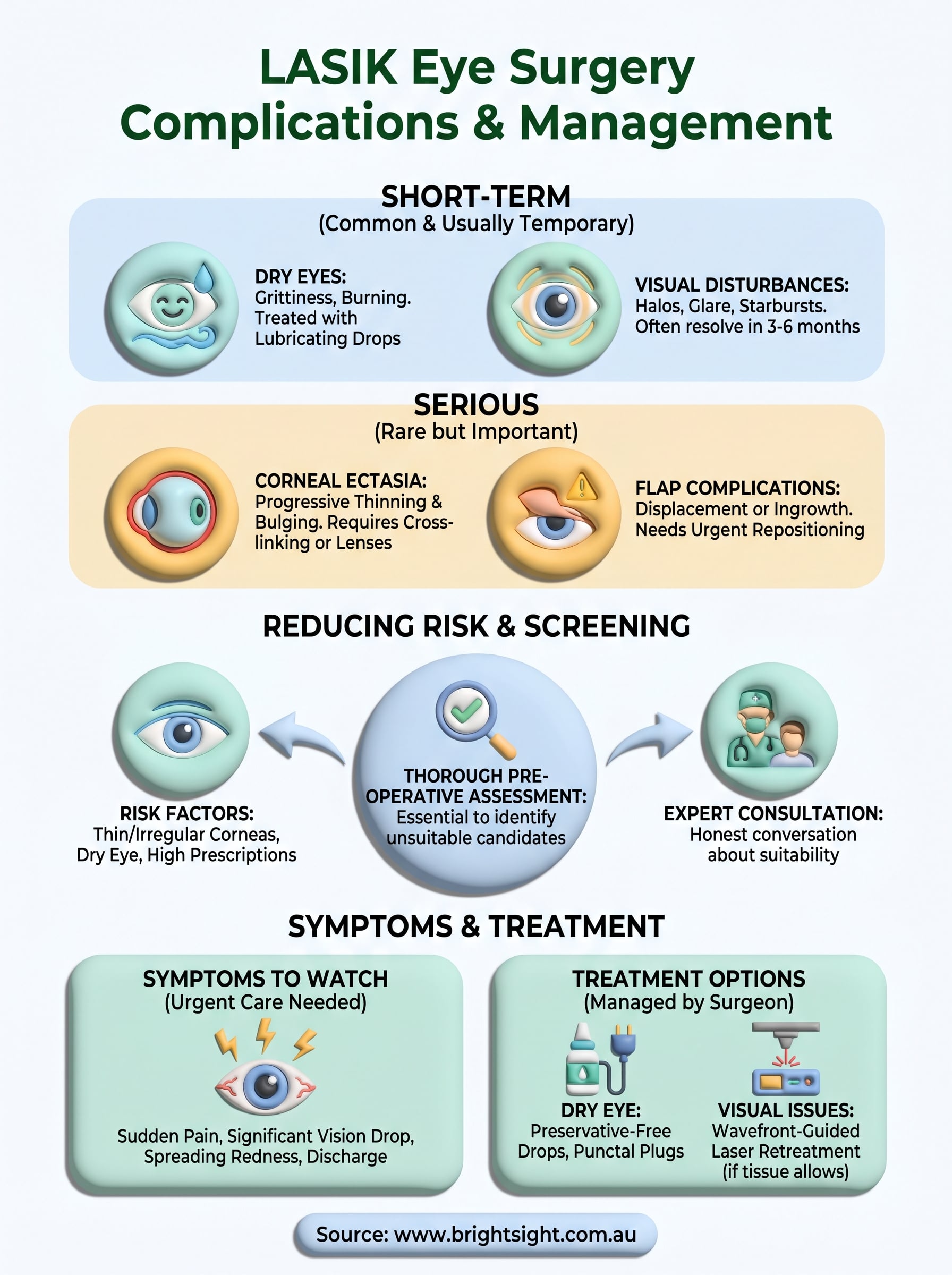
Dry eye is the most frequently reported issue after LASIK, occurring in a significant proportion of patients in the weeks following surgery. Cutting the corneal flap temporarily disrupts the nerves responsible for triggering tear production, which leads to reduced lubrication and symptoms like burning, grittiness, or fluctuating vision. For most patients, lubricating eye drops and time are enough to resolve the problem within three to six months.
Visual disturbances are also common in the early recovery period. You may notice halos around lights, glare from oncoming headlights, or starbursts at night. These effects typically improve as the cornea heals and the pupil adapts to its new refractive surface.
Most short-term side effects after LASIK resolve on their own within the first six months, provided your pre-operative screening confirmed you were a suitable candidate.
Less common but more serious complications
Corneal ectasia is the complication surgeons take most seriously. This condition involves progressive thinning and forward bulging of the cornea after surgery, which distorts vision in ways that glasses cannot fully correct. Flap-related complications, including incomplete flap creation, flap displacement, or epithelial ingrowth beneath the flap, are also possible but occur far less often with modern laser platforms and experienced surgical technique.

Symptoms to watch for and when to seek urgent help
Knowing what is normal after LASIK helps you act quickly if something goes wrong. Most patients notice mild discomfort, light sensitivity, and some blurring in the first 24 to 48 hours. These are expected responses to the procedure and settle on their own as your cornea begins to heal.
Symptoms that are expected during recovery
Dry eye symptoms, including a gritty feeling or mild burning, are very common in the first few weeks and are a recognised part of LASIK eye surgery complications that the vast majority of patients experience. Your surgeon will typically prescribe preservative-free lubricating drops to manage this. Halos around lights and some glare at night are also normal early on, particularly if you are in a brightly lit environment or driving after dark.
Symptoms that require urgent attention
Some symptoms should not be left unmonitored. If you notice sudden or worsening pain, a significant drop in vision, or increasing sensitivity to light beyond the first couple of days, contact your surgeon the same day. Flap displacement, though uncommon, can cause immediate distortion in your vision and requires urgent repositioning to prevent a lasting outcome.

If your vision is getting worse rather than better after the first 48 hours, that is not a normal part of recovery and you should call your eye surgeon straight away.
Any discharge from the eye, spreading redness, or a visible change in the surface of your cornea may indicate infection, which can progress rapidly without treatment. Do not wait for your scheduled follow-up appointment if these symptoms develop.
Who is at higher risk and how to lower your risk
Not everyone carries the same level of risk when it comes to LASIK eye surgery complications. Certain pre-existing conditions and anatomical factors make some patients significantly more vulnerable to poor outcomes. Knowing where you sit on that risk spectrum before you book a consultation gives you a more realistic basis for your decision.
Factors that raise your personal risk
Thin or irregularly shaped corneas are among the strongest predictors of post-operative problems, particularly corneal ectasia. If your cornea does not have enough tissue depth to safely accommodate the laser ablation, the structural integrity of the eye is compromised during surgery. Undiagnosed keratoconus, even in its mildest subclinical form, raises the risk of progressive corneal weakening after the procedure substantially.
Other factors include severe dry eye disease before surgery, large pupils in low-light conditions, very high prescriptions at the outer edge of the treatable range, and a history of autoimmune conditions that affect healing. Patients who are still experiencing prescription changes year on year are generally not considered ready for LASIK until their refraction has been stable for at least 12 months.
Your risk profile is not fixed. Many of the factors that disqualify patients from LASIK can be addressed, or may make an alternative procedure like PRK or refractive lens exchange a better fit.
What you can do to reduce your risk
Choosing a surgeon who uses comprehensive corneal mapping technology and who will decline to operate if your anatomy does not meet the required criteria is the most direct step you can take. Being honest about your full medical history, including any dry eye symptoms, is equally important. An experienced surgeon will guide you toward the right procedure rather than simply approving you for the one you requested.
How doctors treat LASIK complications
Treatment for LASIK eye surgery complications depends entirely on what went wrong and how quickly you report it. Most issues respond well to straightforward medical management, particularly when caught early. Your surgeon will guide you through the most appropriate option based on your specific situation and the timing of your symptoms.
Managing dry eye and visual disturbances
Dry eye after LASIK is treated primarily with preservative-free lubricating eye drops, used frequently throughout the day to compensate for reduced tear production during corneal nerve recovery. If your symptoms are more persistent, your surgeon may recommend punctal plugs, which are tiny devices inserted into the tear ducts to slow tear drainage and keep the eye surface better lubricated. In most cases, consistent use of prescribed drops over several months resolves the problem without further intervention.
Visual disturbances such as halos and glare generally improve on their own as your cornea stabilises. If they persist beyond six months, wavefront-guided laser retreatment may help refine your result and reduce the optical irregularities driving those symptoms.
Retreatment is only suitable when sufficient corneal tissue remains. Your surgeon will measure this carefully before recommending any further laser work.
Treating flap complications and corneal ectasia
Flap displacement is treated by lifting and repositioning the flap under sterile conditions, ideally within hours of the incident. Epithelial ingrowth beneath the flap may require the flap to be lifted and the cells removed manually. Corneal ectasia is a more complex problem and is typically managed with corneal cross-linking, a procedure that uses UV light and riboflavin to strengthen and stabilise the weakened corneal tissue. In advanced cases, specialised rigid contact lenses or corneal transplant surgery may be necessary to restore usable vision.
Next steps
LASIK eye surgery complications are real, but they are also well understood, manageable in most cases, and largely preventable with the right screening. The evidence is clear that the procedure delivers strong outcomes for the right candidates. What separates a good result from a difficult one is almost always the quality of the pre-operative assessment and the experience of the surgeon performing it.
If you are considering LASIK and want to know whether you are a suitable candidate, the next step is a thorough consultation with a qualified ophthalmologist who will map your corneal anatomy, assess your tear film, and give you an honest answer rather than simply telling you what you want to hear. Dr Capucine Odouard at Bright Sight Eye Specialists in Randwick specialises in refractive surgery and takes a patient-centred approach to every assessment. Book a consultation with Dr Odouard to find out whether LASIK, PRK, or another option is right for your eyes.