


You’ve decided to go ahead with laser eye surgery, or you’re seriously considering it. Either way, one of the first practical questions is: how long is laser eye surgery recovery time, and when can I get back to normal life? It’s a fair question, and the answer depends on the procedure, your eyes, and how closely you follow post-operative care instructions.
Most people notice improved vision within the first 24 to 48 hours, but full healing takes longer than that initial wow moment. Knowing what to expect, day by day, helps you plan time off work, avoid setbacks, and feel less anxious about every little sensation during recovery.
At Bright Sight Eye Specialists in Randwick, Dr Capucine Odouard performs refractive laser procedures including LASIK, PRK, and SMILE at Sydney Surgical Centre and Sydney Eye Hospital. She works with each patient to set realistic recovery expectations based on their specific procedure and lifestyle needs. Below, we break down the recovery timeline, cover common do’s and don’ts, and outline when you can expect to return to driving, screens, and exercise.
Why laser eye surgery recovery time varies
Not everyone heals at the same pace after laser eye surgery, and that’s completely normal. Laser eye surgery recovery time is shaped by a combination of factors, some related to the procedure itself and others unique to you as a patient. Understanding these variables helps you plan more accurately and avoid comparing your progress with someone else’s experience.
The procedure you choose matters
LASIK, SMILE, and PRK each involve different levels of corneal disruption, which directly affects how quickly your vision stabilises. LASIK creates a thin corneal flap, which heals relatively quickly, and most patients see clearly within one to two days. SMILE involves a smaller incision with no flap, offering a similar early recovery window for most people. PRK, however, removes the surface epithelium entirely, meaning the outer layer needs to regenerate before vision sharpens fully. This typically takes one to two weeks for functional clarity and up to three months for your final prescription to settle.
PRK generally involves a longer, more uncomfortable initial recovery than LASIK or SMILE, though long-term outcomes are comparable across all three procedures.
Your eyes and health play a role
Even within the same procedure, individual factors like your prescription strength, corneal thickness, age, and tear film quality all influence healing speed. A higher prescription often means more tissue is treated, which can slow early vision stability.
Dry eye is particularly common after laser procedures and tends to be more pronounced in people who already had borderline tear production before surgery. Your overall health, immune response, and how consistently you follow aftercare instructions also shape how smoothly your eyes recover. Two people who have the same procedure on the same day can have noticeably different experiences in the first week.
Day-by-day recovery timeline after LASIK, SMILE, PRK
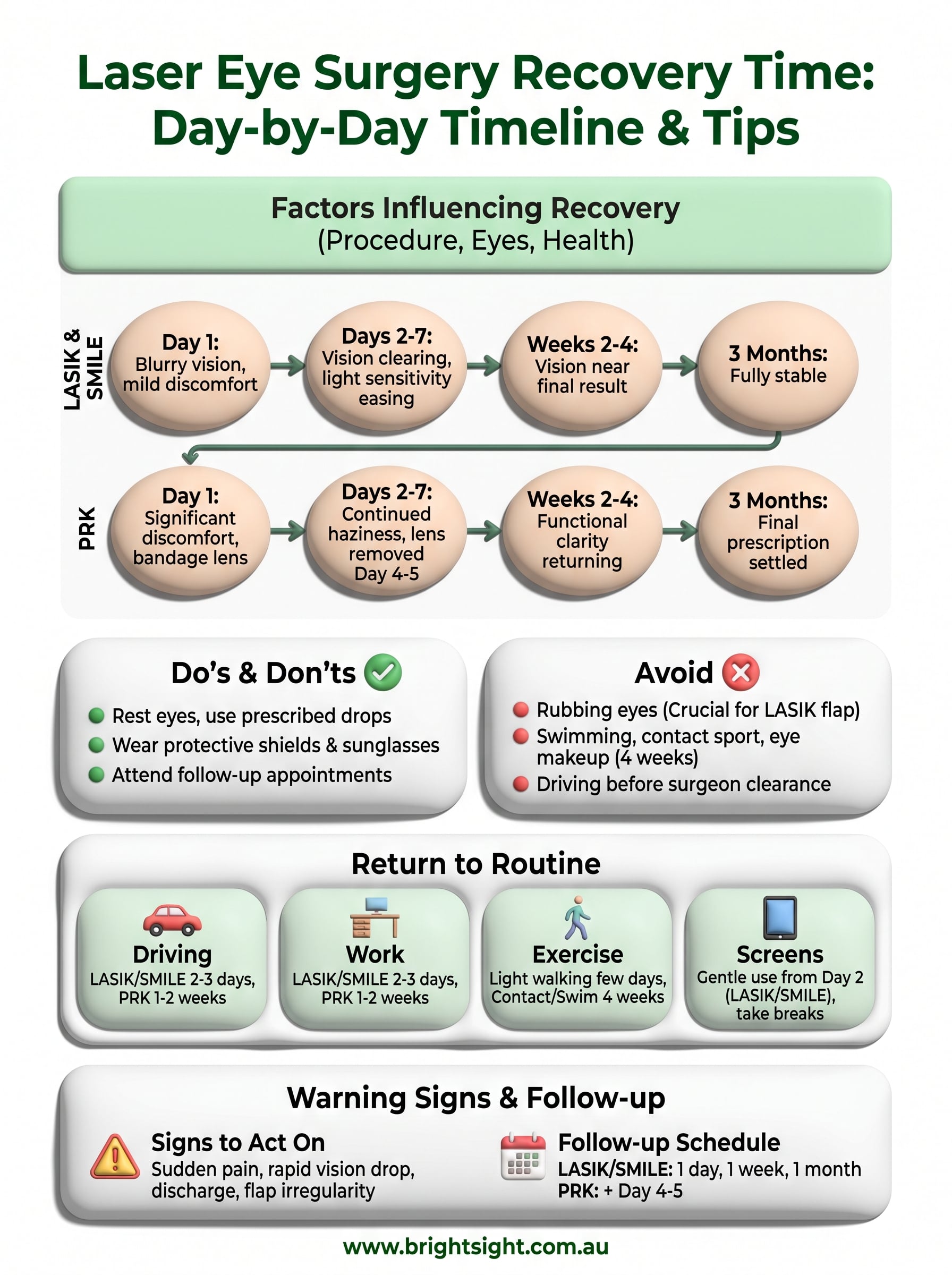
Laser eye surgery recovery time follows a predictable pattern for most patients, though the pace differs between procedures. The table below gives you a practical overview of what to expect at each stage.
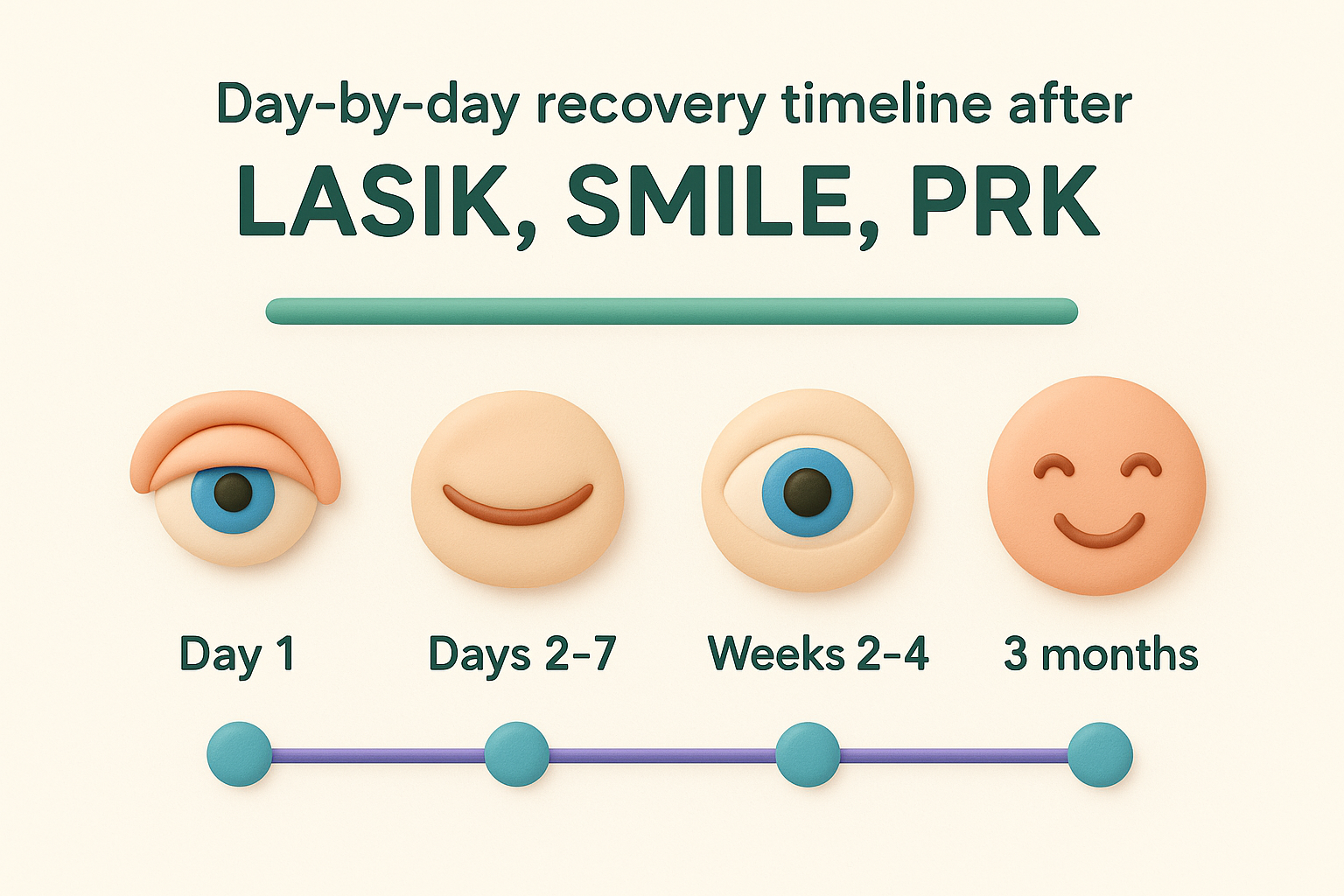
| Timeframe | LASIK & SMILE | PRK |
|---|---|---|
| Day 1 | Blurry vision, mild discomfort | Significant discomfort, bandage contact lens fitted |
| Days 2-7 | Vision clearing, light sensitivity easing | Continued haziness, contact lens removed around day 4-5 |
| Weeks 2-4 | Vision near final result | Functional clarity returning |
| 3 months | Fully stable | Final prescription settled |
The first 48 hours
After LASIK or SMILE, most patients wake up the next morning with noticeably better vision, even if some haziness remains. PRK recovery starts more slowly because the outer surface cells need to regenerate over the bandage contact lens placed at the end of your procedure.
PRK patients often find days two to four the most uncomfortable, before the surface epithelium heals over.
Days 7 to 30
LASIK and SMILE patients typically achieve stable vision within the first week and can return to most routine activities shortly after. PRK patients experience a more gradual improvement, with functional clarity usually returning by week two, though fine detail and night vision can still fluctuate until the three-month mark.
What you can do and avoid after surgery
The decisions you make in the first few weeks directly shape your laser eye surgery recovery time and the quality of your final vision outcome. Following your surgeon’s aftercare instructions carefully gives your cornea the best chance to heal without complications.
What to do
Rest your eyes as much as possible on the day of surgery and use all prescribed eye drops on schedule, including lubricating drops and any antibiotic or steroid drops your surgeon provides.
- Sleep with the protective eye shields provided for the first few nights
- Wear sunglasses outdoors to manage light sensitivity
- Attend every scheduled follow-up appointment without skipping
Consistent use of lubricating drops in the first month significantly reduces dry eye symptoms, which are one of the most common complaints after laser surgery.
What to avoid
Rubbing your eyes is the single most important thing to avoid after surgery, particularly after LASIK where the corneal flap can shift from pressure or friction. Keep swimming, contact sport, and eye makeup off your schedule for at least the first four weeks to lower infection risk and protect the healing surface.
- Avoid dusty or smoky environments
- Stay out of spa baths and pools for at least four weeks
- Do not drive until your surgeon specifically clears you to do so
When you can drive, work, exercise and use screens
Getting back to your daily routine is one of the most practical concerns during laser eye surgery recovery time. Your surgeon sets these return timelines based on your specific procedure, how quickly your vision stabilises, and what they observe at your follow-up appointments.
Driving and screen use
Most LASIK and SMILE patients can drive again within two to three days, once their surgeon confirms at the first follow-up that vision meets the legal standard. PRK patients typically wait one to two weeks before driving safely. Screen use can resume gently from day two for LASIK and SMILE, but keep sessions short and apply lubricating drops regularly to manage dryness and reduce eye strain.
Tired, dry eyes after screen use are common in the first month and do not indicate a problem with your vision outcome.
Work and exercise
Desk-based work is generally possible within two to three days after LASIK or SMILE, and within one to two weeks after PRK. Physical activity follows a staged return. Light walking is fine within a few days, but swimming, contact sport, and heavy lifting require at least a four-week break to protect the healing cornea from infection and pressure.
Warning signs and follow-up appointments
Most people move through laser eye surgery recovery time without serious issues, but knowing which symptoms need prompt action helps you catch any problem early. Your surgeon schedules follow-up appointments specifically to monitor healing and address anything before it becomes a bigger concern.
Signs that need prompt attention
Mild redness, light sensitivity, and watery eyes are all expected in the first few days and settle on their own. However, certain symptoms require you to contact your surgeon without delay rather than waiting for your next scheduled visit.
- Sudden or worsening pain that does not ease with lubricating drops
- A rapid or significant drop in vision clarity
- Thick or yellow discharge from the eye
- A visible flap irregularity or a persistent sensation of something in your eye
Any sudden deterioration in vision after the first 48 hours should be treated as urgent and not monitored at home.
Your follow-up schedule
LASIK and SMILE patients are typically seen at one day, one week, and one month after surgery. PRK patients often have an additional appointment around day four to five when the bandage contact lens is removed.
Attending every appointment, even when your vision feels good, lets your surgeon confirm that healing is on track and adjust your lubricating drop routine if dry eye symptoms are more persistent than expected.
Next steps for a smooth recovery
Understanding your laser eye surgery recovery time before surgery puts you in a much stronger position to manage it well. Every stage of healing, from the first blurry hours to the three-month mark, follows a predictable path when you stick to your aftercare plan, attend your follow-up appointments, and use your prescribed drops consistently.
Your role in recovery matters as much as the surgery itself. Avoiding eye rubbing, protecting your eyes from sun and dust, and resting screens when your eyes feel fatigued are small habits that add up to a better outcome. If something feels off at any point, contact your surgeon rather than waiting.
Dr Capucine Odouard at Bright Sight Eye Specialists works with each patient to make sure the recovery process is clear and supported from day one. To find out whether LASIK, SMILE, or PRK suits your eyes and lifestyle, book a consultation with Dr Odouard.