


Considering laser eye surgery to correct your vision? You’re not alone, thousands of Australians explore this option each year to reduce their dependence on glasses or contact lenses. One of the first questions that comes up is whether laser eye surgery private health insurance will help cover the cost. The answer depends on your policy type, your insurer, and how long you’ve held your cover.
Understanding what your private health insurance actually covers can feel overwhelming. Most laser eye surgery falls under "extras" or optical cover, not hospital cover, which catches many people off guard. At Bright Sight Eye Specialists, we regularly help patients in Sydney’s Eastern Suburbs navigate the financial side of eye procedures, and we know how important it is to have clear information before making decisions about your eye health.
This guide breaks down how private health insurance works for laser eye surgery in Australia, including which funds offer rebates, typical waiting periods, and what level of cover you’ll need.
Why cover is limited for laser eye surgery
Private health insurers in Australia treat laser eye surgery as an elective cosmetic procedure, not a medical necessity, which is why most policies offer limited or no rebates. The Australian government classifies vision correction surgery differently from treatments for eye diseases or injuries that threaten your sight. You can live a normal life with glasses or contact lenses, so insurers don’t consider laser surgery essential to your health.
Most private health funds place laser eye surgery in the same category as cosmetic dentistry or plastic surgery, not medical treatment.
How Medicare views laser vision correction
Medicare doesn’t provide any rebate for laser eye surgery because the procedure falls outside the Medicare Benefits Schedule (MBS). Your eyes may function perfectly well with corrective lenses, so the government views laser surgery as a lifestyle choice rather than a medical requirement. This classification means you’ll bear most or all of the cost yourself, even with comprehensive hospital cover.
Insurers follow Medicare’s lead on this classification. When a procedure doesn’t qualify for Medicare rebates, private funds treat it as non-essential and typically exclude it from hospital policies altogether. This approach applies across all major Australian health insurers, regardless of the policy tier you hold.
The extras cover exception
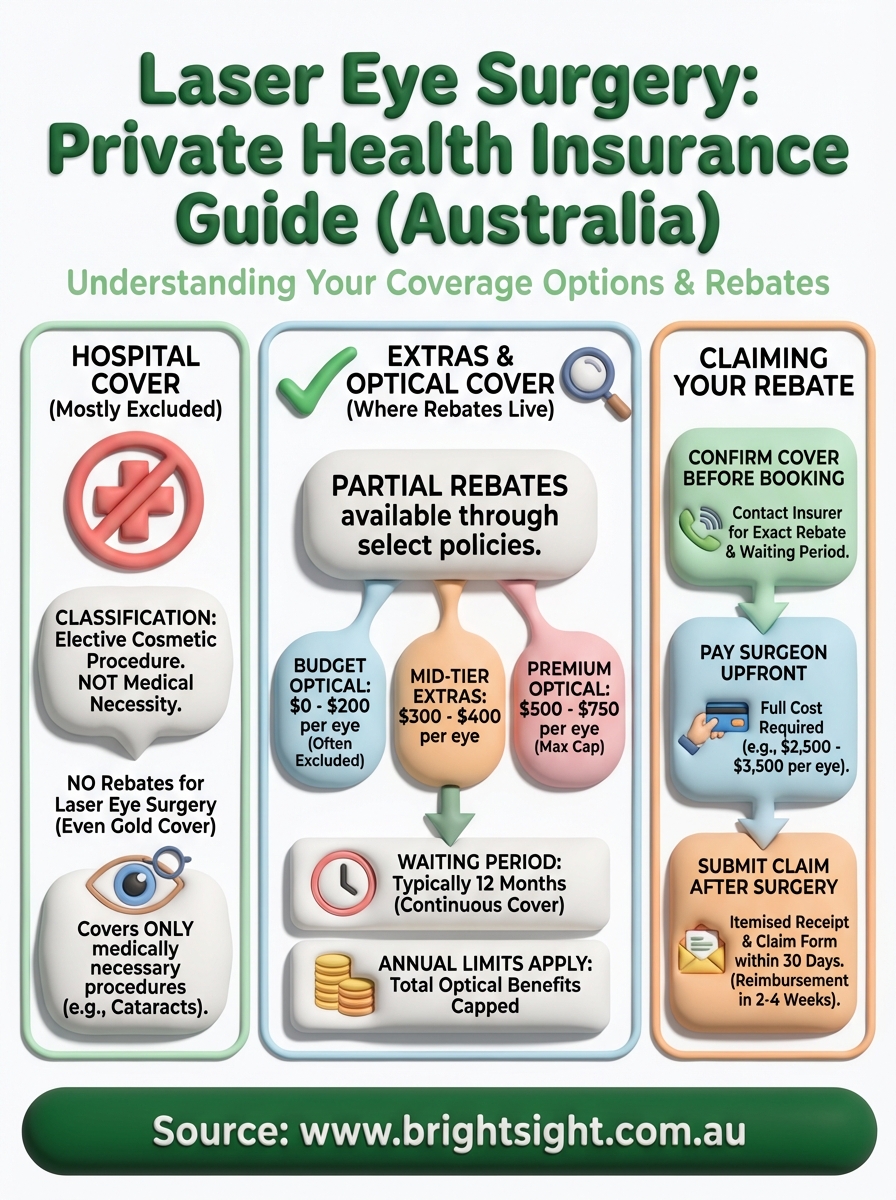
Some insurers do offer partial rebates through their extras or optical cover, which sits separate from your hospital policy. These rebates usually range from $200 to $500 per eye, depending on your fund and policy tier. You’ll need to check whether your laser eye surgery private health insurance includes optical extras at a level that covers refractive surgery, as basic optical cover often excludes these procedures entirely.
What private health insurance may pay for
Your extras or optical cover determines how much you can claim back for laser eye surgery, not your hospital policy. Most funds cap their rebates at $200 to $500 per eye, though a few top-tier policies stretch to $750 per eye. You’ll receive this amount as a partial reimbursement after you pay the surgeon upfront, which means you’ll still cover the majority of the procedure cost yourself.
Typical rebate amounts from optical extras
Rebate amounts vary significantly between insurers and policy tiers. Budget optical extras often exclude laser eye surgery entirely or limit rebates to $200 per eye annually. Mid-tier policies typically offer $300 to $400 per eye, while premium optical extras can provide $500 to $750 per eye. These figures apply per financial year, so you can’t claim multiple procedures within the same 12-month period and stack rebates.
Your laser eye surgery private health insurance rebate covers only a fraction of the total procedure cost, which ranges from $2,500 to $3,500 per eye at most Australian clinics.
What hospital cover won’t reimburse
Hospital policies exclude laser vision correction because insurers classify it as cosmetic or elective. Even Gold-level hospital cover won’t contribute to laser eye surgery costs, regardless of whether you have the procedure in a hospital or day surgery. Your hospital policy applies only to medically necessary eye procedures like cataract surgery or retinal repairs.
Funds and policy tiers that may offer rebates
Major Australian health insurers approach laser eye surgery rebates differently, with Medibank, Bupa, and HCF among the funds offering partial reimbursements through their optical extras. You’ll need to hold at least a mid-tier or top-tier extras policy to access these rebates, as basic optical cover typically excludes refractive surgery altogether. Each fund sets its own annual limits and waiting periods, so your laser eye surgery private health insurance rebate depends entirely on which insurer you choose.
Comparing major fund rebate structures
Bupa’s optical extras typically reimburse $300 to $500 per eye on higher-tier policies, while Medibank offers similar amounts on their Top Extras cover. HCF provides rebates ranging from $250 to $500 per eye depending on your policy level. Australian Unity and NIB also include laser surgery in their premium optical extras, though rebates rarely exceed $500 per eye across any insurer.
You’ll find the most generous rebates on top-tier extras policies that cost $50 to $80 per month, though these amounts still cover only a fraction of the total procedure cost.
Check your policy’s Product Disclosure Statement directly, as insurers regularly adjust their optical benefits and exclusions. Your fund may require specific policy codes or product names that include enhanced optical cover before you can claim any rebate for vision correction surgery.
Waiting periods and rules that affect your claim
Most insurers apply a 12-month waiting period before you can claim rebates for laser eye surgery through your optical extras. You need to hold your policy continuously for this full period without any lapses or downgrades, which means you can’t sign up just before booking your procedure and expect coverage. Your laser eye surgery private health insurance will also include annual claim limits that cap how much you can receive per financial year, regardless of how many procedures you undergo.
Standard waiting periods for optical extras
Your insurer typically enforces a 12-month waiting period for major optical services including laser vision correction. You start counting from the day your policy becomes active, not from when you first enquire about coverage. Some funds reduce this to six months on top-tier extras policies, though you’ll need to confirm this directly with your insurer before making any surgical commitments.
Switching funds or upgrading your policy mid-year resets your waiting period, which means you’ll start the 12-month countdown again from scratch.
Annual claim limits and benefit caps
You can claim for both eyes in the same financial year, but your total rebate can’t exceed your policy’s annual optical limit. Most funds cap combined claims at $500 to $1,000 per year across all optical services, including glasses, contacts, and refractive surgery. Claiming your laser surgery rebate will reduce or exhaust your remaining optical benefits for that year.
How to confirm cover and claim your rebate
You need to contact your insurer directly before booking your procedure to confirm your exact rebate amount and verify that you’ve completed any required waiting periods. Your fund’s customer service team can tell you which policy tier you hold, what your annual optical limit covers, and whether laser vision correction falls within your current benefits. This conversation prevents surprises when you submit your claim after surgery.
Steps to verify your policy coverage
Contact your insurer at least four weeks before your planned surgery date to request written confirmation of your laser eye surgery private health insurance benefits. Ask specifically about your waiting period status, annual claim limits, and whether you need pre-approval before the procedure. Your fund may require a quote from your surgeon before they can confirm your rebate amount.
Your policy’s Product Disclosure Statement includes detailed information about optical extras coverage, though calling your insurer provides the most accurate assessment of your individual circumstances. Request they email you a written confirmation showing your exact rebate per eye and any conditions that apply.
The claim submission process
Most insurers require you to pay your surgeon upfront and then submit a claim form with your itemised receipt within 30 days of your procedure. You’ll need the clinic’s provider number and specific item codes from your invoice to complete the claim correctly. Your fund typically processes rebates within two to four weeks and deposits the amount directly into your nominated bank account.
Keep all documentation from your consultation and surgery appointments, as your insurer may request additional medical information to verify your claim.
Next steps
Understanding your laser eye surgery private health insurance coverage helps you budget accurately for your procedure. You’ve learned that most rebates come from optical extras rather than hospital policies, typically ranging from $200 to $500 per eye depending on your fund and policy tier. Your 12-month waiting period must be complete before you can claim, and annual limits cap your total optical benefits.
Contact your insurer now to verify your exact rebate amount and confirm you’ve met all waiting periods. Request written confirmation of your benefits before booking any surgical appointments. You’ll need to pay upfront and claim back your rebate within 30 days of your procedure.
If you’re considering vision correction surgery in Sydney’s Eastern Suburbs, speak with our experienced team at Bright Sight Eye Specialists about your options. We’ll help you understand the full cost of your procedure and answer any questions about your eye health.