


Short sightedness, or myopia, affects roughly one in three Australians, making distant objects appear blurred while close-up vision stays sharp. If you’ve worn glasses or contact lenses for years, you’ve likely wondered whether laser eye surgery for short sightedness could give you the freedom to see clearly without them. The short answer is yes, for many people it can, but the type of procedure, your prescription, and your eye health all play a role in determining the right approach.
At Bright Sight Eye Specialists in Randwick, Dr Capucine Odouard performs refractive laser procedures including LASIK, PRK, and SMILE at Sydney Surgical Centre and Sydney Eye Hospital. Her training across Sydney Eye Hospital and University College London gives her a strong foundation in both the science and surgical precision these procedures demand. She works closely with each patient to recommend the option that best suits their eyes, lifestyle, and visual goals.
This article breaks down how laser eye surgery corrects myopia, outlines the main procedure types available in Australia, and covers what you need to know about safety, candidacy, and realistic outcomes, so you can make a well-informed decision about your vision.
Why consider laser eye surgery for myopia
For most people with myopia, glasses and contact lenses are a daily part of life from childhood or early adulthood onwards. They work, but they also come with constant compromise. You need to remember them, maintain them, replace them, and work around them during sport, travel, or any situation where wearing lenses simply isn’t practical. Laser eye surgery for short sightedness offers a path to reducing or eliminating that dependence altogether, which is why more Australians are asking their specialists about it each year.
The limitations of glasses and contact lenses
Glasses and contact lenses correct your vision optically, but they don’t change your eye. Each morning you wake up, you start the same routine. Contacts carry a real risk of infection if worn too long or handled without care, and soft lenses don’t suit everyone’s eyes over the long term. Dry eye, lens intolerance, and corneal complications from extended contact lens wear are more common than many wearers realise, and they can become significant issues over years of use.
Prescription frames come with their own frustrations. Peripheral distortion and fogging in humidity, plus the physical limitations during active sport or swimming, mean that even well-fitted glasses have gaps. For people with higher prescriptions, lenses become thick and heavy, and frame choice narrows considerably. Neither option gives you the unrestricted, natural vision that laser surgery aims to restore.
Long-term contact lens wear can gradually alter the shape of your cornea, which is why surgeons ask you to stop wearing them for several weeks before a laser assessment.
The long-term cost of corrective lenses
The financial case for laser surgery is worth examining clearly. Glasses and contact lenses are ongoing costs that accumulate over decades. A single pair of prescription glasses in Australia typically costs between $300 and $800, with many people replacing them every one to two years. Contact lenses add up even faster, with monthly disposable lenses costing $400 to $700 per year or more depending on the brand and prescription strength.
Over 10 years, you could easily spend $5,000 to $8,000 or more on corrective lenses alone, before factoring in eye tests, cleaning solutions, and replacing lost or damaged pairs. Laser surgery is a one-time investment for most patients, and when you view it across a decade, the figures often compare favourably.
What clearer vision can change day to day
The practical benefits extend well beyond convenience or cost. Sport, travel, and night driving all become noticeably easier without the constraints of glasses or contacts. Many patients describe the change as significant in their confidence and daily freedom, particularly those who have worn glasses since childhood.
Your occupation and lifestyle also factor into this. People working in dusty environments, healthcare workers who layer protective eyewear over prescription frames, or anyone who spends long hours in front of screens often find that removing the glasses variable simplifies their routine considerably. These aren’t minor adjustments; for many people, they represent a meaningful shift in how they move through daily life without a second thought about their vision.
How laser eye surgery corrects short sight
Understanding what happens during the procedure makes it easier to weigh your options with confidence. Short sightedness occurs when your eye is too long or your cornea is too curved, causing light to focus in front of the retina rather than directly on it. Laser eye surgery changes the shape of your cornea permanently, redirecting light so it lands precisely where it should.
The role of the cornea in myopia
Your cornea is the clear dome at the front of your eye, and it does most of the heavy optical lifting. In a myopic eye, the cornea is typically too steep, which bends incoming light at the wrong angle before it reaches the retina. This is why distant objects appear blurred while closer ones stay sharp. The cornea is also the ideal target for laser correction because it’s accessible, it reshapes predictably, and it heals well after treatment.
The cornea accounts for roughly 70% of your eye’s total focusing power, which is why even small changes to its curvature produce significant improvements in vision.
Before your surgery, your specialist maps your corneal shape and thickness in precise detail using topography and tomography scans. This data guides exactly how much tissue the laser needs to remove and where, ensuring the correction is tailored to your prescription and your anatomy rather than a generic template.
What the laser actually does
During the procedure, the laser removes microscopic layers of corneal tissue in a pattern calculated to flatten the central curvature of the cornea and bring your focal point back onto the retina. The amount of tissue removed is tiny, often just a few microns per dioptre of correction, but the optical effect is substantial.
Different laser platforms and techniques vary in how they access the corneal tissue, whether through a flap, surface removal, or a keyhole incision. Your surgeon selects the approach based on your corneal thickness, prescription strength, and lifestyle factors. Regardless of the technique, the underlying physics and the goal remain the same: reshape the cornea so your eye focuses light accurately without assistance from glasses or lenses.
Types of laser procedures for myopia
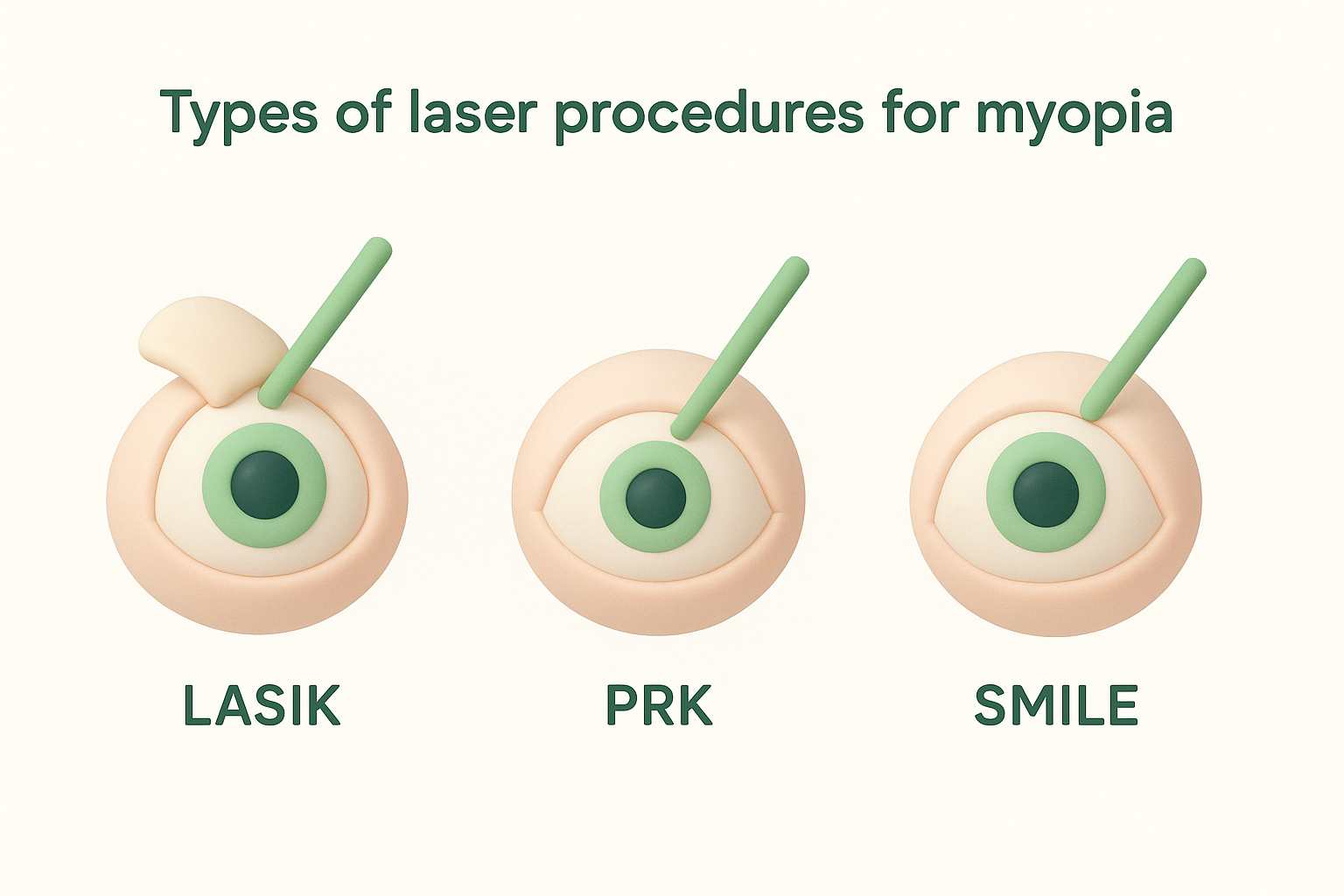
Three main laser procedures correct short sightedness in Australia: LASIK, PRK, and SMILE. Each targets the same goal of reshaping your cornea, but they differ in how the surgeon accesses the tissue beneath the surface. Your corneal thickness, prescription strength, and lifestyle all help determine which approach suits you best.
LASIK
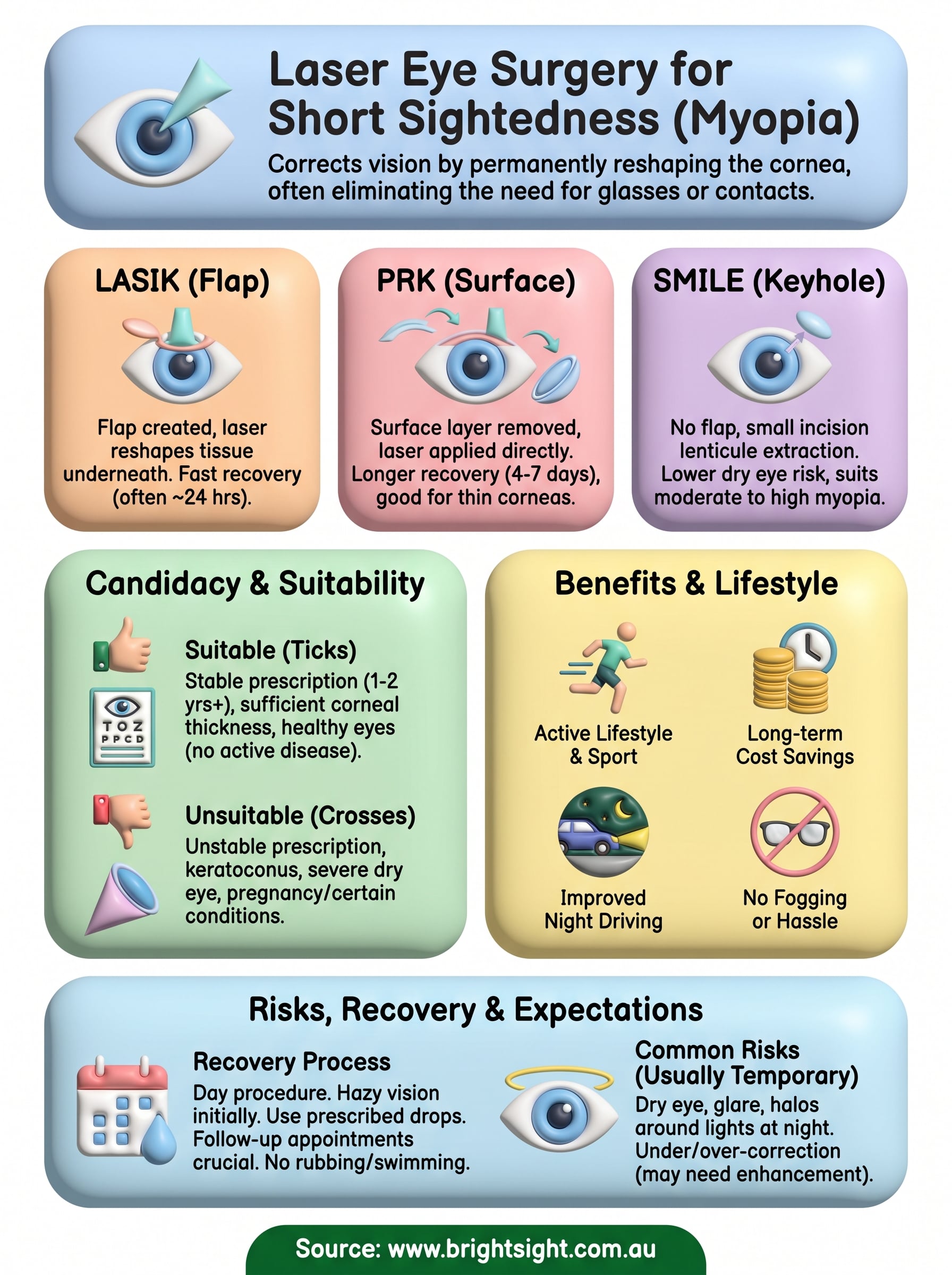
LASIK is the most widely performed laser eye surgery for short sightedness worldwide. Your surgeon creates a thin flap in the outer corneal layer using either a blade or a femtosecond laser, lifts it back, applies the excimer laser to reshape the tissue underneath, and then replaces the flap. Recovery is fast, with most patients noticing a significant improvement in vision within 24 hours.
The flap creation is what makes LASIK both convenient and, for some patients, a limiting factor. People with thinner corneas or very high prescriptions may not have sufficient tissue depth to safely create the flap and still achieve the desired correction. Your surgeon confirms this during pre-operative corneal mapping.
PRK
PRK, or photorefractive keratectomy, removes the surface cell layer of the cornea rather than creating a flap, then applies the excimer laser directly to the corneal surface. Recovery takes longer than LASIK, typically four to seven days of blurred vision while the surface regenerates, but the final outcome is comparable.
PRK is often the preferred option for patients whose corneas are too thin for LASIK or who participate in contact sports where a flap could pose a risk.
Surface ablation techniques like PRK also suit patients with dry eye concerns, since flap creation can temporarily reduce corneal nerve sensitivity and worsen dryness in susceptible individuals.
SMILE
SMILE, or Small Incision Lenticule Extraction, is the newest of the three options. Your surgeon uses a femtosecond laser to create a small disc of corneal tissue, called a lenticule, inside the cornea and then removes it through a tiny keyhole incision. No flap is required, which preserves more of the corneal surface structure and reduces the dry eye risk associated with LASIK.
Patients with moderate to high myopia who want to minimise post-operative dryness are often well suited to SMILE. Because no flap is created, the procedure also carries a lower risk of flap-related complications during recovery.
Who is a good candidate and who is not
Not everyone with myopia is automatically eligible for laser correction. Your age, prescription stability, corneal thickness, and overall eye health all need to meet specific criteria before a surgeon can safely offer any procedure. A thorough pre-operative assessment is the only reliable way to confirm suitability, and a good specialist will tell you clearly if laser surgery is not the right path for your particular eyes.

Signs you are likely suitable
Most suitable candidates share a few key characteristics. Your prescription should have been stable for at least 12 months, ideally two years, before surgery is considered. A prescription that continues to shift means the correction could under-perform or become outdated within a few years of treatment.
Patients typically need to be at least 18 to 21 years old before laser eye surgery for short sightedness is considered, as younger eyes are still changing.
You also need sufficient corneal thickness to allow safe tissue removal without compromising the structural integrity of your eye. Your surgeon determines this using corneal topography and pachymetry scans during your assessment. Beyond that, your eyes need to be free of active disease, with no significant dry eye, keratoconus, or other corneal irregularities that would affect how the laser reshapes your tissue.
Factors that may rule out surgery
Some conditions make laser correction unsuitable or require an alternative approach entirely. Keratoconus, a condition where the cornea progressively thins and bulges forward, is a clear contraindication for laser procedures. Operating on an already weakened cornea could accelerate progression and lead to significantly worse outcomes than leaving the eye untreated.
Very high myopia can also push the limits of what laser surgery can safely correct. In these cases, your surgeon may recommend an implantable collamer lens instead, which sits inside the eye and corrects vision without removing corneal tissue. Uncontrolled autoimmune conditions, pregnancy, and severe dry eye also generally exclude a patient from laser treatment until those factors are managed or resolved. A thorough consultation protects you from a poor outcome, which is why the assessment process matters just as much as the surgery itself.
What to expect, risks, and recovery
Knowing what happens before, during, and after your procedure helps you plan realistically and approach the experience with confidence. Laser eye surgery for short sightedness is performed as a day procedure, meaning you arrive, have the treatment, and return home the same day. The surgery itself takes less than 30 minutes for both eyes, and the laser application is often only a matter of seconds per eye.
The day of surgery and immediate recovery
Your surgeon applies anaesthetic drops before the procedure begins, so you should not feel pain during treatment, though some patients notice pressure or mild discomfort at various points. After surgery, your vision will likely be hazy for several hours, and your eyes may feel gritty, watery, or sensitive to light for the remainder of that day. Most LASIK patients notice clear improvement by the following morning, while PRK patients typically need four to seven days before the surface heals and vision fully stabilises.
Plan to have someone drive you home after surgery, as your vision will not meet the legal standard required to drive on the day of the procedure.
Your surgeon will schedule follow-up appointments to monitor healing, typically the next day, at one week, and at one month after surgery. During recovery, you need to avoid rubbing your eyes, swimming, and wearing eye makeup for a period your surgeon specifies, which varies depending on which procedure you had.
Risks and how they are managed
All surgical procedures carry risk, and laser eye surgery is no exception. The most commonly reported issues include dry eye, glare, and halos around lights at night, as well as temporary fluctuation in vision. Most of these resolve within the first three to six months as your cornea settles into its new shape. Severe or permanent complications remain uncommon when the pre-operative assessment correctly identifies suitable candidates.
Under-correction or over-correction can occur in a small percentage of cases and may call for an enhancement procedure once your vision has fully stabilised. Selecting a surgeon who performs thorough pre-operative corneal mapping and uses current laser technology gives you the best chance of achieving the visual outcome you are working towards.
Your next step
Laser eye surgery for short sightedness has helped many people move away from glasses and contact lenses permanently, but the right outcome depends on starting with a thorough, honest assessment. Every detail covered in this article, from procedure choice to candidacy criteria to recovery expectations, points back to the same conclusion: the quality of your pre-operative consultation determines everything that follows.
If you are based in the Eastern Suburbs of Sydney and want to explore whether laser correction suits your eyes, Dr Capucine Odouard at Bright Sight Eye Specialists offers detailed assessments and clear guidance on which procedure, if any, fits your prescription, corneal anatomy, and lifestyle. She will work through your options with you directly, without pressure, so you leave understanding exactly what is possible.
To take the first step, book a consultation with Dr Odouard and get a clear picture of what your vision could look like without glasses.