


If you have astigmatism, you already know how it affects your daily life, blurred vision at multiple distances, reliance on glasses or contact lenses, and the frustration that comes with neither option being perfect. The good news is that laser eye surgery for astigmatism is one of the most effective and well-established ways to correct this common refractive error, often reducing or eliminating the need for corrective lenses altogether.
But not all laser procedures are the same, and not every eye is suited to every technique. Procedures like LASIK, PRK, and SMILE each reshape the cornea differently, and the right choice depends on your specific corneal shape, prescription, and lifestyle. Understanding these differences matters, especially when it’s your vision on the line.
At Bright Sight Eye Specialists in Randwick, Dr Capucine Odouard offers all three major laser correction procedures, including LASIK, PRK, and SMILE, with a focus on matching each patient to the approach that suits them best. With training from Sydney Eye Hospital and specialist expertise in refractive and corneal surgery, she works closely with patients across Sydney’s Eastern Suburbs to deliver clear, lasting results.
This article breaks down how each procedure treats astigmatism, what to expect in terms of safety and recovery, and how to determine whether you’re a suitable candidate. Whether you’ve been considering laser surgery for years or are just starting to explore your options, you’ll find the practical, evidence-based information you need right here.
Why astigmatism blurs vision
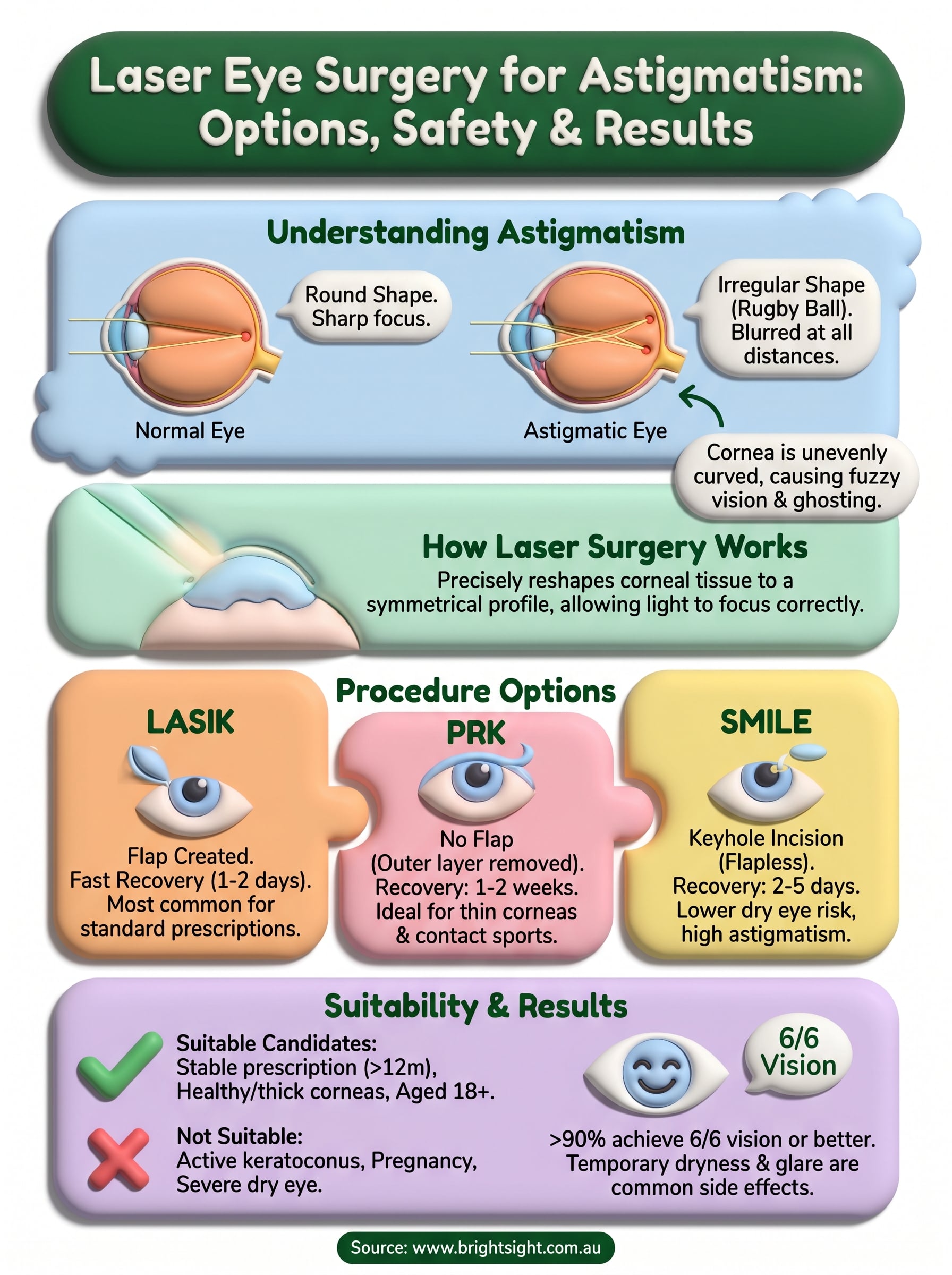
A normal eye focuses light onto a single point on the retina, producing a sharp, clear image. With astigmatism, the cornea or sometimes the lens is irregularly shaped, meaning light entering the eye bends unevenly and lands on multiple focal points instead of one. The result is blurred or distorted vision at any distance, which is why astigmatism can feel quite different from straightforward short- or long-sightedness and why it often goes undetected for years.
The shape behind the blur
Think of a normal cornea as the surface of a perfectly round ball, smooth and symmetrical in every direction. An astigmatic cornea is shaped more like a rugby ball or the back of a spoon, curved more steeply in one direction than the other. Light passing through the steeper meridian bends more sharply than light passing through the flatter one, so the two beams land at different points on the retina. Your brain receives two slightly offset signals and cannot merge them into a single, clean image, which is why vision stays fuzzy regardless of how far away the object is.
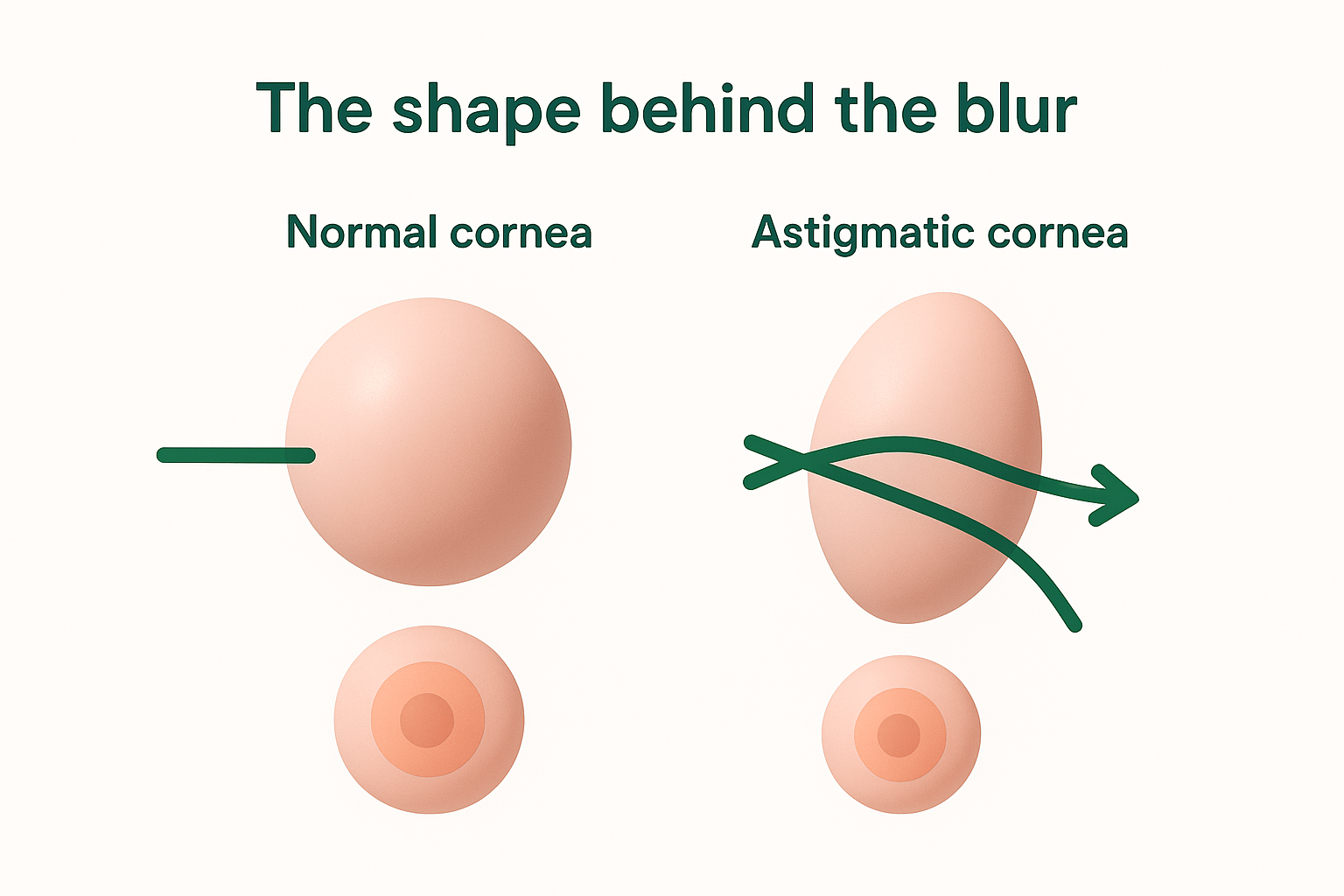
The steeper the difference between the two meridians, the more pronounced your visual distortion will be.
What astigmatism actually feels like
The visual effects go well beyond simple blur. You might notice ghosting or doubling around letters and edges, struggle to read fine print clearly, or experience significant eyestrain after prolonged screen use. Driving at night often becomes particularly difficult, as light sources such as streetlights and headlights appear to streak or spread in multiple directions. Many people attribute these symptoms to tiredness rather than a refractive error, which is why a comprehensive eye test is often the first step. When astigmatism is moderate to high, glasses or contact lenses become a daily necessity, and that ongoing reliance is usually what leads people to explore laser eye surgery for astigmatism as a more permanent solution.
How laser eye surgery corrects astigmatism
Laser eye surgery for astigmatism works by reshaping the cornea so that light entering your eye bends evenly and lands on a single focal point. Instead of compensating for the irregular shape through glasses or contact lenses, the laser removes microscopic amounts of corneal tissue in a precise, computer-guided pattern that matches the unique measurements of your eye.
Targeting the irregular curve
Every treatment starts with a detailed map of your corneal surface, called a topography scan. This map identifies exactly where your cornea is steeper or flatter and guides the laser to flatten the steeper meridian and steepen the flatter one. The result is a more symmetrical corneal profile that bends light the same way in every direction.
The laser removes tissue in fractions of a micron, which is why the level of precision far exceeds what any lens can achieve.
What makes this approach reliable is that modern laser platforms treat astigmatism at the same time as any short- or long-sightedness you have. Your surgeon programmes the exact correction before the procedure begins, so the laser addresses your full refractive error in a single, controlled treatment.
Which procedure fits: LASIK, PRK, SMILE
All three procedures correct astigmatism by reshaping the cornea, but the method of accessing the tissue differs between them. Your corneal thickness, prescription strength, and daily lifestyle all influence which option suits you best.
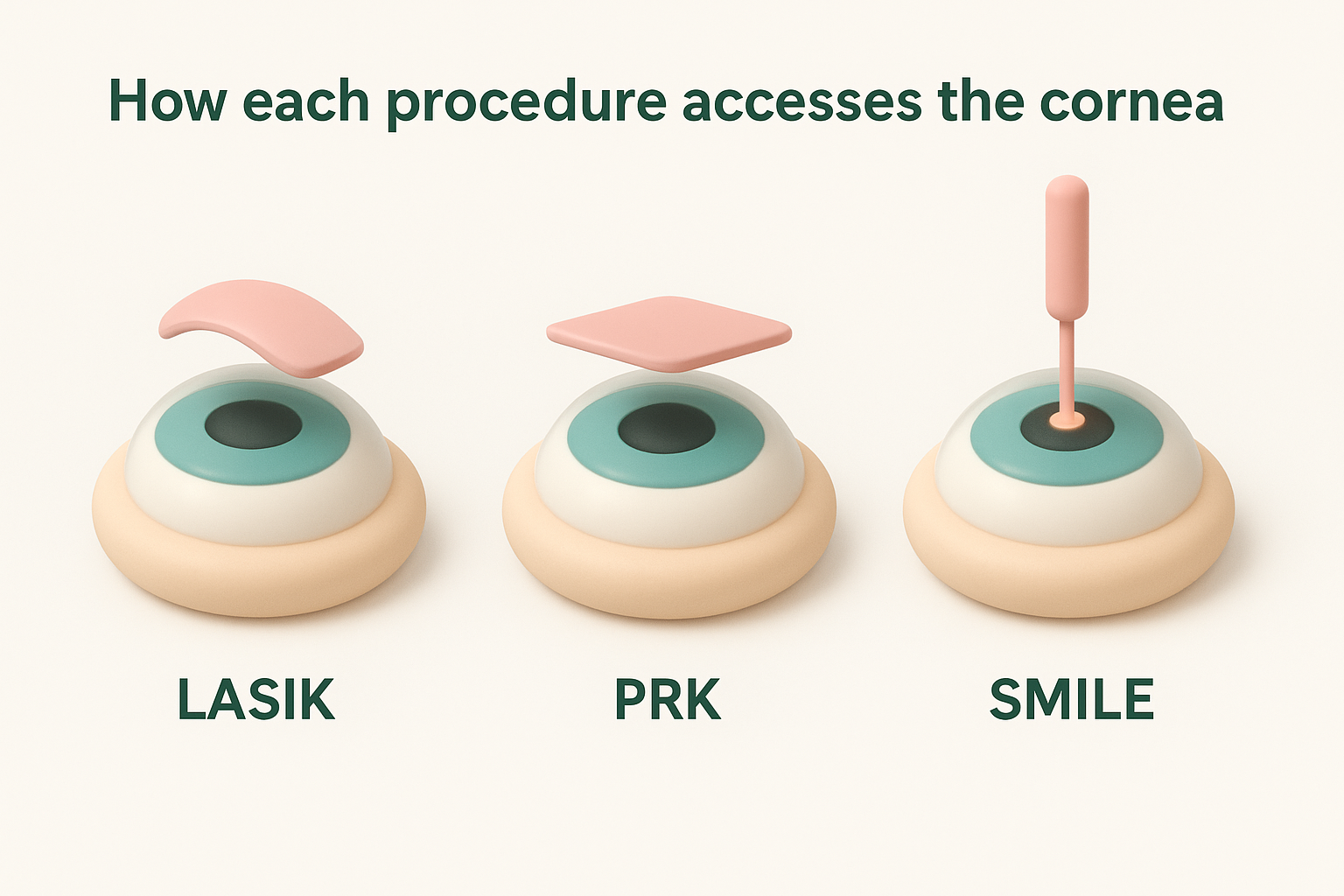
How each procedure accesses the cornea
LASIK creates a thin flap on the corneal surface, applies the laser underneath, then repositions the flap. PRK removes the outer epithelial layer before treating the tissue directly, with no flap involved. SMILE uses a femtosecond laser to remove a small disc of tissue through a tiny keyhole incision, making it entirely flapless.
| Procedure | Access method | Recovery | Best suited to |
|---|---|---|---|
| LASIK | Corneal flap | 1-2 days | Most astigmatism prescriptions |
| PRK | No flap | 1-2 weeks | Thin corneas, contact sports |
| SMILE | Keyhole incision | 2-5 days | Higher astigmatism, dry eye risk |
SMILE preserves more corneal nerves than LASIK, which lowers the likelihood of dry eye symptoms after laser eye surgery for astigmatism.
Which one suits your situation
If you lead an active lifestyle or play contact sports, PRK or SMILE removes the risk of flap displacement entirely. For most standard prescriptions with adequate corneal thickness, LASIK delivers the fastest return to clear, functional vision.
Who is a good candidate and who is not
Suitability for laser eye surgery for astigmatism comes down to several measurable factors, and a thorough pre-operative assessment is the only reliable way to know where you stand. Corneal thickness, prescription stability, and overall eye health all play a role in determining whether you proceed and which procedure suits you best.
Signs you are likely suitable
Most good candidates are aged 18 or older with a stable prescription that has not changed significantly over the past 12 months. Your corneas need sufficient thickness to allow safe tissue removal, and your refractive error must fall within the treatable range for the chosen procedure.
Adults with mild to moderate astigmatism and healthy corneas typically achieve the strongest outcomes from laser correction.
When laser surgery is not the right fit
Certain conditions exclude or delay treatment entirely. Active keratoconus, where the cornea progressively thins and bulges forward, makes laser surgery unsafe because removing further tissue weakens an already compromised structure. Pregnancy, autoimmune conditions, and significantly dry eyes may also rule out treatment or require managing those conditions first before surgery is considered.
If your prescription falls outside the treatable range, refractive lens exchange offers an alternative worth discussing with your surgeon.
Safety, side effects and expected results
Laser eye surgery for astigmatism has a strong long-term safety record, with large-scale studies consistently reporting high satisfaction rates among treated patients. The procedures are performed under local anaesthetic drops, take under 15 minutes per eye, and carry a very low risk of serious complications when performed by a qualified surgeon on a well-selected candidate.
Side effects to expect in the short term
Most people experience temporary dryness, light sensitivity, and mild hazing in the days and weeks after surgery. These effects are common and typically resolve as your cornea heals. Halos and glare around lights at night can persist for two to three months before settling, particularly after LASIK.
Dry eye symptoms are usually managed well with lubricating drops and rarely persist beyond the initial healing period.
What results you can realistically expect
Studies show that more than 90% of patients achieve 6/6 vision or better after laser correction for astigmatism. Your final result depends on your pre-operative prescription, corneal measurements, and how well your eye heals.
Some patients with higher degrees of astigmatism may retain a mild residual prescription, though this is often correctable with an enhancement procedure if your corneal thickness allows it.
Next steps for clearer vision
If you have read this far, you likely already know that laser eye surgery for astigmatism can make a real difference to your daily life. The key is finding out whether your eyes are suited to the procedure and which of the three approaches gives you the best outcome. A comprehensive pre-operative assessment is where that process begins, and it takes the guesswork out of the decision entirely.
Your next step is straightforward. Book a consultation with Dr Capucine Odouard at Bright Sight Eye Specialists in Randwick, where she will map your corneal shape, review your prescription history, and walk you through the options that fit your specific situation. Patients from Bondi, Maroubra, Kensington, and across Sydney’s Eastern Suburbs regularly make that first appointment. Clear, glasses-free vision starts with one conversation. Book your laser eye surgery consultation today and find out exactly what is possible for your eyes.