


If you’ve been told you need cataract surgery, or you’re exploring options to reduce your dependence on glasses, you’ve likely come across the term IOL surgery. This procedure involves implanting an artificial lens inside the eye to replace your natural lens, and it’s one of the most commonly performed surgeries worldwide.
Understanding your options is essential when making decisions about your vision. Different types of intraocular lenses offer varying benefits, from correcting distance vision to addressing astigmatism or providing a full range of focus. Knowing what to expect, from the procedure itself through to recovery, helps you feel confident and prepared.
At Bright Sight Eye Specialists in Randwick, Dr Rahul Dubey and Dr Capucine Odouard perform IOL surgery using advanced techniques and technology. This guide covers everything you need to know: how IOL surgery works, the lens types available, potential risks, and what recovery looks like. Whether you’re comparing premium lens options or simply want clear answers before your consultation, you’ll find the information you need here.
Why people choose IOL surgery
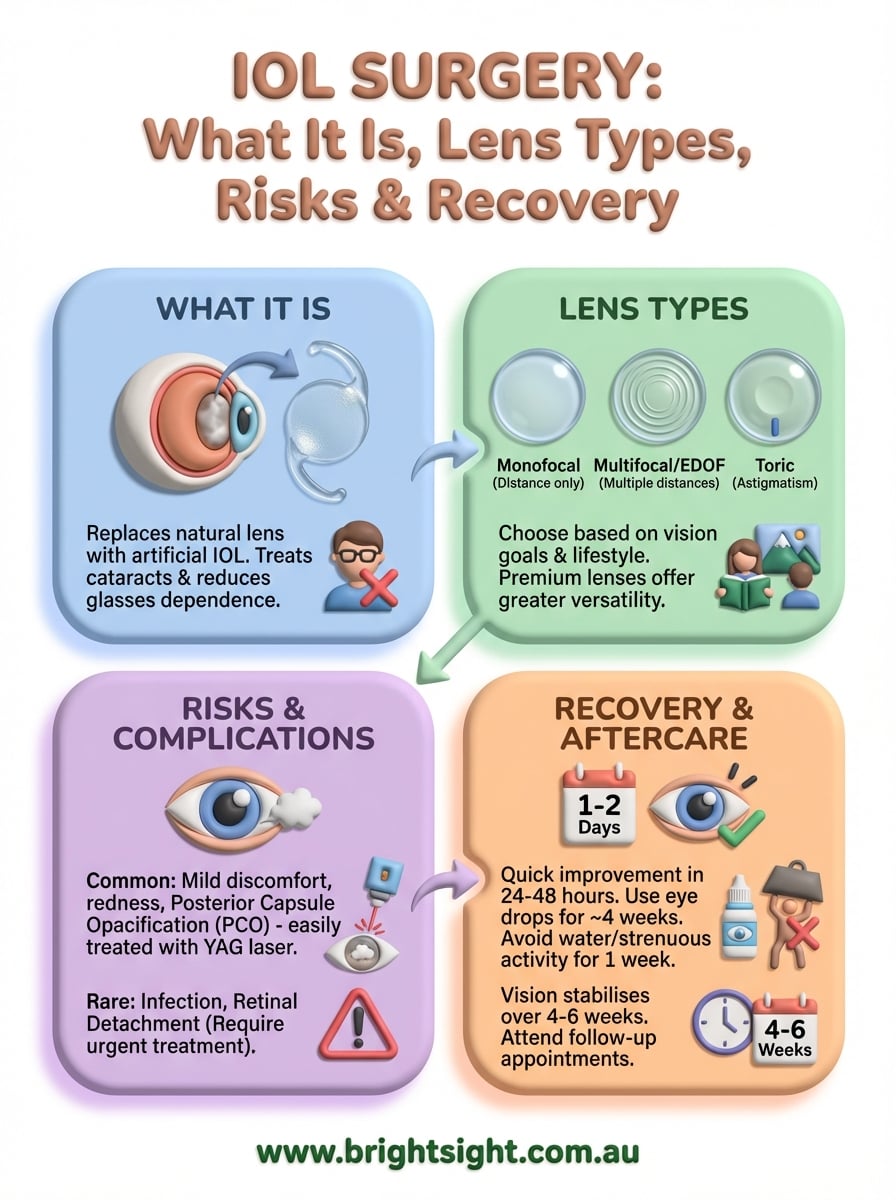
People choose IOL surgery for different reasons, but the most common is treating cataracts. When your natural lens becomes cloudy, it affects your ability to drive, read, or recognise faces. IOL surgery restores clarity by replacing that clouded lens with a clear artificial one. Beyond cataracts, some people opt for this procedure to correct refractive errors like severe short-sightedness or long-sightedness, particularly when laser eye surgery isn’t suitable.
Restoring vision after cataracts
Cataracts develop gradually, and you might not notice the changes until they significantly impact your daily life. You may struggle with glare from headlights at night, find colours appear faded, or need brighter lighting to read. These symptoms worsen over time, and eventually, glasses alone can’t compensate for the clouding of your natural lens.
IOL surgery offers a permanent solution. Once your surgeon removes the cataract and implants the new lens, the cloudiness doesn’t return. Most patients experience immediate improvement in vision quality, often reporting that colours look brighter and images appear sharper than they have in years.
The procedure restores functional vision, allowing you to return to activities you may have avoided due to poor sight.
Reducing dependence on glasses
You might choose IOL surgery even if you don’t have cataracts, particularly if you want freedom from glasses or contact lenses. Premium lens options, such as multifocal or extended depth of focus lenses, can correct vision at multiple distances. This means you could read, use a computer, and drive without constantly reaching for your glasses.
Refractive lens exchange (RLE) uses the same technique as cataract surgery but focuses on vision correction rather than cataract removal. If you’re over 50 and have high levels of short-sightedness, long-sightedness, or astigmatism, this option may suit you better than laser procedures.
Addressing other vision problems
IOL surgery also treats specific conditions beyond standard cataracts. If you have astigmatism, a toric lens can correct the irregular curvature of your cornea during the same procedure. People with previous refractive surgery complications or corneal irregularities may benefit from specialised IOL options that compensate for these issues.
Your surgeon selects the lens type based on your individual eye anatomy, lifestyle needs, and vision goals. This personalised approach ensures the implant addresses your specific concerns while providing the clearest possible outcome for your circumstances.
How IOL surgery works
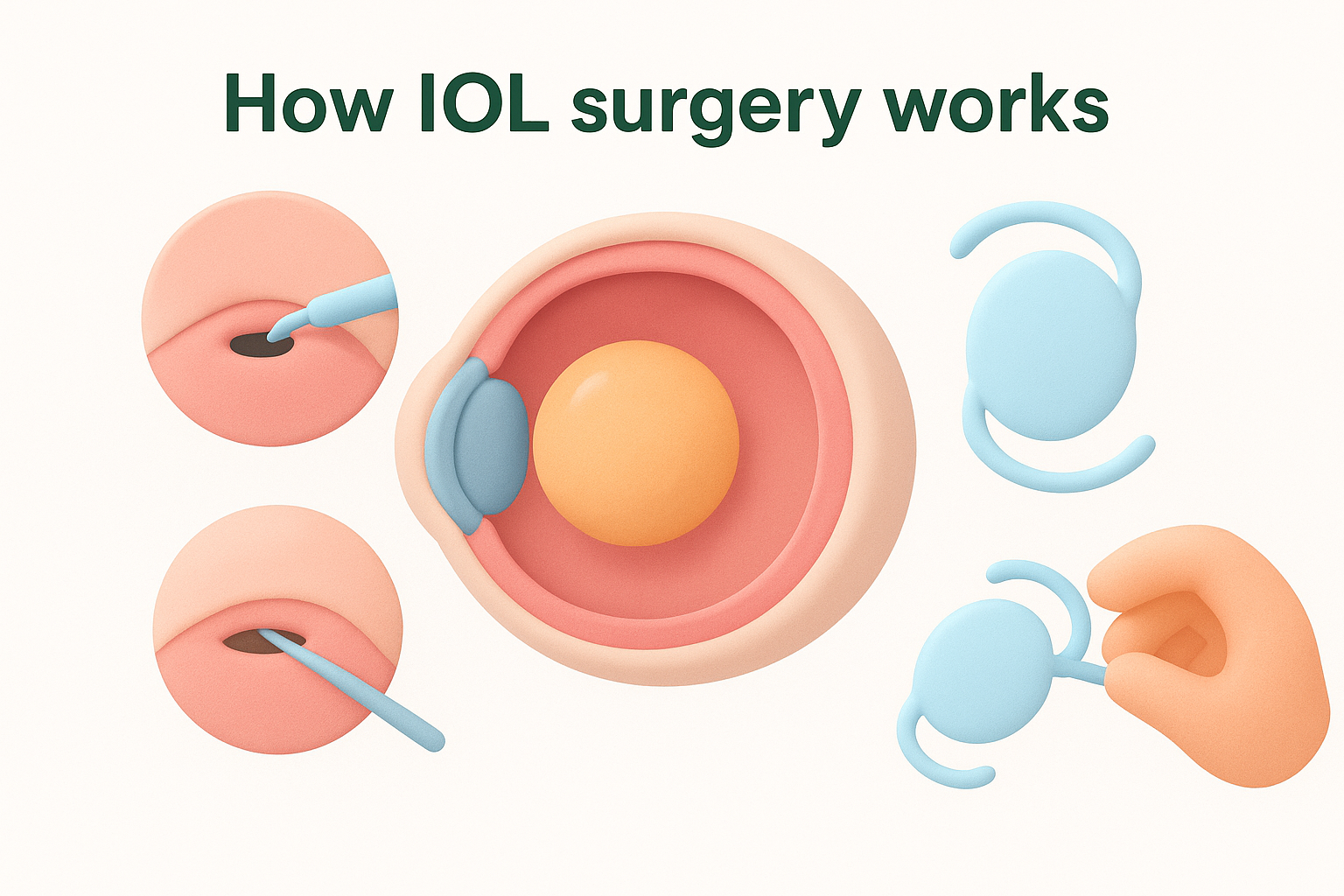
IOL surgery replaces your clouded or dysfunctional natural lens with a clear artificial one. The procedure takes approximately 15 to 30 minutes per eye and usually happens under local anaesthetic with sedation. You remain awake but feel no pain, and most patients describe feeling only mild pressure during the operation.
The surgical procedure
Your surgeon creates a tiny incision (typically 2-3mm) at the edge of your cornea to access the lens. Using an ultrasound probe, they break up your natural lens into small fragments through a process called phacoemulsification. This technique uses high-frequency sound waves to gently fragment the lens, which is then removed through the same small incision.
Once your natural lens is removed, your surgeon folds the IOL and inserts it through the incision. The lens unfolds inside your eye and positions itself where your natural lens sat. Most modern IOLs are flexible and designed to self-centre within the lens capsule, the thin membrane that held your original lens.
The incision is so small that it typically heals without stitches, reducing recovery time and discomfort.
What happens during the operation
You lie on a reclining chair beneath a surgical microscope that allows your surgeon to view the inside of your eye with precision. Your eye remains open using a gentle speculum, and anaesthetic drops numb the surface completely. Throughout the procedure, your surgeon monitors the positioning of instruments and the IOL using real-time imaging technology, ensuring accurate placement and optimal visual outcomes for your specific eye anatomy.
IOL lens types and how to pick one
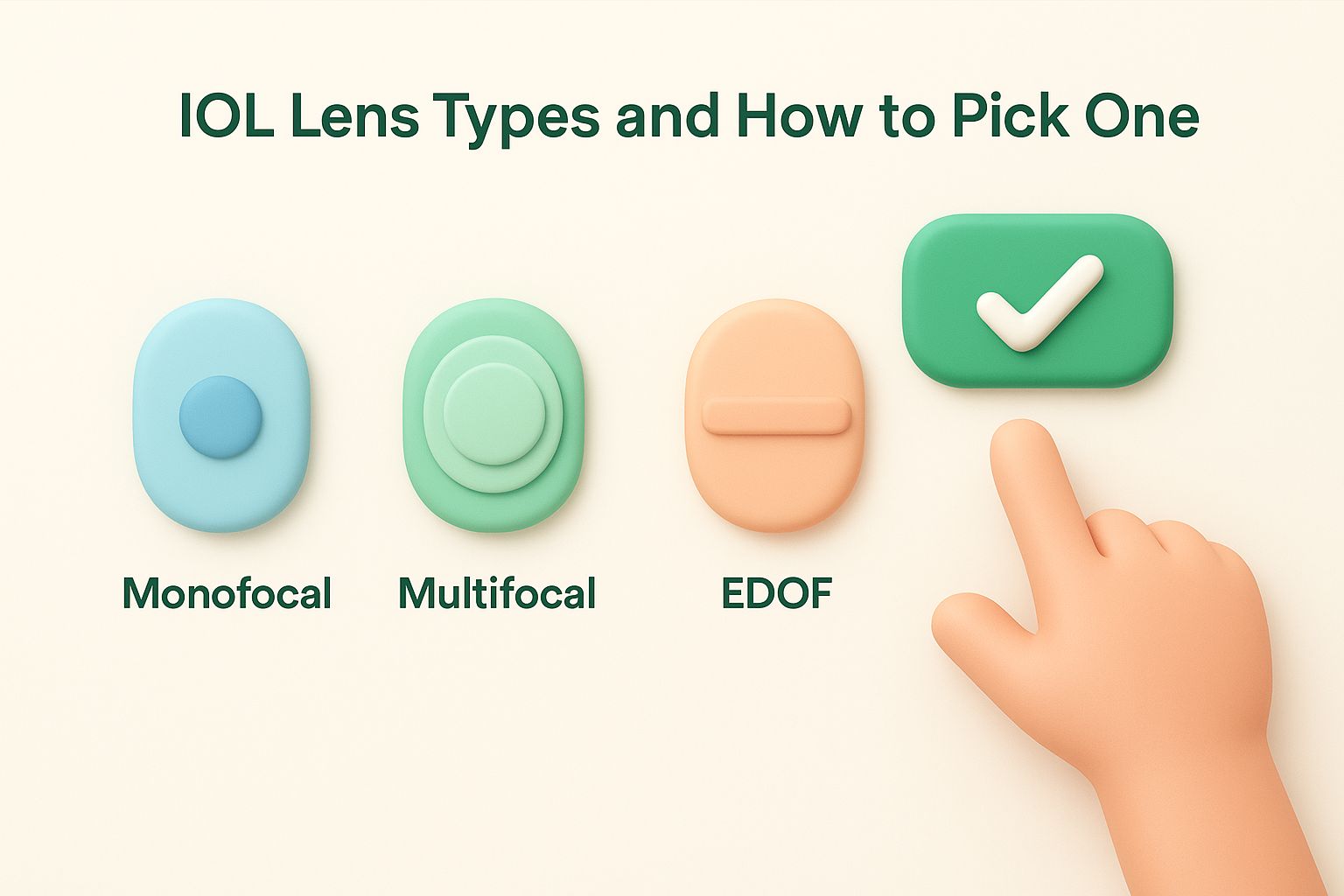
Your surgeon selects an IOL based on your vision goals and lifestyle requirements. Several lens types exist, each designed to address different needs. Monofocal lenses correct vision at one distance, typically far. Multifocal and extended depth of focus (EDOF) lenses allow clear vision at multiple distances, reducing your dependence on glasses for reading or computer work.
Standard and premium lens options
Monofocal lenses represent the most common choice for IOL surgery. These lenses provide excellent distance vision, allowing you to drive and watch television clearly. However, you’ll still need reading glasses for close work. Toric monofocal lenses correct astigmatism alongside distance vision, eliminating the need for glasses to compensate for corneal irregularities.
Premium lenses offer greater versatility. Multifocal IOLs use different zones to focus light from various distances, enabling you to read, use a computer, and see far objects without glasses. EDOF lenses create an extended range of vision, particularly strong for distance and intermediate tasks. These options suit people who want minimal reliance on glasses after surgery.
Premium lenses cost more but can eliminate the ongoing expense and inconvenience of multiple pairs of glasses.
Choosing the right lens for your lifestyle
Your daily activities determine which lens suits you best. If you spend hours reading, doing detailed craft work, or using digital devices, a multifocal or EDOF lens may serve you well. People who prioritise distance vision for driving or outdoor activities often choose monofocal lenses paired with reading glasses.
Your surgeon considers your eye health, previous surgeries, and expectations when recommending a lens. They measure your eye’s dimensions precisely and discuss how each option aligns with your vision priorities. Being honest about your lifestyle and what matters most helps ensure you receive the most appropriate lens for your circumstances.
Risks and possible complications
IOL surgery carries a high success rate, but like any surgical procedure, it involves potential risks. Most complications are minor and treatable, though understanding what could occur helps you make an informed decision and recognise issues early if they arise. Your surgeon discusses these risks during your consultation and takes measures to minimise them throughout the procedure.
Common short-term issues
You may experience mild discomfort, redness, or light sensitivity in the days following IOL surgery. These symptoms typically resolve within a week as your eye heals. Some patients notice temporary blurred vision or halos around lights, particularly at night. This often improves as your brain adapts to the new lens and any post-operative inflammation subsides.
Posterior capsule opacification (PCO) affects approximately 20-40% of patients within a few years after surgery. Your natural lens capsule, which holds the IOL in place, becomes cloudy over time. This creates symptoms similar to your original cataract. A quick laser procedure called YAG capsulotomy clears the cloudiness permanently, restoring clear vision within minutes.
The procedure requires no incision and causes no pain, making it a simple solution if PCO develops.
Rare but serious complications
Serious complications occur in less than 1% of cases but require immediate attention. Endophthalmitis, an infection inside the eye, causes severe pain, redness, and vision loss. Your surgeon prescribes antibiotic drops to prevent this and monitors you closely after surgery. Retinal detachment, where the retina pulls away from the back of your eye, causes sudden flashes of light or a curtain-like shadow across your vision. Both conditions need urgent treatment to preserve your sight.
Recovery time and aftercare
Most patients recover quickly after IOL surgery, with noticeable vision improvement within 24 to 48 hours. Your eye continues healing over several weeks, and following your surgeon’s aftercare instructions ensures the best possible outcome. Understanding what to expect during recovery helps you plan accordingly and recognise when something needs attention.
The first week after surgery
Your surgeon prescribes antibiotic and anti-inflammatory eye drops to prevent infection and reduce swelling. You’ll use these drops several times daily for approximately four weeks, tapering the frequency as directed. A protective shield covers your eye at night for the first week to prevent accidental rubbing or pressure whilst you sleep.
Avoid getting water directly in your eye during the first week. You can shower and wash your face, but keep your eyes closed and avoid directing the spray onto your operated eye. Heavy lifting, strenuous exercise, and bending below waist level should wait until your surgeon clears you, typically after one to two weeks.
Most patients return to light daily activities within a few days, though driving requires your surgeon’s approval once vision meets legal standards.
Long-term healing and follow-up
Your vision stabilises over four to six weeks following IOL surgery. You’ll attend follow-up appointments at one day, one week, and four to six weeks after surgery. These visits allow your surgeon to monitor healing, check eye pressure, and ensure the lens sits correctly. Some patients notice fluctuating vision or mild dryness during this period, both of which typically resolve as healing completes.
Report any sudden vision loss, severe pain, increasing redness, or flashing lights immediately to your surgeon. These symptoms could indicate complications requiring prompt treatment to protect your sight.
Next steps for clear vision
IOL surgery offers a proven solution for restoring clarity and reducing your dependence on glasses. Understanding your options, from lens types to recovery expectations, helps you feel confident about moving forward with treatment. If you experience symptoms like cloudy vision, difficulty reading, or glare whilst driving at night, scheduling a consultation provides clarity about whether this procedure suits your needs and addresses your specific vision concerns.
Your vision affects every aspect of daily life, from driving safely to enjoying hobbies and spending time with loved ones. Delaying treatment allows symptoms to worsen gradually, potentially impacting your quality of life and independence over time. Taking action now means you can return to activities you may have avoided and experience the world with renewed clarity.
Dr Rahul Dubey and Dr Capucine Odouard at Bright Sight Eye Specialists in Randwick combine advanced technology with personalised care throughout your journey. Book a consultation to explore your options and take the first step towards clearer vision.