


An IOL lens (intraocular lens) is a tiny artificial lens that replaces your natural eye lens during cataract surgery. When cataracts cloud your natural lens and blur your vision, your surgeon removes the clouded lens and positions an IOL in the same spot. This small piece of medical-grade plastic or silicone performs the same function as your original lens. It bends light rays and focuses them onto your retina, allowing you to see clearly again.
Choosing the right IOL can feel overwhelming when you start researching your options. You’ll encounter terms like monofocal, multifocal, extended depth of focus, and toric lenses. Different brands offer various features, and costs vary significantly between standard and premium options. This guide breaks down the main IOL types available in Australia, explains who benefits most from each design, covers the brands your surgeon might recommend, and gives you realistic cost expectations including insurance coverage. You’ll understand your choices so you can make confident decisions about your vision.
Why IOL lenses matter in cataract surgery
Your surgeon cannot simply remove the cataract and leave your eye without a lens. Your natural lens provides approximately one-third of your eye’s focusing power, and removing it would leave you with severely blurred vision. The cornea handles the other two-thirds of focusing, but without a lens behind it, light rays would fall far short of your retina. You would see the world as an unfocused blur, unable to read, drive, or perform everyday tasks safely.
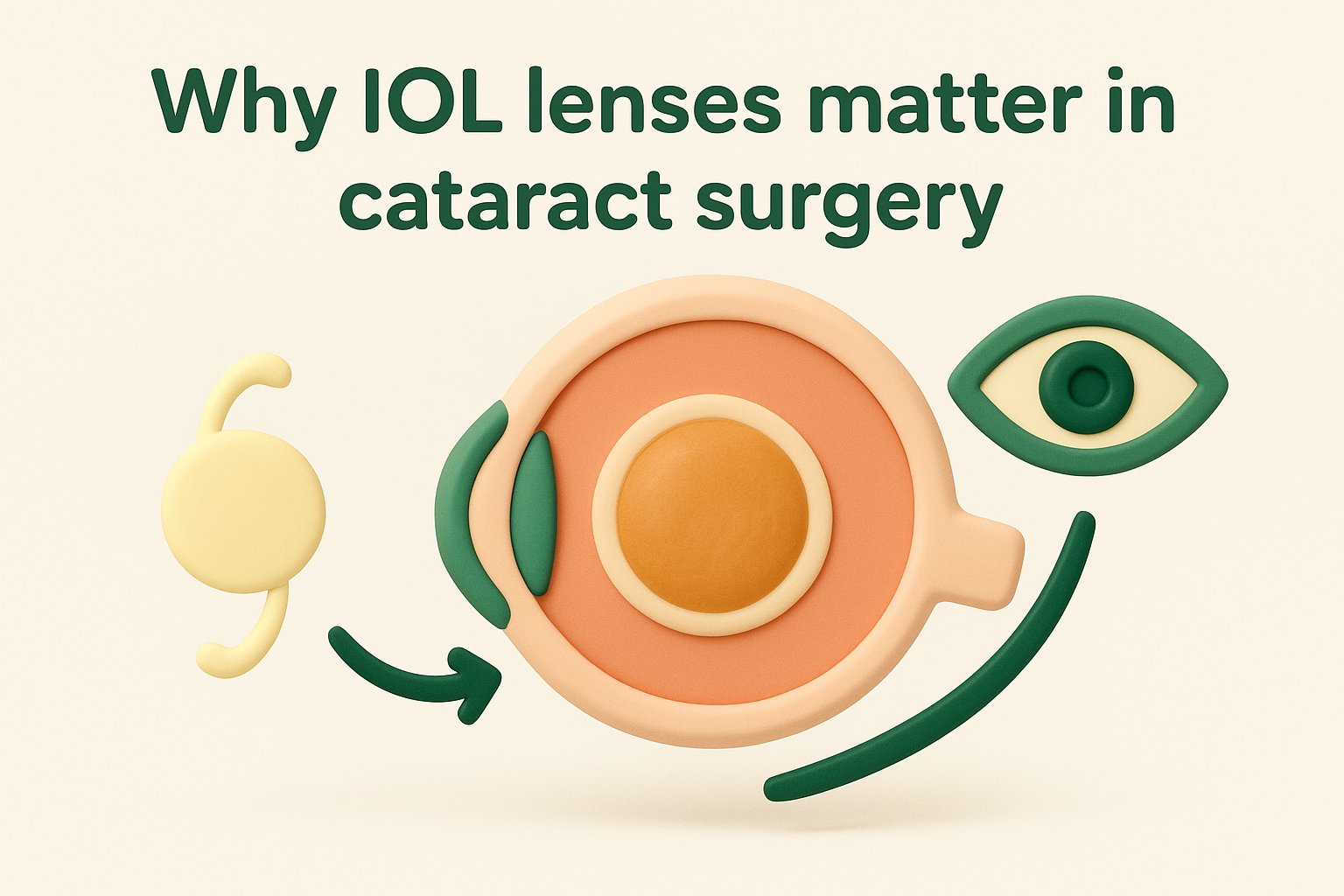
Without an intraocular lens implant, you would need extremely thick glasses to achieve even basic functional vision.
The permanent solution
An IOL lens becomes a fixed part of your eye’s optical system after surgery. Unlike glasses or contact lenses that you remove daily, your surgeon positions the IOL inside the natural lens capsule, where it remains stable for life. This placement allows the lens to work seamlessly with your cornea, focusing incoming light precisely onto your retina. Modern IOLs are designed to last your lifetime without degrading, clouding, or requiring replacement under normal circumstances.
How to choose the right IOL lens
Your surgeon will guide you through selecting an IOL lens based on your vision goals and your eye’s specific characteristics. This decision involves balancing what you want to see clearly without glasses against your lifestyle needs, budget, and eye health. You cannot simply choose the most expensive option and assume it will suit you best. Each lens design offers different trade-offs between distance clarity, near vision, independence from glasses, and potential visual side effects like halos around lights at night.
Your vision priorities come first
Think about which daily activities matter most to you and how often you perform them. If you spend hours reading, working on computers, or doing detailed close-up work, you might prioritize near vision correction. If you drive frequently, especially at night, you need excellent distance vision with minimal glare. Some patients accept wearing reading glasses occasionally if it means crisp distance vision without halos. Others prefer reducing their dependence on glasses for most tasks, even if that means adapting to some visual compromises.
Your honest answers about your lifestyle help your surgeon match you with the IOL lens design that aligns with how you actually live and work.
Medical factors your surgeon assesses
Your ophthalmologist will examine whether you have astigmatism, which requires specialized toric IOLs to correct the irregular corneal shape. They’ll check for any existing retinal conditions or corneal irregularities that might affect how certain lens types perform in your eye. Previous eye surgeries, dry eye severity, and pupil size also influence which IOL designs will work best for you. Some premium lenses require healthy retinas and regular corneal surfaces to deliver their intended benefits. Your surgeon combines these medical factors with your lifestyle priorities to recommend the most suitable options.
Types of IOL lenses and who they suit
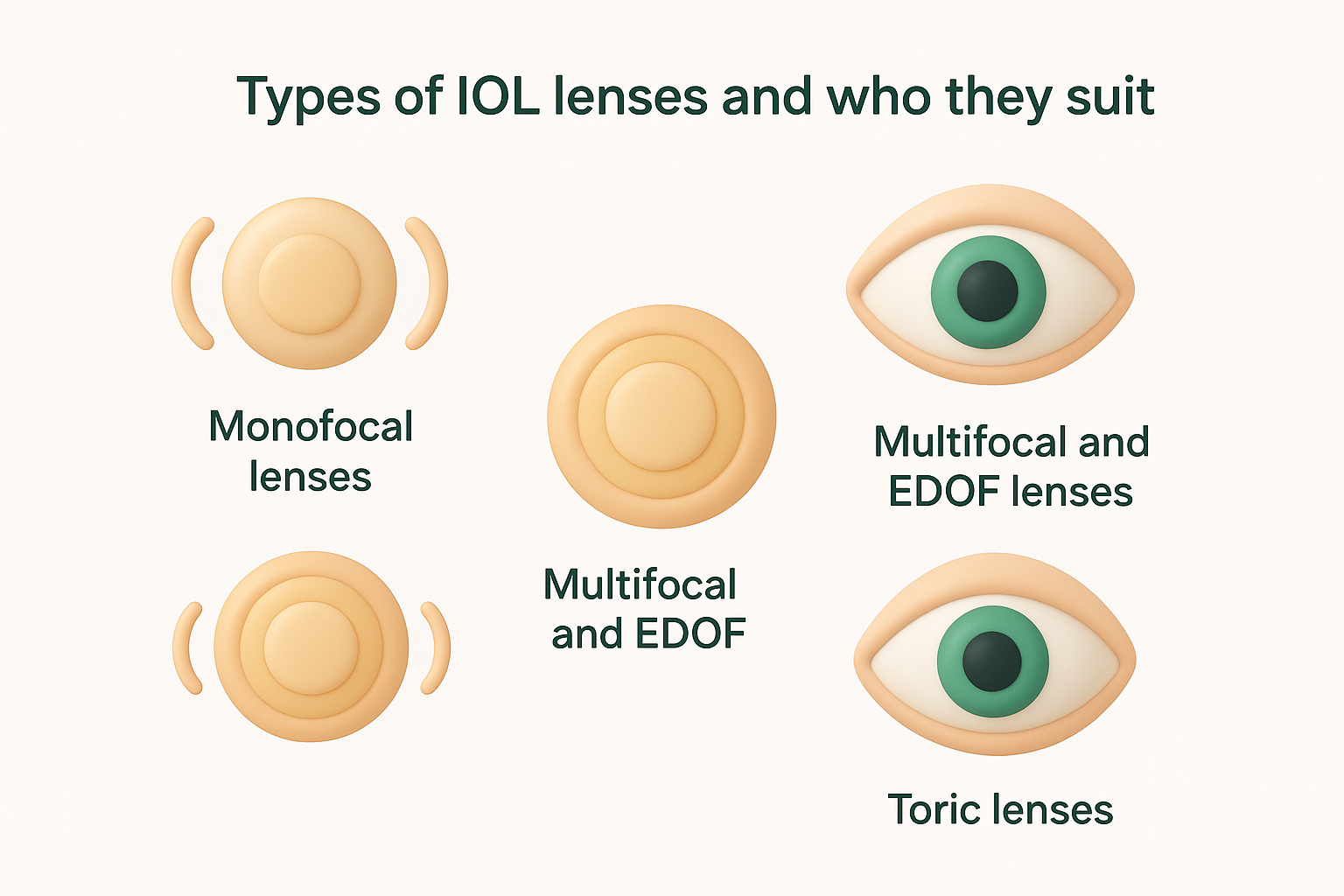
Australian ophthalmologists offer several distinct IOL lens designs, each engineered to solve specific vision problems. The type your surgeon recommends depends on whether you have astigmatism, how much you want to reduce your dependence on glasses, and what visual trade-offs you can accept. Standard monofocal lenses come with basic cataract surgery packages, while premium options like multifocal, extended depth-of-focus, and toric designs address additional vision needs but carry extra costs. Understanding each type helps you decide which features justify the investment for your particular situation.
Monofocal lenses for straightforward vision
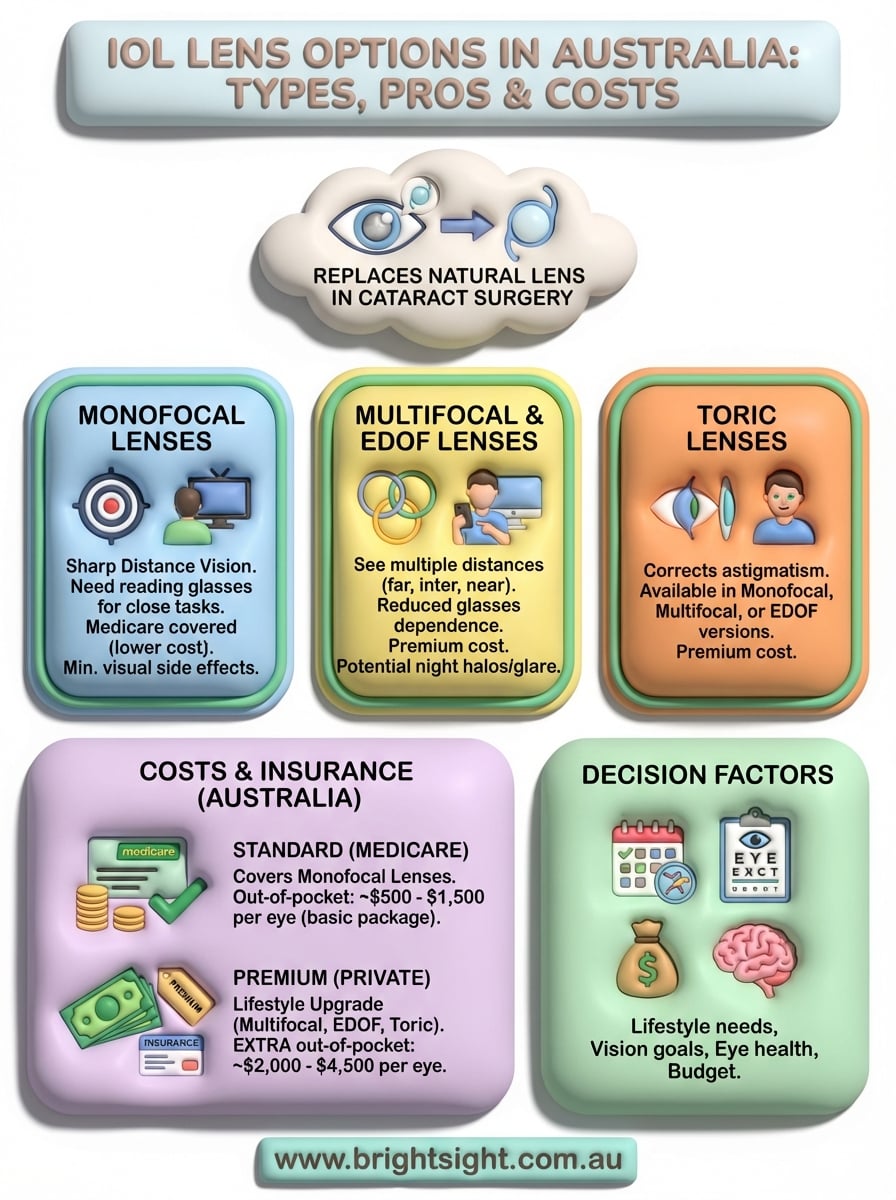
Monofocal IOLs provide sharp focus at one set distance, typically optimized for far vision so you can drive, watch television, and see faces clearly across a room. You’ll need reading glasses for close-up tasks like reading books, using your phone, or working on detailed hobbies. These lenses deliver excellent clarity with minimal visual side effects like halos or glare around lights at night. Most Australians who choose monofocal lenses set both eyes for distance vision and keep reading glasses handy. Some patients opt for monovision, where your surgeon sets one eye for distance and the other for near vision, though this approach requires your brain to adapt to each eye handling different ranges.
Multifocal and EDOF lenses for reduced dependence on glasses
Multifocal lenses contain multiple focusing zones within the same lens, allowing you to see clearly at far, intermediate, and near distances without switching glasses. Extended depth-of-focus (EDOF) lenses work differently, using a single elongated focal zone that covers distance and intermediate vision smoothly, though you might still need reading glasses for very small print. These premium designs suit active people who dislike wearing glasses for daily activities. However, you may notice halos around headlights when driving at night, and your brain needs several weeks to adapt to processing images from different lens zones.
Multifocal and EDOF lenses trade some crispness and night vision quality for the convenience of seeing multiple distances without glasses.
Toric lenses for astigmatism correction
Toric IOLs correct astigmatism caused by an irregularly curved cornea while also replacing your cataractous lens. Without a toric design, your astigmatism would persist after cataract surgery, leaving your vision slightly blurred and requiring corrective glasses. These lenses come in monofocal, multifocal, or EDOF versions, so you can combine astigmatism correction with your preferred focusing design. Your surgeon measures your astigmatism precisely and aligns the toric lens at a specific angle during surgery to neutralize the corneal irregularity.
IOL lens brands in Australia
Several major manufacturers supply IOL lenses to Australian ophthalmologists, each offering different lens designs with varying features and performance characteristics. Your surgeon typically works with two or three preferred brands based on their surgical experience, the lens designs that best match their patients’ needs, and their confidence in each manufacturer’s quality and consistency. You won’t usually choose a brand directly. Instead, your ophthalmologist recommends a specific lens model from their preferred manufacturers that aligns with your vision goals and eye anatomy.
What you need to know about brand selection
The largest IOL suppliers in Australia include Alcon, Johnson & Johnson Vision, Bausch + Lomb, and Zeiss. These companies each produce multiple lens designs spanning monofocal, multifocal, EDOF, and toric options. Your surgeon’s familiarity with a particular brand’s insertion techniques and optical performance often matters more than brand reputation alone.
Brand selection primarily influences which specific lens features are available rather than overall quality differences between major manufacturers. Some brands offer certain multifocal designs or toric options that competitors don’t manufacture. Your surgeon evaluates whether a particular brand’s lens design addresses your specific vision needs better than alternatives. You should focus on the lens type and optical design rather than the manufacturer’s name when making decisions about your IOL lens.
IOL lens costs and insurance in Australia
IOL lens costs in Australia vary dramatically depending on whether you choose standard monofocal lenses or premium multifocal, EDOF, or toric designs. Medicare and private health insurance cover basic cataract surgery with standard lenses, but you’ll pay substantial out-of-pocket fees for premium options. Understanding what your insurance covers and what you’ll pay personally helps you budget realistically and decide which lens features justify the additional expense for your situation.
Standard monofocal IOLs and Medicare coverage
Medicare covers standard monofocal IOL lenses as part of medically necessary cataract surgery when your cataracts significantly impair your vision. You’ll still pay some out-of-pocket costs even with Medicare, typically between $500 and $1,500 per eye depending on your surgeon’s fees and whether you have private health insurance with hospital cover. Your private insurance can reduce or eliminate these gap payments if you choose a surgeon who participates in your fund’s no-gap or known-gap agreements. The basic package provides you with excellent distance vision correction using proven monofocal lens technology.
Premium IOL lenses and out-of-pocket expenses
Premium IOL options including multifocal, EDOF, and toric lenses cost between $2,000 and $4,500 extra per eye beyond what Medicare and insurance cover for standard cataract surgery. Medicare and most private health funds classify these advanced lenses as lifestyle upgrades rather than medical necessities, so you’ll pay the full premium lens cost yourself. Some private insurers offer small rebates toward premium lenses, but these rarely exceed a few hundred dollars.
Your total out-of-pocket cost for premium IOL lenses typically ranges from $4,000 to $9,000 for both eyes after accounting for Medicare rebates and private insurance contributions.
Your surgeon will provide detailed quotes showing exactly what Medicare covers, what your private insurance contributes, and what you’ll pay directly for your chosen lens type.
Key takeaways
Choosing the right IOL lens determines how well you see after cataract surgery and how often you’ll need glasses for daily activities. Monofocal lenses deliver excellent distance vision at lower costs but require reading glasses, while premium multifocal and EDOF designs reduce your dependence on glasses for most tasks with some trade-offs in night vision quality. Toric lenses correct astigmatism regardless of which focusing design you choose. Your surgeon evaluates your eye health, lifestyle priorities, and budget to recommend options that match your specific needs.
Medicare covers standard monofocal lenses with some out-of-pocket costs, while premium lenses add $2,000 to $4,500 per eye to your total expenses. Your decision involves balancing what you want to see clearly against what you’re willing to pay and which visual compromises you can accept. Book a consultation at Bright Sight Eye Specialists to discuss which IOL lens type suits your vision goals and receive transparent pricing for your cataract surgery options.