


You pick up a menu, squint, then reach for your glasses, again. If you’re over 40, this routine probably feels all too familiar. Presbyopia, the gradual loss of your eyes’ ability to focus on close objects, affects virtually everyone with age. But how to get rid of reading glasses isn’t just wishful thinking anymore, there are real surgical and laser procedures that can reduce or eliminate your dependence on them.
At Bright Sight Eye Specialists in Randwick, Sydney, Dr Capucine Odouard and Dr Rahul Dubey perform a range of vision correction procedures, from laser eye surgery to refractive lens exchange with premium implants. We see patients every week who are fed up with juggling multiple pairs of glasses, and who want to know what their options actually are.
This article covers five proven surgical and laser treatments for presbyopia, how each one works, who they suit best, and what to realistically expect from the results.
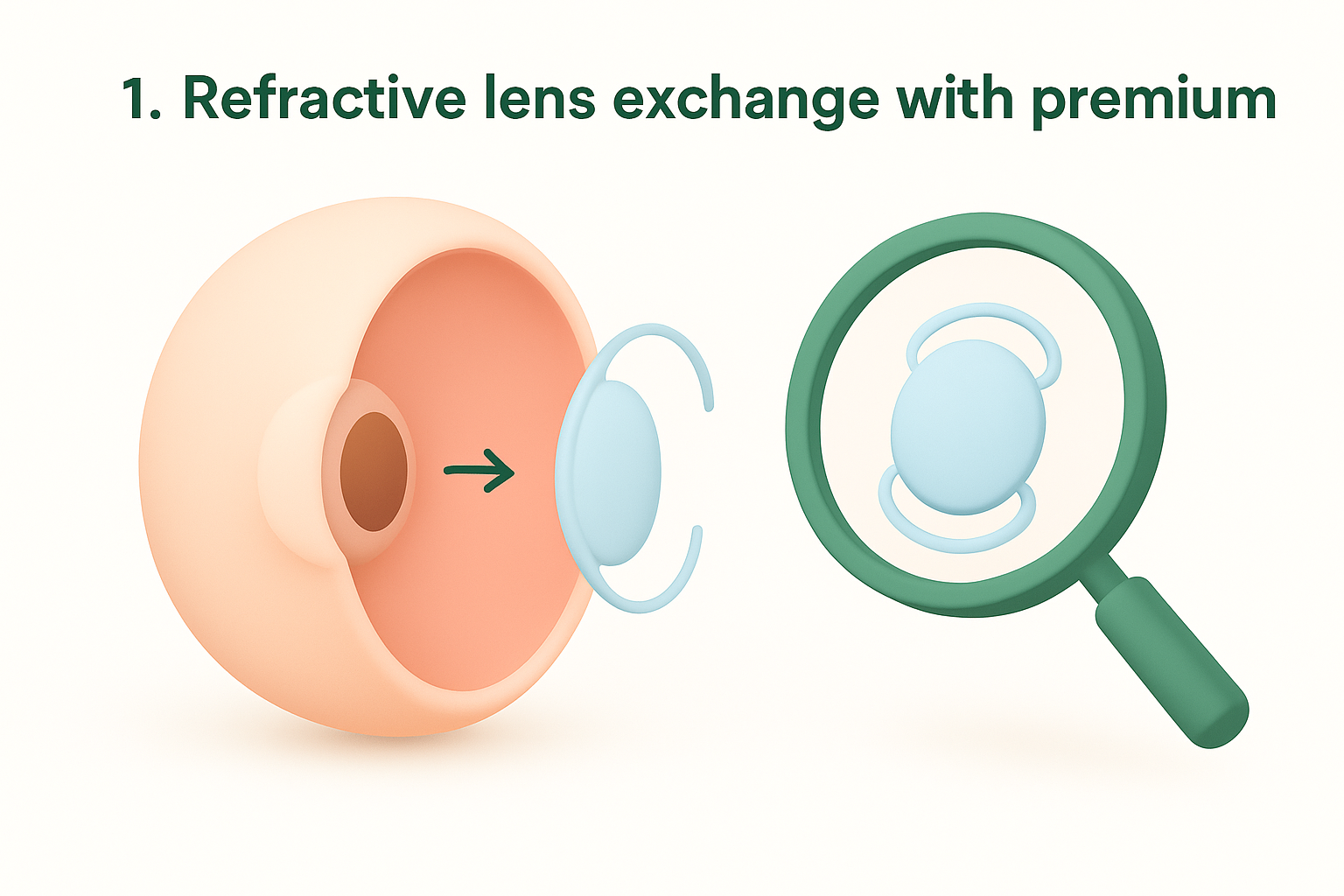
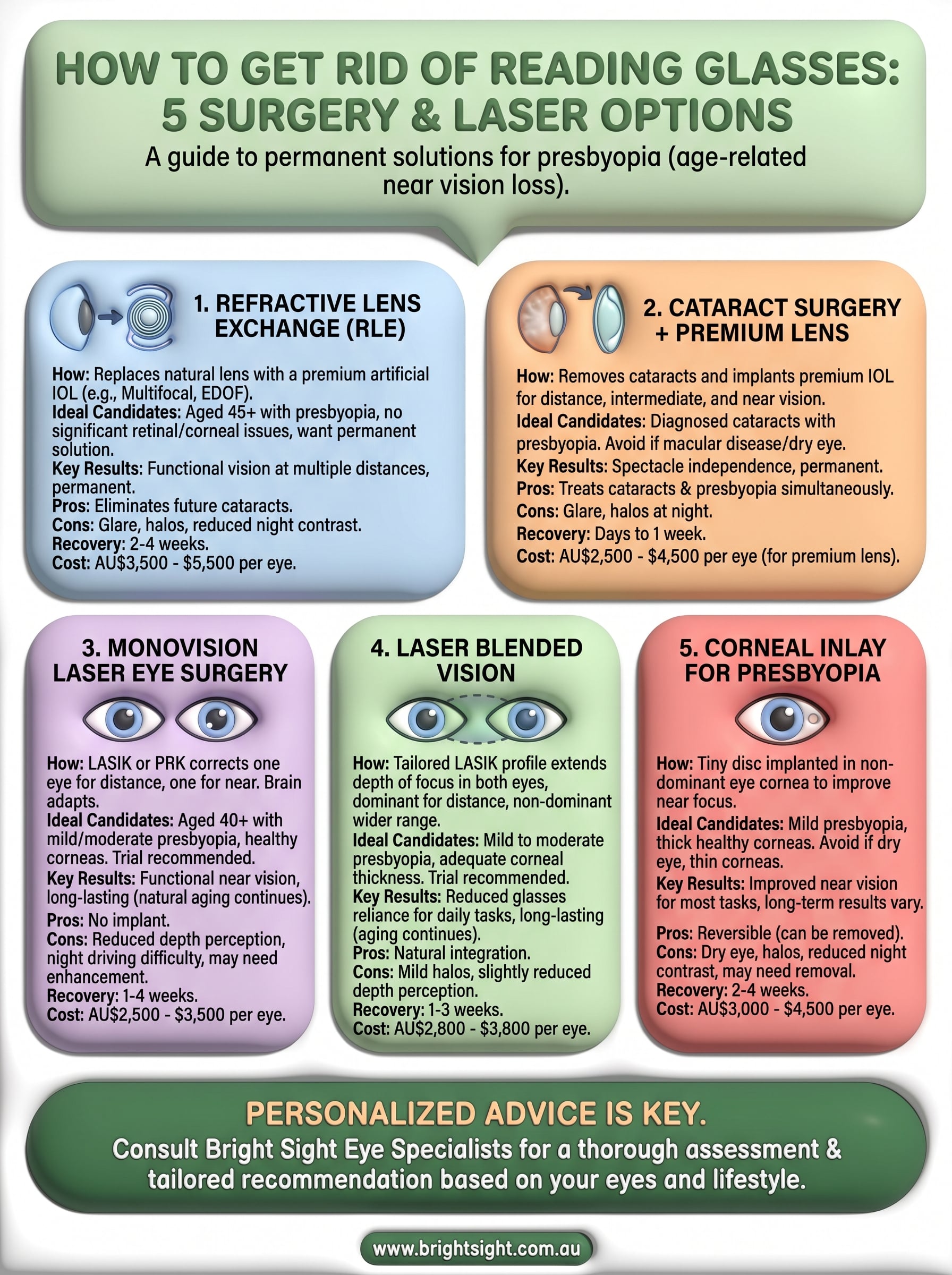
1. Refractive lens exchange with premium IOLs
Refractive lens exchange (RLE) involves surgically removing your eye’s natural lens and replacing it with an artificial intraocular lens (IOL). Unlike reading glasses, premium IOLs can restore your ability to see at multiple distances, making RLE one of the most effective permanent solutions to how to get rid of reading glasses for good.
How it changes near vision
RLE replaces your natural lens, which has lost its flexibility with age, with a premium IOL designed to focus light at near, intermediate, and distance ranges. Multifocal and EDOF (extended depth of focus) lenses are the most commonly implanted options for presbyopia correction.
Ideal candidates and who should avoid it
You are a strong candidate if you are over 45 with presbyopia and want a lasting solution. People with significant retinal disease or corneal irregularities should discuss suitability carefully with their surgeon, as these conditions can affect outcomes.
RLE suits patients who are also approaching the age when cataract surgery would eventually be necessary, since it eliminates the need for that procedure later.
What results to expect and how long they last
Most patients achieve functional vision across multiple distances without glasses after RLE. Because the artificial lens does not change over time, results are permanent.
Recovery timeline and aftercare
Vision typically stabilises within two to four weeks. You will use antibiotic and anti-inflammatory eye drops for several weeks and attend follow-up appointments to monitor healing progress.
Risks, side effects, and trade-offs
Common side effects include glare, halos, and reduced contrast sensitivity, especially at night. A small risk of retinal detachment and infection also exists following the procedure.
Typical cost range in Australia
RLE typically costs between $3,500 and $5,500 per eye in Australia. Private health insurance may contribute to costs depending on your level of cover.
2. Cataract surgery with multifocal or EDOF lenses
If you already have cataracts, cataract surgery with a premium lens implant offers a way to correct presbyopia at the same time, rather than treating each condition separately.
How it changes near vision
Cataract surgery removes your clouded natural lens and replaces it with a premium multifocal or EDOF IOL, restoring clear vision at near, intermediate, and distance ranges without reading glasses.
Ideal candidates and who should avoid it
You are an ideal candidate if you have diagnosed cataracts alongside presbyopia. Patients with significant macular disease or severe dry eye may see reduced outcomes from premium lenses and should discuss this carefully with their surgeon.
This is one of the most practical answers to how to get rid of reading glasses if cataract surgery is already on your treatment horizon.
What results to expect and how long they last
Most patients achieve spectacle independence for everyday tasks. Because the implanted lens is artificial, results are permanent.
Recovery timeline and aftercare
Vision improves within days to one week. You will use prescribed antibiotic and anti-inflammatory drops for several weeks and attend scheduled follow-up reviews.
Risks, side effects, and trade-offs
Glare and halos at night are common with multifocal lenses. A small risk of posterior capsule opacification exists, though this is treatable with a straightforward laser procedure.
Typical cost range in Australia
Costs range from $2,500 to $4,500 per eye for premium lenses. Private health insurance typically covers the base procedure, with an out-of-pocket gap for the premium lens upgrade.
3. Monovision laser eye surgery
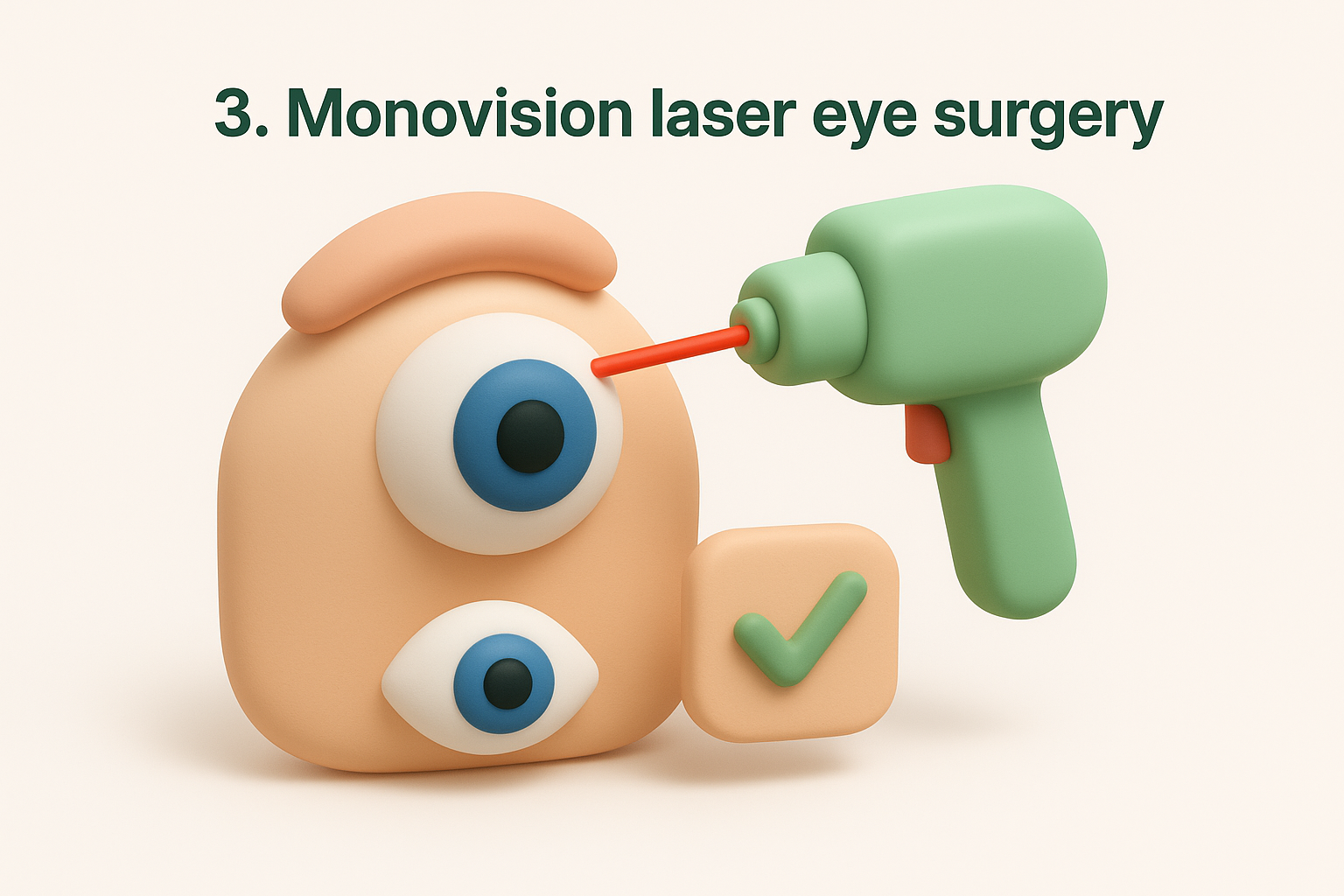
Monovision laser eye surgery corrects one eye for distance and the other for near vision. Your brain learns to use each eye selectively depending on the task, reducing your dependence on reading glasses without implanting any device.
How it changes near vision
Your surgeon uses LASIK or PRK to correct your non-dominant eye for near focus while keeping your dominant eye optimised for distance. Over time, your brain combines both signals naturally.
Ideal candidates and who should avoid it
You suit monovision well if you are over 40 with mild to moderate presbyopia and healthy corneas. People with poor binocular vision or significant depth perception demands are generally not ideal candidates.
A monovision contact lens trial beforehand helps confirm whether your brain adapts well to this approach before committing to surgery.
What results to expect and how long they last
For patients exploring how to get rid of reading glasses, monovision delivers functional near vision for most everyday tasks. Results are long-lasting, though natural age-related changes may still progress over time.
Recovery timeline and aftercare
Vision typically stabilises within one to four weeks. You will use antibiotic and lubricating eye drops during the healing period and attend follow-up reviews as directed.
Risks, side effects, and trade-offs
Some patients notice reduced depth perception or difficulty with night driving. A small percentage find long-term adaptation uncomfortable and may later opt for an enhancement or occasional reading glasses for detailed tasks.
Typical cost range in Australia
Monovision LASIK costs approximately $2,500 to $3,500 per eye in Australia, depending on the laser technology used.
4. Laser blended vision for presbyopia
Laser blended vision uses a tailored LASIK profile to extend the depth of focus across both eyes, so your brain can process near and far images together without switching between glasses.
How it changes near vision
Your dominant eye is optimised for distance while your non-dominant eye receives a wider focal range. The overlap between both signals lets your brain combine them naturally, reducing your reliance on glasses throughout the day.
Ideal candidates and who should avoid it
You suit this procedure if you have mild to moderate presbyopia and adequate corneal thickness. Patients with thin corneas or advanced presbyopia may not achieve full spectacle independence.
A short trial with blended vision contact lenses beforehand helps confirm your brain adapts well before committing to surgery.
What results to expect and how long they last
Blended vision is a practical answer for how to get rid of reading glasses for most daily tasks. Results are long-lasting, though presbyopia can continue advancing with age.
Recovery timeline and aftercare
Vision stabilises within one to three weeks. You will use antibiotic and lubricating eye drops as directed and attend follow-up appointments.
Risks, side effects, and trade-offs
Some patients notice mild halos or reduced contrast at night. A small number find depth perception slightly reduced for tasks like night driving.
Typical cost range in Australia
This procedure costs approximately $2,800 to $3,800 per eye in Australia, depending on laser technology and the clinic.
5. Corneal inlay for presbyopia
A corneal inlay is a tiny disc implanted inside your cornea that sharpens near focus without replacing your natural lens or altering both eyes equally.
How it changes near vision
The inlay sits within your non-dominant eye, adjusting how light converges on your retina to improve close-range focus. Your dominant eye continues handling distance, and your brain integrates both signals naturally over time.
Ideal candidates and who should avoid it
You suit a corneal inlay if you have mild presbyopia and thick, healthy corneas. Patients with significant dry eye, thin corneas, or a history of prior corneal surgery are generally not suitable candidates.
A thorough pre-operative assessment confirms whether your corneal health meets the requirements for safe implantation.
What results to expect and how long they last
For patients exploring how to get rid of reading glasses, a corneal inlay improves near vision for most everyday tasks. Long-term results vary, and some patients eventually need a replacement or removal as presbyopia advances.
Recovery timeline and aftercare
Vision typically stabilises within two to four weeks. You will use prescribed lubricating and anti-inflammatory drops throughout the healing period and attend follow-up reviews.
Risks, side effects, and trade-offs
Possible side effects include dry eye, halos, and reduced night-time contrast. A small number of patients require inlay removal due to poor long-term adaptation.
Typical cost range in Australia
Corneal inlays cost approximately $3,000 to $4,500 per eye in Australia. Private health insurance does not typically cover this procedure.
Where to get personalised advice
No two eyes are the same, and the right procedure for how to get rid of reading glasses depends on your corneal thickness, lens condition, age, and lifestyle. A thorough clinical assessment is the only way to know which option suits you best and what realistic outcomes look like for your specific situation.
At Bright Sight Eye Specialists in Randwick, Dr Capucine Odouard and Dr Rahul Dubey offer comprehensive consultations covering the full range of vision correction procedures discussed in this article. Both surgeons take a patient-centred approach, walking you through the evidence, the trade-offs, and the costs before you make any decision.
If you are ready to explore your options, book a consultation with our team to get clear, personalised advice based on a full examination of your eyes.