


You’ve started holding your phone at arm’s length. Menus are a blur unless you squint. And the idea of relying on reading glasses for the rest of your life? Not exactly thrilling. If you’re wondering how to avoid reading glasses, you’re not alone, it’s one of the most common questions we hear from patients at our Randwick practice, especially once presbyopia (age-related focusing loss) starts creeping in around the age of 40.
The good news is that reading glasses aren’t your only option. Depending on where you are in the process, there are practical steps you can take right now, from eye exercises and nutrition changes to advanced surgical solutions like refractive lens surgery and laser vision correction, that can reduce or even eliminate your dependence on readers.
At Bright Sight Eye Specialists, Dr Rahul Dubey and Dr Capucine Odouard help patients across Sydney’s Eastern Suburbs find the right approach for their eyes, lifestyle, and goals. In this guide, we’ll walk you through seven proven strategies, from the simplest habit changes to the most advanced procedures, so you can make an informed decision about your vision.
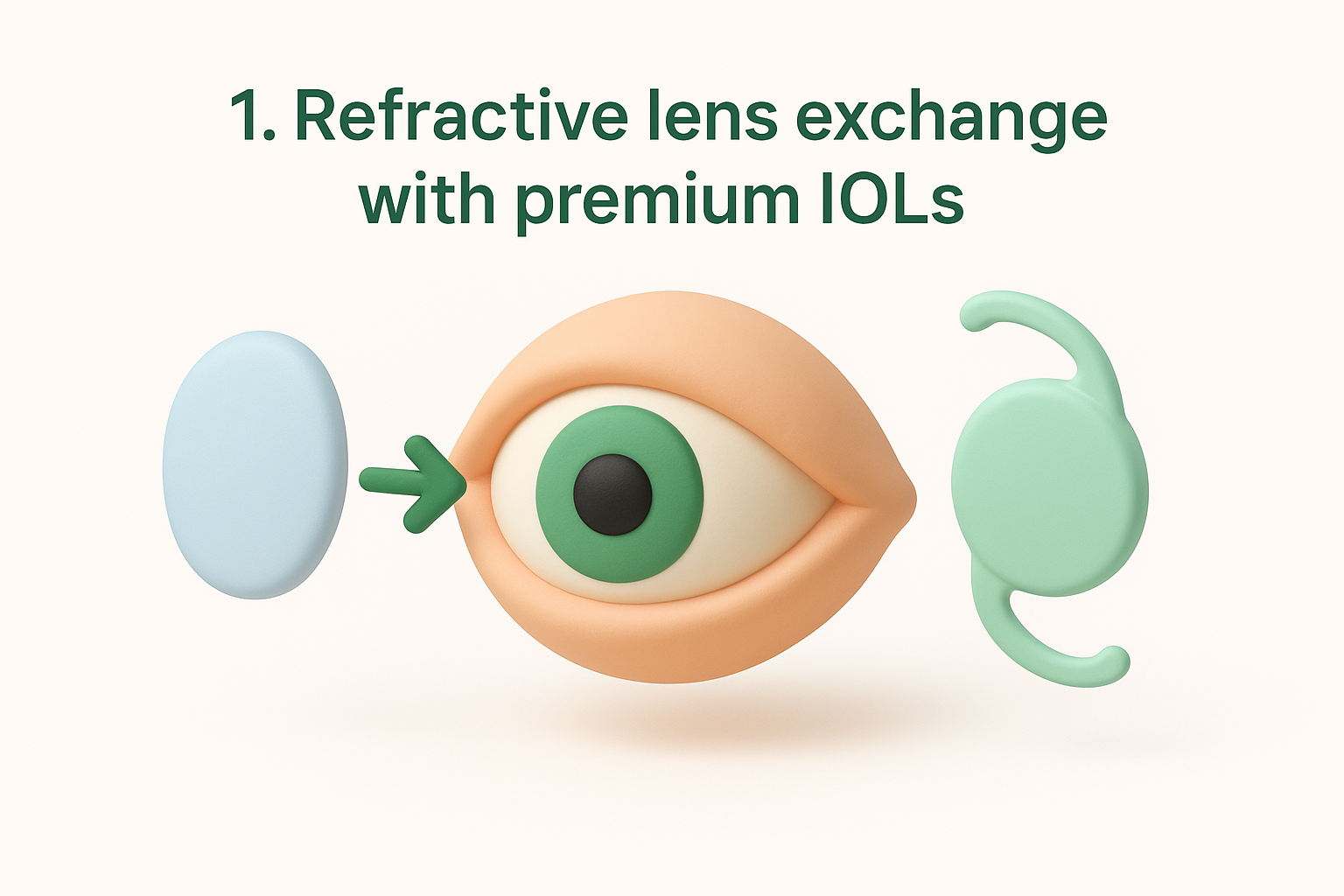
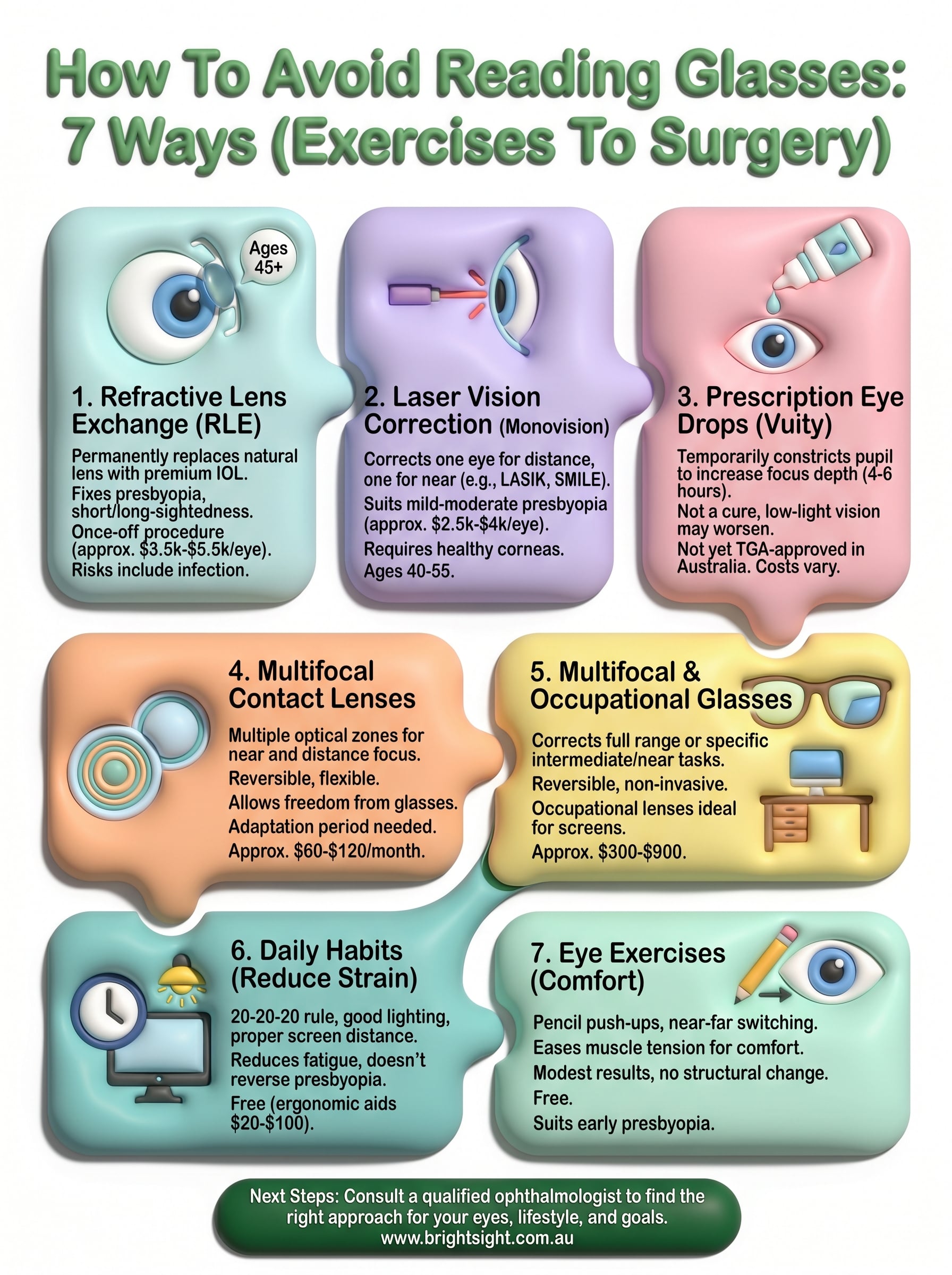
1. Refractive lens exchange with premium IOLs
If you want a permanent solution and are serious about understanding how to avoid reading glasses for good, refractive lens exchange (RLE) is the most powerful option available. It tackles the root cause of presbyopia rather than working around it.
What it is and how it works
RLE replaces your eye’s natural crystalline lens with an artificial intraocular lens (IOL). Unlike cataract surgery, which removes a clouded lens, RLE removes a clear but stiffened lens and replaces it with a premium multifocal or extended depth of focus (EDOF) IOL that restores a full range of vision. The procedure takes around 15 to 20 minutes per eye.
What it can and cannot fix
Premium IOLs correct presbyopia, short-sightedness, long-sightedness, and astigmatism simultaneously. What they cannot do is fully replicate the seamless, dynamic focusing of a young eye. Some patients notice halos or glare around lights at night, particularly in the first few months.
Once your natural lens is removed, you will never develop cataracts in that eye, meaning RLE eliminates a likely future procedure as well.
Who it suits best
RLE is best suited to patients aged 45 and over who are already experiencing presbyopia and want a long-term, glasses-free outcome. It particularly suits people who are not good LASIK candidates due to high prescriptions or thin corneas.
How to get started safely
Begin with a thorough assessment from a qualified ophthalmologist. Your surgeon will measure your corneal shape, lens power, and overall eye health before recommending the most appropriate IOL for your lifestyle and visual goals.
Risks and trade-offs
RLE carries small but real risks including infection, posterior capsule opacification, and retinal detachment. Patients with high short-sightedness carry a slightly elevated retinal risk, which your surgeon should discuss with you in detail before you decide.
What it costs in Australia
RLE with a premium IOL typically costs between $3,500 and $5,500 per eye in Australia. Private health insurance may offset part of the hospital and anaesthetic fees, but the premium lens upgrade is generally an out-of-pocket cost.
2. Laser vision correction for presbyopia
Laser vision correction has evolved beyond treating short-sightedness. Presbyopia-specific laser treatments now give many patients a genuine way to explore how to avoid reading glasses without surgery inside the eye.
What it is and how it works
Procedures like LASIK, SMILE, and PRK can be adapted for presbyopia using a technique called monovision or blended vision, where one eye is corrected for distance and the other for near. Some clinics also offer presbyLASIK, which reshapes the cornea to create multiple focal zones.
What it can and cannot fix
Laser correction works well for mild to moderate presbyopia, especially when combined with distance correction. It cannot restore the full dynamic focusing range of a youthful lens, and results tend to diminish as presbyopia progresses with age.
Patients who already adapt well to monovision contact lenses are usually the strongest candidates for laser-based presbyopia correction.
Who it suits best
This approach suits adults aged 40 to 55 with healthy corneas and mild presbyopia, particularly those who want to reduce reading glass dependence without an intraocular procedure.
How to get started safely
Your surgeon will assess corneal thickness, pupil size, and your current prescription during a pre-operative consultation to confirm you’re a suitable candidate.
Risks and trade-offs
Some patients find monovision uncomfortable or notice reduced depth perception, particularly during activities like driving. Dry eye is also a common short-term side effect.
What it costs in Australia
Laser correction for presbyopia typically costs between $2,500 and $4,000 per eye in Australia, depending on the technology used and your surgeon’s fees.
3. Prescription eye drops for presbyopia
If you prefer a non-surgical approach to managing close-up vision loss, prescription eye drops offer a newer option worth knowing about on your journey to understand how to avoid reading glasses.
What it is and how it works
The drop currently approved in the US (pilocarpine 1.25%, sold as Vuity) works by temporarily constricting the pupil, which increases depth of focus, similar to a controlled squint. You apply the drops once daily, and the effect typically lasts four to six hours.
What it can and cannot fix
These drops reduce your dependence on reading glasses for everyday near tasks like checking your phone or reading a label. They cannot permanently correct presbyopia, and low-light vision can worsen because a smaller pupil lets in less light.
Prescription eye drops are a useful bridge, not a cure, and work best alongside realistic expectations.
Who it suits best
They suit adults with mild to moderate presbyopia who want occasional relief from reading glasses without committing to a surgical procedure.
How to get started safely
Speak to your ophthalmologist or optometrist before using any prescribed drops. A proper eye examination confirms your prescription and rules out conditions like narrow-angle glaucoma, where pilocarpine can be dangerous.
Risks and trade-offs
Common side effects include headaches and reduced night vision. Some patients also notice eye redness and temporary blurred distance vision shortly after application.
What it costs in Australia
Pilocarpine drops for presbyopia are not yet TGA-approved in Australia as of 2026, meaning access remains limited and costs vary significantly through specialist channels.
4. Multifocal contact lenses
Multifocal contact lenses offer a reversible, non-surgical way to manage presbyopia. For many people exploring how to avoid reading glasses, they provide a practical balance between convenience and freedom without committing to a procedure.
What it is and how it works
These lenses contain multiple optical zones in a single lens, giving your eye access to near and distance focus simultaneously. Your brain selects the appropriate zone depending on what you’re viewing.
What it can and cannot fix
Multifocal contacts reduce your reliance on reading glasses for most everyday tasks. They cannot fully replicate sharp vision at every distance, and some patients notice reduced contrast, particularly in low light.
Allow several weeks for your eyes to adjust before deciding whether the lenses are working for you.
Who it suits best
They suit adults with mild to moderate presbyopia who are already comfortable wearing contacts and want a flexible, non-permanent alternative to glasses during daily activities.
How to get started safely
Book a contact lens fitting with your optometrist or ophthalmologist. A trial period lets you compare different lens designs and brands before finalising your prescription.
Risks and trade-offs
Some patients experience visual fluctuation or ghosting during adaptation. Extended wear can also trigger dry eye and discomfort, so follow your practitioner’s recommended wearing schedule closely.
What it costs in Australia
Multifocal contact lenses typically cost $60 to $120 per month, depending on the brand and lens type, such as daily or monthly disposables.
5. Multifocal and occupational glasses
If you’re not ready for surgery but still want to manage close-up vision more effectively, multifocal and occupational glasses offer a straightforward, reversible solution that many people overlook on the path to understanding how to avoid reading glasses.
What it is and how it works
Multifocal glasses combine distance, intermediate, and near zones in one lens. Occupational lenses prioritise the intermediate and near range, making them ideal for desk-based work, screen use, and reading.
What it can and cannot fix
These glasses correct your full range of daily vision tasks without switching between pairs. They cannot replace the natural focusing ability of a young eye, and peripheral distortion in progressive lenses takes some adjustment.
Occupational lenses are specifically designed for screen and desk distances, which standard readers simply cannot cover.
Who it suits best
They suit anyone with presbyopia who wants reliable, non-invasive vision correction across multiple distances without committing to a surgical or contact lens approach.
How to get started safely
Visit a qualified optometrist for a current prescription and frame fitting. Getting lenses made by a reputable optical dispenser ensures the lens zones are positioned correctly for your eye height and posture.
Risks and trade-offs
Adaptation time can range from a few days to several weeks for progressive lenses. Some patients never fully adjust and prefer single-vision readers instead.
What it costs in Australia
Multifocal glasses typically cost between $300 and $900 in Australia, depending on the lens type and frame. Private health extras cover may offset part of this cost.
6. Daily habits that cut near-vision strain
Simple daily changes won’t reverse presbyopia, but they can significantly reduce eye strain and help you understand how to avoid reading glasses for longer during your day.
What it is and how it works
The 20-20-20 rule is the most practical habit available: every 20 minutes of near work, look at something 20 feet away for 20 seconds. Good lighting, screen distance, and font size also reduce the effort your eyes need to focus throughout the day.
What it can and cannot fix
These habits ease digital eye strain and focusing fatigue during close work. They cannot slow the structural changes of presbyopia itself, but they do reduce how quickly you reach for your readers.
Adequate screen brightness matched to your room lighting makes a bigger difference than most people expect.
Who it suits best
Anyone aged 35 and over who spends long hours on screens or reading will benefit most from building these habits early, before strain becomes a daily problem.
How to get started safely
Start by adjusting your screen to arm’s length, increasing font sizes, and positioning your primary light source to the side rather than behind the screen.
Risks and trade-offs
There are no real risks to these changes. The main trade-off is consistency: habits only help when you maintain them.
What it costs in Australia
Daily habit adjustments are completely free. Ergonomic lighting or screen filters cost between $20 and $100 if you choose to invest in supportive tools.
7. Eye exercises for comfort and focusing skills
Eye exercises won’t reverse the physical changes of presbyopia, but they remain a useful tool for anyone researching how to avoid reading glasses from a lifestyle-first perspective. They work by reducing muscle tension and improving your eye’s efficiency during near work.
What it is and how it works
The most common exercises include pencil push-ups (slowly moving a focal point toward your nose while maintaining focus) and near-far switching (alternating your gaze between a close object and a distant one). Both drills train the ciliary muscles that control your lens shape.
What it can and cannot fix
These exercises ease accommodative strain and fatigue during reading or screen work. They cannot physically reverse lens stiffening, which is the structural cause of presbyopia.
Think of eye exercises as a warm-up for tired muscles, useful for comfort, but not a cure.
Who it suits best
They suit adults in their late 30s and early 40s who are just beginning to notice close-up fatigue and want to manage symptoms before considering any optical or surgical option.
How to get started safely
Practice pencil push-ups for five minutes daily, ideally in good lighting. Consistency matters more than duration, so short daily sessions outperform occasional longer ones.
Risks and trade-offs
There are no known risks to these exercises. The main limitation is that results are modest, and most people see only marginal comfort improvements.
What it costs in Australia
Eye exercises are entirely free and require no equipment beyond basic household objects.
Next steps
Understanding how to avoid reading glasses is one thing; taking action is another. The right path depends entirely on your age, prescription, lifestyle, and how much you’re willing to invest, so there’s no single answer that works for everyone. If you’re in your early 40s and just noticing strain, daily habits and contact lenses may be enough for now. If you want a permanent fix, refractive lens exchange or laser correction could change your vision for life.
The most important step is getting a thorough eye examination from a qualified ophthalmologist who can assess your full visual picture and walk you through the options that suit your specific situation. At Bright Sight Eye Specialists in Randwick, Dr Rahul Dubey and Dr Capucine Odouard offer exactly that kind of personalised, evidence-based assessment. Book a consultation with our team to find the approach that genuinely works for your eyes and your life.