


If you’re considering SMILE laser eye surgery, one of the first practical questions is how long does SMILE eye surgery take, from the moment you sit down in the surgical chair to walking back out the door. It’s a fair question, especially when you’re weighing time off work, arranging a lift home, and planning your recovery.
The short answer: the laser itself works for under 30 seconds per eye, and the full procedure is typically done within 15 to 20 minutes. But there’s more to the timeline than what happens in the operating room. At Bright Sight Eye Specialists in Randwick, Dr Capucine Odouard performs SMILE surgery and guides patients through every stage, from pre-operative preparation to post-operative recovery milestones.
This article breaks down exactly what to expect at each phase: the procedure duration, your time at the clinic on the day, and how long it takes for your vision to stabilise in the days and weeks that follow.
What happens during SMILE and how long it takes
SMILE (Small Incision Lenticule Extraction) is a flapless, single-laser procedure that reshapes the cornea without cutting the large flap used in LASIK. Understanding the steps helps you grasp why the timing is different from other laser eye surgeries, and why many patients find it more straightforward on the day.
The femtosecond laser phase
When you ask how long does SMILE eye surgery take at the technical level, the answer starts with the femtosecond laser. The laser fires rapid pulses of light inside the cornea to create a thin, disc-shaped piece of tissue called a lenticule. It also creates a small arc-shaped incision, roughly 2 to 4 millimetres wide, through which the surgeon will remove that lenticule.
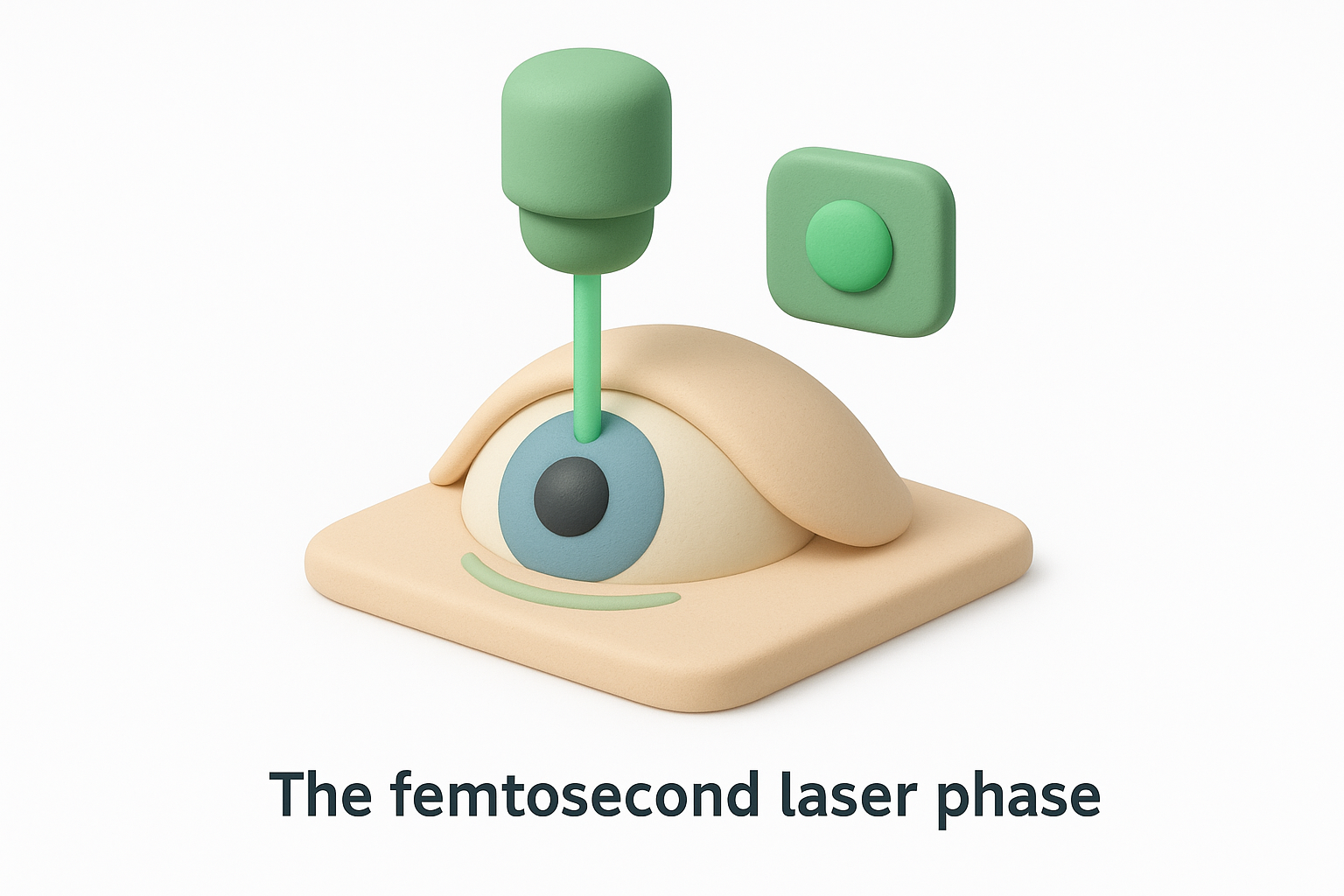
This laser phase takes approximately 25 to 30 seconds per eye. The precision is extremely high, and you are asked to look at a fixed green light during this time. Most patients report feeling light pressure on the eye rather than any pain.
The femtosecond laser in SMILE works entirely beneath the corneal surface, which means there is no exposed tissue and no flap to manage during or after surgery.
How the surgeon removes the lenticule
Once the laser has finished, Dr Odouard separates the lenticule from the surrounding corneal tissue using a fine instrument and gently extracts it through the small incision. This manual step takes a further one to two minutes per eye and requires considerable surgical skill. Because the incision is so small, the structural integrity of the cornea is largely preserved compared to flap-based procedures.
Your role during this step is simply to keep your gaze steady and remain relaxed. The anaesthetic eye drops administered beforehand mean you should not feel discomfort, though you may sense slight movement on the eye’s surface.
Total time in the surgical chair
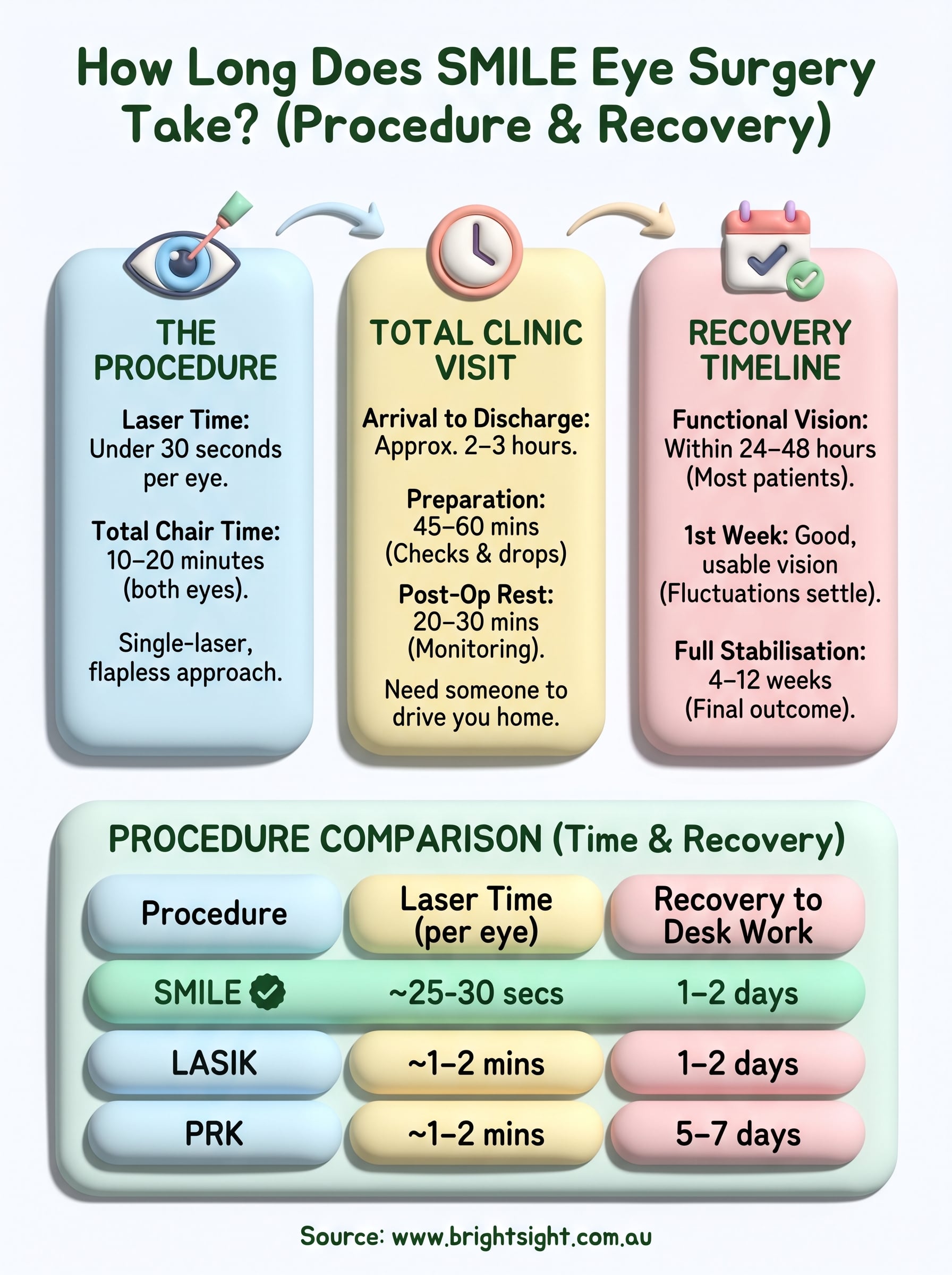
For both eyes combined, the active surgical time sits between 10 and 20 minutes. Some straightforward cases take closer to 10 minutes; others with higher prescriptions may take slightly longer as the surgeon takes additional care during lenticule separation.
The procedure is brief by design. The single-laser approach eliminates several steps present in LASIK, which is one reason the operating time is compact and well-tolerated by the vast majority of patients.
How long you will spend at the clinic
The surgery itself is brief, but your total clinic visit runs considerably longer. When thinking about how long does SMILE eye surgery take from door to door, plan to be at the clinic for approximately two to three hours from arrival to discharge. That window covers preparation, the procedure itself, and a post-operative rest period before you head home.
Before you go into surgery
When you arrive, the clinic team will complete a series of pre-operative checks before Dr Odouard proceeds. These include confirming your eye measurements, administering anaesthetic drops, and allowing time for those drops to take full effect. You will also receive a final briefing on what to expect during the procedure.
This preparation stage typically takes 45 to 60 minutes. It is not rushed, because accurate preparation directly affects the quality of your surgical outcome. If you wear contact lenses, you will have already been asked to stop wearing them for a set period before this appointment.
After the procedure
Once the surgery is complete, you will rest at the clinic for 20 to 30 minutes while the team monitors your initial comfort and checks for any immediate concerns. Your vision will likely be blurry at this point, which is entirely normal and expected.
You will need someone to drive you home after SMILE surgery, as your vision is not stable enough to drive safely in the hours immediately following the procedure.
Before you leave, the team will give you post-operative eye drops and a clear set of instructions covering the first 24 hours. A follow-up appointment is typically scheduled for the next day or within a few days of the procedure.
SMILE recovery timeline and when vision stabilises
Recovery after SMILE is generally faster and more comfortable than after LASIK or PRK. Because there is no flap and only a small incision, your cornea retains more structural stability from day one. Most patients notice a significant improvement in vision within the first 24 hours, though the full picture takes a little longer to develop.
The first 24 to 48 hours
In the hours immediately after surgery, your vision will be hazy and light-sensitive. This is normal and settles quickly for the majority of patients. You should rest at home, avoid screens where possible, and use the prescribed eye drops as directed by Dr Odouard. Most patients report functional vision by the following morning, which is why many return to desk-based work within one to two days.
Avoid rubbing your eyes in the first week after SMILE, as this can disturb the small incision while it heals.
The first week and beyond
By the end of the first week, most patients achieve good, usable vision and notice that fluctuations are settling. Your sight may still shift slightly day to day during this period, particularly in varying light conditions. This is a normal part of how the cornea adjusts after reshaping.
Stable vision typically arrives between four and twelve weeks post-surgery. For some patients with higher prescriptions, the cornea takes longer to fully settle. Your follow-up appointments with Dr Odouard track this progression and confirm when your outcome is complete. If you are still wondering how long does SMILE eye surgery take to deliver its full result, that final stabilisation point is the true answer.
What can affect procedure time and recovery
Not every patient experiences the same timeline, and several factors can shift how long does SMILE eye surgery take in your specific case, as well as how quickly your vision settles afterwards. Knowing these variables in advance helps you set realistic expectations rather than comparing your progress against someone with a very different prescription or eye anatomy.
Your prescription strength
Higher prescriptions require a thicker lenticule to be created and removed, which means the laser phase may run slightly longer and the manual extraction step demands more precision from your surgeon. The cornea also needs to do more remodelling after surgery when the correction is significant, which can push your full stabilisation window closer to the twelve-week mark rather than four weeks. Patients with mild to moderate myopia tend to see faster results.
If you have a higher prescription, your surgeon may schedule an additional follow-up appointment to monitor how your cornea is settling.
Your healing response and lifestyle factors
Individual biology plays a meaningful role in recovery speed. Dry eye conditions, immune function, and general health all influence how quickly your corneal tissue heals around the incision. Patients who follow post-operative instructions closely, including avoiding swimming, contact sport, and rubbing their eyes, tend to recover more smoothly. Screen use, dusty environments, and sleep quality can each affect comfort and visual clarity in the first few weeks, so the steps you take at home matter as much as what happens in the surgical chair.
SMILE vs LASIK vs PRK: time, downtime, and trade-offs
When you’re choosing between laser eye surgery options, comparing the three procedures side by side helps clarify what each involves. SMILE, LASIK, and PRK all correct refractive errors, but they differ in how long does SMILE eye surgery take versus the alternatives, and in how much recovery time each demands from you.
Procedure and clinic time compared
The surgical steps involved in each procedure directly affect your time in the chair. LASIK uses two separate lasers, first to create a corneal flap and then to reshape, extending active surgical time to roughly 15 to 30 minutes for both eyes. SMILE uses a single laser with no flap, keeping it closer to 10 to 20 minutes. PRK removes the corneal surface cells before reshaping, which shortens the laser phase but adds considerably to your recovery window.
| Procedure | Laser time per eye | Total clinic time | Visual recovery |
|---|---|---|---|
| SMILE | ~25-30 seconds | 2-3 hours | 24-48 hours |
| LASIK | ~1-2 minutes | 2-3 hours | 24-48 hours |
| PRK | ~1-2 minutes | 2-3 hours | 5-7 days |
Recovery and downtime
PRK carries the longest recovery of the three, with many patients needing five to seven days before returning to desk work and up to three months for full vision stabilisation. LASIK and SMILE offer comparable short-term recovery, with functional vision typically returning within one to two days.
If you play contact sport or lead a physically active lifestyle, SMILE’s flapless design removes one category of post-surgical risk that LASIK carries throughout your life.
SMILE holds a structural advantage in long-term corneal stability because there is no flap to displace. For most patients, the trade-off between the three procedures comes down to prescription range, lifestyle, and how quickly you need to return to normal activity.
Your next step
By now you have a clear picture of how long does SMILE eye surgery take at every stage: roughly 25 to 30 seconds of laser time per eye, 10 to 20 minutes total in the surgical chair, two to three hours at the clinic on the day, and functional vision returning within 24 to 48 hours for most patients. The full stabilisation of your vision takes four to twelve weeks depending on your prescription and how your cornea heals.
If SMILE sounds like it fits your lifestyle and schedule, the most useful next step is a consultation to confirm whether your eyes are suitable candidates. Dr Capucine Odouard at Bright Sight Eye Specialists in Randwick assesses your corneal thickness, prescription, and eye health to give you a personalised recommendation rather than a general answer. To book your assessment or ask a question before committing, get in touch with the team at Bright Sight.