


If you’re considering SMILE laser eye surgery, one of the first questions on your mind is probably how long does SMILE eye surgery last, and whether the results are truly permanent. It’s a fair question. You’re making a decision about your eyes, and you want to know exactly what you’re signing up for.
The short answer: SMILE produces permanent structural changes to your cornea, and most people enjoy stable, glasses-free vision for years. But there’s more to it than that. Factors like age, prescription stability, and natural eye changes over time all play a role in how long your results hold up. The procedure itself takes around 10 to 15 minutes per eye, and most patients notice clearer vision within the first few days.
At Bright Sight Eye Specialists in Randwick, Dr Capucine Odouard performs SMILE surgery for patients across Sydney’s Eastern Suburbs, helping them achieve independence from glasses with a minimally invasive approach. This article breaks down what to expect, from how long the procedure takes, to recovery timelines, to the long-term durability of your results.
Why SMILE can deliver long-lasting correction
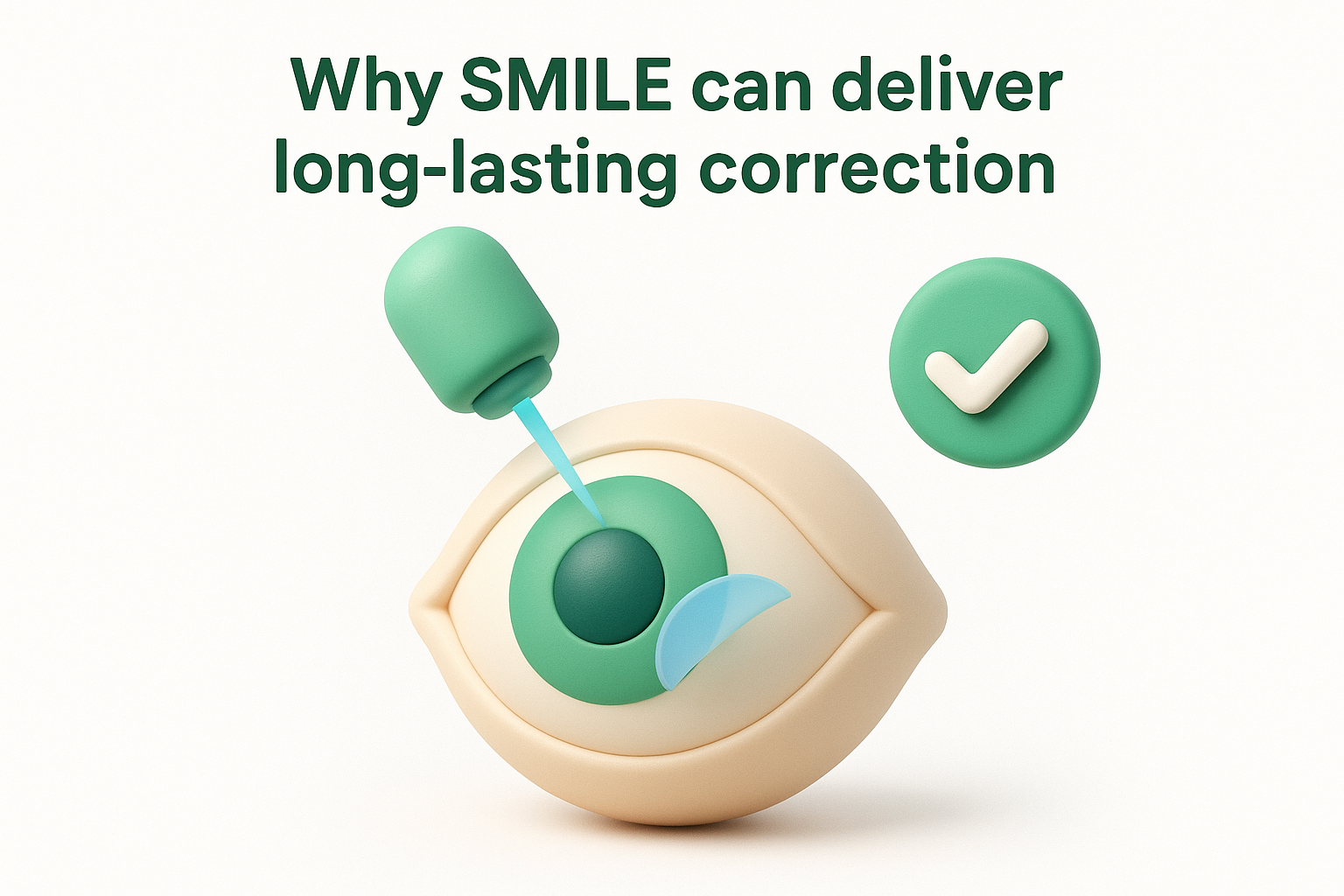
Understanding why SMILE produces durable results starts with understanding what the procedure actually does to your eye. SMILE, which stands for Small Incision Lenticule Extraction, uses a femtosecond laser to cut a precise, lens-shaped piece of tissue called a lenticule from within your cornea. Your surgeon then removes this lenticule through a small incision of around 2 to 4 millimetres, reshaping the cornea to correct your refractive error. Because the change happens to the physical structure of your cornea, it does not reverse on its own.
The corneal reshaping is permanent
Once your surgeon removes the lenticule, your cornea holds its new shape. There is no flap, no external surface removal, and no tissue that can shift back into its original position. The laser targets your specific prescription with a high degree of accuracy, and the structural change remains in place for life. That is why, when people ask how long does SMILE eye surgery last in terms of the correction itself, the answer is that the reshaping is permanent.
Your cornea does not regenerate the removed tissue. What was taken out stays out, and your eye adapts to function with its new curvature. This is fundamentally different from wearing glasses or contact lenses, where you are simply correcting the refractive error optically without changing the underlying structure at all.
The permanence of SMILE comes from a physical change to corneal anatomy, not a temporary or reversible adjustment.
How SMILE compares structurally to other laser procedures
SMILE preserves more of the cornea’s anterior stromal layers compared to LASIK, which cuts a flap through those same layers. The anterior stroma carries a significant portion of the cornea’s tensile strength, so keeping it intact means your eye maintains better biomechanical stability after surgery. This matters for long-term durability because a stronger corneal structure is less likely to change shape over time due to normal eye pressure or mechanical stress.
LASIK creates a hinged flap that never fully reattaches with the same strength as the original tissue. SMILE avoids this entirely. Your cornea heals around the small incision site, and the bulk of the treated tissue remains structurally sound. For patients with higher prescriptions, this biomechanical advantage can be particularly relevant since more tissue is being reshaped.
Why your prescription matters at the time of surgery
SMILE works best when your prescription has been stable for at least 12 months before the procedure. If your prescription is still changing at the time of surgery, the correction may not remain accurate as your eye continues to shift. Dr Odouard reviews your prescription history carefully before proceeding, because performing SMILE on a stable eye gives you the best chance of long-lasting, accurate results from day one.
How long SMILE results last in real life
Clinical studies show that SMILE produces stable vision correction that holds well over time. A 2022 long-term follow-up study published in the Journal of Refractive Surgery tracked patients for up to five years and found that the majority maintained vision of 20/20 or better without glasses. In real-world practice, most patients report that their results remain clear and consistent for well over a decade.
For most patients, SMILE correction remains stable and accurate for ten years or longer, provided their prescription was stable before surgery.
What the clinical evidence shows
Long-term data on SMILE specifically is still growing compared to LASIK, which has decades of follow-up. However, early SMILE outcomes are comparable to LASIK in terms of visual accuracy, and some studies suggest better stability due to the preserved corneal biomechanics discussed earlier. Patients treated for myopia (short-sightedness) and astigmatism tend to show the most consistent long-term outcomes, particularly those with mild to moderate prescriptions.
One key metric that researchers track is regression, which is when a small portion of the original prescription gradually returns. Minor regression can occur in the first 12 months after surgery, but beyond that, your corneal shape tends to remain stable. Your surgeon factors in a small allowance for this when calculating your treatment, which helps keep your final result accurate.
What patients experience day to day
Most people who have SMILE simply stop thinking about their vision correction after the first year. Driving, reading, and screen use feel natural without glasses or contacts, and the correction holds through daily activities without any special maintenance. If you ask most patients how long does SMILE eye surgery last from a practical standpoint, the honest answer is that it becomes a non-issue for most of their lives.
What might change your vision over time
SMILE permanently corrects the refractive error you have at the time of surgery, but it does not freeze your eyes in place forever. Your eyes are living tissue, and certain age-related changes can affect your vision independently of what the laser did to your cornea. Understanding these changes helps you set realistic expectations and know when to act if something shifts down the track.
Presbyopia and age-related near vision
The most common change that affects patients after SMILE is presbyopia, which is the gradual stiffening of the natural lens inside your eye. This is not related to your cornea at all. It typically becomes noticeable around your mid-forties, and it makes close-up tasks like reading or phone use harder to focus on. If you ask how long does SMILE eye surgery last for your distance vision, the answer remains very good, but presbyopia develops independently and reading glasses may eventually become necessary for near tasks.
Presbyopia affects the lens inside the eye, not the cornea that SMILE reshapes, so it is a separate process entirely.
Your distance vision from the SMILE correction itself tends to remain stable well into this period. Many patients go a decade or more without needing any additional correction for distance.
Minor prescription regression and enhancement options
Some patients experience a small amount of regression in the first six to twelve months after surgery, where a fraction of the original prescription gradually returns. This is more common with higher prescriptions and typically settles on its own. If your residual prescription causes noticeable blurring and your corneal thickness allows it, Dr Odouard can discuss an enhancement procedure to fine-tune your result. This is not a common outcome, but it is worth knowing the option exists if your vision shifts meaningfully after surgery.
How long SMILE takes and what happens on the day
One of the most common concerns before any eye procedure is how much time it actually takes. The good news is that SMILE is a fast procedure, and most patients find the whole experience far less stressful than they expected. When you factor in preparation and post-operative checks, you should plan to be at the clinic for around two to three hours in total, though the laser time itself is much shorter than most people anticipate.
What happens before the laser starts
Before the procedure begins, your surgical team will apply numbing eye drops to ensure you feel no pain during the surgery. Your eye area is cleaned, and a small device holds your eyelid open so you do not need to worry about blinking at the wrong moment. Your surgeon will ask you to focus on a small target light, which helps keep your eye correctly positioned throughout the treatment. This preparation phase typically takes around 15 to 20 minutes per eye.
How long the laser treatment itself takes
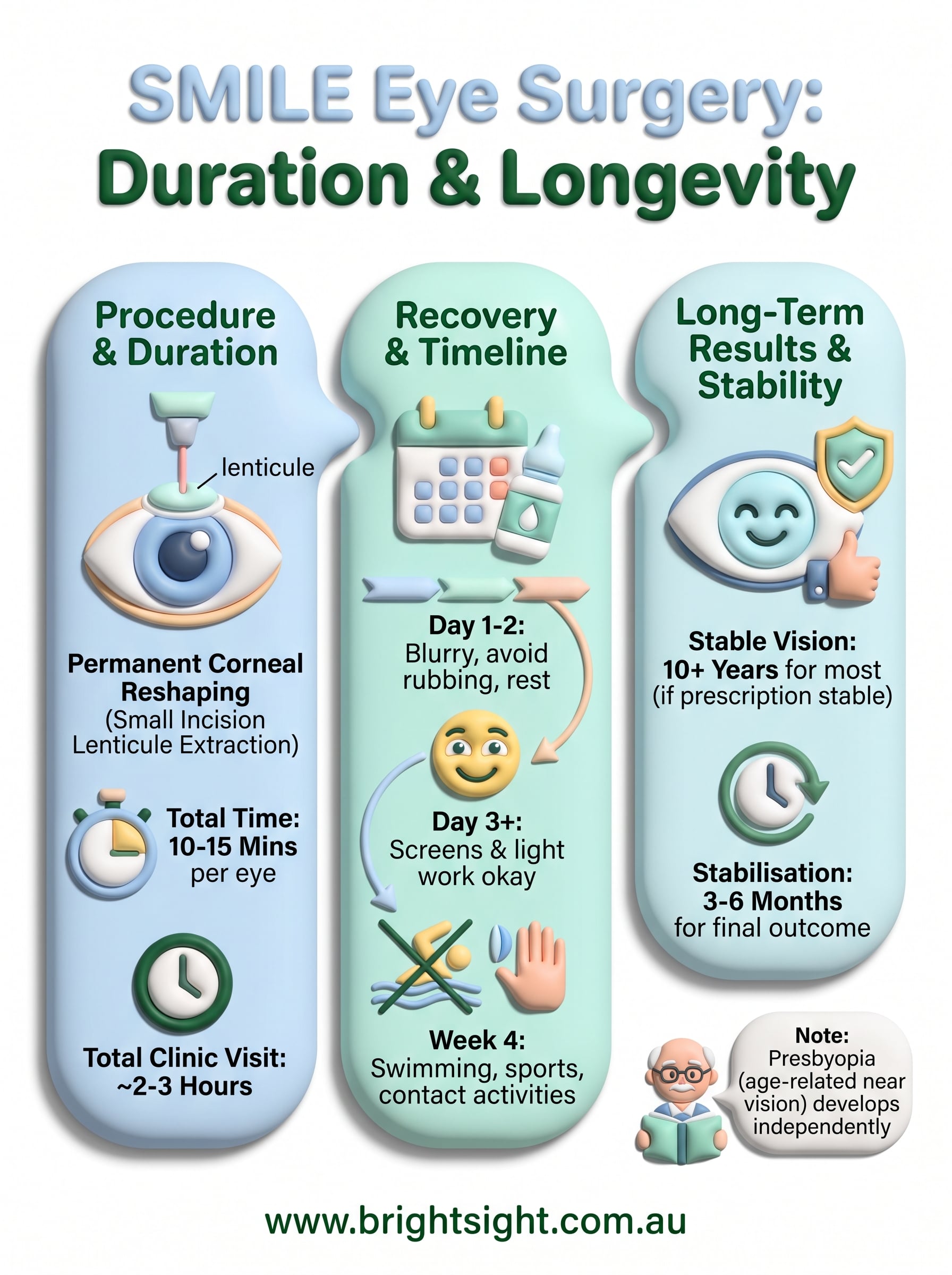
When people ask how long does SMILE eye surgery last as a procedure, the answer is surprisingly brief. The femtosecond laser works on each eye for roughly 25 to 30 seconds, making it one of the fastest laser vision correction procedures available. Your surgeon then removes the lenticule through the small incision, which adds a few minutes per eye. The total treatment time for both eyes usually sits between 10 and 15 minutes from start to finish.
The laser component of SMILE takes under a minute per eye, which surprises many patients who expected a far longer process.
After the procedure, your team will check your eyes before you leave. You will receive protective eyewear to wear on the way home, along with written aftercare instructions covering your drops and activity restrictions for the days ahead.
How long recovery takes and what to expect
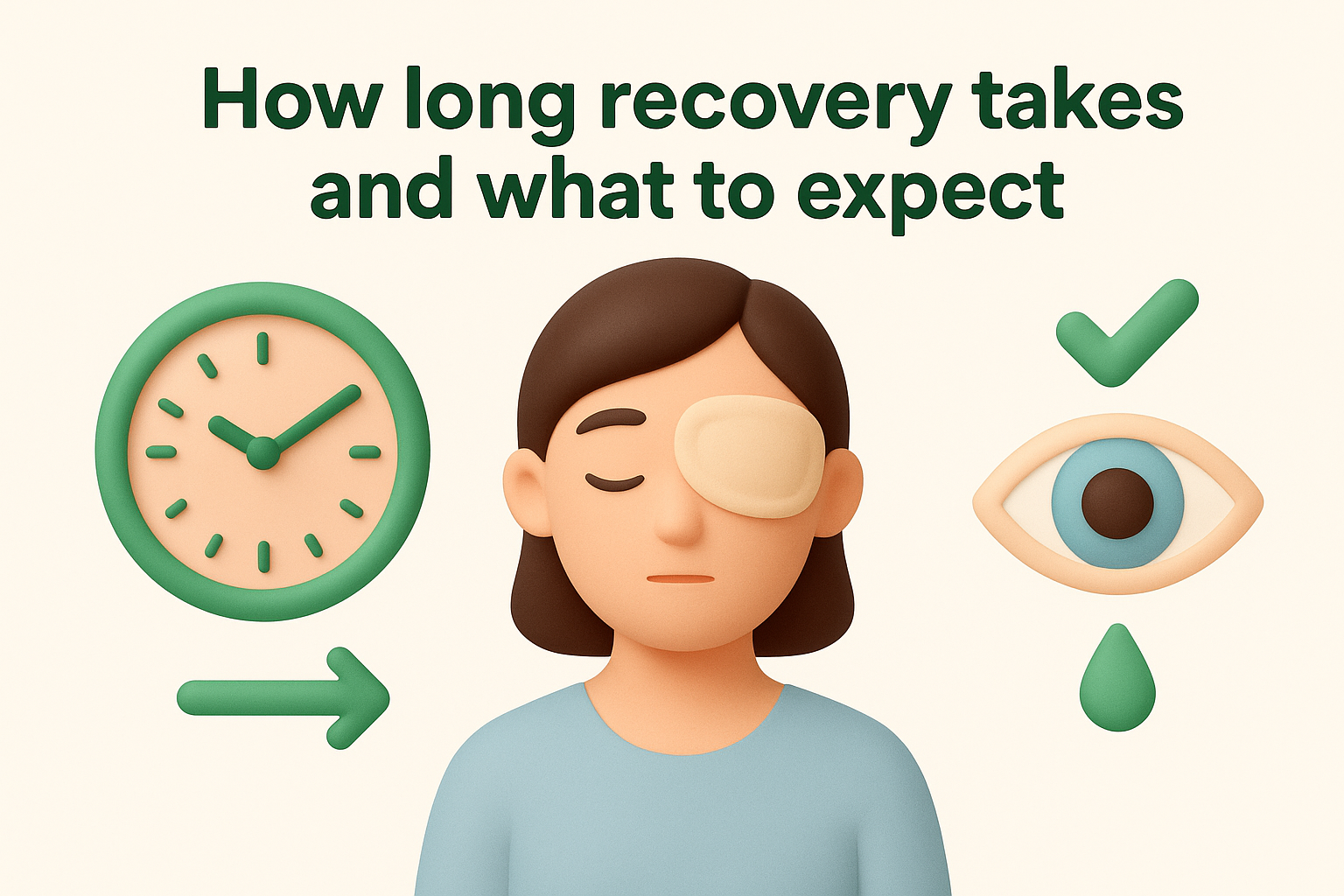
Recovery from SMILE is faster and more comfortable than many patients expect, partly because the procedure avoids creating a corneal flap. Most people notice significantly improved vision within the first 24 hours, though your eyes may feel slightly tired or sensitive during this initial period.
The first 24 to 48 hours
In the hours immediately after surgery, your vision will likely be blurry or hazy, and your eyes may feel mildly gritty or dry. You will need to use prescribed antibiotic and anti-inflammatory eye drops on a schedule your care team provides, and you should avoid rubbing your eyes entirely during the healing phase. Arrange someone to drive you home and plan to rest for the remainder of that day.
During the first 48 hours, avoid:
- Rubbing or touching your eyes
- Swimming or getting water directly in your eyes
- Wearing eye makeup
- Driving until your surgeon clears you
Most patients wake up the morning after SMILE and find their vision is already noticeably clearer than before surgery.
When you can return to normal activities
Screen use and reading are usually comfortable again within two to three days, though your eyes may tire more easily at first. You can typically return to office-based work within two to three days, and light exercise such as walking is generally fine after about a week. Swimming and contact sport require a longer pause, with most surgeons recommending you wait at least four weeks before returning to water activities or anything involving physical contact near your eyes.
Your vision continues to settle over the following weeks, and minor fluctuations in clarity during the first month are normal. When you consider how long does SMILE eye surgery last in terms of results, it helps to know that the stabilisation period is relatively short, with most patients reaching their final, stable outcome within three to six months of surgery.
Key takeaways
When you ask how long does SMILE eye surgery last, the answer depends on which part of the question you mean. The corneal reshaping is permanent, the procedure itself takes under 15 minutes, and most patients reach stable, clear vision within three to six months. Age-related changes like presbyopia can affect your near vision later in life, but these happen independently of your SMILE correction and do not undo the work done to your cornea.
Recovery is faster than most people expect. Screen use and light work return within a few days, and the majority of patients settle into stable, glasses-free vision within the first few months. If your prescription was stable before surgery and your corneas were healthy enough to proceed, the results typically last well into the long term.
If you are ready to find out whether SMILE is right for your eyes, book a consultation with Dr Capucine Odouard at Bright Sight Eye Specialists in Randwick.