


If you’ve been diagnosed with a pterygium, that fleshy, wedge-shaped growth on the surface of your eye, and surgery has been recommended, one of your first questions is likely how long does pterygium surgery take. The short answer: the procedure itself usually takes between 30 and 60 minutes, depending on the size of the growth and the surgical technique used.
But the time spent in the operating theatre is only part of the picture. You’ll also want to know what the full day looks like, from pre-operative preparation to discharge, and how long recovery takes before your eye feels normal again. These details matter when you’re planning time off work or arranging someone to drive you home.
At Bright Sight Eye Specialists in Randwick, Dr Capucine Odouard performs pterygium surgery at Sydney Surgical Centre and Sydney Eye Hospital, drawing on her training at Sydney Eye Hospital and her specialisation in corneal conditions. In this article, we break down the procedure timeline step by step, the surgery itself, the day-of logistics, and what to expect during each stage of healing.
How long the procedure takes in minutes
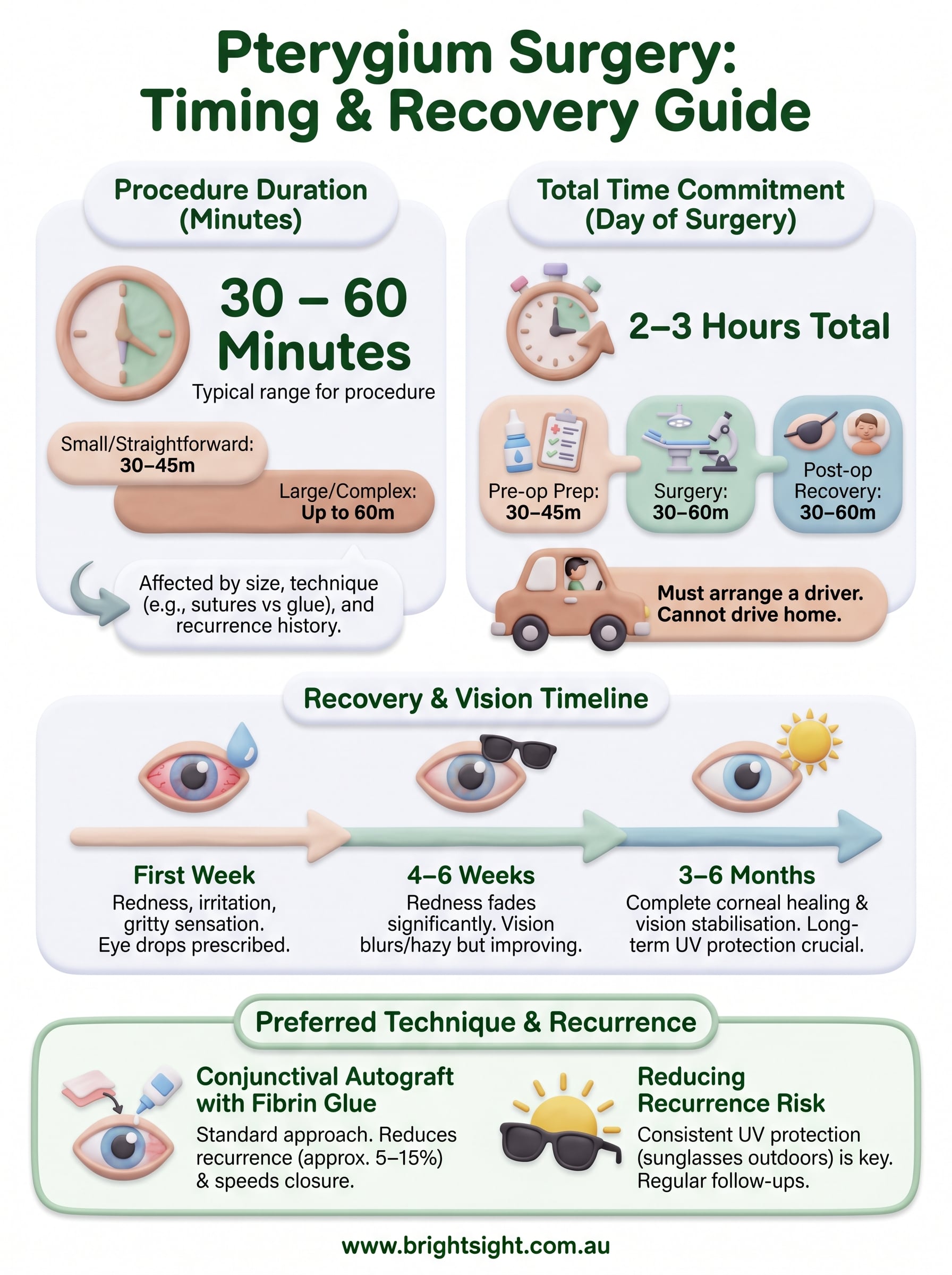
When patients ask how long does pterygium surgery take, the answer depends on a few key variables, but most straightforward procedures are completed in 30 to 45 minutes. A larger or more complex growth may push that closer to 60 minutes. Anything beyond an hour is uncommon in routine cases, though the exact duration is something your surgeon can estimate more accurately once they assess the size and location of the growth at your pre-operative appointment.
Small vs large pterygiums
The size and extent of the pterygium on your eye is the single biggest factor affecting how long the procedure runs. A small, early-stage pterygium that hasn’t grown far onto the cornea can typically be removed in around 30 minutes, including the time needed to prepare and position the graft tissue. A larger growth that has extended well across the cornea requires more careful dissection to protect the delicate layers underneath, which adds meaningful time to the operation.
The more cornea the pterygium has covered, the more precision the surgery demands during removal, and that precision directly affects how long you spend in theatre.
Your surgeon will give you a realistic time estimate during your pre-operative consultation once they have reviewed the full extent of the growth and confirmed the most appropriate technique.
What can extend the time in theatre
Several factors can add minutes beyond the baseline estimate. The conjunctival autograft technique, where healthy tissue is taken from another part of your eye to cover the removal site, involves a separate harvesting and positioning step that naturally adds time to the procedure. Surgeons who secure the graft with sutures rather than fibrin glue take longer to complete the closure, since each suture is placed with careful precision to hold the graft flat.
A recurrent pterygium, one that has regrown after a previous removal, also tends to extend theatre time because scar tissue from the earlier operation makes dissection more involved and requires greater care to avoid complications. Your ability to remain comfortable and still under local anaesthetic, along with individual differences in your eye anatomy, can also influence the total time spent in theatre.
What happens during surgery and the main techniques
Pterygium surgery is performed under local anaesthetic, so you remain awake but feel no pain. Understanding how long does pterygium surgery take is easier when you know what happens at each stage. Your surgeon starts by numbing the surface of the eye with drops before moving to the removal itself.
Excising the pterygium
Your surgeon carefully dissects the pterygium away from the cornea and conjunctiva, removing all tissue from the affected area. A recurrent pterygium adds time here because scarring from a previous procedure makes dissection more involved and requires greater care to avoid damaging the delicate corneal layers beneath.
The surgeon checks the cleared site for remaining tissue fragments and assesses the health of the surrounding cornea before moving to the next step.
Grafting and securing the site
Once the growth is removed, the bare area needs to be covered. The standard approach is a conjunctival autograft, where a small piece of healthy tissue from under your upper eyelid is positioned over the removal site. This reduces the chance of the pterygium growing back significantly compared to leaving the area exposed.

Your surgeon then secures the graft with fibrin glue, a biological adhesive that bonds the tissue without sutures and reduces overall theatre time considerably.
The autograft with fibrin glue is now the preferred technique at most specialist centres because it lowers recurrence rates and speeds up closure.
Your total time commitment on the day
The procedure itself runs for 30 to 60 minutes, but your total time at the surgical facility will be considerably longer. Most patients spend between two and three hours at the centre from arrival to discharge, covering pre-operative preparation, the surgery, and a post-operative monitoring period before you leave.
Before you go into theatre
When you arrive, the nursing staff will review your medical history, confirm your consent, and begin preparing your eye for surgery. This includes administering anaesthetic drops and allowing adequate time for them to take full effect before your surgeon is ready. The preparation phase typically runs for 30 to 45 minutes before you enter the operating theatre.
After the procedure
Once surgery is complete, you move to a recovery area where staff monitor your comfort and check the treated eye before clearing you to leave. This observation period usually lasts between 30 and 60 minutes. You cannot drive yourself home after the procedure, so arranging for someone to collect you is a firm requirement, not a suggestion.
Plan your whole day around the appointment rather than fitting it between other commitments, since rushing the post-operative period adds unnecessary stress to your recovery.
What to arrange beforehand
Wear loose, comfortable clothing on the day and leave contact lenses at home. Ask your support person to remain within reach of the facility throughout the procedure so you are not left waiting once staff clear you to leave. Having a quiet space to rest at home for the remainder of the day is also worth organising in advance.
Recovery timeline and when vision stabilises
Recovery from pterygium surgery is gradual, and understanding the timeline helps you plan your return to work and daily activities without rushing the process. Most patients experience redness, irritation, and a gritty sensation in the treated eye for the first week, which is normal as the graft settles into position. Your surgeon will prescribe antibiotic and anti-inflammatory eye drops to protect the site and reduce swelling during this early phase.
The first week after surgery
Your eye will look red and feel uncomfortable for the first few days, and your vision may appear blurred or slightly hazy while the drops do their work. Avoiding rubbing the eye, swimming, and dusty environments is essential during this period to prevent disturbing the graft before it has bonded properly. Most patients find they can return to desk-based work within two to five days, though this depends on how quickly the initial irritation settles.
When vision clears and healing completes
Full visual stability takes longer than most patients expect. While redness fades noticeably within four to six weeks, complete healing of the corneal surface can take anywhere from three to six months. Any blurring linked to the surgery itself typically improves steadily over this window as the eye adjusts to the treated area.
Knowing how long does pterygium surgery take is straightforward, but the healing phase is where patience genuinely pays off.
Your surgeon will guide you through each stage at follow-up appointments and adjust your drop schedule as healing progresses.
Risks, recurrence, and follow-up schedule
Pterygium surgery is generally safe, but like any procedure involving the eye, it carries specific risks you should understand before agreeing to proceed. The most commonly reported issues include temporary redness, irritation, and dry eye symptoms, which usually settle within a few weeks as the graft heals. Less frequently, patients experience infection, graft displacement, or scarring that affects vision. Your surgeon will review your personal risk profile at your pre-operative appointment and discuss any factors that could increase your likelihood of complications.
Recurrence and how to reduce it
Recurrence is the main concern after pterygium removal, and the surgical technique your surgeon uses directly influences how likely the growth is to return. The conjunctival autograft method, particularly when combined with fibrin glue for graft fixation, carries a recurrence rate of roughly five to fifteen per cent compared to much higher rates with older techniques that left the removal site bare. Younger patients and those with high UV exposure face a greater risk of regrowth. Consistent sun protection, including wearing UV-blocking sunglasses outdoors, remains one of the most practical steps you can take to reduce that risk long term.
If you notice any new growth at the edge of the treated area during recovery, contact your surgeon promptly rather than waiting for your next scheduled appointment.
Your follow-up schedule
Understanding how long does pterygium surgery take is only part of your commitment. Follow-up appointments typically occur at one week, one month, and three months after surgery, allowing your surgeon to monitor graft adhesion, adjust your drop regimen, and confirm the cornea is healing on track.
Key takeaways and next steps
Knowing how long does pterygium surgery take gives you the confidence to plan properly. The procedure runs for 30 to 60 minutes, your full day at the surgical facility takes roughly two to three hours, and complete healing unfolds over three to six months. The conjunctival autograft technique, secured with fibrin glue, gives you the best chance of a lasting result with the lowest risk of recurrence.
Protecting your eyes from UV exposure after surgery is one of the most practical steps you can take to reduce the chance of the growth returning. Wearing quality sunglasses outdoors and attending every follow-up appointment keeps your surgeon informed and your recovery on track.
If you are ready to take the next step or have questions about whether surgery is right for you, book a consultation with Dr Capucine Odouard at Bright Sight Eye Specialists in Randwick.