


Most people associate herpes simplex with cold sores or genital ulcers, and rightly so, as these are its most recognised presentations. But this extremely common virus, carried by billions of people worldwide, can affect far more than the lips or genitals. It can target the skin, the nervous system, and critically, the eyes.
Ocular herpes simplex is one of the leading infectious causes of corneal blindness in developed countries. At Bright Sight Eye Specialists, Dr. Rahul Dubey and Dr. Capucine Odouard regularly see patients in Randwick and the Eastern Suburbs of Sydney whose eye symptoms, redness, pain, blurred vision, light sensitivity, trace back to an underlying HSV infection. Early recognition and proper specialist management make a real difference in protecting long-term vision.
This article provides a clear, practical overview of the herpes simplex virus. You’ll learn how HSV-1 and HSV-2 differ, how the virus spreads, what symptoms to watch for across different parts of the body, and what treatment options are available. We also explain when herpes simplex becomes an eye health concern and why prompt assessment matters.
Why herpes simplex matters
Herpes simplex is not a rare or obscure condition. Two distinct types of the virus affect a significant proportion of the global population, and the majority of people carrying it have no idea. The World Health Organization estimates that over 3.7 billion people under the age of 50 carry HSV-1 infection globally. Many live without noticeable symptoms, yet the virus remains present in the body for life, capable of reactivating at any point and causing real harm, sometimes in places far removed from cold sores or genital ulcers.
Global reach and missed diagnoses
The scale of HSV infection makes it one of the most widespread viral infections on the planet. Because outbreaks are often mild or mistaken for unrelated skin conditions, a large portion of infections go undiagnosed. Studies published by the WHO indicate that only a fraction of infected individuals have received a formal diagnosis. This gap between actual infection rates and diagnosed cases means many people unknowingly transmit the virus to partners, family members, and close contacts through everyday interaction.
You may have carried HSV-1 since childhood, acquired through a kiss from a family member, and experienced very few symptoms. Mild tingling, occasional skin irritation, or brief fatigue can all represent HSV reactivation, yet most people chalk these up to something entirely unrelated. Without knowing you carry the virus, you cannot take steps to reduce the risk of transmission or monitor for complications.
The virus does not need to produce visible sores to be transmissible, which is why understanding herpes simplex matters even if you have never had a recognisable outbreak.
The dormancy problem
One reason HSV receives sustained medical attention is the way it hides in the nervous system after initial infection. The virus travels to nearby nerve clusters, called ganglia, and establishes a latent (dormant) state within the nerve cells. It can remain there for months or years before reactivating, triggered by factors such as illness, sleep deprivation, ultraviolet light exposure, psychological stress, or hormonal shifts.
This cycle of dormancy and reactivation makes HSV difficult to eliminate entirely. Each recurrence carries a transmission risk, and in some cases reactivation occurs with no visible symptoms at all while the virus is still shed from skin or mucous membranes. This phenomenon, known as asymptomatic viral shedding, is a primary driver of ongoing transmission within the population.
When HSV affects the eyes
For most people, HSV produces manageable cold sores or occasional genital symptoms. For a smaller but medically significant group, the virus spreads to ocular tissue, causing a condition called herpes simplex keratitis, which is an infection of the cornea, the clear front surface of the eye. This is where the consequences become substantially more serious.
Repeated episodes of ocular herpes can produce progressive corneal scarring that permanently reduces vision. Without early diagnosis and appropriate specialist management, herpes simplex keratitis can advance to the point where a corneal transplant becomes necessary. Any persistent redness, eye pain, light sensitivity, or blurred vision warrants prompt assessment by an ophthalmologist, particularly if you have a known history of cold sores or HSV infection elsewhere on the body.
HSV-1 vs HSV-2: what’s the difference
Both HSV-1 and HSV-2 belong to the same family of herpesviruses and share a core biological trait: once you contract either type, it remains in your body for life. They also both follow the same pattern of latency and reactivation, hiding in nerve ganglia between outbreaks. Despite these similarities, the two types differ meaningfully in where they typically establish themselves, how they spread, and what long-term risks they carry.
Where each type typically appears
HSV-1 is primarily associated with oral infections. Most people acquire it during childhood through non-sexual contact, such as a kiss from a family member or sharing utensils. It typically establishes latency in the trigeminal nerve ganglion, which serves the face, mouth, and eyes. This is why HSV-1 is directly relevant to eye health: reactivation can send the virus along the nerve pathways that lead to the cornea, causing herpes simplex keratitis.
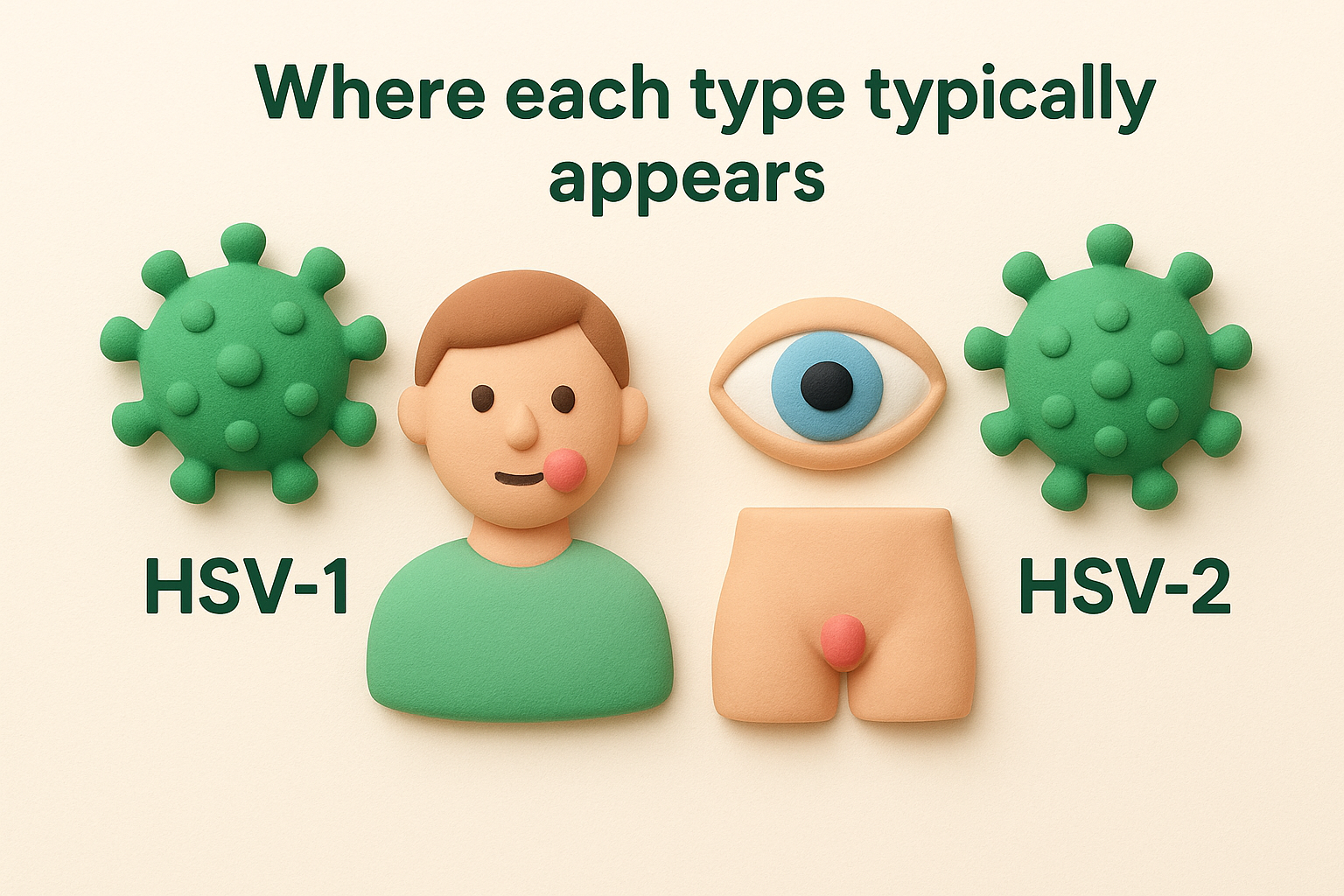
HSV-2 is primarily transmitted through sexual contact and tends to establish itself in the sacral ganglia at the base of the spine, which explains why recurrences typically produce genital symptoms. That said, both types can appear in locations outside their typical zones. HSV-1 can cause genital infections through oral-genital contact, and HSV-2 can occasionally affect the oral area or eyes.
Either type of herpes simplex can infect the eye, so a history of genital HSV-2 does not rule out ocular involvement.
Recurrence rates and severity
One practical difference between the two types is how often each reactivates in its non-primary location. HSV-2 tends to reactivate more frequently overall, particularly in the genital region. HSV-1, when acquired genitally, reactivates less often in that area than HSV-2 does. In the oral and ocular regions, HSV-1 reactivates more readily than HSV-2 would in the same location.
From an eye health perspective, this matters. Patients with a history of oral cold sores caused by HSV-1 carry a genuine risk of ocular involvement with each reactivation, which is why monitoring and prompt assessment by an ophthalmologist is important when eye symptoms develop alongside any known HSV history.
Symptoms and stages of an outbreak
Herpes simplex outbreaks follow a fairly predictable pattern, though the intensity and duration vary considerably from person to person. Some individuals experience severe, painful episodes while others have symptoms so mild they barely register. Knowing what to look for at each stage helps you respond quickly and seek care before complications develop.
Early warning signs
Most outbreaks begin with a prodrome phase, a short window before any visible sores appear where the body signals that the virus is reactivating. You might notice tingling, itching, burning, or a dull ache in the area where the outbreak is about to occur. This phase typically lasts 12 to 48 hours and is actually the period of highest viral activity, meaning transmission risk is elevated even without visible lesions.
If you act during the prodrome phase by starting antiviral medication, you can often reduce the severity and duration of the outbreak that follows.
In ocular cases, early warning signs may include eye irritation, increased light sensitivity, or a gritty sensation rather than the typical skin tingling. These symptoms are easy to dismiss as hay fever or tiredness, which is why they are frequently overlooked until more serious inflammation develops.
Active outbreak
During the active phase, fluid-filled blisters form on the affected area, then break open, releasing fluid before forming crusts or ulcers. On the lips or skin, this typically resolves within 7 to 10 days. Genital outbreaks may involve painful ulcers, difficulty urinating, and swollen lymph nodes. Corneal infection from HSV produces redness, watery discharge, reduced vision, and sometimes a visible branching ulcer on the cornea that an ophthalmologist can identify during a slit-lamp examination.
Healing and recurrence
Tissue repair begins once the ulcers crust over and close. Healthy skin returns within one to two weeks in most cases, though corneal healing can take longer and may leave residual scarring with repeated episodes. After healing, the virus re-enters its dormant state in the nerve ganglia. Recurrences can happen weeks, months, or years later, and each episode carries the same risk of transmission and, in ocular cases, further corneal damage.
How herpes spreads and how to lower risk
Herpes simplex spreads primarily through direct contact with infected skin, mucous membranes, or bodily fluids. The virus does not survive long outside the human body, so transmission requires close physical contact rather than environmental exposure. Understanding the specific routes helps you make informed decisions about protecting yourself and others.
Routes of transmission
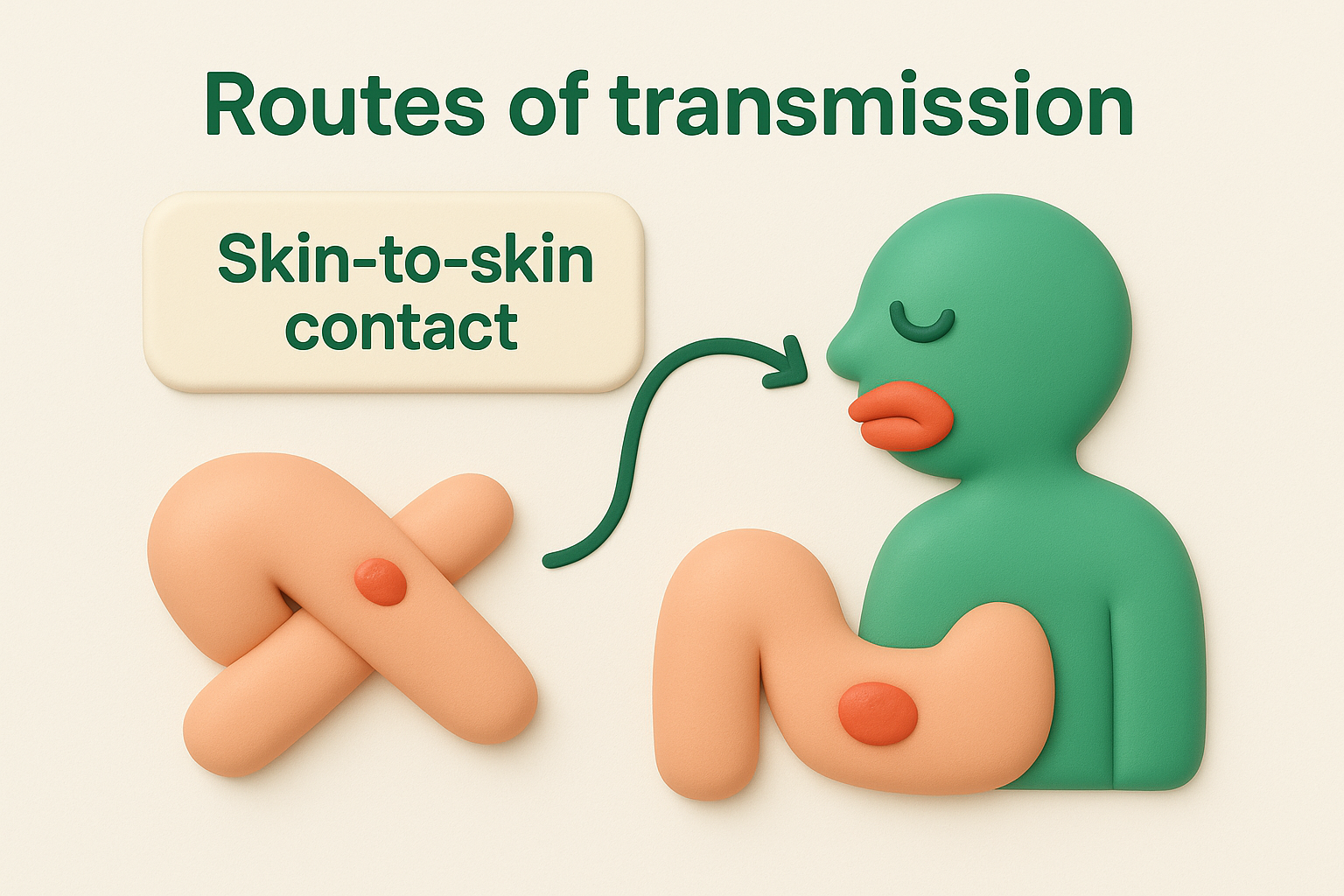
Skin-to-skin contact is the most common route. HSV-1 typically spreads through oral contact, kissing, or sharing items like cups and lip balm during an active outbreak. HSV-2 spreads most often through sexual contact, including vaginal, anal, and oral sex. However, because both types can infect either site, oral-genital contact can transmit HSV-1 to the genitals or HSV-2 to the mouth.
A critical point many people overlook is asymptomatic viral shedding. The virus can be present on the skin and transmissible even when you have no visible sores, no tingling, and no other symptoms. This shedding occurs regularly between outbreaks and is responsible for a substantial proportion of new infections.
You do not need an active outbreak to pass herpes simplex to another person, which is why open communication with sexual partners is important regardless of visible symptoms.
Ocular transmission deserves specific mention. Touching an active cold sore and then rubbing your eye can introduce the virus to the corneal surface. This is one reason why hand hygiene is a practical and meaningful protective measure for anyone with a known HSV infection.
Reducing your risk
Antiviral suppression therapy, taken daily rather than only during outbreaks, significantly reduces both the frequency of reactivation and the risk of transmission to partners. Your doctor can assess whether this approach suits your situation based on how often you experience outbreaks and your personal circumstances.
Using barrier protection during sexual activity lowers transmission risk for HSV-2, though it does not eliminate it entirely since the virus can shed from areas not covered. Avoiding contact during visible outbreaks, practising consistent hand hygiene, and being aware of early prodrome symptoms all contribute meaningfully to reducing transmission in everyday life.
Diagnosis and testing options
Confirming a herpes simplex infection is not always as straightforward as it might seem. Because symptoms can mimic other skin conditions, eye infections, and inflammatory conditions, getting an accurate diagnosis requires more than a visual inspection. Knowing which tests exist and when to use them helps you have a productive conversation with your doctor or specialist.
Clinical examination
A doctor can often make a provisional diagnosis based on the appearance, location, and pattern of symptoms alone. Cold sores with the typical blister-to-crust progression in the perioral area are usually recognisable on sight. For ocular herpes, an ophthalmologist performs a slit-lamp examination, which uses magnified light to inspect the cornea closely. A branching or "dendritic" ulcer on the corneal surface is a strong indicator of HSV keratitis and typically allows a confident clinical diagnosis without further testing.
Early examination by an ophthalmologist matters because corneal damage from HSV can progress quickly if treatment is delayed.
Laboratory tests
When the diagnosis is unclear, or when confirmation is needed for medical or legal reasons, laboratory testing provides definitive answers. The most commonly used methods include:
- Polymerase chain reaction (PCR): The gold standard for accuracy. PCR detects viral DNA in a swab taken from a sore, eye discharge, or cerebrospinal fluid in severe cases. It is highly sensitive and can identify the virus even when viral load is low.
- Viral culture: A swab from an active lesion is used to grow the virus in a laboratory setting. This method is most reliable when samples are collected during the active outbreak phase before lesions begin to crust over.
- Blood serology (type-specific IgG testing): Blood tests detect antibodies to HSV-1 or HSV-2, indicating prior exposure. These tests confirm infection but cannot pinpoint when or where on the body the infection occurred.
Timing your test
When you get tested significantly affects accuracy. Laboratory swabs produce the most reliable results when collected during an active outbreak, ideally within the first 48 hours of lesion appearance. Waiting too long reduces the chance of detecting the virus. If you suspect ocular involvement, do not delay seeking specialist assessment, as early diagnosis directly influences treatment outcomes and the risk of lasting corneal damage.
Treatment and long-term management
No cure exists for herpes simplex, but effective antiviral medications control outbreaks, reduce their duration, and lower the risk of transmission. The right treatment approach depends on how often you experience recurrences, how severe they are, and whether the infection involves your eyes.
Antiviral medications
The first-line treatments for HSV are oral antivirals, primarily aciclovir, valaciclovir, and famciclovir. These medications work by blocking the virus from replicating, which shortens the active outbreak phase and reduces symptom severity. Starting antiviral therapy during the prodrome phase, before blisters appear, consistently produces the best results.
For most people, antivirals are prescribed as episodic treatment, meaning you take a short course when an outbreak begins. Your doctor determines the appropriate dose and duration based on which type of herpes simplex you have and the severity of your symptoms.
Treating ocular herpes
Herpes simplex keratitis requires specialist management from an ophthalmologist rather than a general practitioner. Treatment typically involves topical antiviral eye drops or ointment, such as aciclovir ophthalmic preparations, applied directly to the eye to clear the active infection. In some cases, oral antivirals are added alongside topical treatment.
Corticosteroid eye drops can worsen active HSV keratitis, so never use them without direct guidance from an ophthalmologist who has examined your eye.
Repeated corneal infections can cause scarring that permanently reduces vision. Your ophthalmologist may recommend long-term oral antiviral therapy after an ocular episode to reduce the likelihood of recurrence and protect the cornea from cumulative damage.
Long-term suppressive therapy
If you experience frequent outbreaks, broadly defined as six or more per year, daily suppressive antiviral therapy is a practical option. Taken continuously at a lower dose, suppressive therapy reduces recurrence frequency, decreases asymptomatic viral shedding, and lowers the risk of transmitting the virus to partners.
Regular monitoring by your specialist matters particularly for anyone with a history of ocular involvement. Vision changes, returning eye discomfort, or new light sensitivity between known outbreaks all warrant prompt review rather than a wait-and-see approach.

Key takeaways and next steps
Herpes simplex is a lifelong viral infection that most people manage well with the right information and timely care. HSV-1 typically affects the mouth and eyes, while HSV-2 is primarily associated with genital infections, though either type can infect either location. Both follow a pattern of dormancy and reactivation, and both can shed without visible symptoms. Transmission is possible even between outbreaks, which makes awareness genuinely important rather than optional.
For anyone experiencing eye symptoms including redness, light sensitivity, blurred vision, or a gritty sensation, prompt specialist assessment is essential. Ocular herpes can cause cumulative corneal damage with each untreated episode, and early intervention directly protects your long-term vision. Antiviral therapy, whether episodic or suppressive, gives you real control over recurrence frequency and transmission risk.
If you have concerns about eye symptoms or a known history of HSV, book an appointment with Bright Sight Eye Specialists for a thorough assessment in Randwick.