


Wearing glasses or contact lenses every day works fine, until it doesn’t. Whether it’s the inconvenience, the cost of replacements, or simply wanting sharper vision without relying on corrective lenses, more Australians are exploring eye surgery for vision correction as a long-term alternative. Modern procedures can reshape the cornea or replace the eye’s natural lens to treat refractive errors like short-sightedness, long-sightedness, and astigmatism, often with results that reduce or eliminate the need for glasses altogether.
But choosing to have surgery on your eyes isn’t a casual decision. You’ll want to understand how each procedure works, what the recovery looks like, what it costs, and whether the risks are worth it for your situation. The options, from LASIK and PRK to SMILE and refractive lens exchange, each come with distinct advantages and trade-offs depending on your prescription, age, and eye health.
At Bright Sight Eye Specialists in Randwick, Sydney, Dr Capucine Odouard performs laser vision correction and refractive surgery using the latest evidence-based techniques, tailored to each patient’s eyes and lifestyle. This guide breaks down the main types of vision correction surgery available today, along with realistic information on costs, risks, and what to expect during recovery, so you can make a well-informed choice about your eyesight.
Why people consider eye surgery for vision
Most people who start researching eye surgery for vision correction aren’t doing it on a whim. They’ve usually spent years managing a refractive error with glasses or contacts, and at some point the inconvenience passes a threshold they’re no longer willing to accept. The reasons vary, but a handful of motivations come up consistently.
The everyday frustrations that add up
Glasses and contact lenses work, but they come with a constant list of minor irritations that accumulate over time. Fogged lenses when you walk into a warm room, contacts drying out on long flights, misplacing your glasses before bed, or squinting at your phone first thing in the morning without reaching for the bedside table. These aren’t dramatic problems, but they affect your daily quality of life in ways that are easy to underestimate until you actually list them.
Many patients report that the decision to explore surgery came not from a single event, but from years of low-level frustration finally reaching a tipping point.
Contact lens wearers also face ongoing costs that are easy to overlook because they spread across months and years. When you add up the price of lenses, solution, cases, and replacement frames over a decade, the total often exceeds the one-off cost of laser surgery by a significant margin.
Active lifestyles and sport
For people who play sport, swim, surf, or work in physically demanding environments, corrective lenses become a genuine obstacle. Glasses fog up, fall off, or break. Contacts are incompatible with water sports and carry a serious infection risk if worn in pools or the ocean. Many patients who seek care at practices like Bright Sight Eye Specialists in Randwick are triathletes, surfers, and outdoor workers who want clear, uninterrupted vision without the gear getting in the way.
Occupational and safety requirements
Certain careers place strict requirements on vision that glasses or contacts don’t always satisfy. Pilots, defence personnel, and emergency services workers may face licensing or fitness standards that make refractive surgery not just convenient but necessary. Others work in dusty, chemical, or sterile environments where wearing contact lenses creates real health or safety risks.
Your prescription level also plays a role here. People with high myopia often find that even well-fitted glasses distort peripheral vision or trigger headaches, and contacts only partially solve the problem. Refractive surgery, performed by an experienced specialist, can correct these errors more precisely than any external lens.
Wanting to see without relying on aids
Beyond convenience and career considerations, many people simply want the experience of clear, natural vision without a device on their face or in their eye. Waking up and seeing the room clearly, swimming without hesitation, reading a menu in low light without patting your pockets for glasses. Most people with strong natural vision take these moments for granted. For many patients, that freedom is the single most compelling reason to explore surgery seriously.
How the main procedures work
Each type of eye surgery for vision correction works on a different part of the eye, but they all share the same goal: changing how light focuses on your retina so you can see clearly without lenses. Understanding the mechanics helps you ask the right questions when you sit down with your surgeon.
LASIK and SMILE
LASIK uses a laser to reshape the cornea after lifting a thin flap of tissue from its surface. The laser removes microscopic amounts of corneal tissue in a precise pattern, altering its curvature so light bends correctly onto the retina. The flap is then repositioned, acting as a natural bandage, and healing begins almost immediately. Most patients notice noticeably sharper vision within 24 hours.
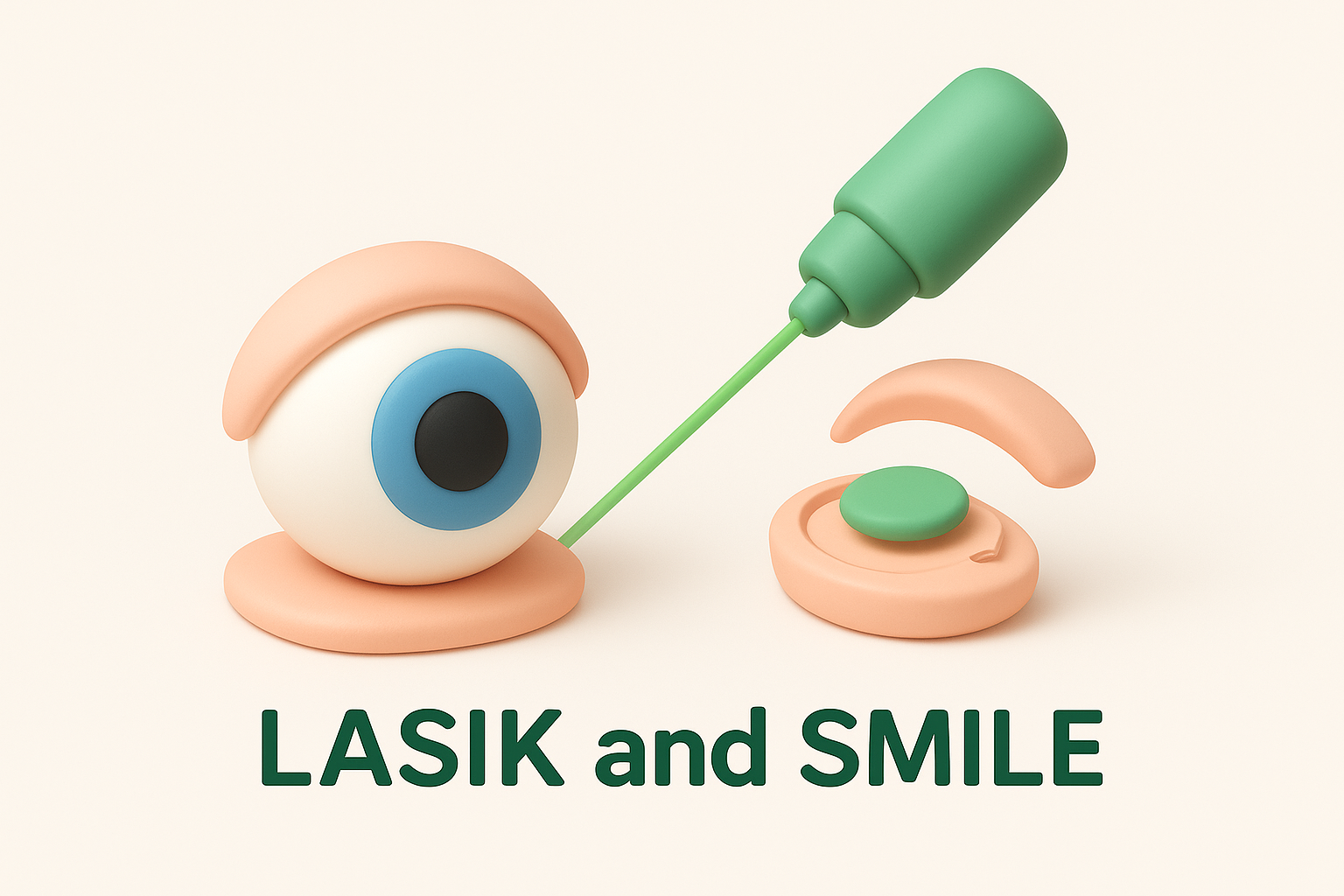
SMILE takes a different approach by removing a small disc of tissue, called a lenticule, through a tiny incision without creating a flap. This makes it a practical option for people with dry eye concerns or slightly thinner corneas, and the procedure is completely bladeless from start to finish.
Both LASIK and SMILE are performed while you are awake, but your eye is fully numbed with drops, so you feel pressure rather than pain.
PRK
PRK removes the outer surface layer of the cornea entirely before applying the laser, rather than creating a flap. The surface cells regenerate over several days, which means recovery takes longer than LASIK, but the long-term outcome is comparable. PRK suits patients whose corneas are too thin for a flap-based approach and those involved in contact sports where a flap could present a risk from impact.
Refractive Lens Exchange
Refractive lens exchange (RLE) replaces your eye’s natural lens with an artificial intraocular lens (IOL) selected to match your prescription. Surgeons use the same technique as cataract surgery, making a small incision and folding the new lens into position. RLE is particularly well-suited to patients over 45 because it also removes the future risk of cataracts by taking out the natural lens before it has a chance to cloud.
Which option suits which vision problem
Not every procedure suits every prescription. The right type of eye surgery for vision correction depends on your specific refractive error, the thickness and shape of your cornea, your age, and whether you want to preserve reading vision or correct it entirely. Your surgeon will assess all of these factors thoroughly before recommending any procedure.
Short-sightedness and astigmatism
LASIK and SMILE are the most common choices for people with myopia (short-sightedness) and astigmatism. Both reshape the cornea to correct how the eye focuses light, and they work well across a wide range of prescriptions. SMILE carries a slight advantage for people with dry eye symptoms or higher prescriptions, since the smaller incision preserves more corneal nerve fibres than LASIK.
If your cornea is too thin for LASIK or SMILE, PRK achieves the same outcome without creating a flap, making it a safe alternative for patients who might not qualify for flap-based approaches.
PRK is also worth considering if you play contact sports or work in an environment where impact to the face is possible. The absence of a corneal flap removes any risk of flap displacement from physical force, which gives it a clear safety advantage in those situations.
Long-sightedness and age-related changes
Long-sightedness (hyperopia) can be corrected with laser surgery, but the treatment range is narrower than for myopia, and not all hyperopic prescriptions qualify. Your surgeon will measure your corneal thickness and curvature to confirm whether you are a suitable candidate before proceeding.
Patients over 45 who also experience presbyopia, the gradual loss of near focus that comes with age, are often better served by refractive lens exchange than laser surgery. RLE replaces the natural lens with a premium intraocular lens that can target both distance and reading vision simultaneously. Choosing a multifocal or extended depth of focus (EDOF) lens means you are also eliminating the future risk of cataracts in a single procedure, which makes it a particularly practical option for older patients.
Risks, side effects and recovery
Like any surgical procedure, eye surgery for vision correction carries risks, and your surgeon has an obligation to explain them clearly before you consent. For the vast majority of patients, outcomes are predictable and positive, but knowing what can go wrong and what normal recovery feels like helps you set realistic expectations and respond appropriately if something feels off.
Common side effects after surgery
Most people experience temporary side effects in the first few days or weeks after laser surgery. These include dry eye, light sensitivity, haloes around lights at night, and mild blurring while the eye heals. These symptoms usually resolve within three months as the cornea stabilises and the surface nerves recover.
Dry eye is the most frequently reported side effect after LASIK, and your surgeon will typically prescribe lubricating drops to manage it during recovery.
Serious but rare complications
Serious complications from laser surgery are uncommon when a qualified, experienced surgeon performs the procedure on a properly selected candidate. Risks include overcorrection or undercorrection, corneal haze, flap complications in LASIK, or, very rarely, infection. The best way to reduce these risks is to attend all pre-operative assessments honestly, disclose your full medical history, and follow all aftercare instructions without shortcutting.
Refractive lens exchange carries a slightly different risk profile since it involves entering the eye. Possible complications include posterior capsule opacification, which is treatable with a quick laser procedure, and in rare cases, retinal detachment. Your surgeon will discuss your individual risk level based on your anatomy and prescription.
What recovery looks like
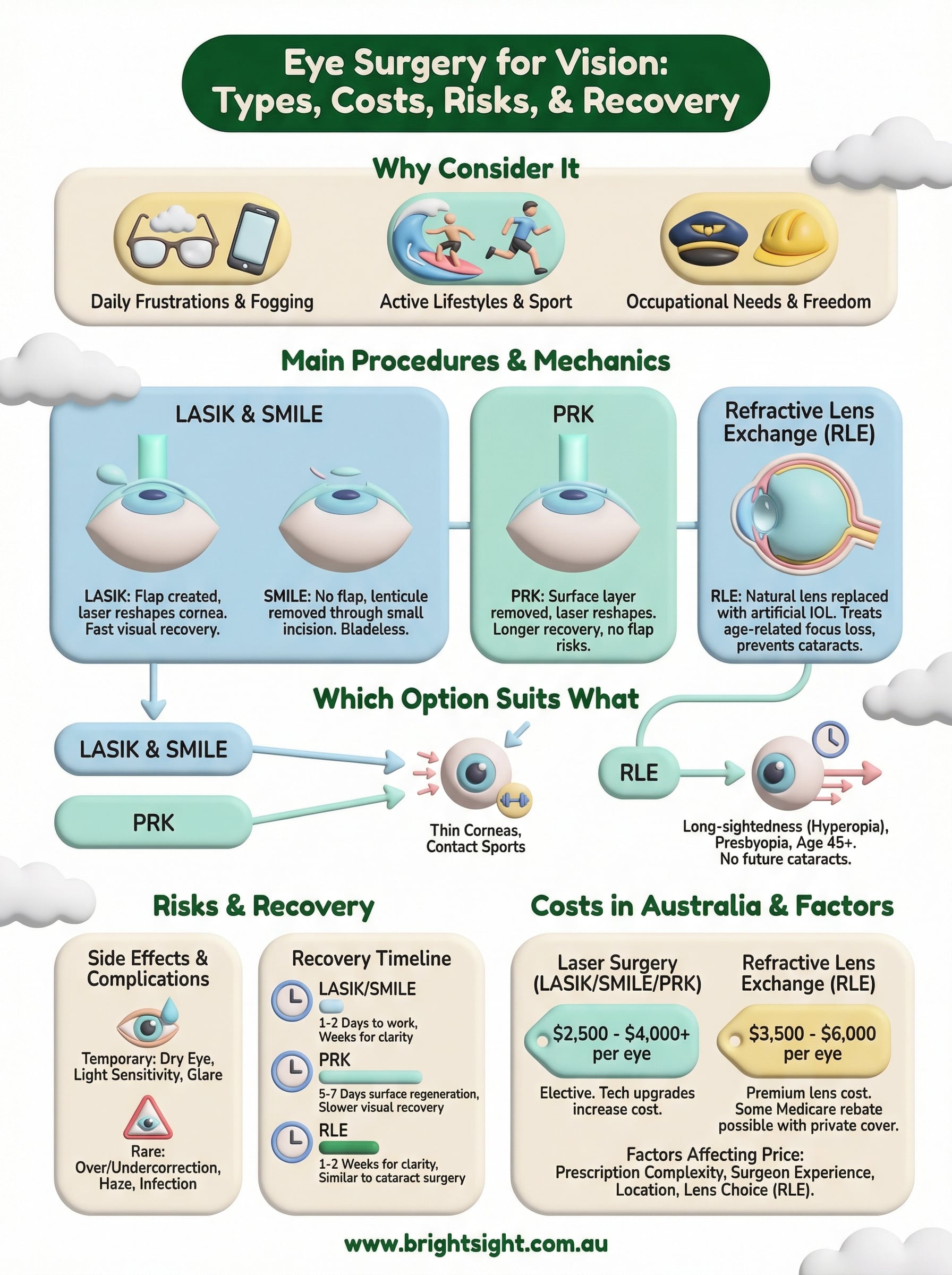
Recovery time depends on the procedure you have and how quickly your eyes respond. LASIK and SMILE typically allow patients to return to work within one to two days, with vision continuing to improve over two to four weeks. PRK requires more patience, as the surface cells take five to seven days to regenerate and vision remains blurred during that window. RLE recovery is similar to cataract surgery, with most patients seeing clearly within one to two weeks.

Costs in Australia and what affects the price
The price of eye surgery for vision correction in Australia varies widely depending on the procedure, the technology used, and the practice you choose. Laser surgery generally starts around $2,500 per eye and can reach $4,000 or more per eye for premium options, while refractive lens exchange sits at a higher price point due to the lens implant involved. Most procedures are not covered by Medicare because they are classified as elective, so understanding the full cost upfront matters.
What laser surgery typically costs
LASIK, SMILE, and PRK all fall within a similar price range in Australia, though technology upgrades such as wavefront-guided or topography-guided treatment can push the total higher. Some clinics quote a single all-inclusive fee, while others separate the consultation, procedure, and aftercare. Always confirm exactly what is included in the quoted price before committing, particularly whether follow-up appointments are bundled in.
Private health insurance with extras cover rarely contributes meaningfully to laser vision correction costs, so it pays to check your specific policy rather than assume.
What refractive lens exchange costs
Refractive lens exchange involves a premium intraocular lens implant, and the cost reflects that. Prices typically range from $3,500 to $6,000 per eye depending on the lens type selected, with multifocal and EDOF lenses sitting at the higher end. Patients with private hospital cover may find that the hospital and anaesthetist fees attract a Medicare rebate, which reduces the out-of-pocket amount compared to laser surgery.
Factors that affect your price
Several variables influence what you will pay for any refractive procedure. Understanding them helps you compare quotes accurately rather than selecting the cheapest option without context.
- Prescription strength and complexity: Higher or irregular prescriptions often require more planning and precision, which increases cost.
- Surgeon experience and technology: Practices using the latest laser platforms and staffed by fellowship-trained surgeons typically charge more for good reason.
- Location: Clinics in major metropolitan areas like Sydney tend to charge more than regional providers.
- Lens choice for RLE: Premium lenses cost significantly more than standard monofocal implants.
Key takeaways and next steps
Eye surgery for vision correction has moved well past the experimental stage. LASIK, SMILE, PRK, and refractive lens exchange are proven, well-understood procedures with strong safety records when performed by a qualified surgeon on a properly assessed candidate. The right choice depends on your prescription, corneal anatomy, age, and lifestyle, and no single procedure suits everyone.
If you are seriously considering surgery, the most important step you can take is booking a thorough pre-operative assessment with an experienced specialist. During that consultation, your surgeon will measure your corneas and review your prescription history, then confirm whether you are a suitable candidate before recommending any procedure.
At Bright Sight Eye Specialists in Randwick, Dr Capucine Odouard performs laser vision correction and refractive surgery using a patient-centred, evidence-based approach tailored to your individual goals. To find out whether surgery is right for you, book a consultation with Dr Odouard.