


If you’re considering lens replacement surgery, whether for cataracts or to reduce your dependence on glasses, one of the first questions you’ll have is about the eye lens replacement price. It’s a fair question, and unfortunately, one that many clinics don’t answer clearly. Costs can vary significantly depending on the type of lens, the surgeon’s experience, the facility used, and whether you hold private health insurance.
At Bright Sight Eye Specialists in Randwick, we believe you deserve straightforward answers about what you’ll pay before you commit to anything. Dr Rahul Dubey and Dr Capucine Odouard both perform lens replacement procedures, including cataract surgery and refractive lens exchange, at Sydney Surgical Centre and Sydney Eye Hospital. We offer transparent pricing upfront, including no-gap and known-gap options for insured patients, so there are no surprises on your bill.
This article breaks down the real costs of eye lens replacement surgery in Australia per eye, explains what drives those costs up or down, and covers what Medicare and private health funds typically contribute. Whether you’re comparing quotes or just starting your research, you’ll walk away with a clear picture of what to budget and the questions worth asking before you book. Let’s get into the specific numbers and factors that matter most.
Why eye lens replacement prices vary
The eye lens replacement price you receive from one clinic will often look nothing like what another clinic quotes, even for what sounds like the same procedure. That is not always because one is overcharging or the other is cutting corners. It reflects a genuine range of variables that affect what your surgery actually involves and what resources go into performing it safely. Understanding those variables helps you read quotes critically rather than just picking the lowest number.
The type of lens implanted
The single biggest driver of cost is the intraocular lens (IOL) used to replace your natural lens. Standard monofocal lenses correct vision at one fixed distance, typically for distance, meaning you will likely still need reading glasses afterwards. These carry the lowest cost. Premium lenses, including extended depth of focus (EDOF) lenses and multifocal lenses, correct vision across a broader range of distances and can significantly reduce or eliminate your dependence on glasses. Toric lenses address astigmatism. Because premium lenses are more complex to manufacture, require precise surgical placement, and demand higher levels of surgical skill to achieve the best outcome, they sit at a noticeably higher price point.
The jump from a standard lens to a premium lens can add several thousand dollars per eye, so the lens selection alone can almost double the quoted price between two clinics offering very different packages.
The lens type accounts for a large portion of any cost difference between quotes, so confirm exactly which lens each clinic is including before you compare figures.
Your surgeon’s experience and training
Surgical expertise matters and it carries a price. A surgeon with subspecialty fellowship training in cataract or corneal surgery, particularly at internationally recognised institutions, brings a level of precision and judgement that directly affects your outcome. At Bright Sight Eye Specialists, both Dr Rahul Dubey, who trained at Moorfields Eye Hospital in London, and Dr Capucine Odouard, who was appointed Professorial Senior Registrar at Sydney Eye Hospital, bring specialist-level training to every procedure. The surgeon’s fee forms a significant part of your total cost and varies based on their level of experience, reputation, and the complexity of your individual case.
The facility and equipment used
Where your surgery takes place affects what you pay. Procedures performed at accredited private surgical centres, such as Sydney Surgical Centre in Randwick, involve theatre fees, anaesthetist fees, and nursing staff costs. The technology used also plays a role. High-resolution imaging and advanced phacoemulsification equipment improve precision and surgical outcomes, but they contribute to the overall cost of running the procedure. Clinics that quote lower prices may be using older equipment or less experienced support staff, so it is worth asking specifically what the quote includes in terms of facilities and technology.
The complexity of your individual eye
Not every lens replacement is straightforward. If you have pre-existing conditions such as a dense or advanced cataract, a high refractive error, a shallow anterior chamber, or corneal irregularities, your procedure may require additional steps, longer operating time, or a higher level of specialist skill. These factors add cost because they increase the clinical demands of the procedure.
A quote based on a standard uncomplicated case may change once your surgeon reviews your full ocular assessment. That is why any accurate pricing conversation starts with a thorough pre-operative examination, not a figure pulled from a price list. Clinics that quote without examining your eyes first are giving you an estimate, not a real number.
Eye lens replacement price ranges per eye
Before you can plan your budget, you need actual figures. The eye lens replacement price in Australia varies widely, but there are established ranges that give you a realistic starting point. What you pay per eye depends primarily on lens type and whether you hold private health insurance, both of which can swing your out-of-pocket cost dramatically.
Standard monofocal lens surgery (cataract)
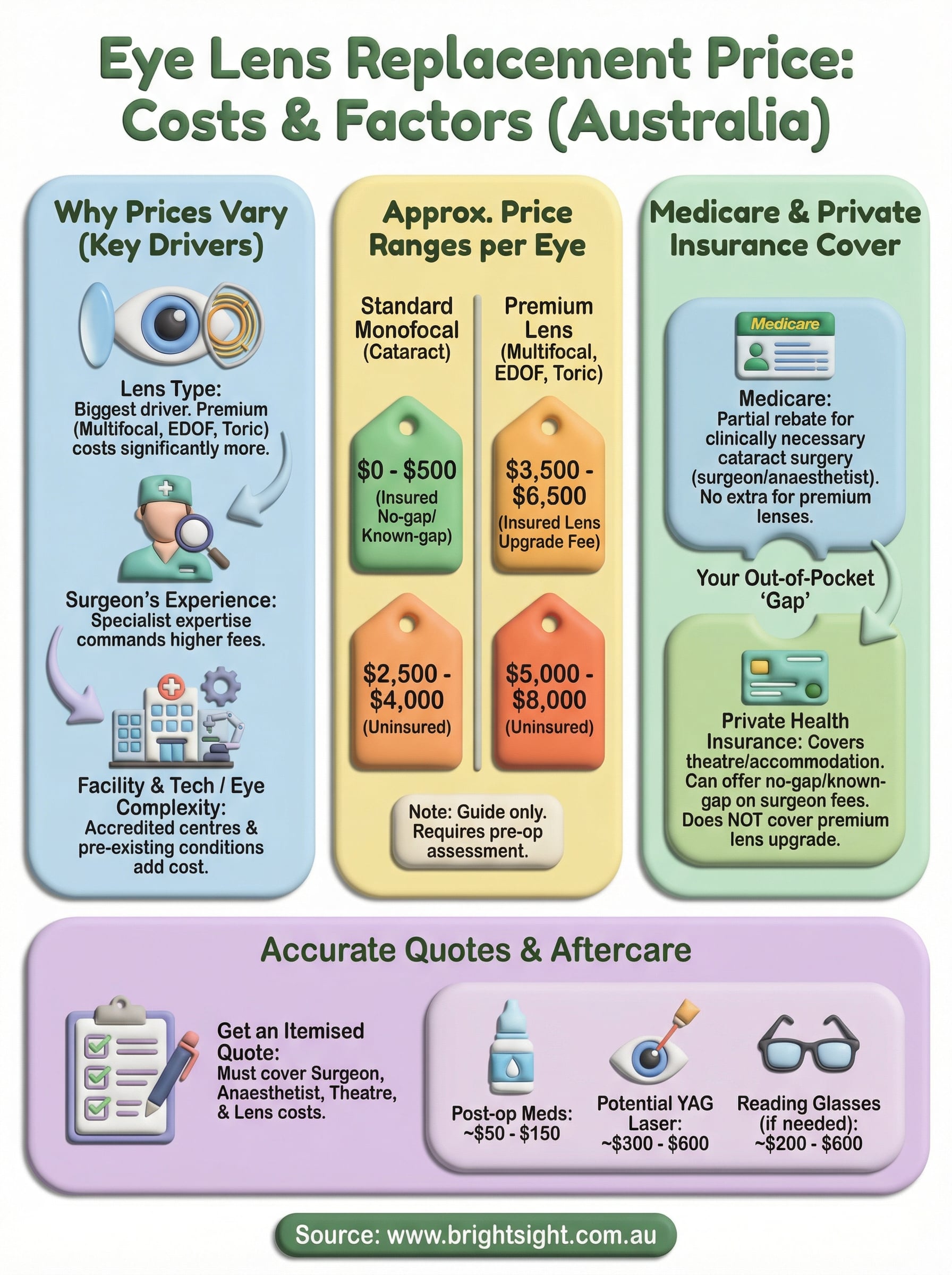
For cataract surgery with a standard monofocal lens, insured patients at accredited private hospitals can often access no-gap or known-gap options through their health fund. In these cases, your out-of-pocket cost per eye may range from $0 to around $500, depending on your fund and policy level. Without private health insurance, the total cost per eye typically sits between $2,500 and $4,000, covering the surgeon’s fee, anaesthetist, and theatre costs. Medicare provides a partial rebate for cataract surgery when it is clinically indicated, which reduces the gap for uninsured patients but does not cover the full cost.
If you hold hospital-level private health insurance and your cataract surgery is performed at an agreed facility, ask your surgeon directly whether a no-gap arrangement is available before you assume there will be an out-of-pocket cost.
Premium lens surgery (multifocal, EDOF, toric)
Choosing a premium intraocular lens to reduce your reliance on glasses after surgery adds a significant cost above the standard procedure. For multifocal or extended depth of focus (EDOF) lenses, you can expect to pay between $3,500 and $6,500 per eye out of pocket, even with private health insurance. Health funds cover the procedure itself as a hospital benefit, but the lens upgrade fee sits outside that coverage and falls to you directly.
| Lens type | Approximate cost per eye (insured) | Approximate cost per eye (uninsured) |
|---|---|---|
| Standard monofocal | $0 to $500 | $2,500 to $4,000 |
| Toric (astigmatism correction) | $1,500 to $3,000 | $3,500 to $5,000 |
| Multifocal or EDOF | $3,500 to $6,500 | $5,000 to $8,000 |
These figures reflect the current Australian private hospital market and serve as a guide only. Your specific quote will depend on your surgeon, the facility, and the findings from your pre-operative assessment. Refractive lens exchange in younger patients who do not have a clinical cataract diagnosis sits at a similar cost to premium cataract surgery, as Medicare rebates are more limited in that setting.
What drives the cost: lens type and complexity
Two factors shape the eye lens replacement price more than anything else: the intraocular lens (IOL) your surgeon implants and the clinical complexity of your individual case. These are not arbitrary pricing decisions. They reflect real differences in materials, surgical technique, and the level of precision your eyes require. Understanding both helps you see why your quote may differ from someone else’s, even when you are both having lens replacement surgery.
Standard lenses versus premium lenses
A standard monofocal lens corrects your vision at one fixed distance, typically long distance, which means you will still reach for reading glasses afterwards. These lenses are well-established, reliable, and carry the lowest cost. Premium lenses, including multifocal, extended depth of focus (EDOF), and toric options, are engineered to correct vision across multiple distances or to address astigmatism simultaneously. They require more exacting surgical placement and greater post-operative management to deliver the intended result.
The difference in lens material and manufacturing alone justifies a significant cost gap. Premium lenses also demand a higher level of pre-operative planning, including detailed corneal mapping and biometry, to ensure the right lens power and positioning. That additional assessment time and clinical precision is part of what you are paying for when you choose a premium option.
Choosing a premium lens is not just an upgrade in materials; it requires a higher level of surgical skill and planning to achieve the outcome you are aiming for.
Complexity factors that affect your individual cost
Not every eye is straightforward. A dense or mature cataract, for example, requires more ultrasound energy to break up the lens material safely, which adds surgical time and demands greater precision to protect the surrounding eye structures. Other complexity factors include:
- High refractive errors that make lens power calculation more demanding
- Previous corneal laser surgery, which affects biometry accuracy
- A shallow anterior chamber or narrow angle that limits surgical access
- Conditions such as pseudoexfoliation or weak zonules that increase procedural risk
Each of these factors can add to your surgeon’s fee and the time required in theatre. A straightforward case in a healthy eye takes less time and carries less clinical risk than a complicated one, and pricing reflects that reality. This is why your surgeon needs to examine your eyes thoroughly before giving you a final figure. Any quote issued without a pre-operative assessment is an estimate at best, and it may not reflect what your surgery will actually involve.
Medicare and private insurance: what’s covered
When budgeting for lens replacement surgery, understanding what Medicare and your private health fund actually contribute is essential. The two systems work together, but they do not cover everything, and the gap between what they pay and what your surgery costs is the amount you personally pay out of pocket. Knowing how each system works before your procedure avoids unwelcome surprises when the bill arrives.
What Medicare covers
Medicare provides a rebate for cataract surgery when the procedure is clinically necessary, meaning a cataract is confirmed and affecting your vision to a measurable degree. The rebate applies to the surgeon’s fee and the anaesthetist’s fee through the Medicare Benefits Schedule (MBS), but it does not cover theatre fees, consumables, or the cost of your lens implant. For refractive lens exchange in patients without a confirmed clinical cataract diagnosis, Medicare rebates are significantly reduced or may not apply at all, which is why the out-of-pocket cost in that setting tends to be higher than for standard cataract surgery.
Medicare does not distinguish between standard and premium lenses. It contributes a fixed schedule fee regardless of which lens your surgeon implants, so choosing a multifocal or EDOF lens does not attract any additional Medicare benefit. The difference in lens cost falls entirely to you, which is why the lens upgrade fee is the component most patients need to plan for independently.
How private health insurance changes what you pay
Private hospital cover at the appropriate level allows your fund to contribute to theatre and accommodation costs when your surgery takes place at an accredited private hospital. This is the main way health insurance reduces your eye lens replacement price beyond what Medicare alone covers. Funds operate on their own benefit schedules, and the amount they contribute toward your surgeon’s fee varies by policy and whether your surgeon participates in a no-gap arrangement.
Confirm your hospital cover includes ophthalmology procedures before your surgery date, as some lower-tier policies carry exclusions or waiting periods that apply to eye surgery.
At Bright Sight Eye Specialists, no-gap and known-gap arrangements are available for eligible insured patients, which means your total out-of-pocket cost is confirmed before you book. The lens upgrade fee for premium lenses sits outside what health funds cover, so even well-insured patients pay this component directly. Asking your surgeon’s billing team to itemise each cost, covering the surgeon fee, anaesthetist, theatre, and lens, gives you a complete picture of what your fund contributes and what remains your responsibility.
How to get an accurate quote and compare clinics
Getting a genuine eye lens replacement price requires more than a phone call asking for a number. Many clinics quote a base figure that excludes the anaesthetist, theatre fees, or the lens itself, which means the real cost only becomes clear after you have already committed. A reliable quote covers every component in writing, so you can compare clinics on equal terms rather than comparing an incomplete figure from one practice against a complete one from another.
What a complete quote should include
Before you compare prices between clinics, confirm that each quote covers the same items. A thorough, itemised quote should include:
- Surgeon’s fee and whether a Medicare rebate applies
- Anaesthetist’s fee, including their gap if applicable
- Theatre or facility fee at the surgical centre
- The specific lens implant being used and its cost, including any premium lens upgrade fee
- Pre-operative assessment and post-operative consultations
- Any additional costs for managing complexity or complications if your case is not straightforward
If a clinic gives you a single figure without breaking down these components, ask them to itemise it. A practice that is genuinely transparent will provide this without hesitation.
A quote that omits the anaesthetist or theatre fee is not a quote for your surgery; it is a quote for part of it.
Questions to ask before you commit
When you contact a clinic, ask specifically which lens is included in the quoted price and whether upgrading to a premium lens involves an additional fee. Many practices quote based on a standard monofocal lens, so if you are interested in a multifocal or EDOF option, the figure you received may be materially different from what your preferred procedure actually costs. Ask also whether the clinic offers no-gap or known-gap arrangements for insured patients, and confirm that your health fund recognises the surgical facility where your procedure will take place.
You should also ask when pre-operative measurements are performed and whether they are included in the quoted price or billed separately. Biometry, corneal topography, and a full ocular assessment are necessary before any surgeon can give you a final price with confidence. Clinics that quote without examining your eyes first are providing an estimate based on assumptions, not a price based on your actual clinical needs. A practice that schedules a thorough assessment before issuing a final figure is one that takes both your safety and your financial clarity seriously.
Aftercare and long-term costs to factor in
The eye lens replacement price you receive before surgery covers the procedure itself, but your total investment extends beyond the operating theatre. Post-operative care, medications, and the occasional follow-up procedure are all real costs worth building into your budget before you sign anything. Most are manageable and predictable, but they catch patients off guard when no one mentions them upfront.
Post-operative appointments and medications
Your surgeon will schedule several follow-up consultations in the weeks after your procedure to monitor healing, check your lens position, and confirm your vision is settling as expected. At Bright Sight Eye Specialists, these post-operative visits are included in your quoted price, but this is not universal across all practices, so confirm with any clinic you are comparing whether follow-up consultations are bundled or billed separately.
You will also receive prescription eye drops to use for several weeks after surgery, typically a combination of antibiotic and anti-inflammatory drops. These are dispensed from a pharmacy and are not covered by Medicare in most cases, so factor in a cost of roughly $50 to $150 for your post-operative drop regimen depending on what is prescribed. Your surgeon will give you a clear written plan so you know exactly what you need and for how long.
The chance of needing a YAG laser capsulotomy
A significant number of patients develop a condition called posterior capsule opacification (PCO) in the months or years after lens replacement surgery. This occurs when the thin membrane behind your new lens becomes cloudy, causing your vision to blur in a way that can feel similar to your original cataract returning. It is not a complication of surgery; it is a natural biological response that affects a proportion of patients regardless of how well the procedure went.
PCO is entirely treatable with a quick, painless laser procedure called a YAG capsulotomy, which typically takes only a few minutes in a consulting room and restores vision the same day.
The cost of a YAG capsulotomy in Australia generally falls between $300 and $600 per eye, and Medicare provides a partial rebate. Private health insurance may contribute an additional benefit. It is not guaranteed you will need one, but knowing it exists as a possibility helps you budget realistically over the longer term.
Planning for glasses if needed after surgery
Even with a premium multifocal or EDOF lens, some patients find they still want a light pair of reading glasses for extended fine print or low-light tasks. Budget approximately $200 to $600 for a quality pair from an optometrist if this applies to you, bearing in mind this is far less than the cost of full-time spectacle dependence before surgery.
Next steps to decide and book
You now have a solid understanding of what shapes the eye lens replacement price in Australia, what Medicare and private health funds contribute, and what to look for when comparing clinics. The next step is a pre-operative assessment with a qualified eye surgeon who can examine your eyes, confirm which procedure suits your situation, and give you a fully itemised quote based on your actual clinical needs, not a generic estimate.
At Bright Sight Eye Specialists in Randwick, Dr Rahul Dubey and Dr Capucine Odouard offer transparent, upfront pricing with no-gap and known-gap options for eligible insured patients. Both surgeons bring specialist-level training to every procedure and take the time to explain your options clearly before you make any decision. You are never pressured into a choice that does not suit your vision goals or budget.
Book a consultation with our team to get your personal assessment and a clear quote.