


Choosing the right eye health plan can save you hundreds of dollars a year on glasses, contact lenses, and routine eye exams, but only if you know what to look for. Most private health insurance extras covers include some form of optical benefit, yet the details vary widely between funds. What counts as "optical" under one policy might not be covered under another, and the gap between what you expect and what you actually receive can be frustrating.
At Bright Sight Eye Specialists in Randwick, we see patients every week who are surprised by what their cover does, and doesn’t, include when it comes to eye care. Whether you’re comparing extras policies for the first time or reviewing your current plan ahead of a procedure, understanding the fine print matters. It’s the difference between paying full price for new lenses and walking out with minimal out-of-pocket costs.
This article breaks down what an eye health plan typically covers in Australia, how optical extras work within private health insurance, and what to consider when choosing or switching your cover. We’ll also look at how your plan fits into a broader approach to protecting your vision, because the right insurance is only one part of keeping your eyes healthy long-term.
What an eye health plan means in Australia
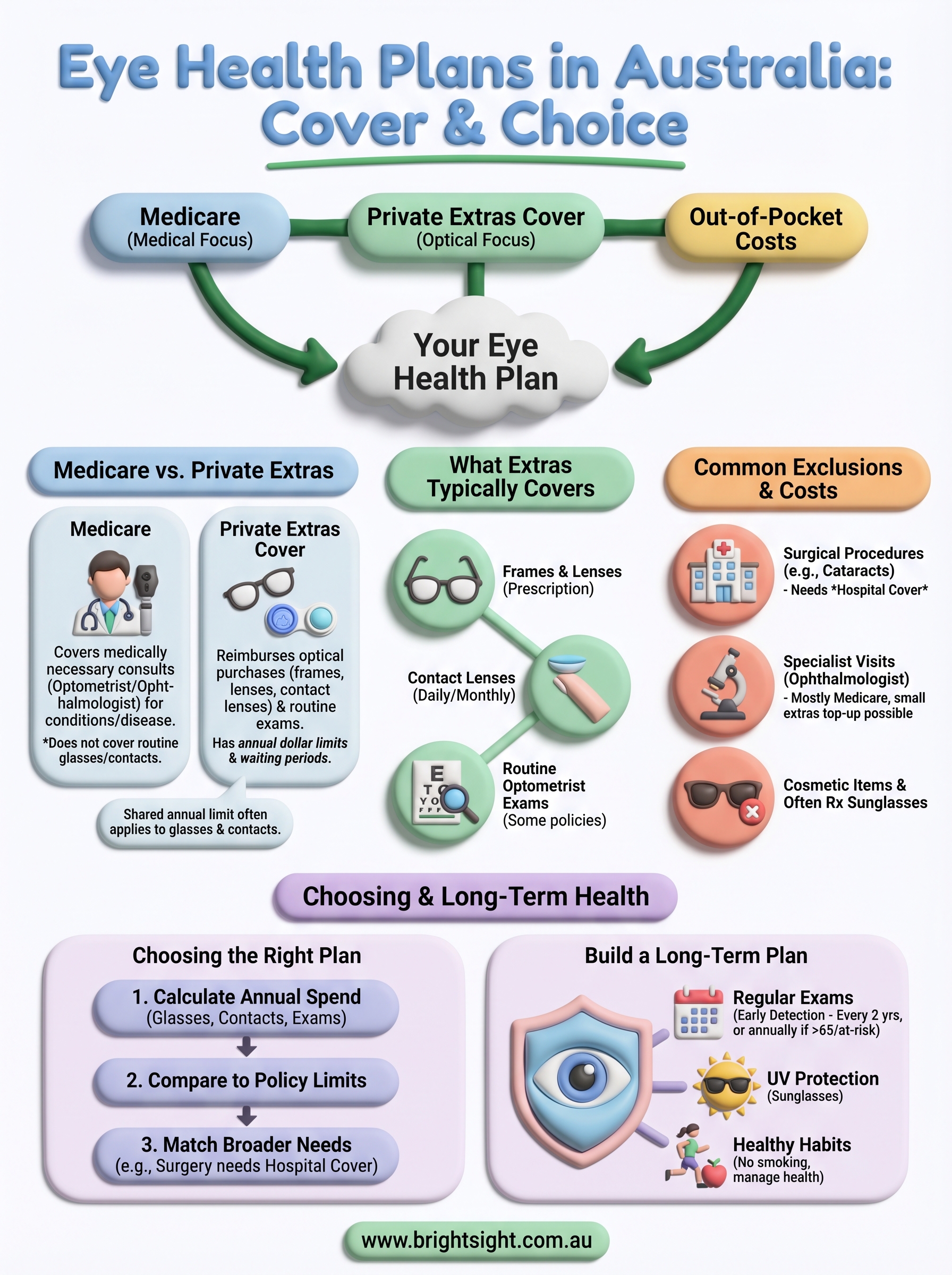
In Australia, there is no single product called an "eye health plan." The term is used loosely to describe the combination of Medicare entitlements, private health insurance extras cover, and out-of-pocket arrangements that together fund your eye care. Understanding how these layers interact is the starting point for making smart decisions about your vision and your budget.
How Medicare and private extras work together
Medicare covers consultations with optometrists and ophthalmologists when those visits are medically necessary, such as diagnosing a condition or managing an eye disease. It does not pay for routine optical purchases like glasses or contact lenses. That gap is where private health insurance extras cover steps in.

If you rely on Medicare alone for eye care, you will pay full price for every pair of glasses and every contact lens prescription you need.
Extras cover is the component of your private health insurance policy that reimburses everyday health services, including optical. You can hold extras cover on its own or alongside hospital cover. Most major Australian health funds, including those regulated under the Private Health Insurance Act 2007, offer tiered extras policies with different annual optical benefit limits and waiting periods.
What "optical" means under an extras policy
Under a typical extras policy, the optical category covers things like prescription glasses frames and lenses, contact lenses, and sometimes eye examinations with a registered optometrist. Your eye health plan in practical terms is whatever combination of Medicare and extras benefits your current policy provides.
Knowing exactly which services fall under optical, and which fall under the hospital or specialist categories, helps you avoid unexpected bills and choose cover that actually reflects how you use your eyes.
What an eye health plan usually covers
Most extras policies include a defined set of optical benefits, and knowing these helps you get the most from your cover. The benefits typically fall into two broad categories: optical purchases and eye examinations.
Frames, lenses, and contact lenses
Your extras cover will usually reimburse a set dollar amount per year toward prescription glasses, including frames and lenses. This annual limit commonly sits between $150 and $300, though higher-tier policies can offer significantly more. Some funds also apply a per-item limit on frames, so the total benefit is shared across different purchases.
Contact lenses are covered under most optical extras, including both daily disposables and monthly wear lenses. You claim against the same annual limit you use for glasses, so using your full allocation on contacts means less available for frames later that year.
Eye examinations with an optometrist
Routine optometrist consultations for vision testing and prescription updates are often included, though Medicare already covers bulk-billed optometrist visits for most people. Your eye health plan extras cover can supplement this, particularly for services that fall outside Medicare’s scope.
Always check your fund’s schedule of benefits before booking, so you know your exact entitlement.
What it may not cover and common costs
Your extras cover is not designed to fund surgical eye care or specialist consultations. Understanding these exclusions upfront prevents unexpected bills and helps you plan your eye health plan around the actual care you need.
Surgical procedures and specialist visits
Cataract surgery, retinal procedures, and other surgical interventions fall under hospital cover, not extras. If you need surgery, your hospital policy determines what Medicare and your fund will contribute, and an out-of-pocket gap may still apply depending on your surgeon’s fees and your policy tier.
If you have extras cover but no hospital cover, you will fund any eye surgery entirely out of pocket.
Specialist ophthalmologist consultations are billed through Medicare as a medical service, not as optical extras. Your fund may contribute a small additional benefit through ancillary cover, but this varies significantly between policies.
Prescription sunglasses and cosmetic items
Many funds exclude or limit benefits for prescription sunglasses, placing them in a different category or applying a lower annual limit. Purely cosmetic items, including non-prescription lenses and fashion frames without a valid optical script, are not covered under any standard extras policy. Always confirm which items your specific fund reimburses before you purchase.
How to choose the right eye health plan
Choosing the right eye health plan starts with understanding how you actually use eye care each year. If you wear prescription glasses or contact lenses, optical extras with a higher annual limit will likely return more value than a basic policy with a $150 cap.
Check your annual optical spend first
Before comparing policies, add up what you spent on glasses, contact lenses, and optometrist visits over the past 12 months. This figure tells you the minimum benefit limit worth looking for. If your out-of-pocket spend consistently exceeds what your current fund reimburses, upgrading your extras tier is worth the premium increase.

Compare your actual annual optical spend against your current benefit limit before renewing your policy each year.
Match your cover to your broader eye health needs
If you already know you need specialist care or eye surgery, hospital cover matters more than extras in the short term. Your waiting periods also affect timing, so check whether your fund applies a 2 or 6-month wait on optical benefits before you switch. Reviewing both components together gives you a complete picture of your annual eye care costs and helps you avoid paying for cover that doesn’t reflect your actual needs.
Build a long-term eye health plan for vision
A good eye health plan extends beyond what your extras policy reimburses each year. Protecting your vision long-term depends on regular monitoring, early intervention, and a few consistent habits that cost nothing extra.
Schedule regular eye examinations
Routine eye examinations every two years are recommended for most adults, and annually if you are over 65, have diabetes or a family history of conditions like glaucoma or macular degeneration. Many serious conditions develop silently, without noticeable symptoms, until significant damage has already occurred.
Catching changes early gives you the best chance of preserving your sight. An optometrist can identify signs of many ocular conditions during a standard exam, making these appointments far more valuable than simply updating a prescription.
Regular eye examinations are one of the most effective steps you can take to protect your vision over a lifetime.
Protect your eyes from UV and lifestyle risks
UV exposure is a known contributor to cataracts and macular degeneration. Wearing prescription sunglasses or wraparound lenses outdoors consistently reduces your cumulative UV load, particularly in Australia’s high-UV climate. Smoking and unmanaged blood sugar also accelerate eye disease, so addressing these factors strengthens your long-term vision outcomes.
Combining consistent daily habits with appropriate insurance cover and specialist oversight when needed gives your eyes the strongest possible protection over time.
Next steps
Your eye health plan works best when it combines the right insurance extras with consistent specialist oversight and a few protective habits. Reviewing your current extras policy against your actual annual optical spend is the first practical step you can take today. If your benefit limits no longer reflect what you spend on glasses, contact lenses, or examinations, switching funds before your next renewal period will save you money without changing the quality of care you receive.
Beyond the policy itself, booking a comprehensive eye examination is the single most important action you can take to protect your vision long-term. Many conditions that respond well to treatment show no early symptoms, so waiting until something feels wrong is a risk worth avoiding. If you are in the Eastern Suburbs of Sydney and want specialist advice tailored to your eyes and your circumstances, contact Bright Sight Eye Specialists to arrange an appointment with our team.