


You know you should get your eyes checked. Maybe your vision’s gone a bit blurry, or it’s simply been a few years since your last appointment. Either way, searching for an eye check up doctor brings up a mix of optometrists, ophthalmologists, and clinics, and it’s not always obvious who you actually need to see.
The answer depends on your age, your symptoms, and whether you need a routine screen or something more involved. A standard eye test picks up refractive errors like short-sightedness, but conditions such as cataracts, macular degeneration, and diabetic eye disease require a specialist ophthalmologist to diagnose and treat. Understanding this distinction can save you time, money, and, in some cases, your sight.
At Bright Sight Eye Specialists in Randwick, Dr Rahul Dubey and Dr Capucine Odouard see patients across the Eastern Suburbs of Sydney for everything from comprehensive eye assessments to advanced surgical care. This article breaks down the types of eye care professionals available in Australia, when to book with each one, what a typical check-up involves, and what you can expect to pay, with or without private health insurance.
What an eye check-up doctor means in Australia
"Eye check up doctor" is not a formal title you will find on a clinic door in Australia. It is simply the phrase most people type when they need professional help with their vision or eye health, and it can refer to two quite different types of clinicians. Knowing which one suits your situation is the first step to getting the right care without wasting time or money on the wrong appointment.
Optometrists: your front-line vision expert
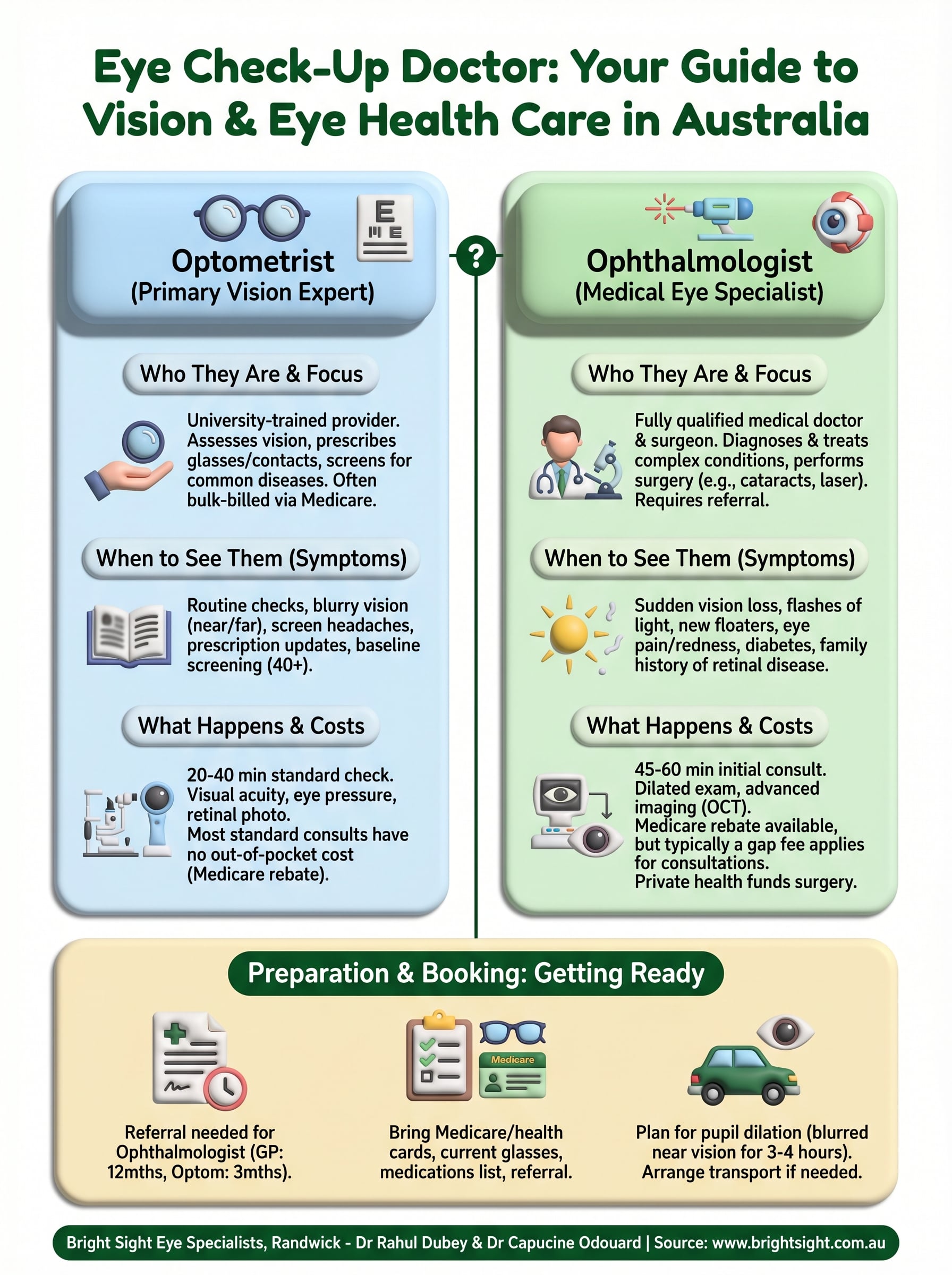
An optometrist is a university-trained primary eye care provider who can assess your vision, prescribe glasses or contact lenses, screen for common eye diseases, and co-manage certain conditions alongside a specialist. In Australia, optometrists complete a five-year university degree and register with the Optometry Board of Australia. You do not need a GP referral to see one, and standard consultations attract a Medicare rebate under item 10918, making them accessible for most people.
Your optometrist is usually the right starting point for routine checks, updating a prescription, or picking up early warning signs of conditions like glaucoma or macular degeneration. They use instruments including a slit lamp, retinal camera, and tonometer to examine your eye structures and measure intraocular pressure. If they find something that needs medical or surgical attention, they will refer you to an ophthalmologist.
An optometrist can identify many eye conditions, but only an ophthalmologist holds the medical and surgical qualifications to treat them.
Ophthalmologists: medical specialists in eye health
An ophthalmologist is a fully qualified medical doctor who has completed six to nine years of specialist training in eye disease, medicine, and surgery after their medical degree, including a fellowship with the Royal Australian and New Zealand College of Ophthalmologists (RANZCO). This depth of training means they can manage conditions that sit well beyond the scope of a routine vision test. You generally need a referral from your GP or optometrist to access Medicare rebates when seeing an ophthalmologist.
Ophthalmologists diagnose and treat complex conditions including cataracts, retinal detachment, macular degeneration, diabetic eye disease, corneal disease, and glaucoma. They also perform procedures such as cataract surgery, retinal repair, and laser vision correction. When you search for an eye check up doctor and your symptoms include sudden vision loss, flashes, new floaters, or you have a history of diabetes or a family history of retinal disease, an ophthalmologist is the right clinician to see. The earlier you reach the right specialist, the better the outcome tends to be.
At Bright Sight Eye Specialists in Randwick, Dr Rahul Dubey and Dr Capucine Odouard are both RANZCO-trained ophthalmologists. They see patients across the Eastern Suburbs of Sydney for everything from comprehensive specialist assessments to advanced surgical procedures, covering the full range of medical and surgical eye care under one practice.
Choose the right clinician for your symptoms
The most common mistake people make when searching for an eye check up doctor is booking the wrong type of appointment for their situation. Seeing an optometrist when you need an ophthalmologist can delay treatment for conditions that progress quickly, while going straight to a specialist for a simple prescription update adds unnecessary cost. Matching your symptoms to the right clinician from the start gets you better care, faster.
When to see an optometrist
Start with an optometrist if your concerns are routine or vision-related. This includes blurry vision at distance or close range, headaches from screen use, updating glasses or contact lens prescriptions, and general annual check-ups with no specific symptoms. Optometrists are also a smart first stop if you want a baseline screen for glaucoma or early macular changes, particularly once you are over 40 or have a family history of these conditions. They can usually see you within days and without a referral.
If your optometrist finds anything outside their scope of treatment, they will write you a formal referral to an ophthalmologist, which you need to access the Medicare specialist rebate.
When to see an ophthalmologist
Book directly with an ophthalmologist if you have any of the following symptoms: sudden or rapidly worsening vision loss, a new shower of floaters, flashes of light, a shadow or curtain across your vision, eye pain with redness, or a known diagnosis of diabetes, macular degeneration, or glaucoma requiring ongoing management. These symptoms can signal conditions such as retinal detachment or vitreous haemorrhage, where hours matter. You will need a referral from your GP or optometrist to claim a Medicare rebate, so contact your GP promptly if symptoms appear suddenly and you do not yet have a referral in hand.
Know what happens at an eye check-up
Walking into an eye appointment without knowing what to expect can feel unsettling. Whether you are seeing an optometrist or an ophthalmologist, understanding the process helps you prepare properly and get more out of the consultation. Both types of appointments follow a logical sequence, but the depth and focus differ depending on the clinician you see.
What your optometrist checks
A standard optometry appointment runs for 20 to 40 minutes and covers several areas. Your optometrist will begin with a case history, asking about your current vision complaints, medical conditions, medications, and family eye history. From there, they will measure your visual acuity using a letter chart, check how your eyes move and work together, and assess your current prescription if you wear glasses or contact lenses. They will also use a tonometer to measure intraocular pressure, which screens for glaucoma, and examine the front and back of your eye using a slit lamp. Many practices also take retinal photos to document your eye health over time.
If your optometrist dilates your pupils to get a clearer view of your retina, arrange for someone else to drive you home, as your close vision will be blurred for several hours afterwards.
What your ophthalmologist assesses
An eye check up doctor at the ophthalmologist level goes deeper. Your first specialist consultation typically lasts 45 to 60 minutes and includes a full review of your referral notes and history, detailed visual acuity testing, and a dilated fundus examination using specialised lenses to inspect your retina, optic nerve, and macula. Depending on your condition, additional diagnostic imaging such as optical coherence tomography (OCT) or fundus fluorescein angiography may be performed on the day. These tests give your ophthalmologist the precise information needed to confirm a diagnosis and recommend the most effective treatment pathway for your situation.
Understand costs, Medicare and private cover
One of the most common questions people ask when searching for an eye check up doctor is how much it will cost. The answer depends on whether you see an optometrist or an ophthalmologist, and whether you hold private health insurance or rely solely on Medicare.
Optometrist fees
Most optometrists bulk bill standard consultations under Medicare item 10918, meaning you pay nothing out of pocket for a routine eye test. Some practices charge a gap fee on top of the Medicare rebate, particularly for extended consultations or additional tests such as retinal photography. Checking with your optometrist before your appointment will tell you exactly what you will pay on the day.
Ophthalmologist consultation costs
Seeing an ophthalmologist involves a Medicare specialist rebate, but most practices charge fees above this rebate, leaving an out-of-pocket amount. For an initial specialist consultation, the Medicare rebate sits around $155, though total fees can run higher depending on the practice and the complexity of your assessment. Diagnostic testing such as OCT imaging is typically billed separately and carries its own Medicare item number, which reduces the gap.
Ask your ophthalmologist’s rooms for a fee estimate before your appointment so you are not caught off guard on the day.
Private health insurance does not cover outpatient consultations, but it plays a significant role in funding surgical procedures such as cataract surgery, retinal repair, and corneal surgery. Patients with appropriate hospital cover at practices like Bright Sight Eye Specialists in Randwick can access no-gap or known-gap surgical options, meaning you know your out-of-pocket costs before you agree to any procedure. If you are unsure what your policy covers, call your insurer directly and quote the specific procedure name.
Book and prepare for your appointment
Booking the right appointment is straightforward once you know which eye check up doctor you need. For an optometrist, call or book online directly with a practice near you. For an ophthalmologist, you need a valid referral from your GP or optometrist to claim the Medicare specialist rebate, so contact your referring doctor first and ask them to fax or email the referral ahead of your appointment. Most specialist rooms will then contact you to confirm a time.
Getting your referral sorted
A GP referral to an ophthalmologist lasts 12 months, while an optometrist referral typically lasts 3 months. If you suspect your referral has expired before your appointment, ask your GP to issue a new one. Practices like Bright Sight Eye Specialists in Randwick can also advise you on referral requirements when you call to book.
Always confirm your referral is current before your appointment to avoid delays in claiming your Medicare rebate on the day.
What to bring on the day
Arriving prepared helps your consultation run smoothly. Bring the following:
- Your Medicare card and private health insurance card
- Any current glasses or contact lenses you wear
- A list of your current medications, including eye drops
- Your referral letter, if you have a printed copy
- Details of any previous eye conditions, surgery, or family history of eye disease
How to prepare your eyes
Avoid wearing contact lenses for at least 24 hours before a specialist appointment if you wear soft lenses, as lenses alter the shape of the cornea and can affect measurements. Your ophthalmologist may dilate your pupils during the assessment, so plan for blurred near vision for 3 to 4 hours afterwards and arrange a lift home if you can. Do not drive after dilation.
Your next step for clearer vision
You now have a clear picture of who to see, when to book, and what it costs when searching for an eye check up doctor in Australia. Whether you need a routine prescription update with an optometrist or a specialist assessment with an ophthalmologist, acting early almost always leads to better outcomes than waiting until symptoms worsen.
If you are in Sydney’s Eastern Suburbs and your symptoms point to something beyond a routine eye test, Bright Sight Eye Specialists in Randwick is the right place to start. Dr Rahul Dubey and Dr Capucine Odouard offer comprehensive specialist eye care, from detailed assessments through to advanced surgical treatment, with transparent pricing and no-gap options for eligible insured patients. Telehealth appointments are also available for regional patients.
Book a consultation with Bright Sight Eye Specialists and take the first step towards protecting your vision.