


CSR treatment refers to the medical management of central serous retinopathy, a condition where fluid leaks under your retina and causes blurred or distorted vision. The approach depends on how severe your symptoms are and how long the fluid has been there. Some cases resolve without intervention. Others need laser therapy, photodynamic treatment, or medication to seal the leak and restore your vision.
This article walks you through the full spectrum of CSR treatment options available in Australia. You’ll learn when observation is appropriate versus when active treatment becomes necessary. We’ll cover what each procedure involves, typical recovery periods, potential complications, and what you can expect to pay. Whether you’ve just been diagnosed or you’re weighing up different treatment paths, you’ll find practical information to help you make informed decisions about your eye care.
Why CSR treatment matters
Central serous retinopathy changes how you see the world around you. Blurred central vision makes it harder to read text messages, recognise faces across a room, or judge distances when you drive. Distorted images turn straight lines into wavy ones, and colours often appear washed out or dull. These symptoms disrupt your work, your hobbies, and your independence in ways that go beyond simple inconvenience.
The risk of lasting damage
Untreated CSR can lead to permanent changes in your retina. Fluid that sits beneath your macula for months damages the light-sensitive cells that give you sharp central vision. Retinal pigment epithelium (RPE) cells break down over time, creating patches of irregular pigmentation that never fully recover. Studies show that up to 50% of patients experience recurrence within a year, and each episode increases your chance of developing chronic CSR with more stubborn fluid accumulation.
Chronic CSR accounts for roughly 15% of all cases and carries a higher risk of permanent vision loss if you delay intervention.
Timely csr treatment prevents these long-term complications. When you address the fluid leak early, your retina has a better chance of returning to its normal structure. Photoreceptor cells remain healthy when they’re not bathed in subretinal fluid for extended periods. Your ophthalmologist can identify whether you need immediate intervention or whether careful monitoring will suffice. Either way, catching CSR early gives you the best odds of maintaining the vision you rely on for everyday tasks. Ignoring symptoms or hoping they’ll vanish on their own puts you at risk of irreversible macular damage that no treatment can fully repair later.
How to know if you need CSR treatment
Your ophthalmologist bases the treatment decision on how long you’ve had symptoms and whether the fluid is resolving naturally. Most acute CSR cases improve within three to four months without intervention. Your specialist tracks this progress through regular optical coherence tomography (OCT) scans that measure the exact amount of subretinal fluid beneath your macula. If your vision remains stable and the fluid level drops at each appointment, watchful waiting often proves to be the safest path.
Signs that warrant immediate attention
You need prompt csr treatment when your symptoms persist beyond three to four months without improvement. Chronic CSR develops when fluid remains under your retina for six months or longer, causing progressive damage to photoreceptor cells that may never fully recover. Your ophthalmologist will recommend intervention if your vision continues to deteriorate or if you develop new symptoms such as larger blind spots or more severe distortion.
Multiple episodes of CSR also signal the need for active treatment rather than continued observation. Each recurrence increases your risk of permanent macular changes and choroidal neovascularisation, where abnormal blood vessels grow beneath your retina. Fluorescein angiography reveals the exact location of these leaks and guides your specialist in choosing the most appropriate treatment approach.
Regular monitoring becomes critical when you have chronic CSR, as delayed intervention significantly reduces your chances of full visual recovery.
When observation is appropriate
You can safely defer treatment if you’ve had symptoms for less than three months and your vision hasn’t worsened noticeably. Many patients experience spontaneous resolution during this window, with their retina reattaching naturally as the fluid drains back into the choroid. Your ophthalmologist schedules monthly check-ups to confirm that this natural healing process is taking place.
Good baseline vision also supports a watch-and-wait strategy. If you can still read comfortably and perform most daily tasks without significant difficulty, your specialist may recommend patience while closely monitoring your condition. This conservative approach avoids potential treatment complications when your body might resolve the problem on its own.
CSR treatment options at a glance
Your csr treatment path splits into two broad categories: conservative management and active intervention. Most ophthalmologists start with observation when symptoms are recent and vision remains relatively good. They recommend active treatment when fluid persists beyond three to four months, when you experience multiple recurrences, or when your vision deteriorates rapidly. Each approach carries different timelines, risks, and costs that you’ll want to understand before you commit to any particular strategy.
Conservative management
Watchful waiting forms the foundation of early CSR care. Your ophthalmologist monitors your retina through monthly OCT scans and checks whether the fluid drains naturally. You avoid unnecessary procedures while giving your body time to heal itself. Lifestyle modifications support this process by reducing stress, eliminating corticosteroid use where possible, and addressing conditions like sleep apnoea or hypertension that may contribute to fluid leakage.
Most acute CSR resolves spontaneously within three months, making observation the safest initial strategy for patients with good baseline vision.
Active interventions
Photodynamic therapy (PDT) targets the choroidal blood vessels that leak fluid beneath your retina. Your ophthalmologist injects a light-sensitive drug into your arm, then applies a low-intensity laser to seal the leakage. Half-dose and half-fluence versions reduce side effects while maintaining effectiveness. Micropulse laser photocoagulation delivers short bursts of thermal energy that activate retinal pigment epithelium cells without creating visible scars on your retina.
Medications offer a non-surgical alternative when you have chronic CSR or when laser therapy isn’t suitable. Eplerenone and spironolactone block mineralocorticoid receptors that contribute to fluid accumulation. Your specialist may prescribe rifampicin to accelerate steroid metabolism if corticosteroid use triggered your CSR. Anti-VEGF injections come into play when choroidal neovascularisation develops alongside your CSR, though they play a limited role in standard cases without abnormal blood vessel growth.
Observation and lifestyle changes
Your ophthalmologist recommends observation when you’ve had CSR symptoms for less than three months and your subretinal fluid hasn’t significantly affected your daily activities. This conservative approach avoids the risks that come with active intervention while giving your retina time to reattach naturally. You attend monthly appointments where OCT scans track whether the fluid beneath your macula is draining on its own. Most acute cases resolve completely within this observation period, sparing you from unnecessary procedures and potential complications.
When watchful waiting works best
Observation proves most effective when you catch CSR early and your baseline vision remains above 6/12 (20/40). Your specialist confirms through fluorescein angiography that you have a single focal leak rather than widespread choroidal hyperpermeability. You avoid immediate csr treatment if your symptoms are stable or improving at each check-up. Studies show that roughly 80% of first-time CSR patients achieve complete resolution within four months without any intervention beyond lifestyle modifications.
Patience during the initial three-month period often delivers better long-term outcomes than rushing into laser therapy for acute CSR that would have resolved naturally.
Stress reduction and sleep management
Chronic stress triggers your body to release cortisol, which increases choroidal permeability and worsens fluid leakage beneath your retina. You need to identify your stress triggers and develop practical strategies to reduce them. Regular exercise, meditation, or counselling sessions help many patients lower their cortisol levels and accelerate CSR resolution. Your ophthalmologist may recommend keeping a stress diary to track patterns between your emotional state and symptom fluctuations.

Sleep apnoea contributes to CSR by causing repeated episodes of oxygen deprivation that damage choroidal blood vessels. You should arrange a polysomnography study if you snore loudly, wake frequently during the night, or feel excessively tired during the day. Continuous positive airway pressure (CPAP) therapy improves choroidal blood flow and helps many patients achieve faster fluid resorption.
Steroid elimination
Corticosteroids in any form represent the strongest known trigger for CSR. You must inform your ophthalmologist about all steroid-containing medications you use, including nasal sprays, skin creams, inhalers, and oral tablets. Your specialist works with your GP or other doctors to find alternative treatments that don’t contain corticosteroids. Even low-dose steroid use significantly delays CSR resolution and increases your recurrence risk.
Other lifestyle adjustments
You reduce your CSR risk by maintaining healthy blood pressure through regular monitoring and appropriate medication if needed. Limiting alcohol consumption and avoiding smoking improve choroidal circulation and support natural healing. Some patients benefit from treating underlying Helicobacter pylori infections, though research on this connection remains mixed. Your ophthalmologist may suggest dietary changes that reduce inflammation and support retinal health.
Laser and photodynamic therapy
Your ophthalmologist recommends laser-based csr treatment when subretinal fluid persists beyond three to four months or when you experience multiple recurrences. These procedures target the choroidal blood vessels that leak fluid beneath your retina, either by sealing them directly or by reducing their permeability. Photodynamic therapy (PDT) and micropulse laser photocoagulation represent the two most common approaches, each with distinct advantages depending on your leak pattern and symptom duration. Focal argon laser remains an option when you have a single, well-defined leak located away from your central vision.
Photodynamic therapy explained
PDT combines a light-sensitive drug called verteporfin with a cold laser to seal leaking choroidal vessels. Your specialist injects the drug into a vein in your arm, then waits approximately 15 minutes for it to accumulate in the abnormal blood vessels beneath your retina. A low-intensity laser activates the verteporfin, causing temporary vessel closure that reduces fluid leakage without destroying surrounding tissue. The entire procedure takes roughly 30 minutes in your ophthalmologist’s office.

Half-dose PDT delivers better results with fewer complications than the original full-dose protocol. Your specialist uses either half the standard drug amount or half the laser fluence to achieve therapeutic benefit while minimising risks like retinal pigment epithelium atrophy and choroidal ischemia. Studies confirm that half-dose PDT resolves subretinal fluid in approximately 75% of chronic CSR cases within three months. You attend follow-up appointments every four to six weeks so your ophthalmologist can track your response and determine whether you need a second treatment session.
Half-dose photodynamic therapy offers the strongest evidence base for treating chronic CSR that hasn’t responded to observation alone.
Micropulse laser photocoagulation
Micropulse laser delivers rapid bursts of thermal energy separated by cooling periods that prevent permanent retinal damage. Your ophthalmologist applies these pulses across the area of choroidal hyperpermeability identified on indocyanine green angiography. The treatment activates your retinal pigment epithelium cells without creating visible laser scars, making it safe to apply directly over your central vision when necessary. Each session lasts 10 to 20 minutes and causes minimal discomfort.
This approach works particularly well when you have diffuse choroidal leakage rather than a single focal point. Your specialist uses either a 577-nanometre yellow laser or an 810-nanometre infrared laser, both of which target the RPE layer without burning through to your photoreceptors. Recovery happens gradually over two to three months as your retina reattaches. Some patients require a second micropulse treatment if fluid persists at their three-month follow-up scan.
Focal laser for specific cases
Focal argon laser photocoagulation suits you when fluorescein angiography reveals a discrete leak located at least 500 micrometres from your foveal centre. Your ophthalmologist applies small laser burns directly to the leaking spot, creating a controlled scar that seals the defect. The procedure shortens your symptom duration by roughly two months compared to observation alone. You must have clear media and good pupil dilation for your specialist to target the leak accurately.
This treatment carries a higher risk of permanent scotomas where the laser burns destroy retinal tissue. Your ophthalmologist avoids focal laser if the leak sits close to your central vision or if you have widespread choroidal changes typical of chronic CSR. Modern specialists increasingly favour PDT or micropulse laser over focal argon photocoagulation due to their superior safety profiles and broader applicability across different CSR patterns.
Medications and injections for CSR
Your ophthalmologist prescribes medications when you have chronic CSR with persistent fluid or when laser therapy isn’t suitable for your particular case. These treatments work by blocking the hormonal pathways that increase choroidal permeability or by targeting abnormal blood vessels that develop alongside your CSR. Oral medications represent the most common pharmaceutical approach, though intravitreal injections play a role when specific complications arise. Your specialist selects the appropriate medication based on your leak pattern, symptom duration, and any underlying conditions that contribute to your CSR.
Mineralocorticoid antagonists
Eplerenone blocks mineralocorticoid receptors that make your choroidal blood vessels more permeable when activated by stress hormones. Your ophthalmologist typically prescribes 50 milligrams daily for chronic CSR that hasn’t responded to observation or lifestyle changes. Studies show modest improvements in visual acuity and subretinal fluid height after three to six months of treatment. You need regular blood tests to monitor your potassium levels, as this medication can cause dangerous hyperkalemia if your kidneys don’t function properly.
Spironolactone offers an alternative mineralocorticoid antagonist when you can’t tolerate eplerenone or when cost becomes a barrier. Your specialist prescribes doses between 25 and 50 milligrams daily, adjusting based on your response and side effect profile. This medication reduces subfoveal choroidal thickness alongside decreasing subretinal fluid accumulation. You avoid this csr treatment option if you have chronic kidney disease or heart failure, as these conditions increase your risk of serious complications from elevated potassium levels.
Mineralocorticoid antagonists work best for patients with chronic CSR who have elevated cortisol levels or who can’t eliminate steroid use from their medical regimen.
Anti-VEGF injections
Intravitreal anti-VEGF injections target abnormal blood vessels that sometimes grow beneath your retina when you develop choroidal neovascularisation (CNV) alongside chronic CSR. Your ophthalmologist injects medications like bevacizumab or ranibizumab directly into your eye during an office procedure that takes roughly five minutes. These injections don’t treat standard CSR without CNV, as studies confirm that VEGF levels remain normal in uncomplicated cases. You need OCT angiography or fluorescein angiography to confirm CNV before your specialist recommends this approach.
Recent research shows that faricimab, which blocks both VEGF and angiopoietin-2 pathways, reduces macular thickness and subretinal fluid in chronic CSR patients. Your ophthalmologist may suggest this newer injection when you have longstanding fluid that hasn’t responded to other treatments. You receive injections every four to eight weeks initially, with the interval extending based on your response. This option remains relatively new, so long-term data on its effectiveness continues to accumulate.
Other oral medications
Rifampicin accelerates steroid metabolism by inducing liver enzymes that break down cortisol more quickly. Your specialist prescribes 300 milligrams twice daily for one to two weeks when you have CSR triggered by high endogenous cortisol levels. This antibiotic can cause orange-coloured body fluids and carries a risk of liver toxicity, so you need baseline liver function tests before starting treatment. Studies show complete fluid resolution within one month in selected patients.
Treatment for Helicobacter pylori infection remains controversial, with conflicting evidence about whether eliminating this bacterium speeds CSR resolution. Your ophthalmologist may suggest testing and treatment if you have stomach symptoms alongside your eye condition. Low-dose aspirin and melatonin represent additional options some specialists prescribe, though robust clinical trial data supporting their use remains limited.
Recovery time, risks and long term outlook
Your recovery timeline depends on which csr treatment approach your ophthalmologist selects and how your individual retina responds. Acute CSR managed with observation typically resolves within three to four months, while chronic cases treated with photodynamic therapy may take six to twelve weeks before you notice significant improvement. Each intervention carries distinct risks ranging from temporary discomfort to permanent vision changes. Your long-term outlook remains generally favourable when you receive timely treatment, though recurrence rates stay substantial across all management strategies.
Recovery timelines by treatment type
Observation alone requires the longest wait, with most patients seeing complete fluid resolution between two and four months from symptom onset. You attend monthly appointments during this period so your ophthalmologist can confirm that natural drainage is progressing. Your vision improves gradually as the subretinal fluid recedes and your photoreceptor cells recover from their temporary displacement.
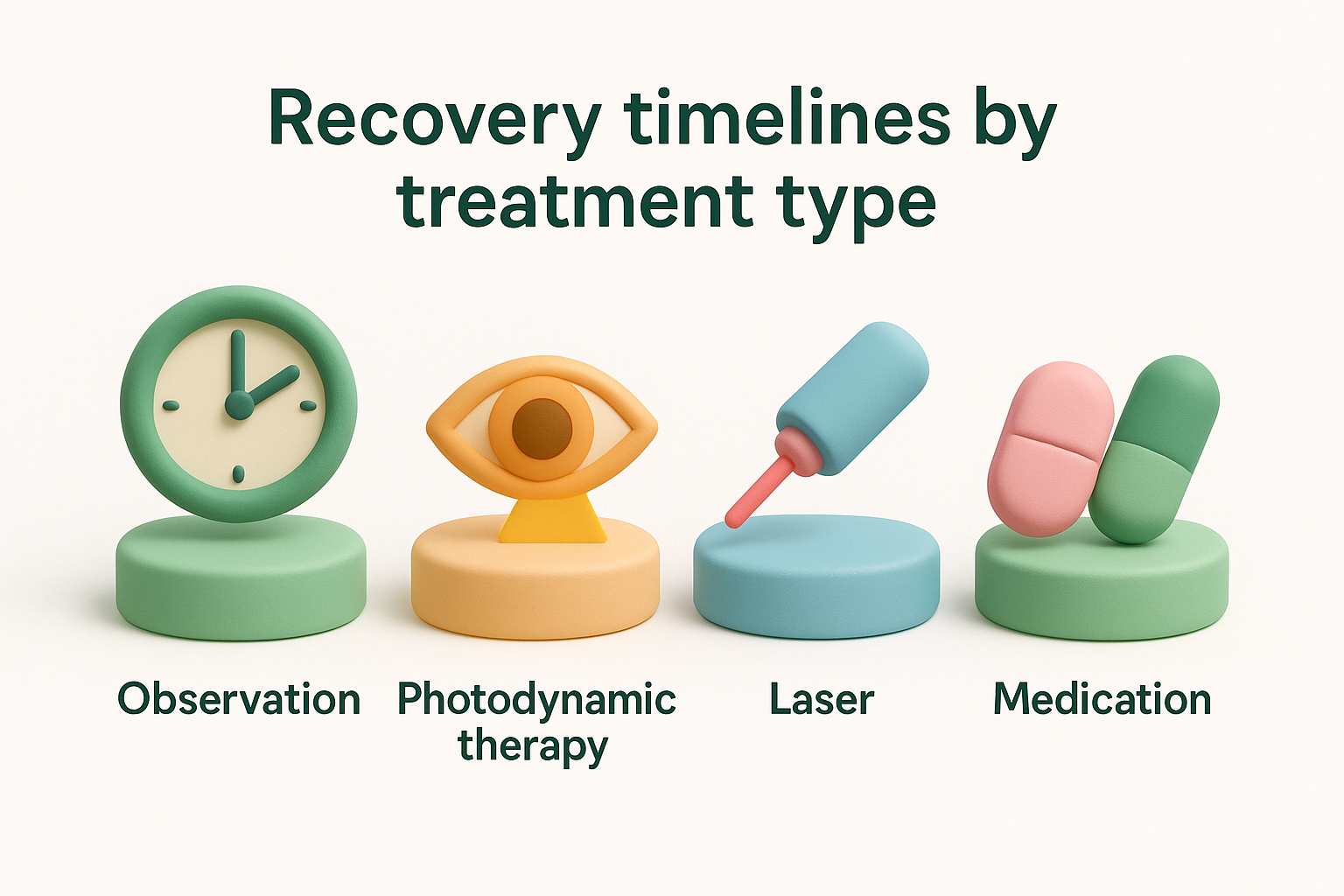
Photodynamic therapy delivers faster results in chronic CSR cases. You notice initial improvement within four to six weeks after treatment, with peak visual recovery occurring around three months post-procedure. Your specialist schedules follow-up OCT scans at six-week intervals to track fluid resorption. Roughly 25% of patients need a second PDT session if fluid persists beyond three months.
Micropulse laser photocoagulation produces more gradual changes, with your retina reattaching over eight to twelve weeks following treatment. You may not perceive significant visual improvement until six to eight weeks after your laser session. Your ophthalmologist evaluates your response at three months to determine whether additional treatment becomes necessary.
Oral medications like eplerenone require continuous use for three to six months before delivering measurable benefit. Your vision stabilises slowly as the medication reduces choroidal permeability and allows existing fluid to drain. You need regular blood tests throughout treatment to monitor for electrolyte imbalances.
Common complications and risks
Photodynamic therapy carries risks including RPE atrophy, choroidal ischemia, and secondary choroidal neovascularisation in approximately 5% of treated eyes. You may experience temporary worsening of vision immediately after PDT as inflammation peaks before subsiding. Half-dose protocols significantly reduce these complications compared to historical full-dose treatments.
Focal laser photocoagulation creates permanent scotomas at the treatment site in nearly all cases. Your ophthalmologist only uses this approach when the leak sits far enough from your central vision that these blind spots won’t affect your reading or driving ability. You face a small risk of inadvertent foveal burns if you move during the procedure.
Micropulse laser proves safer than conventional photocoagulation, though some patients develop transient visual field defects that resolve within weeks. This treatment rarely causes permanent damage when applied correctly. You may notice increased glare or light sensitivity during the first month of recovery.
Mineralocorticoid antagonists like eplerenone cause hyperkalemia in up to 10% of patients, particularly those with underlying kidney disease. Your potassium levels can climb dangerously high within weeks of starting treatment. You experience fatigue, muscle weakness, or irregular heartbeats if this complication develops.
Regular monitoring during the first three months after any active CSR intervention gives your ophthalmologist the best chance of catching complications before they cause lasting harm.
Long-term visual outcomes
Most patients regain reading vision of 6/12 (20/40) or better after successful treatment, though subtle visual disturbances often persist. You may notice mild metamorphopsia, reduced contrast sensitivity, or colour desaturation even when OCT scans show complete fluid resolution. These symptoms reflect permanent photoreceptor damage from prolonged fluid exposure rather than ongoing disease activity.
Recurrence affects 30 to 50% of patients within five years of their initial episode. Your risk increases if you continue steroid use, fail to manage stress effectively, or have underlying sleep apnoea. Each recurrence carries a higher likelihood of developing chronic CSR with more resistant fluid accumulation. Maintaining close contact with your ophthalmologist allows early detection and prompt intervention when fluid reappears beneath your macula.
CSR treatment costs in Australia
Your csr treatment expenses vary dramatically depending on whether you use public or private healthcare and which intervention your ophthalmologist recommends. Observation costs nothing beyond standard consultation fees, while photodynamic therapy or laser procedures can reach several thousand dollars when you pay privately. Understanding the breakdown of these costs helps you plan financially and explore all available options for managing your condition without creating undue stress about medical bills.
Public vs private treatment options
Public hospital ophthalmology departments provide CSR diagnosis and treatment at no direct cost to you through Medicare. You join a waiting list after your GP refers you to a specialist clinic, with typical wait times ranging from six weeks to six months depending on your symptom severity and hospital capacity. Acute cases that threaten your vision receive priority appointments, while chronic CSR with stable vision typically faces longer delays. Public treatment includes all necessary consultations, imaging studies, and interventions without requiring private health insurance.
Private ophthalmology services let you choose your specialist and schedule appointments within days or weeks rather than months. You pay consultation fees ranging from $150 to $300 per visit, though Medicare rebates cover a portion of these costs. Private treatment gives you access to the latest technologies and treatment protocols that may not be universally available in public hospitals.
Private health insurance coverage
Your private health insurance covers photodynamic therapy and laser procedures when you hold an appropriate level of hospital cover. Most insurers require either Gold or Silver Plus policies that include ophthalmology benefits. You face no gap or known gap charges at many private practices, meaning your out-of-pocket costs for the procedure itself stay minimal or predictable. Your insurance pays for the hospital or day surgery facility fees, anaesthetist charges, and ophthalmologist’s procedural fee.
Private health insurance significantly reduces your upfront costs for active CSR interventions, though you must hold your policy for the required waiting period before claiming benefits.
Pre-admission costs like OCT scans, fluorescein angiography, and specialist consultations happen outside your hospital admission and attract separate fees. You claim Medicare rebates on these diagnostic tests, though you typically pay a gap of $100 to $200 per imaging study. Your insurance won’t cover these preliminary investigations unless your policy includes optical benefits.
Out-of-pocket expenses
Photodynamic therapy costs approximately $3,000 to $5,000 as a private patient without insurance, including the verteporfin drug, laser treatment, and facility fees. Medicare rebates return roughly $800 to $1,200 of this amount, leaving significant out-of-pocket expenses. Your specialist may offer payment plans for these procedures.
Micropulse laser photocoagulation typically costs $1,500 to $2,500 privately, with similar Medicare rebate structures. Oral medications like eplerenone cost $50 to $80 per month through the Pharmaceutical Benefits Scheme, making them an affordable option when you have chronic CSR requiring extended treatment. Anti-VEGF injections reach $1,800 to $2,200 per injection privately, though Medicare covers most of this cost when your ophthalmologist documents appropriate clinical indications.

Looking after your vision
Your best defence against CSR complications involves regular monitoring and prompt action when symptoms appear or worsen. You need an ophthalmologist who understands the nuances of csr treatment and can tailor an approach to your specific leak pattern and symptom duration. Early intervention prevents the permanent photoreceptor damage that occurs when you delay seeking help or hope the problem will vanish on its own.
Maintaining your follow-up appointments becomes critical once you’ve had CSR, as recurrence rates remain high even after successful treatment. Your specialist tracks subtle changes on OCT scans that might escape your notice until vision deteriorates significantly. Addressing stress, eliminating unnecessary steroids, and treating underlying conditions like sleep apnoea all reduce your risk of future episodes.
Contact Bright Sight Eye Specialists in Randwick if you notice blurred vision, distortion, or central blind spots that don’t improve within days. Dr Dubey and his team provide comprehensive retinal care with transparent pricing and modern treatment options.