


Central serous retinopathy (CSR) occurs when fluid builds up beneath the retina, causing a blister-like detachment that distorts your central vision. If you’ve noticed blurry vision, dimming, or straight lines appearing warped, understanding the cause of central serous retinopathy is the first step toward getting the right treatment. This condition most commonly affects adults between 20 and 50, and while it often resolves on its own, recurring episodes can lead to lasting vision changes if left unmanaged.
The biological mechanism behind CSR involves a breakdown in the retinal pigment epithelium, the barrier that normally keeps fluid away from the retina. But what triggers that breakdown? Research points to a combination of factors, from chronic stress and corticosteroid use to personality type and hormonal influences. Some of these triggers are modifiable, which means early awareness can make a real difference in reducing your risk of recurrence.
At Bright Sight Eye Specialists, Dr Rahul Dubey treats central serous retinopathy at our Randwick practice, using advanced retinal imaging to accurately diagnose and monitor the condition. This article breaks down the known causes, biological mechanisms, and key risk factors behind CSR, so you can have a more informed conversation with your eye specialist about what’s happening and what to do next.
Why the cause of CSR matters for your vision
Most cases of CSR clear up within three to four months without intervention, which leads many people to assume the condition is harmless. That assumption can be costly. If the underlying cause of central serous retinopathy remains unaddressed, the fluid returns, and repeated episodes gradually damage the photoreceptors in your macula, the part of your retina responsible for sharp, detailed central vision.
Identifying what triggered your CSR in the first place gives you and your specialist the best chance of preventing long-term vision loss.
How recurrence changes the outcome
A single episode of CSR rarely causes permanent damage. Chronic CSR, defined as fluid persisting beyond four months, is a different situation entirely. Prolonged fluid beneath the retina stretches and degrades the retinal pigment epithelium, reducing your ability to read fine print, recognise faces, and see clearly in low light. The longer the fluid remains, the harder it becomes to recover full visual acuity, even after treatment.
Recurrent CSR follows a similar pattern. Each episode adds cumulative stress to the retinal layers, and over time, the damage becomes less reversible. Knowing the specific trigger, whether it is steroid medication, ongoing psychological stress, or a hormonal factor, lets your specialist tailor treatment and significantly reduce the likelihood of the fluid returning.
Why early diagnosis makes a real difference
Catching CSR early means your specialist can use optical coherence tomography (OCT) and fundus fluorescein angiography to map exactly where the fluid sits and how much retinal tissue is affected. This baseline data shapes every decision that follows, from watchful waiting through to laser treatment or photodynamic therapy.
Acting promptly also protects your treatment options. Certain interventions work best before the retina has experienced prolonged stress. If you wait until your vision has already deteriorated significantly, the window for the most effective treatments narrows considerably, and some structural retinal changes may become permanent.
How CSR happens in the eye
To understand the cause of central serous retinopathy, you need a basic picture of your eye’s layered structure. The retina rests on a sheet of cells called the retinal pigment epithelium (RPE), which sits between the retina and the choroid, the densely vascularised tissue that supplies much of the retina’s blood. Under normal conditions, the RPE acts as a tight barrier, controlling exactly what fluid and nutrients cross into the retinal space.
When the RPE barrier fails
The choroid can become hyperpermeable under certain biological stressors, meaning it leaks fluid at an abnormally high rate. That increased pressure pushes against the RPE, and if cells in the RPE weaken or develop a small defect, fluid seeps through and pools in the space beneath the retina. The result is a localised, blister-like separation of the retina that distorts your central vision, making objects appear smaller, darker, or warped.
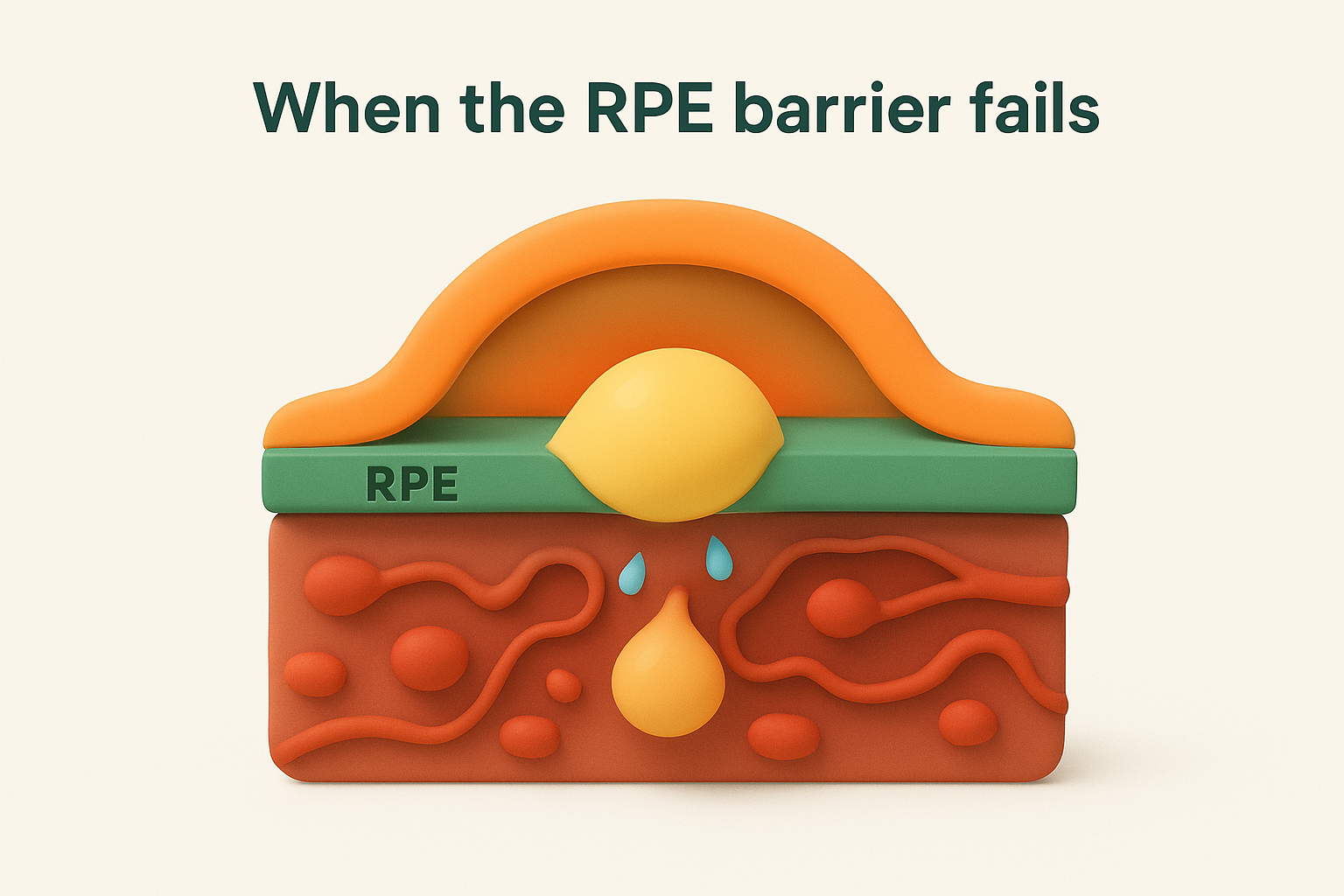
This isn’t a random failure. Specific stressors compromise RPE integrity in predictable ways, which is why understanding your personal triggers matters.
What keeps the fluid there is equally important. As long as the choroidal pressure stays elevated or the RPE cannot repair the breach, the pocket of fluid persists. Cortisol, adrenaline, and certain medications all interfere directly with choroidal blood flow and RPE cell function, which is why the same triggers tend to cause fluid to return to the same area of your retina with each episode.
Common CSR triggers you can change
Several factors linked to the cause of central serous retinopathy fall within your control, and that is genuinely useful information. Reducing or eliminating certain triggers can lower your risk of a first episode and, critically, reduce the likelihood of recurrence if you have already experienced CSR.
Corticosteroid use
Corticosteroids are among the most consistently identified triggers for CSR. These medications elevate cortisol-like compounds in your bloodstream, which directly increase choroidal permeability and weaken RPE cell function. If you are using any form of corticosteroid, discuss the risk with both your prescribing doctor and your eye specialist before making any changes to your medication.
Never stop prescribed corticosteroids without medical guidance, as abrupt withdrawal carries its own serious health risks.
Common corticosteroid forms linked to CSR include:
- Oral prednisone or prednisolone
- Steroid nasal sprays and inhalers
- Topical skin creams applied over large areas
- Epidural or joint injections
Psychological stress and sleep disruption
Chronic stress raises circulating cortisol levels, producing the same choroidal changes as steroid medications, just more gradually. Research consistently links high-stress occupations and poor sleep quality to CSR onset. Improving sleep hygiene, managing workload, and addressing chronic stress through evidence-based approaches all reduce your biological exposure to cortisol, directly targeting one of the most modifiable causes of the condition.
Risk factors and health conditions linked to CSR
Beyond the triggers you can modify, certain biological and medical characteristics raise your baseline risk of developing CSR. Understanding where you sit on this risk profile helps your specialist monitor your eye health more proactively and respond quickly if early signs appear.
Who is most likely to develop CSR
Men between 30 and 50 are significantly more affected than women, with research suggesting a ratio of roughly four to one. The reason isn’t fully understood, but hormonal differences in how cortisol regulates choroidal blood flow appear to play a role. Type A personality traits such as competitiveness, sustained time pressure, and difficulty switching off are also consistently linked to higher CSR rates, likely because they keep cortisol elevated over long periods.
Health conditions that increase your risk
Several systemic conditions connect directly to the cause of central serous retinopathy, particularly those that affect cortisol regulation or vascular function. If you already manage one of these conditions, discussing CSR monitoring with your eye specialist at your next appointment is a sensible step:
- Cushing’s syndrome and other hypercortisolaemia conditions
- Hypertension and cardiovascular disease
- Obstructive sleep apnoea
- Autoimmune conditions requiring long-term steroid treatment
- Helicobacter pylori infection
If you have any of these conditions and notice changes to your central vision, book an eye check promptly rather than waiting to see if it settles.
Symptoms, warning signs, and when to get checked
Recognising CSR early gives you the best chance of protecting your central vision before fluid causes lasting damage. The most common symptoms connect directly to the underlying cause of central serous retinopathy: fluid beneath the retina physically distorts the photoreceptors responsible for your sharpest, most detailed vision.
What CSR looks and feels like
The symptoms of CSR are specific enough that most people notice something is wrong within days of onset. Blurred or dimmed vision in the centre of your visual field is the most common first sign, often affecting one eye while the other remains completely normal. You may also notice that straight lines appear bent or wavy, a symptom called metamorphopsia, or that objects look smaller than they actually are. Some people describe a faint grey or dark spot in the middle of their vision, particularly noticeable when reading or looking at detailed patterns.
If you notice any sudden change to your central vision, treat it as urgent and book an eye assessment promptly rather than waiting to see if it settles.
When to seek an eye assessment
See an eye specialist if any of the symptoms above appear, even briefly. Waiting several weeks to see whether your vision self-corrects delays the imaging your specialist needs to assess retinal health accurately. Early OCT imaging gives your specialist a clear baseline to work from, and also rules out other serious retinal conditions that can present in a similar way, including macular degeneration.

Next steps
Understanding the cause of central serous retinopathy gives you a real advantage. You now know that corticosteroid use, chronic stress, sleep disruption, and certain systemic conditions all play a measurable role in triggering and sustaining the condition. You also know that acting quickly on symptoms protects your treatment options and limits the risk of permanent central vision changes.
If you have noticed any blurring, dimming, or distortion in your central vision, do not wait for it to resolve on its own. Prompt imaging is the only way to accurately assess whether fluid is present beneath your retina and how much retinal tissue is involved. The earlier your specialist can map the damage, the more effectively they can guide your care.
At Bright Sight Eye Specialists in Randwick, Dr Rahul Dubey provides specialist retinal assessment and treatment for CSR. Book an appointment with our team to get a clear picture of your retinal health.