


You’ve probably been thinking about it for a while, waking up and actually seeing the alarm clock, exercising without foggy lenses, or travelling without packing a glasses case. But before you get too far ahead of yourself, there’s one question you need answered first: am I suitable for laser eye surgery? The truth is, not everyone qualifies. Your eligibility depends on several factors, from the stability of your prescription to the thickness of your corneas.
At Bright Sight Eye Specialists in Randwick, Dr Capucine Odouard performs refractive laser procedures including LASIK, PRK, and SMILE. She assesses each patient individually, because a procedure that works brilliantly for one person may not be the right fit for another. That assessment is where good outcomes start, well before you ever enter an operating theatre.
This article walks you through the key eligibility criteria, the conditions that might rule you out, and what to expect during a suitability assessment. By the end, you’ll have a clear picture of where you stand and know exactly what your next step should be.
What laser eye surgery can and cannot correct
Laser eye surgery works by reshaping the cornea, the clear curved layer at the front of your eye, to change how light focuses on your retina. When this reshaping is done precisely, your eye can focus without any help from glasses or contact lenses. Understanding what the procedure targets and where it stops is one of the first practical steps in working out whether you’re a good candidate.
Conditions laser eye surgery treats
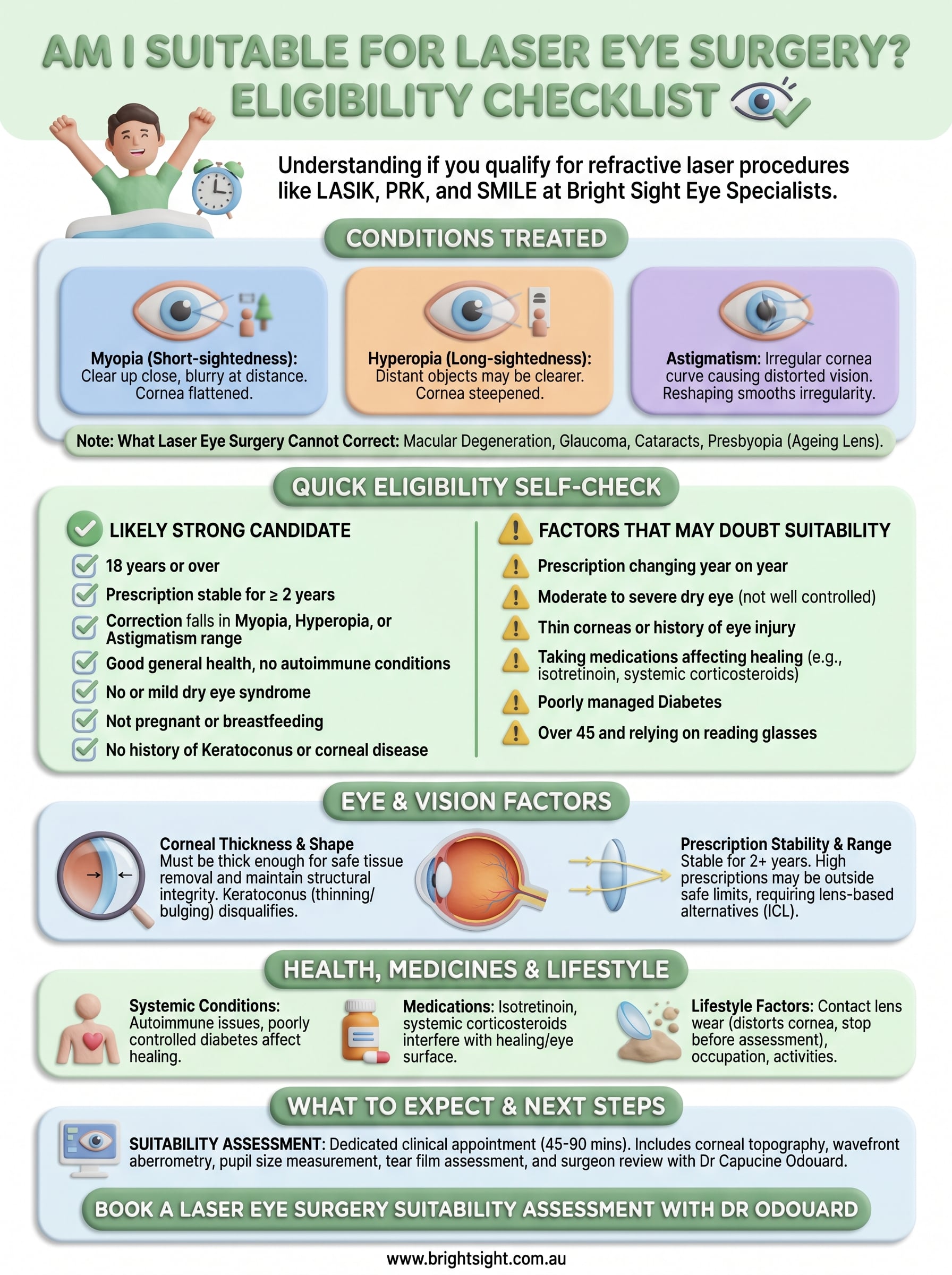
The three procedures available at Bright Sight, LASIK, PRK, and SMILE, all correct refractive errors: focusing problems caused by the shape of your eye rather than by disease. Each procedure adjusts the corneal curvature to redirect light accurately onto the retina. The main conditions treated are:
- Myopia (short-sightedness): You see clearly up close but struggle at a distance. Surgery flattens the cornea to reduce excessive focusing power.
- Hyperopia (long-sightedness): Distant objects may be clearer than near ones. Surgery steepens the cornea to increase its focusing ability.
- Astigmatism: Your cornea has an irregular curve, causing blurred or distorted vision at all distances. Laser reshaping smooths this irregularity.
Most people with mild to moderate prescriptions across these categories are strong candidates for treatment. Your surgeon will confirm whether your specific prescription falls within the safely treatable range during your suitability assessment.
If you have both myopia and astigmatism, laser surgery can typically correct both conditions at the same time in a single treatment session.
What laser eye surgery cannot correct
This is where many patients are genuinely surprised. The laser reshapes your cornea, but it does not treat the underlying cause of every vision problem. Conditions affecting the retina, optic nerve, or lens are entirely outside the scope of what a refractive laser procedure addresses. If you have macular degeneration, glaucoma, or a developing cataract, laser eye surgery will not improve your vision and is not the appropriate treatment path.
Presbyopia, the gradual loss of near-focusing ability that most people notice in their 40s, is another important limitation. Standard laser procedures do not restore the near vision lost through natural ageing of the lens. Some surgeons offer monovision LASIK, which corrects one eye for distance and one for near, but this involves a deliberate trade-off and suits only certain patients. For those in their mid-40s and beyond, refractive lens exchange, where the natural lens is replaced with a premium implant, is often the better solution because it addresses the actual source of the problem.
Why your prescription range matters
Not every refractive error falls within the safe treatable limits of laser surgery. Very high prescriptions require removing more corneal tissue to achieve the correction, and this can leave the cornea too thin for the outcome to be stable and safe. If your prescription sits outside the standard range, your surgeon may recommend an alternative such as an implantable collamer lens (ICL) instead, which sits inside the eye rather than altering corneal tissue.
Asking yourself "am I suitable for laser eye surgery" really starts with knowing your current prescription and bringing that information to your consultation. A high prescription does not automatically mean no, but it does mean the options on the table may look different from what you initially expected.
Quick eligibility checklist you can self-check today
Before you book a formal suitability assessment, there are several factors you can review yourself to get a rough sense of where you stand. This checklist is not a substitute for a clinical evaluation, but it gives you a practical starting point when you’re asking "am I suitable for laser eye surgery?" Running through these points takes only a few minutes and helps you walk into your consultation better informed and with the right questions ready.
Signs you’re likely a strong candidate
Most people who end up being approved for laser eye surgery share a common set of characteristics. If these apply to you, your chances of proceeding are generally good:
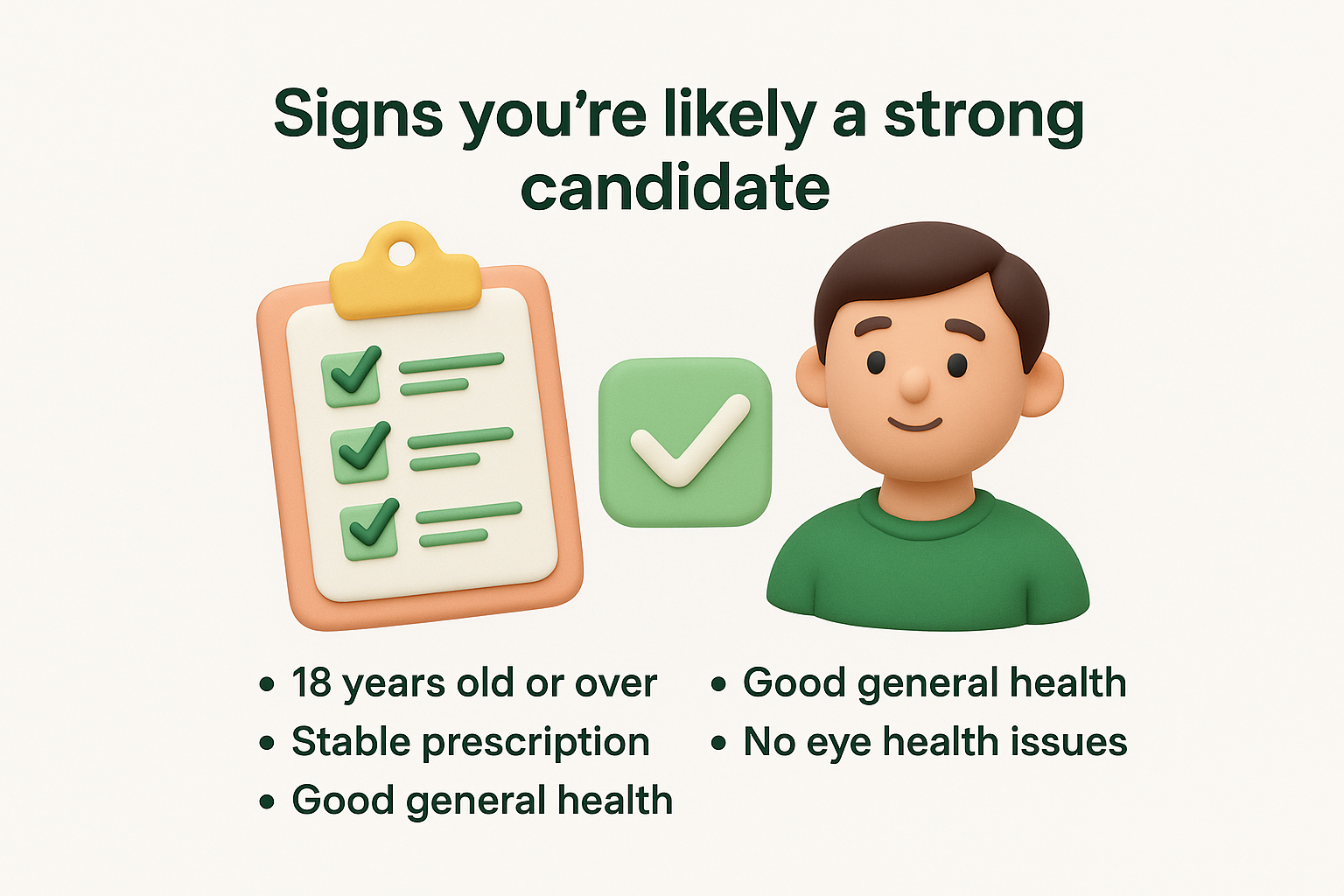
- You are 18 years old or over
- Your prescription has been stable for at least two years
- Your correction falls broadly in the myopia, hyperopia, or astigmatism range
- You are in good general health with no autoimmune conditions
- You do not have dry eye syndrome, or have only mild, manageable dryness
- You are not currently pregnant or breastfeeding
- You have no history of keratoconus or corneal disease
Prescription stability is one of the most common reasons patients are asked to wait before proceeding, so bring your last two years of optometrist records to your assessment.
Factors that may put your suitability in doubt
Certain conditions flag immediately in a clinical assessment. They do not always mean a permanent no, but they do mean your surgeon will look more carefully before making a decision. Flag these early so your assessment can account for them properly:
- Your prescription is still changing year on year
- You have moderate to severe dry eye that is not well controlled
- You have thin corneas or a history of eye injury affecting the corneal surface
- You take medications known to affect healing, such as isotretinoin or systemic corticosteroids
- You have diabetes that is poorly managed
- You are over 45 and already relying on reading glasses for all near tasks
These are starting-point indicators, not a final verdict. Your surgeon reviews each factor in context, because individual anatomy and medical history carry more weight than any single item on this list.
Eye and vision factors that decide suitability
When a surgeon evaluates whether you are suitable for laser eye surgery, your eyes themselves provide most of the critical information. The assessment goes far beyond simply reading letters off a chart. Several structural and functional measurements determine whether your eyes can safely support the procedure and sustain a stable long-term result afterwards.
Corneal thickness and shape
Your cornea needs to be thick enough to allow the laser to remove tissue while leaving sufficient depth behind to maintain structural integrity. If your corneas are naturally thin or have already been altered by previous surgery or injury, the amount of correction your surgeon can safely achieve becomes limited. A specialist uses a scan called corneal topography to map the curvature and thickness of your cornea in detail before any decision is made.
Shape matters just as much as thickness. Keratoconus, a condition where the cornea gradually thins and bulges forward, is one of the more common reasons patients cannot proceed. Even early or subclinical keratoconus, which you may not notice yourself, shows up clearly on a topography scan. Performing laser surgery on a compromised cornea accelerates the problem rather than correcting it, which is why this scan is non-negotiable in any proper suitability assessment.
If keratoconus is detected early, there are other treatment pathways worth exploring, so an honest assessment is always in your best interest even if laser surgery is not the outcome.
Prescription stability and range
Your prescription must have remained stable for at least two years before surgery. Laser eye surgery corrects your current refractive error, but if your eye is still changing, the correction you receive today will drift. Young adults in their late teens and early twenties are particularly likely to still be changing, which is why the minimum age guideline exists in the first place.
The actual power of your prescription also plays a direct role in determining which procedure suits you, or whether laser surgery is the right approach at all. Very high myopia, hyperopia beyond a certain range, or large amounts of astigmatism may place you outside the safe correction limits for LASIK, PRK, or SMILE, prompting your surgeon to discuss lens-based alternatives instead.
Health, medicines, and lifestyle factors to flag early
When you’re asking am I suitable for laser eye surgery, your overall health matters just as much as your eye measurements. A surgeon does not look at your eyes in isolation. Your body’s capacity to heal, your immune function, and the medications you currently take all influence how your cornea recovers after treatment and whether the result stays stable over time.
Systemic health conditions
Certain medical conditions increase the risk of poor healing or post-operative complications after laser eye surgery. Autoimmune conditions such as lupus, rheumatoid arthritis, or Sjögren’s syndrome can interfere with the body’s natural healing response, making outcomes less predictable. Poorly controlled diabetes is another concern, as it affects tissue repair and can contribute to corneal nerve changes that worsen dry eye symptoms after surgery.
If you manage a chronic health condition, bring a full medication and diagnosis list to your suitability assessment so your surgeon can evaluate the risk properly.
Thyroid disease, particularly when active or unstable, can also affect the eye surface in ways that complicate recovery. The key question your surgeon asks is not just whether you have a diagnosis, but whether the condition is well controlled at the time of surgery.
Medicines that affect suitability
Some medications directly interfere with corneal healing or eye surface health. Isotretinoin, used to treat acne, significantly worsens dry eye, and your surgeon will typically ask you to stop it for at least six months before proceeding. Systemic corticosteroids taken long-term can affect intraocular pressure and tissue healing.
Certain immunosuppressants and some antimalarial drugs also warrant a conversation. You do not need to stop these independently, but flagging them early gives your surgeon time to assess the risk and plan accordingly.
Lifestyle factors worth mentioning
Contact lens wear distorts the shape of your cornea, so your surgeon will ask you to stop wearing lenses for a set period before your assessment scans are taken. Hard lenses require a longer break than soft lenses. Your occupation and regular activities also matter, and it helps to mention these early:
- Contact sports or martial arts may influence which procedure is recommended
- Dusty or high-humidity work environments can affect how your recovery is managed
- Night driving requirements may shape discussions around treatment type and expected visual outcomes
Who should not have laser eye surgery
Some patients arrive at a suitability assessment hoping laser eye surgery is the answer, only to learn that a different treatment path will serve them better. This is not a failure of the assessment process. It is the assessment working exactly as it should. Knowing clearly who should not proceed with laser eye surgery protects you from a procedure that carries real risk when applied to the wrong eyes.
Permanent disqualifying factors
Certain conditions make laser eye surgery permanently unsuitable, regardless of how well everything else lines up. Keratoconus that is active or progressing sits at the top of this list. Operating on a cornea that is already weakening and changing shape adds further structural stress to tissue that cannot support it safely. A diagnosis of keratoconus does not leave you without options, but those options sit outside the scope of LASIK, PRK, or SMILE.
Very thin corneas represent another hard limit. If your corneal thickness does not leave an adequate safety margin after the tissue required for correction is removed, no reputable surgeon will proceed. Children and teenagers are also not candidates, not because of any disease, but because the eye continues changing until the mid-twenties in many people, and surgery on an eye that is still developing produces corrections that shift over time.
If you are told you are not suitable for laser eye surgery, ask specifically which alternative is most appropriate for your eye structure and prescription.
Conditions that require a different approach
When you are working out am I suitable for laser eye surgery, it helps to understand that some disqualifying factors point directly toward better alternatives. Significant cataracts cloud the lens inside your eye, and no amount of corneal reshaping addresses that. Refractive lens exchange or cataract surgery with a premium implant delivers far better outcomes in these cases.
Patients with severe, uncontrolled dry eye disease fall into a similar category. Laser surgery disrupts corneal nerves that regulate tear production, and if your baseline is already compromised, the procedure risks making symptoms significantly worse. Stabilising and managing dry eye first, and then reassessing, is the more considered approach your surgeon will take.
What to expect at your laser suitability assessment
A suitability assessment is a dedicated clinical appointment, not a quick pre-operative formality. If you’ve been asking yourself am I suitable for laser eye surgery, this session is where you get a definitive, personalised answer based on your own anatomy and medical history rather than general guidelines. Most assessments run between 45 minutes and 90 minutes, and your eyes will be dilated at some point during the visit, so plan to avoid driving yourself home afterwards.
The scans and measurements taken
Your surgeon and the clinic team run several objective tests during the assessment, each targeting a different aspect of your ocular health. Corneal topography maps the surface curvature and thickness of both eyes in detail, flagging any irregularities that might make laser surgery unsafe. A wavefront aberrometry scan captures how light travels through your entire optical system, giving your surgeon data that goes well beyond what a standard glasses prescription records.
Your pupil size in low light conditions is also measured, because larger pupils in dim environments can contribute to glare or halo effects after surgery. Tear film quality is assessed to establish whether dry eye is present before you enter a procedure that affects corneal nerve density. Each test adds a layer of information that feeds directly into your surgeon’s recommendation.
Bring your current glasses and any recent optometrist reports to the assessment, as your prescription history is one of the first things your surgeon will review.
What the surgeon reviews with you
Once the clinical data is gathered, your surgeon sits down with you and walks through the findings honestly. If you are a strong candidate, they explain which procedure suits your eye structure best and why. If there are concerns, they explain those clearly and tell you what alternatives exist.
No reputable surgeon recommends a procedure they cannot clinically justify, and that conversation is your opportunity to ask every question you’ve held onto. Ask about the expected outcome range, the recovery timeline for the specific procedure recommended, and what the plan would be if your vision changes later. Leaving the assessment with clear, specific answers is exactly what this appointment is designed to deliver.
What to do next
If you have worked through this article and still feel uncertain about whether am I suitable for laser eye surgery applies to you personally, the honest answer is that only a formal clinical assessment can tell you for certain. General guidelines give you a useful starting point, but your corneal measurements, prescription history, and overall health combine in ways that no checklist fully captures on its own.
The next practical step is straightforward: book a suitability assessment with a surgeon who performs these procedures and takes time to explain the findings clearly. At Bright Sight Eye Specialists in Randwick, Dr Capucine Odouard assesses each patient individually and will tell you honestly which procedure suits your eyes, or whether an alternative approach makes more clinical sense for your situation. You leave with a clear recommendation, not a sales pitch.
Book a laser eye surgery suitability assessment with Dr Odouard