


You’ve made it through surgery, whether it was cataract removal, retinal repair, or another procedure, and now you’re wondering what comes next. Understanding after eye surgery care is just as important as the surgery itself, because what you do in the days and weeks following your procedure directly affects how well your eye heals and how strong your final outcome will be.
At Bright Sight Eye Specialists, Dr. Rahul Dubey and Dr. Capucine Odouard guide patients through every stage of recovery at our Randwick practice in Sydney’s Eastern Suburbs. From the moment you leave the surgical centre, our team provides clear, personalised instructions, because we know that feeling confident about your recovery makes the entire experience less stressful.
This guide covers the practical details you need: recovery timelines for common eye surgeries, medication schedules, activity restrictions, and the specific do’s and don’ts that protect your healing eye. Whether you’re preparing for an upcoming procedure or already home and looking for reassurance, you’ll find straightforward, surgeon-backed advice to help you recover safely and get back to your routine.
What to expect after eye surgery
After eye surgery, most patients notice changes to their vision within the first few hours, but it takes time for everything to settle. Your eye has been through a precise, controlled procedure, and swelling, mild discomfort, and blurry vision are a normal part of the initial healing process. Knowing what’s typical helps you stay calm and follow your after eye surgery care plan without second-guessing every sensation you feel.
Immediate effects right after surgery
Right after surgery, you’ll likely leave the operating theatre with a protective shield or pad over your eye. Blurred or hazy vision is completely expected in the first few hours, as the eye adjusts to the procedure and the anaesthetic eye drops wear off. You may also notice light sensitivity, mild redness, or a gritty feeling, all of which are typical responses as healing begins.
Most patients see a significant improvement in vision within 24 to 48 hours of cataract surgery, though retinal procedures can take several weeks before vision stabilises.
Some patients experience floaters or flashes of light in the early recovery period, particularly after retinal surgery. These usually settle as the eye heals, but any sudden increase in floaters or a dark curtain across your vision needs immediate medical attention. Your surgeon will advise you on what falls within the normal range for your specific procedure before you leave the surgical centre.
How recovery differs by procedure
Cataract surgery typically has a faster visual recovery than retinal or vitreous surgery. After cataract removal, many patients notice clearer vision the same day or the morning after the procedure. Retinal surgery, including procedures for retinal detachment or epiretinal membrane, involves more complex tissue healing, so full visual recovery can take several weeks to months depending on how much the macula was affected.
If you’ve had a procedure that required a gas bubble inside the eye, such as macular hole repair, your surgeon may ask you to maintain a specific head position for several days. This positioning keeps the bubble in the correct place to support healing from the inside, and following these instructions closely gives your eye the best possible result.
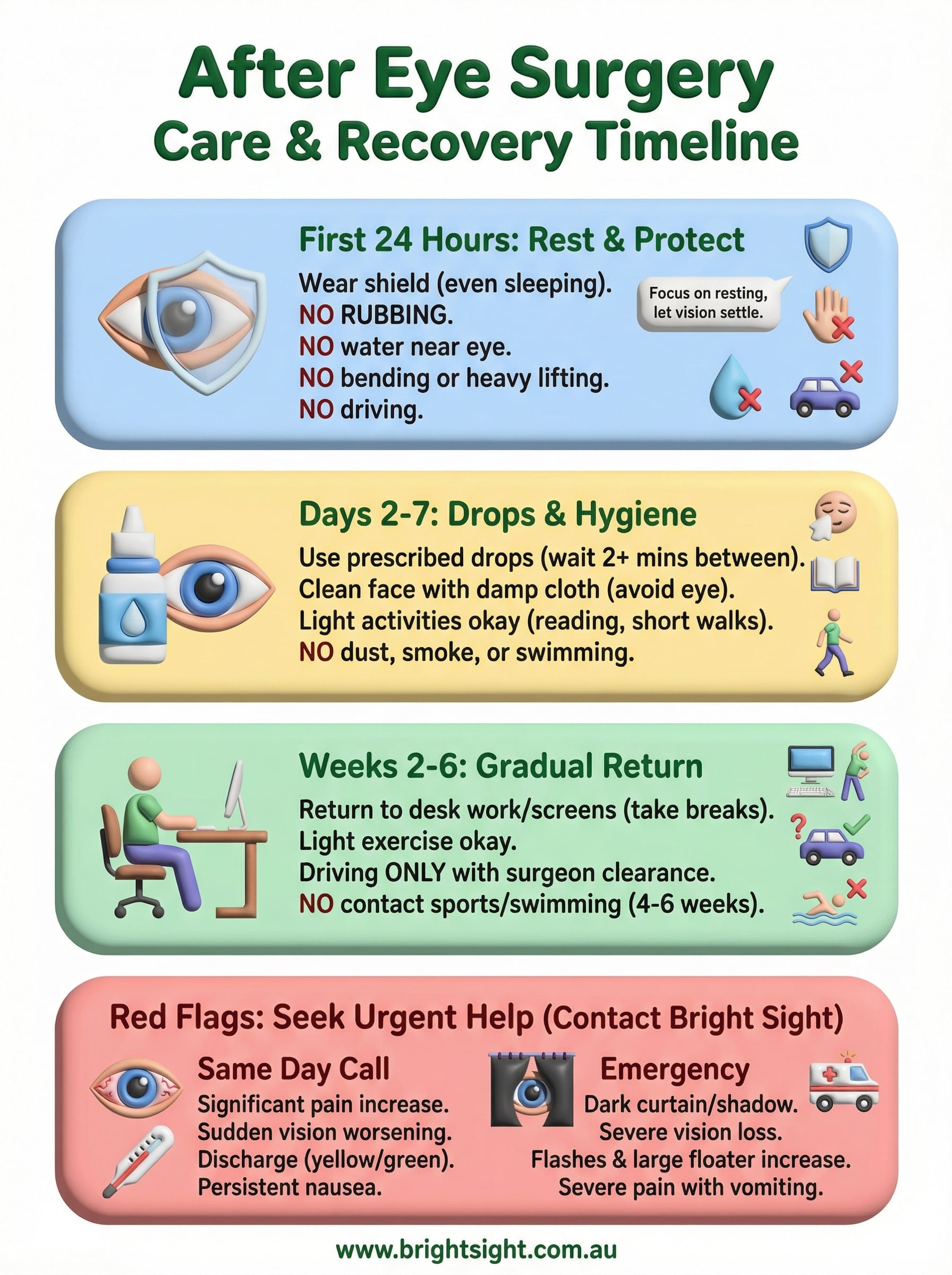
First 24 hours: protect the eye and rest
The first 24 hours set the foundation for your entire recovery. Your eye is at its most vulnerable immediately after surgery, so following your after eye surgery care instructions precisely during this window matters more than at any other stage. Plan to go straight home from the surgical centre and keep activity to a minimum for the rest of the day.
Keep the shield on and avoid rubbing
Your surgeon will place a protective shield over your eye before you leave. Wear it exactly as instructed, including during sleep, to prevent accidental contact while you rest. The single most damaging thing you can do in the first 24 hours is rub or press on your eye, even lightly, so the shield does the job of stopping you from doing this without thinking.

Do not remove the shield early, even if your eye feels fine. Healing tissue is fragile well before it feels that way.
What to avoid in the first 24 hours
Keep the following restrictions in mind for day one:
- No driving under any circumstances, as your vision will still be settling and you will have had a sedative
- No bending at the waist or lifting anything heavier than a light bag
- No water near the eye, including splashing your face in the shower
- No screens for extended periods if light sensitivity is bothering you
- No alcohol, as it can interact with any medications prescribed
Rest on your back or on the side opposite your operated eye, and let someone else handle meals and household tasks for the day.
Days 2 to 7: drops, hygiene and daily tasks
From day two onwards, your focus shifts to managing your prescribed eye drops and keeping your eye clean without disturbing the healing tissue. This stage of after eye surgery care is where small habits make a big difference, so building a consistent routine early helps your eye recover steadily.
Using your eye drops correctly
Your surgeon will prescribe antibiotic and anti-inflammatory drops to prevent infection and reduce swelling. Most patients use both types several times daily, and the order matters: wait at least two minutes between each drop to allow proper absorption. Never let the bottle tip touch your eye or eyelid. A simple schedule helps you stay consistent:

| Drop type | Typical frequency | Notes |
|---|---|---|
| Antibiotic | 4x daily | Complete the full course |
| Anti-inflammatory | 4x daily | Taper only as instructed |
| Lubricating drops | As needed | Relieves dryness and grittiness |
Missing doses or stopping drops early is one of the most common causes of post-operative inflammation, so finish the full course even when your eye feels completely fine.
Hygiene and daily tasks
Keeping your eye clean is essential, but water must stay away from the operated eye for at least one week. Wash your face with a damp cloth, carefully avoiding the eye area. Light activities you can return to from day two include:
- Reading and watching TV with regular breaks
- Short walks indoors or outdoors
- Light cooking and household tasks at waist height
Avoid anything involving dust, smoke, or bending your head below waist level.
Weeks 2 to 6: return to work, exercise and driving
Between weeks two and six, most patients move through the more active phase of after eye surgery care, gradually reclaiming their normal routines. Your eye continues healing beneath the surface even when it feels comfortable, so reintroducing activities in stages rather than all at once protects your final vision outcome.
Returning to work and screens
Most patients return to desk-based or light office work between days five and fourteen, depending on the type of surgery and how vision has stabilised. If your job involves physical labour, dusty environments, or chemical exposure, speak with your surgeon before going back, as these workplaces carry a higher risk of irritation or infection.
Ask your surgeon for a specific clearance date rather than estimating based on how your eye feels alone.
Screen use is generally safe from week one, but take regular breaks every 30 minutes and use lubricating drops if your eye feels dry or strained during longer sessions.
Exercise and driving
Low-impact activity such as walking and gentle stretching is usually fine from around day three or four, but swimming and contact sports require a longer break, typically four to six weeks, because chlorine and physical impact both pose real risks to a healing eye.
Driving depends on your visual acuity in both eyes meeting the legal standard for road safety, which your surgeon will confirm at your post-operative review. Never drive until you have explicit clearance from your surgical team.
Red flags: symptoms that need urgent review
Most discomfort after eye surgery settles within a few days, but certain symptoms signal a complication that needs immediate medical attention. Knowing the difference between normal healing responses and urgent warning signs is a critical part of your after eye surgery care, so read through these carefully before you need them.
If you are ever unsure whether a symptom is serious, call your surgical team the same day rather than waiting to see if it resolves on its own.
Symptoms that require a same-day call
Contact Bright Sight Eye Specialists on the same day if you notice any of the following:
- Significant increase in pain after the first 24 hours, particularly pain that does not ease with paracetamol
- Sudden worsening of blurred vision after an initial period of improvement
- Increasing redness spreading across the white of your eye
- Discharge that is yellow or green rather than clear
- Persistent nausea occurring alongside eye pain
When to go straight to emergency
Some symptoms cannot wait for a clinic appointment. Go directly to your nearest emergency eye department immediately if you experience:
- A dark curtain or shadow spreading across your vision
- Sudden severe or complete vision loss in the operated eye
- A large increase in floaters combined with flashes of light
- Severe pain with vomiting, which can indicate a dangerous spike in eye pressure
These symptoms may point to retinal detachment, a serious infection, or critically elevated intraocular pressure, all of which require treatment within hours to protect your sight.
Next steps for a safe recovery
Recovery from eye surgery is straightforward when you follow the right guidance at each stage. Your job now is to stick to your drop schedule, protect the eye from water and impact, attend every follow-up appointment, and contact your surgical team the moment anything concerns you. After eye surgery care is not just about avoiding complications, it is about giving your eye everything it needs to reach the best possible visual outcome.
Dr. Rahul Dubey and Dr. Capucine Odouard are ready to support you through every stage of your recovery at our Randwick practice in Sydney’s Eastern Suburbs. Whether you have a question about your medications, need clarity on when to return to work, or want to book a post-operative review, our team is here to help. Book your consultation or post-operative review with Bright Sight Eye Specialists and take the next step towards a safe, confident recovery.